
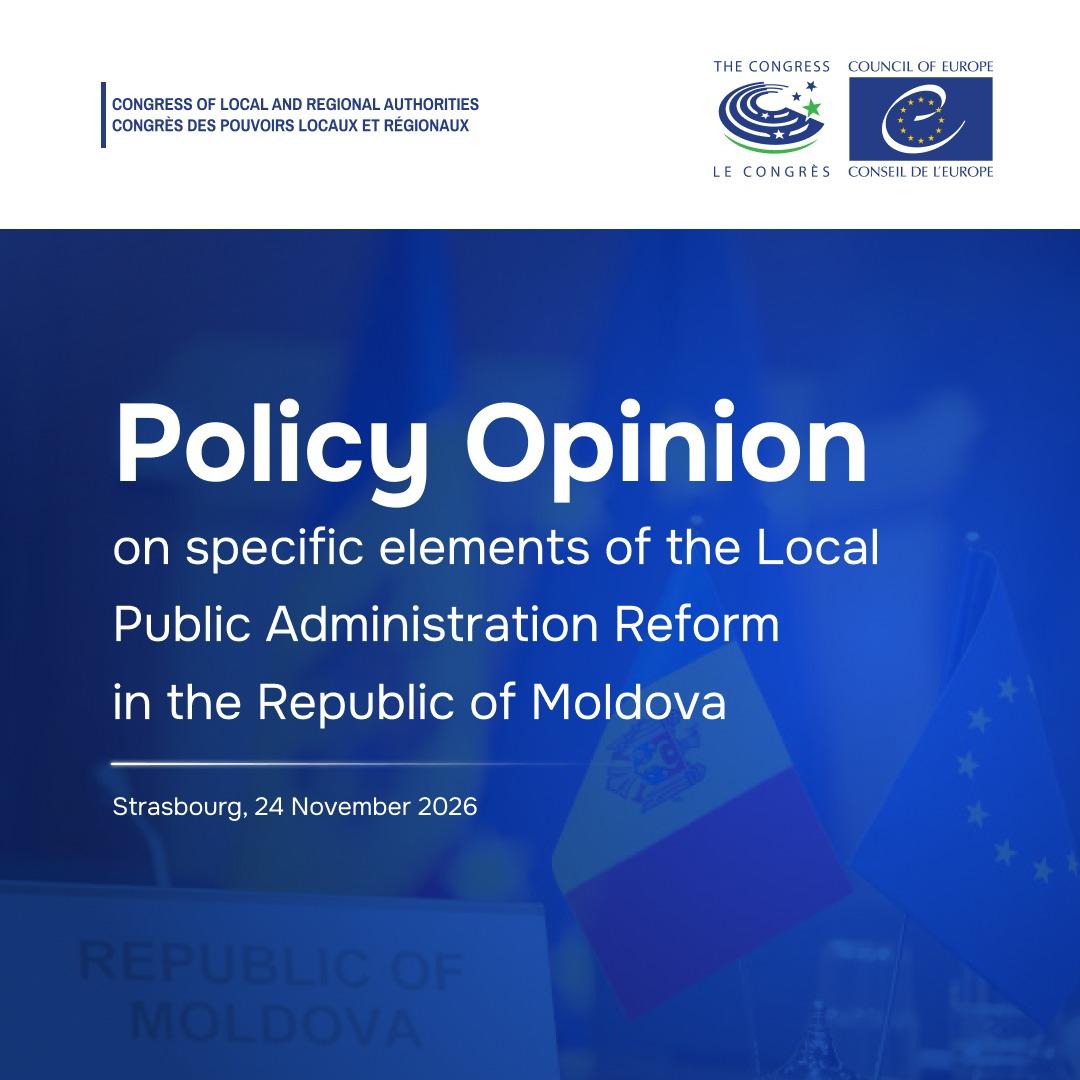
Council of Europe welcomes efforts to reform local public administration and praises amalgamation model chosen by the Republic of Moldova
The need to strengthen city halls, the two-stage amalgamation model, and the provision of financial incentives for mayoralties that merge voluntarily are viewed favorably in an opinion prepared by the Centre of Expertise for Multilevel Governance within the Congress of Local and Regional Authorities of the Council of Europe.

The opinion, prepared on 24 November 2026, analyzes five aspects of local public administration reform: its necessity, its impact on local democracy, the scope of territorial reorganization, the amalgamation model, and the provision of financial incentives.

According to the document, excessive administrative-territorial fragmentation limits the ability of city halls to provide quality public services and contribute to the economic and social development of communities. In this context, the authors of the document welcome the Government's efforts to carry out local public administration reform and commend its intention to strengthen, in parallel, the competences, financial resources, and administrative capacities of mayoralties. This would better prepare mayoralties to make investments, manage public resources efficiently, and respond to citizens' needs.

The authors of the opinion consider the model chosen by the Republic of Moldova to be, in principle, a sound one, combining the advantages of both stages: it gives city halls the opportunity to choose voluntarily with whom to merge and creates the necessary conditions for completing the reform nationwide. The document refers to the experience of Denmark and Estonia, which applied a similar model—a stage of voluntary amalgamation supported by financial incentives, followed by amalgamation mandated by law. As a result of the reforms, the number of mayoralties in Denmark was reduced by 64%, and in Estonia by 63%.

Another conclusion concerns the financial incentives granted to mayoralties that merge voluntarily. These are considered a legitimate and useful public policy instrument, also used by other European states.

The document also emphasizes that amalgamation, accompanied by decentralization and effective mechanisms for citizens' involvement in decision-making, can contribute to strengthening local democracy. The opinion also highlights the importance of the reform in the context of the Republic of Moldova's accession to the European Union. A significant part of European legislation must be implemented at the local and regional levels, and strengthening mayoralties will help prepare them for their new responsibilities.

Regarding the pace of the reform, the document notes that the country has opted for an accelerated reform timetable compared with the experience of other European states. At the same time, the authors acknowledge the constraints created by the Republic of Moldova's electoral calendar and mention that, without accelerating the process, the reform would most likely have had to be postponed by four years.

The authors of the document also note that the reform has been examined repeatedly over the years, with numerous studies and reports prepared both by previous governments and by international organizations, while the Concept presented by the Government contains reliable data and relevant information for administrative-territorial reorganization.

The document can be followed here.
 Facebook
 Instagram
 X/Twitter
 Telegram
Enhanced protection for domestic violence victims and harsher penalties for perpetrators
Speaker: Albania’s experience in developing sports infrastructure important for Moldova
Measures to optimize activities of security institutions: electronic management of special files and electronic signing of documents
Customs legislation to be harmonized with European Union acquis
Moldova to introduce digital identity wallets for citizens and businesses
Moldova assumes presidency of Parliamentary Assembly of Black Sea Economic Cooperation for first half of 2027
Moldovan PM says Latvia’s European journey source of inspiration for Moldova
Moldovan parliament speaker on official visit to Albania: discussions on joint projects, European integration of two states
Moldova set to accede to three international protocols on reducing air pollution
Moldovan parliament's foreign policy commission endorses candidacies of new ambassadors to the Netherlands, Israel, Spain
MP Radu Marian represented Moldovan Parliament at 72nd Annual Session of NATO Parliamentary Assembly
Subcommittee for parliamentary oversight of implementation of decisions of European Court of Human Rights and judgments of Constitutional Court set up
Delegation of Romanian Senate visits Chisinau for talks on energy cooperation
History of 160 years commemorated in Chisinau with launch of commemorative coin, series of postage stamps dedicated to Romanian Royal House
Chisinau denounces new “information diversions” by Moscow after Russian Embassy invoked alleged “anti-Russian provocation”
More people should be deprived of citizenship of the Republic of Moldova because they do not respect and work against state, President says
Head of State about Prime Minister: I think he is doing well, despite all crises coming one after another
 National Bank of Moldova

Moldova's budgets for 2027, administrative-territorial reform, de-bureaucratization of business environment on agenda of November 26–27 plenary meetings
Topics examined at meetings Moldovan parliament's standing commissions on November 24–25, 2026
Better public services in Moldova's settlements with Switzerland's support: results of I GET INVOLVED project in 2026
Moldovan parliament to examine draft state budget for 2027; priorities include support for population, economic recovery, investments in infrastructure
Cultural Heritage Institute to be reorganized through merger with Ion Creanga State Pedagogical University of Moldova
Moldovan PM has discussions with Lithuanian Ambassador
Moldovan PM, Latvian Ambassador discuss Moldova’s European path, expanding of economic cooperation with Latvia
More funding for medical services, reimbursed medicines, hospitals' modernization in Moldova in 2027
Moldovan parliament to examine state social insurances budget draft for 2027 in first reading
VIDEO // Moldovan PM says cost of administration in large mayoralties about 2.5 times lower per citizen than in small ones
MOLDPRES INTERVIEW // Viorica Timbalari: “Violence is a public safety issue and a responsibility of the whole society”
Less bureaucracy, lower administrative costs for businesses in Moldova: parliament to examine new de-bureaucratization package
Moldovan foreign affairs minister speaks about roadmap for aligning with EU sanctions against Russia, Belarus
Moldovan energy minister says need to declare state of alert in energy sector stems from regional situation
More support for pupils with special educational needs: Moldovan government changes way inclusive education is financed
Efficient resources' management for roads' maintenance, preparations for winter season in Moldova discussed at Road Fund Council's meeting
Receive the latest news directly to your email

Receive the latest news directly to your email