
Local Public Administration Reform: 275 city halls, three regions and services closer to citizens
The Government has approved two draft laws establishing the new administrative-territorial organization of the Republic of Moldova and how local public authorities will operate after the reform. The objective is to have mayoralties with greater financial resources, well-trained specialists and enhanced capacity to provide public services and implement local development projects.

Prime Minister Vasile Tofan emphasized the importance of the reform for the efficient use of public funds and the improvement of services provided to citizens: “Everyone wants a state that costs us less. In a city hall with fewer than 3,000 residents, a citizen pays 2,000 lei to cover the cost of administration. In a city hall with more than 3,000 residents, this cost is 810 lei – 2.5 times lower. On the one hand, we want to save public funds; on the other hand, we do not want to introduce unpopular reforms. That is why I want to thank the people and mayors who understand the importance of this reform.”

The new administrative-territorial organization provides for:

 Reducing the number of city halls from 892 to 275;

Reorganizing the 32 districts into three regions – North, Centre and South;

Granting the municipality of Taraclia the status of a second-level administrative-territorial unit;

Establishing a minimum threshold of 3,000 residents for the creation of a first-level administrative-territorial unit.

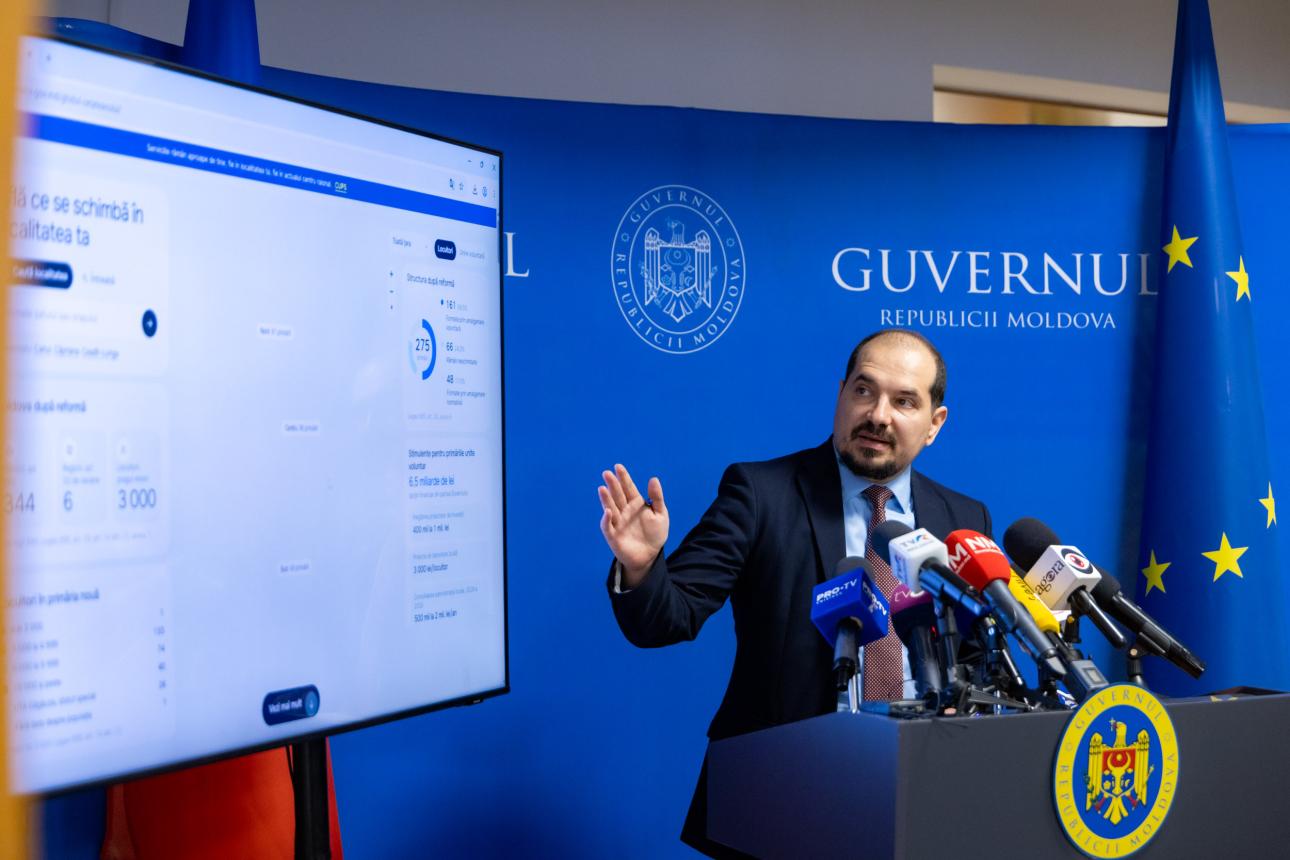
Government Secretary General Alexei Buzu noted that the reform is being carried out together with local representatives and citizens. Over the past 11 months, 85% of the country’s city halls have initiated the voluntary amalgamation process, while 64% have completed it. Around 2,000 meetings with local representatives and 1,300 public consultations were held, attended by 120,000 citizens. During the consultation on the draft law, 1,387 proposals were received and analyzed.

The need to consolidate city halls is also determined by the significant differences in their capacities. According to data presented by the Government Secretary General, only 2% of city halls with fewer than 1,000 residents have a specialist responsible for investments and projects, compared with 76% of city halls with more than 10,000 residents.

The legislative package also establishes a clear division of responsibilities among local authorities. Mayoralties will have 20 areas of responsibility, including water supply and sewage, waste management, maintenance of local roads, street lighting, administration of kindergartens and local public transport.

The regions will have 11 areas of responsibility focused on regional development, attracting investments and European funds, implementing joint projects and supporting mayoralties. They will not provide public services directly to citizens and entrepreneurs.

In localities whose city halls are amalgamated, Unified Public Service Delivery Centres (CUPS) will operate under the management of representatives of the mayor. Thus, citizens will be able to submit applications, obtain documents, certificates and consultations in their own locality, without having to travel to the headquarters of the new city hall.

Services currently provided in district centres will remain accessible in the same localities, including cultural institutions, sports and arts schools, architecture services and archives.

The new administrative-territorial organization will be implemented together with the general local elections in 2027. Until then, the Government, together with local public authorities, will prepare the transition, including by inventorying assets, integrating databases and registers, preparing teams and ensuring the continuity of public services.

The two draft laws will be submitted to Parliament for consideration and adoption.

To inform citizens, the Government has also launched an interactive guide, available on primariiputernice.gov.md platform. Citizens can consult the new administrative-territorial map, find out what will change in their locality, who will be responsible for each public service, what the stages of the reform are and what will happen to the documents they currently hold. The guide also provides answers to the most frequently asked questions about the reform.
 Facebook
 Instagram
 X/Twitter
 Telegram
Moldovan parliament speaker to pay official visit to Albania
Moldovan president, at NATO Parliamentary Assembly, says Russia wages two wars – one conventional against Ukraine, another cognitive war against European democracies, NATO countries
Government Deputy Secretary General at AgroKnowledge Forum: Agricultural modernization and innovation - priorities supported through EU Growth Plan
President to address NATO Parliamentary Assembly
30 high school students learn through games how to become active citizens and help transform communities
Reintegration process and respect for human rights in eastern districts discussed in Bucharest
PM attends event marking 20 years of activity of American Chamber of Commerce in Moldova
Moldova's reintegration process discussed in Bucharest
Moldovan PM has talks with North Carolina Secretary of State
Moldovan government's deputy secretary general says gender equality test of governance's quality
Comment on release of citizens of Moldova Oleg Zaharov, Veaceslav Vasilitov
Moldova's State Chancellery engages in dialogue with young local elected officials on local public administration reform, European integration, EU funds
Prepared Moldova national campaign launched in Stefan Voda
Moldovan parliament's delegation participates in Session of Europe Regional Assembly of Parliamentary Assembly of Francophonie, held in Brussels
CEC begins printing ballot papers for runoff elections in Gagauzia
VIDEO // Government approves new measures to protect against power outages
Deputy Prime Minister at Eastern Partnership Civil Society Summit: Moldova has strengthened resilience and advanced on European path, with support of civil society
Prime Minister: We must take responsible approach to budget. We cannot hand out money left and right
Government approves legislative package on local public administration reform
ANRE approves new electricity tariffs
Moldova enters state of alert in energy sector
 National Bank of Moldova

Fines for illegal parking in public parking lots
Dormitories, workshops and laboratories of vocational education institutions to be modernized with support from Council of Europe Development Bank
Government updates traffic rules to enhance road safety
Enhanced protection for domestic violence victims and harsher penalties for perpetrators
Speaker: Albania’s experience in developing sports infrastructure important for Moldova

Enhanced protection for domestic violence victims and harsher penalties for perpetrators
Speaker: Albania’s experience in developing sports infrastructure important for Moldova
ANRE approves new electricity tariffs
Moldova enters state of alert in energy sector
Measures to optimize activities of security institutions: electronic management of special files and electronic signing of documents
Customs legislation to be harmonized with European Union acquis
Moldsilva Agency to have new director
Moldova to introduce digital identity wallets for citizens and businesses
LIVE // Government Secretary General presents legislative package for local public administration reform
Moldova assumes presidency of Parliamentary Assembly of Black Sea Economic Cooperation for first half of 2027
Moldovan PM says Latvia’s European journey source of inspiration for Moldova
Moldovan parliament speaker on official visit to Albania: discussions on joint projects, European integration of two states
Moldovan parliament speaker has meeting with president of Albania
PHOTO // Police officers of Moldova to be trained to collect evidence in environmental crime cases
Three diplomats proposed to lead Moldova’s embassies in the Netherlands, Israel, Spain
Moldovan parliament speaker has talks with Albanian counterpart
Receive the latest news directly to your email

Receive the latest news directly to your email