
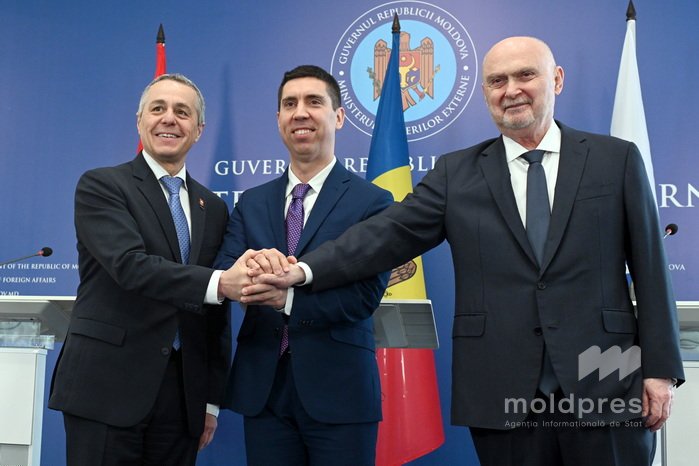
PHOTO // OSCE Secretary General in Chișinău: We are committed to strengthening efforts for comprehensive and peaceful settlement of Transnistrian conflict
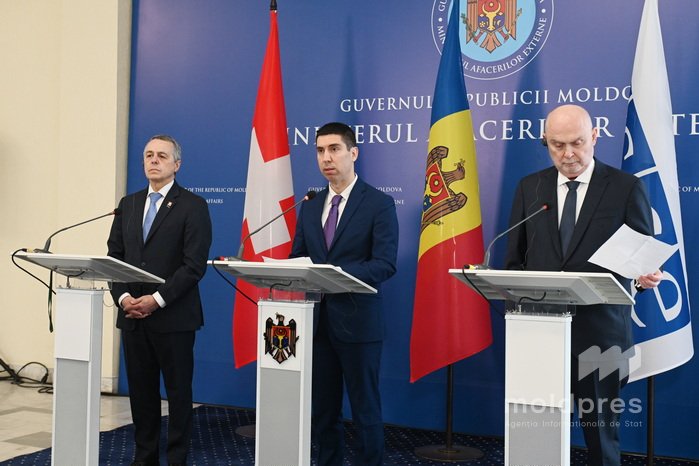
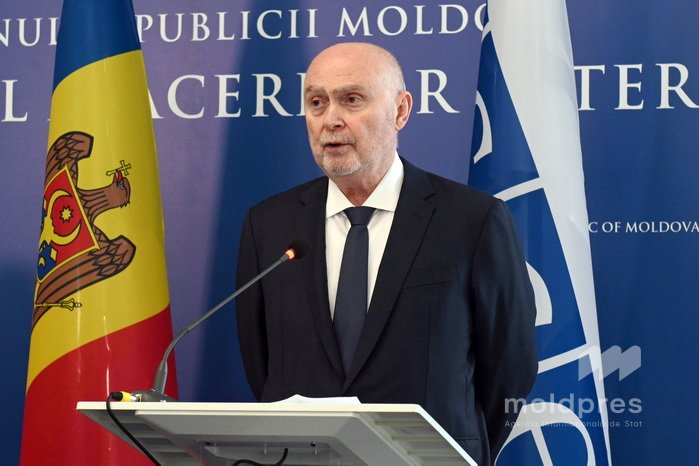
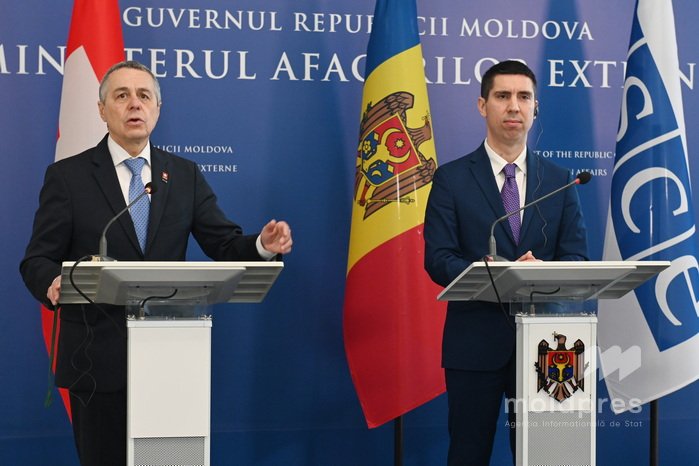
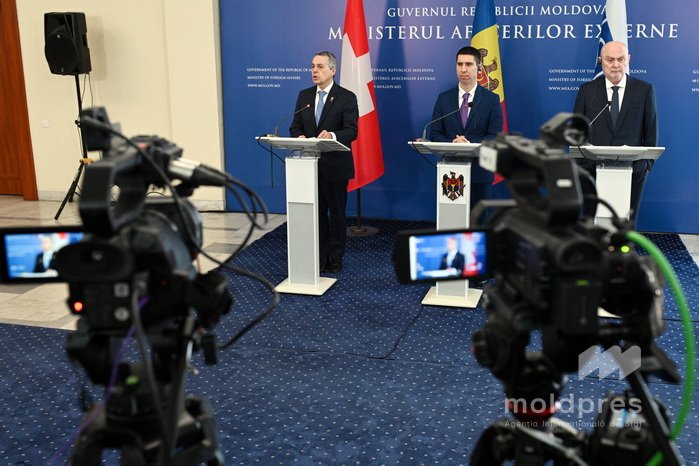
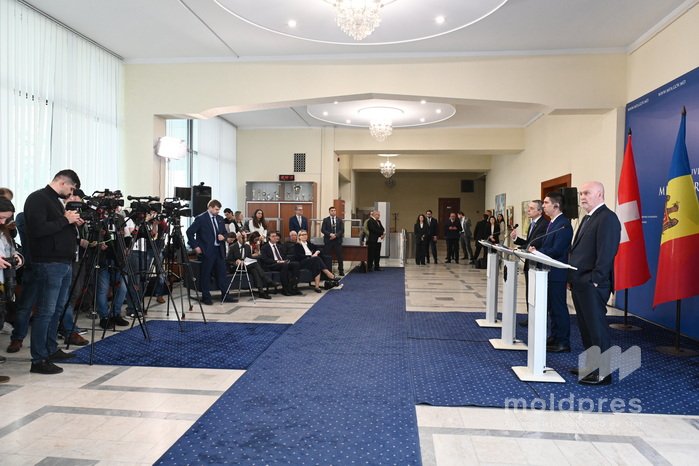
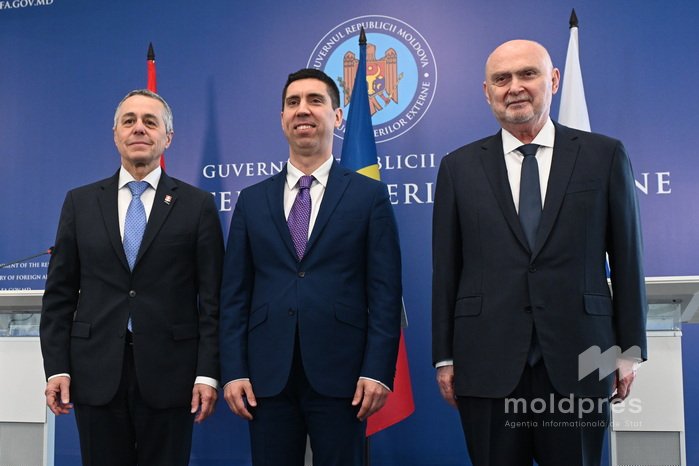
The OSCE Mission to the Republic of Moldova continues to play an important role in facilitating dialogue between the parties involved in the settlement of the Transnistrian conflict. We are committed to strengthening efforts for a comprehensive and peaceful resolution of the dispute. Secretary General of the Organization for Security and Co-operation in Europe (OSCE) Feridun Sinirlioğlu made the statement at a press conference held in Chișinău together with Deputy Prime Minister Mihai Popșoi and Vice President of the Swiss Confederation, Head of the Federal Department of Foreign Affairs, Ignazio Cassis.

Feridun Sinirlioğlu noted that the visit reflects the importance the OSCE attaches to the Republic of Moldova. He welcomed the resilience of the Republic of Moldova and its continued commitment to the peaceful settlement of the Transnistrian conflict.

“The OSCE Mission to the Republic of Moldova continues to play an important role in facilitating dialogue between the parties. The recent discussions in the ‘1+1’ format and within the working group on economic issues represent important steps. We are committed to strengthening efforts that will lead to a comprehensive and peaceful settlement of the dispute. Our Mission works with both sides, on both banks of the Dniester River, and facilitates practical cooperation. In times of uncertainty, dialogue remains the force that stabilizes us the most. That is precisely why the OSCE continues to play a vital role, being an important platform for dialogue, not only in the Republic of Moldova. The current security environment in Europe is becoming increasingly contested, more fragmented, and less predictable. The war in Ukraine continues to cause suffering to people in several regions of Europe and continues to affect the Republic of Moldova, including its security, economy, and energy situation. This war must end on the basis of a negotiated agreement,” the official said.

Vice President of the Swiss Confederation and Head of the Federal Department of Foreign Affairs Ignazio Cassis emphasized that his country has consistently supported the OSCE’s role in the settlement of the Transnistrian conflict, and this visit is a good opportunity to reconfirm this support.

“We encourage dialogue between the parties in order to achieve a settlement of the Transnistrian conflict. The Swiss Chairmanship-in-Office attaches particular importance to a strong, credible OSCE capable of facing current challenges. We have also discussed the contribution that the OSCE can make in the context of a possible peace agreement between Ukraine and Russia. We are seeing, lately, debates taking place on this topic and we may be approaching a solution. Thus, the OSCE remains a useful, indeed indispensable, platform for European security. In a time of pressure, we must ensure that our organizations can cooperate effectively to bring visible benefits to citizens. Our countries share numerous common values, political and economic interests, as well as a strong will to cooperate. Switzerland is committed to remaining a reliable partner for the Republic of Moldova, thanks to its cooperation programme which, as I said, must address the consequences of Russia’s war against Ukraine. Switzerland will also continue to support the Republic of Moldova on its path towards a peaceful, stable and prosperous European future, because, ultimately, this is what all European countries and other states of the world want,” Ignazio Cassis noted.

Deputy Prime Minister Mihai Popșoi praised the work of the OSCE Mission in our country and reaffirmed the authorities’ commitment to a peaceful settlement of the Transnistrian conflict, with full respect for the sovereignty and territorial integrity of the Republic of Moldova within its internationally recognized borders.

“Our priorities on the Transnistrian dimension include maintaining dialogue, strengthening public communication, increasing the resilience of society and deepening economic integration through the gradual and uniform application of fiscal, customs, trade and regulatory standards across the entire territory of the country. It is essential that reintegration be based on common rules, legal certainty and equal treatment. An example is the draft law recently adopted by Parliament, which aims to gradually eliminate fiscal and legislative discrepancies between the two banks of the Dniester River by 2030. This is a necessary step for harmonization, fairness and legal certainty. The proposed Convergence Fund is intended to support social and infrastructure projects in the Transnistrian region and must be understood as a support mechanism. All these processes are to take place simultaneously with the European integration of the Republic of Moldova. I am convinced that our progress on the path of European integration will have a positive impact on the reintegration of the country,” Mihai Popșoi said.

The official also drew attention to the illegal stationing and risks generated by the Russian military presence and ammunition stockpiles on the territory of the Republic of Moldova.

“The presence of Russian military forces and ammunition stockpiles on the territory of the country, which is contrary to the neutrality status enshrined in the Constitution, continues to pose a problem, including an environmental one, for communities on both banks of the Dniester. Certainly, resolving these issues in accordance with the international commitments assumed by the Russian Federation will provide a positive dynamic to the country’s reintegration process,” Mihai Popșoi added.

During the trilateral meeting, the officials’ discussions focused on the cooperation of the Republic of Moldova with the OSCE, developments in regional security and their impact on our country, as well as the settlement of the Transnistrian conflict.

The foundations of the OSCE were laid in 1975, when it was created under the name of the Conference on Security and Co-operation in Europe (CSCE). It was established with the aim of overcoming Europe’s division in the post-war period and strengthening security through dialogue and multilateral negotiations between Eastern and Western states.

At present, the OSCE brings together 57 participating states, all having equal status, and the decision-making process is based on the principle of consensus. The Republic of Moldova joined the CSCE on 30 January 1992 and signed the Helsinki Final Act on 26 February 1992. Since joining, our country has benefited from constant support from the OSCE, which is the main international actor involved in settling the Transnistrian conflict.

The main areas of cooperation are: supporting the process of settling the Transnistrian conflict, including support for negotiation formats; informing the international community about relevant developments in the settlement process; and providing assistance for strengthening democratic institutions and developing civil society, including in the Transnistrian region.
 Facebook
 Instagram
 X/Twitter
 Telegram
EU Commissioner for Enlargement says Moldova on first position in its preparations for European Union membership
Moldovan president says all EU member states reconfirm Moldova ready to open accession negotiations
VIDEO // Moldova and Ukraine reaffirm: Our future in EU
VIDEO // News from Brussels on starting preparations for Cluster I in accession negotiations of Moldova to European Union applauded in Parliament
Strong support for Ukraine reaffirmed in Chisinau Parliament
Prime Minister at Moldova–EU Investment Conference: Moldova ready for accession and becoming part of European economy
European Commissioner in Chișinău: Moldova will be increasingly integrated into European economy, not only at time of accession, but long before it
President at Moldova–European Union Investment Conference: More and more friends from EU want to contribute to our country’s economic success
Siegfried Mureșan: Historic moment for European future of the Republic of Moldova: preparations start for opening cluster negotiations
European Commissioner for Enlargement expected in Chisinau, to advance EU accession reforms, boost investments; visit's agenda
European Parliament Vice-President calls for launch of political negotiations, opening of all clusters with Moldova
CEC launches web platform for district electoral councils
Government approves national reintegration activity program: 25 million lei for 30 projects to be implemented this year
Moldova completed clearing land for construction of new US Embassy
Number of electric cars might double in Moldova by 2030; authorities prepare solutions to expand charging stations
PHOTO // Moldova learns from France’s experience in urban mobility, public transport's modernization; deputy PM’s visit to Paris
Over 300 tons of used appliances collected for recycling through EcoVoucher Programme in Moldova
Moldovan-Hungarian cooperation in focus for foreign ministers of Chisinau and Budapest
European Commission President: EU to open first negotiation cluster with Moldova on days to come
Moldova, Romania coordinate efforts to advance EU accession negotiations
Over 250 rescuers from Europe to take part in MD–EU MODEX 2026 exercise organized in Moldova
 National Bank of Moldova
Moldovan deputy PM for reintegration has meeting with French senators
Moldovan parliament speaker thanks UNICEF representative in Moldova for support in social reforms, child protection
Moldovan president attends ceremony on 24th anniversary of foundation of National Anticorruption Centre
Prime Minister at Moldova Digital Summit 2026: Our ambition is not only to join EU, but to help build Europe’s digital future
Over 1 billion euros in new investment partnerships, financing announced for Moldova

VIDEO // Over 5 million lei seized following searches in fraud file in Moldova; five people detained
Record on electricity exchange in Moldova: largest volume of traded power since its launch
Deputy Prime Minister: EU Growth Plan for Moldova creates conditions for modernizing economy at unprecedented pace
Sergiu Caraman remains head of Superior Council of Magistracy
Moldovagaz to supply natural gas to Transnistrian region by late 2026
VIDEO // Alexei Buzu: Government allocates 145 million lei for development of amalgamated localities in Călărași
Deputy parliament speaker says Moldova must strengthen defense capabilities
Works at Chisinau Electrical Substation progressing; Romanian Ambassador says Romania stays reliable partner of Moldova in strengthening energy security
EUROPEAN VILLAGE // Over 27 million lei invested in modernizing infrastructure in central Moldova settlement
Moldovan Foreign Affairs Ministry issues travel alert for Qatar, Kuwait: “Security situation stays volatile”
Economic, investment opportunities of Moldova promoted at Annual Meeting of Board of Governors of European Bank for Reconstruction and Development
Environmental NGOs' representatives trained in alternative methods for resolving environmental conflicts in Moldova
PHOTO // Moldovan deputy parliament speaker says Grand Duchy of Luxembourg, as EU founding member, firmly supports Moldova's European path
ARMENPRESS: IRI observers: Armenia’s June 7 elections conducted calmly and fairly
Discover Moldova with #MOLDPRES // Sweet business in Prut Meadow
MOLDPRES REPORT // Smart technology for old apartment blocks: Chinese solutions that might fix parking, waste problems in Moldova’s cities
Receive the latest news directly to your email

Receive the latest news directly to your email