
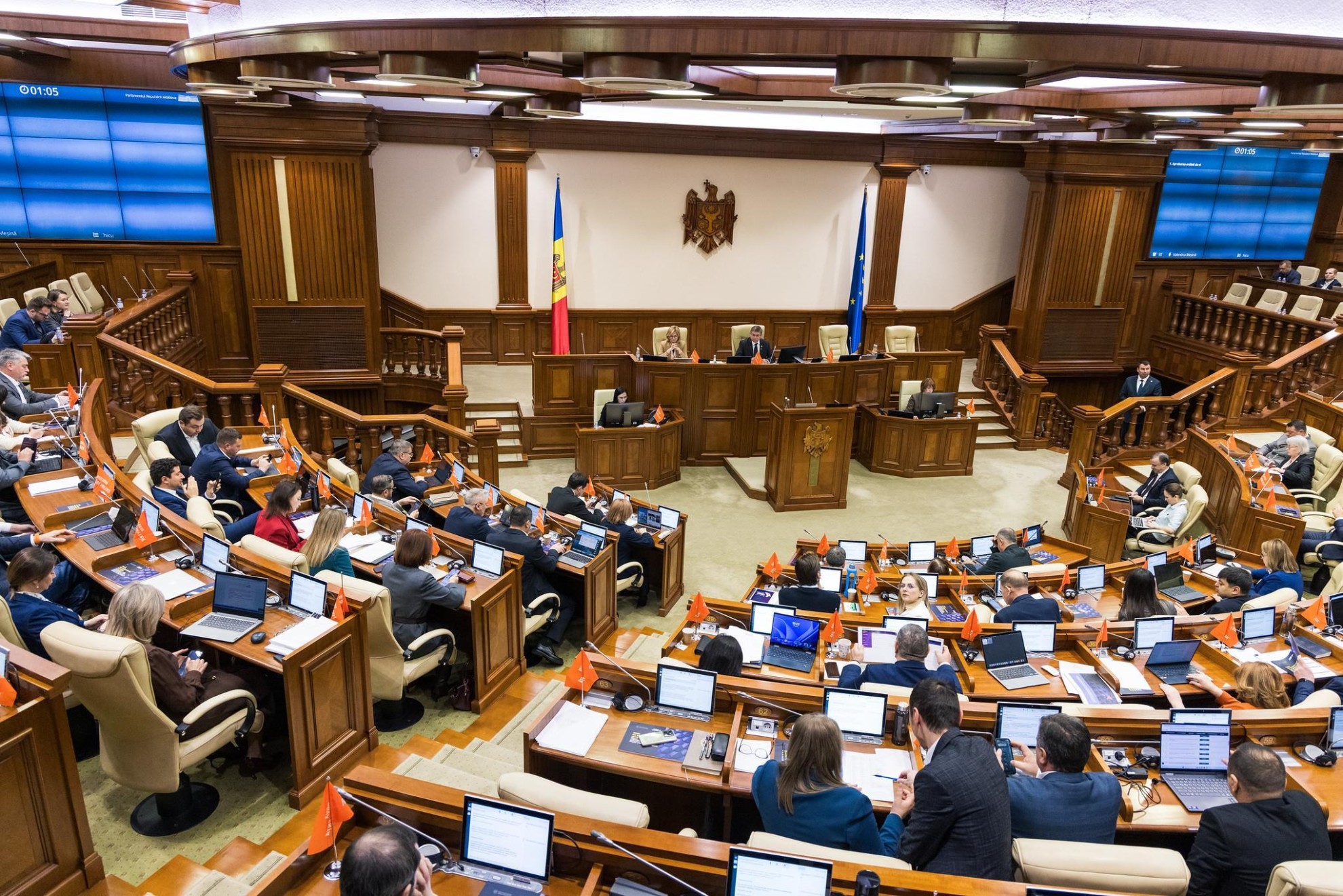
Less bureaucracy and lower administrative costs for businesses: Parliament votes in first reading on new deregulation package
Chisinau, November 26, 2026 – Parliament voted in first reading on a draft law aimed at eliminating excessive regulations in the private sector and optimizing the system of permits and authorizations.

The draft law was developed by the Ministry of Economic Development and Digitalization to reduce bureaucracy and the administrative burden on businesses. “The lack of a standardized and transparent authorization management system limits the predictability of the business environment and discourages investment, particularly by foreign companies seeking clear and stable regulatory conditions,” the explanatory note to the legislative initiative states. The document provides for the elimination or simplification of more than 70 permits, certificates, and other authorizing documents, as well as the review of more than 150 acts and documents required from the private sector.

The authors propose amendments to the Law on Entrepreneurship and Enterprises, as some of its provisions contain outdated wording regarding the founding documents, registration procedures, and liquidation of companies.

The draft law also includes a series of amendments to the Urban Planning and Construction Code. They include the cancellation of the 0.5% contribution for financing the preparation of regulatory documents in construction. The measure is intended to reduce the parafiscal burden on private investment and increase the attractiveness of investment projects in the construction sector.

In the pharmaceutical sector, the authors propose eliminating the requirement concerning the minimum distance from another pharmacy, as well as the criterion establishing one pharmacy for every 3,000–4,000 residents.

For pharmaceutical manufacturers, the draft law proposes eliminating the authorization issued by the Medicines and Medical Devices Agency for the import of pharmaceutical raw materials. According to the authors’ estimates, these changes will facilitate economic activity and generate annual savings of approximately 10 million lei across the industry.

In the case of medical laboratories, the draft law provides for the recognition of existing technical accreditations, so that assessments verifying the same requirements will no longer be carried out repeatedly.

Another amendment concerns guesthouses and other accommodation facilities provided for by law, which will be allowed to produce and serve traditional spirits in limited quantities and in compliance with food safety requirements.

Administrative costs for businesses would also be reduced by establishing an unlimited validity period for the sanitary-veterinary operating authorization and the food safety registration certificate.

Simplifications are also provided for companies operating in free economic zones. They will no longer need an additional authorization from the administration for each type of activity, as the right to conduct the activity will derive from the contract concluded with the administration.

At the same time, the general obligation for petroleum product importers to have storage facilities with a minimum capacity of 1,000 m³ will be eliminated, while the storage obligations provided for by special legislation will remain in force.

Other amendments concern labor legislation, transport, and fire safety. The draft law also provides for amendments to the Contravention Code. Specifically, the fixed fine equal to the value of the product will be replaced with a sanction ranging from 75,000 lei to the value of the product.

The draft law will be considered by Parliament in second reading. Following its adoption, the legislative amendments will enter into force on December 31, 2026.


Communication and Public Relations Department of the Parliament of the Republic of Moldova
 Facebook
 Instagram
 X/Twitter
 Telegram
Fines for illegal parking in public parking lots
Dormitories, workshops and laboratories of vocational education institutions to be modernized with support from Council of Europe Development Bank
Government updates traffic rules to enhance road safety
Enhanced protection for domestic violence victims and harsher penalties for perpetrators
Speaker: Albania’s experience in developing sports infrastructure important for Moldova
Measures to optimize activities of security institutions: electronic management of special files and electronic signing of documents
Customs legislation to be harmonized with European Union acquis
Moldova to introduce digital identity wallets for citizens and businesses
Moldova assumes presidency of Parliamentary Assembly of Black Sea Economic Cooperation for first half of 2027
Moldovan PM says Latvia’s European journey source of inspiration for Moldova
Moldovan parliament speaker on official visit to Albania: discussions on joint projects, European integration of two states
Moldova set to accede to three international protocols on reducing air pollution
Moldovan parliament's foreign policy commission endorses candidacies of new ambassadors to the Netherlands, Israel, Spain
MP Radu Marian represented Moldovan Parliament at 72nd Annual Session of NATO Parliamentary Assembly
Speaker about Russian Embassy’s message on alleged anti-Russian provocation
16 Days of activism against gender-based violence campaign backed by Parliament
Moldova and Romania advance energy interconnection expansion: construction of Suceava–Bălți line to be accelerated
Local Public Administration Reform in Moldova under review by Council of Europe’s Centre of Expertise
Chisinau denounces new “information diversions” by Moscow after Russian Embassy invoked alleged “anti-Russian provocation”
More people should be deprived of citizenship of the Republic of Moldova because they do not respect and work against state, President says
Head of State about Prime Minister: I think he is doing well, despite all crises coming one after another
 National Bank of Moldova

Better conditions for students in vocational and technical education
Introduction of digital identity wallets for citizens and businesses approved in first reading
Council of Europe welcomes efforts to reform local public administration and praises amalgamation model chosen by the Republic of Moldova
Moldova's budgets for 2027, administrative-territorial reform, de-bureaucratization of business environment on agenda of November 26–27 plenary meetings
Topics examined at meetings Moldovan parliament's standing commissions on November 24–25, 2026

More people should be deprived of citizenship of the Republic of Moldova because they do not respect and work against state, President says
Head of State about Prime Minister: I think he is doing well, despite all crises coming one after another
President rejects reports of possible federalization of country
PHOTO GALLERY // Behind-the-scenes moments from premiere of film “2438 km, or All Roads Lead to Rome”
Moldova building air defense system step by step
Moldovan president says Russia does not want to end war
Moldova expands energy communities: citizens, institutions, entrepreneurs join forces to produce, use renewable energy
PHOTO GALLERY // Performances in youth field, recognized at National Youth Awards Gala, held in Chisinau
Moldova's budgets for 2027, administrative-territorial reform, de-bureaucratization of business environment on agenda of November 26–27 plenary meetings
Topics examined at meetings Moldovan parliament's standing commissions on November 24–25, 2026
Better public services in Moldova's settlements with Switzerland's support: results of I GET INVOLVED project in 2026
Moldovan parliament to examine draft state budget for 2027; priorities include support for population, economic recovery, investments in infrastructure
Cultural Heritage Institute to be reorganized through merger with Ion Creanga State Pedagogical University of Moldova
Moldovan PM has discussions with Lithuanian Ambassador
Moldovan PM, Latvian Ambassador discuss Moldova’s European path, expanding of economic cooperation with Latvia
More funding for medical services, reimbursed medicines, hospitals' modernization in Moldova in 2027
Receive the latest news directly to your email

Receive the latest news directly to your email