
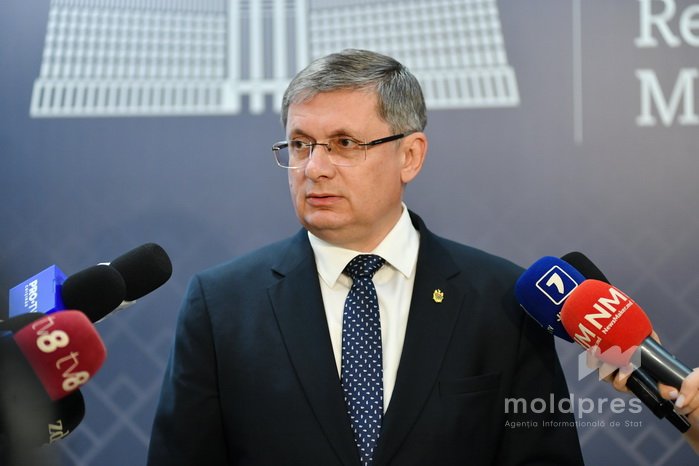
Moldovan parliament speaker comments on Tiraspol leader's return to Transnistrian region, travel restrictions
Parliament Speaker Igor Grosu believes that the decoration of the so-called leader of the Transnistrian region, Vadim Krasnoselski, by Russian President Vladimir Putin represents a challenge to Moldova. At the same time, Grosu says that the restrictions imposed by the Moldovan authorities on Krasnoselski’s travel should also discourage other representatives of the Tiraspol administration from taking similar actions. The speaker made statements to this effect today evening, at the Forum programme, broadcast on the Vocea Basarabiei television station.

Grosu described Vladimir Putin’s decoration of Krasnoselski as “a provocation and a defiance against the Republic of Moldova,” noting that Moscow may have sought to elicit a reaction from the authorities in Chișinău.

“That was probably the intention, and that is what Kremlin propaganda was expecting—such sanctions,” the parliament speaker said.

According to Grosu, the Moldovan authorities allowed Krasnoselski to travel to Moscow and return to the Transnistrian region, in order to avoid an escalation of relations with the Russian Federation, given that his trip to Moscow and return to Moldova took place amid discussions on ensuring natural gas supplies to the left bank of the Dniester for the cold season.

The parliament speaker specified that the Moldovan authorities had advocated identifying solutions to the problems affecting citizens on both banks of the Dniester, in order to prevent the emergence of a humanitarian crisis that could later turn into a political one.

“When it comes to citizens—and they are ultimately our citizens—we must find solutions, because otherwise we will only be responding to the Russian Federation’s plan to create and provoke a humanitarian crisis that would later develop into a political crisis,” Igor Grosu said.

The speaker noted that the decision to allow Krasnoselski to travel was made following discussions with the OSCE, an organization involved in the Transnistrian settlement process. Nevertheless, in his opinion, limiting the possibility of such trips could discourage other representatives of the Tiraspol administration from taking similar actions.

Asked about the legal basis for the restriction and how it would be applied, if the leader in Tiraspol attempted to leave Moldova again, Grosu said the questions were legitimate and should be addressed to the Reintegration Policies Bureau and the competent institutions.

“At that point, I am sure our institutions will have very clear reasoning and a very clear position,” the parliament speaker said.

Grosu said that Vadim Krasnoselski might try to leave the country, but crossing the border could become difficult. He added that, in the context of the discussions held with the OSCE and the organization’s involvement in facilitating the previous trip, representatives of Tiraspol would find it more difficult to justify another departure from Moldova under similar conditions.

Vadim Krasnoselski returned to Chisinau on November 15, after a visit to Moscow, where he was awarded the Order of Honor of the Russian Federation by Russian President Vladimir Putin on November 4. The Moldovan authorities announced that he would be subject to restrictive measures, including a five-year ban on leaving Moldova.
 Facebook
 Instagram
 X/Twitter
 Telegram
Moldovan Foreign Minister pays working visit to Italy
Lithuanian President sends message of support to Chișinău at ceremony accrediting Moldova’s new Ambassador
Moldova, Turkey to boost economic cooperation, hold new inter-ministerial consultations
Moldovan foreign affairs minister, Irish counterpart discuss Ireland’s support for Moldova’s EU accession
Deputy Prime Minister: Moldova ready to contribute to Europe’s security
Salary reform examined in Parliament
Speaker about Vadim Krasnoselski’s return to Moldova: He probably accepted sanction barring him from leaving country
Deputy Speaker calls for explanations regarding opposition MPs' visit to Russia
Head of State visits Brussels: meetings with European officials and discussions on advancing accession negotiations
Elections in Gagauzia: CEC verifies 100% of polling station protocols in the election for the position of Governor of the autonomy
Alexandr Stoianoglo and Fiodor Gagauz to face each other in the second round of elections for the position of Bashkan of Gagauzia
Promo-LEX: Violations of ballot secrecy, voting on behalf of other voters and suspicions of voter bribery during elections in Gagauzia
Preliminary results: Independent candidate Alexandr Stoianoglo leads the race for the position of Governor (Bashkan) of Gagauzia
Low voter turnout in Taraclia district village; almost 200 people participate in repeat election
Moldovan parliament speaker says under what conditions Gagauzia’s new governor could join government
Moldovan parliament speaker comments on Tiraspol leader's return to Transnistrian region, travel restrictions
PHOTO GALLERY // Italian Cuisine Week in the World; Ukrainian refugee children cook pizza alongside renowned chef Luca Pappagallo
Moldovan parliament's standing bureau approves agenda for plenary meeting due on November 19
PHOTO // Drone detected in north Moldova settlement identified as of Gerbera-2 model
Moldovan national team's footballer signed by FCSB for 250,000 euros, awarded monthly salary of 10,000 euros
Moldovan Central Electoral Commission says runoff of elections for governor of Gagauzia to take place on November 29
 National Bank of Moldova

Moldovan parliament's standing bureau approves agenda for plenary meeting due on November 19
Moldovan government's deputy secretary general discuss Council of Europe's support for local public administration reform in Strasbourg
Deputy PM for reintegration has meeting with Representative of Office of United Nations High Commissioner for Refugees in Moldova
Issues examined at meeting of Moldovan parliament's standing commissions on November 16-18, 2026
Customs Service of Moldova to be authorized to conduct forensic examinations recognized as evidence in court

Customs Service of Moldova to be authorized to conduct forensic examinations recognized as evidence in court
Moldovan national team's footballer signed by FCSB for 250,000 euros, awarded monthly salary of 10,000 euros
Moldovan Central Electoral Commission says runoff of elections for governor of Gagauzia to take place on November 29
PHOTO // First version of management plan for Lower Dniester National Park submitted for consultation with experts, authorities of Moldova
Moldovan government simplifies rules for entrepreneurs: over 70 authorizations to be eliminated or simplified, 150 permits to be reviewed
Foreign affairs minister has talks with group of Moldovans settled in Italy
Moldova's State Chancellery receives international award for digitizing legislative drafting process
Moldovan foreign affairs minister says country's goal to be ready for EU accession by 2030
PHOTO // Twenty-four producers promote Moldovan wines, divins in Tokyo
Deputy Prime Minister meets with Italian Parliamentarians
Government approves draft law on mandatory health insurance funds for 2027: more medical services, reimbursed medicines, hospital investments
Introduction of fish species not part of local aquatic fauna to require authorization in Moldova
Moldovan government approves draft state social insurances budget for 2027
Pensions and other social benefits could be indexed by 8.2% in 2027
Fewer documents and lower costs for entrepreneurs: Government facilitates business activity
More transparent state inspections and less bureaucracy
Receive the latest news directly to your email

Receive the latest news directly to your email