
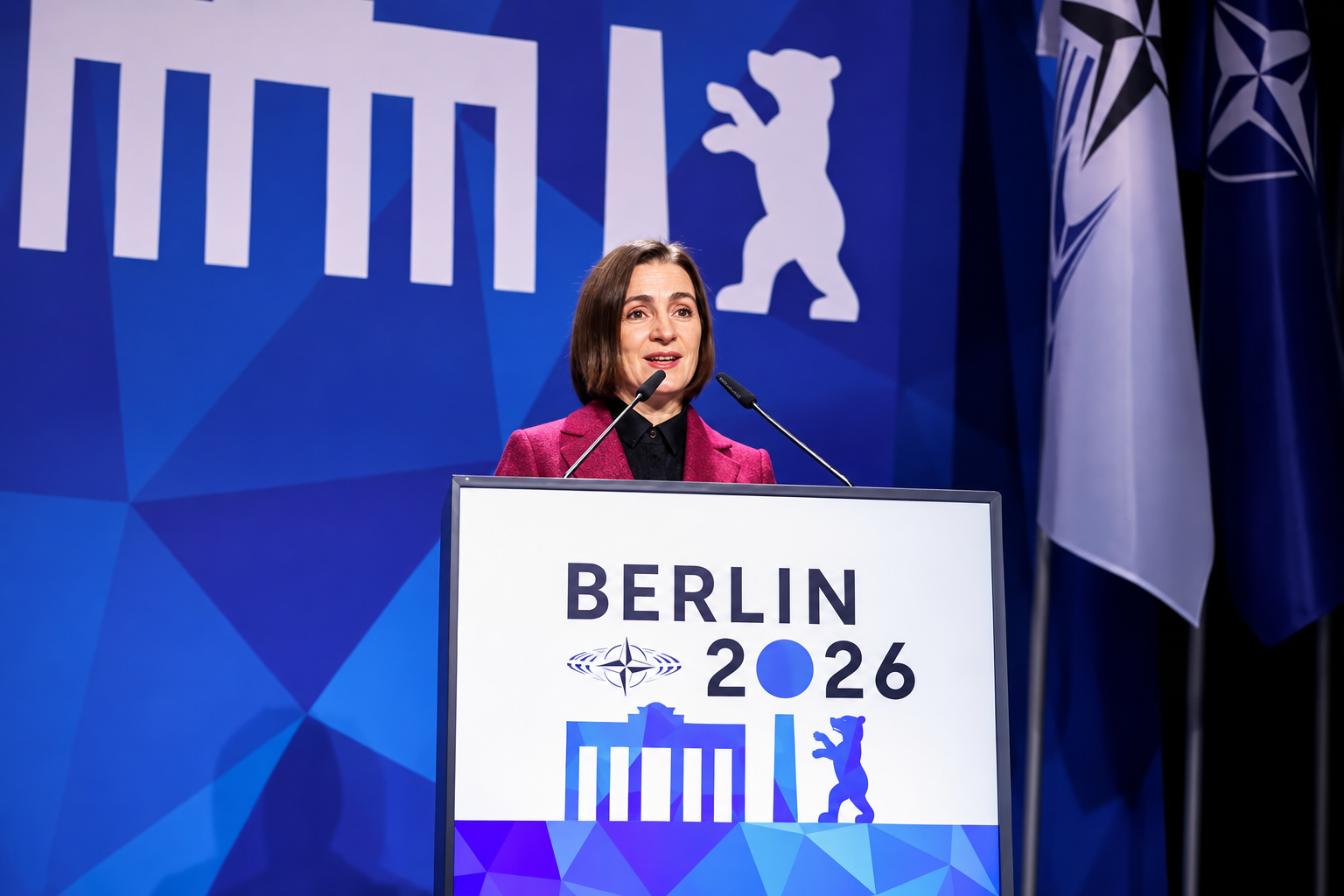
President at NATO Parliamentary Assembly plenary: For Moldova, joining EU means strengthening democracy, reinforcing security and ensuring country can develop in peace and freedom
For the Republic of Moldova, joining the European Union means strengthening democracy, reinforcing security and ensuring that our country can develop in peace and freedom. We have made substantial progress: four negotiation clusters have been opened, and we are ready to open the other two as well. We aim to conclude the negotiations in 2028. It is an ambitious but achievable goal if both sides maintain their pace. This message was delivered today by President Maia Sandu during the plenary session of the NATO Parliamentary Assembly in Berlin.

According to the official, maintaining peace and security in the Republic of Moldova is possible thanks to Ukraine’s resilience and the support provided by the international community, NATO, the European Union, Germany and other important partners.


“The Republic of Moldova contributes to Ukraine’s security by being a stable, democratic and friendly neighbor on its southwestern flank. Russia has tried to change this reality. In three elections held over the course of two years, it used money, lies and intimidation in an attempt to seize power in the Republic of Moldova and turn our country against Ukraine. It failed thanks to the citizens of the Republic of Moldova and the support of our partners. Russia is waging two interconnected wars that reinforce each other. The first is the conventional war against Ukraine, waged with missiles, drones and artillery to occupy territories and deprive a nation of its freedom. The second is a cognitive war against the democracies of Europe and the entire NATO area, a war intended to change what people believe, what they fear, whom they trust and, ultimately, the decisions they make,” Maia Sandu stated.


The head of state noted that the Republic of Moldova is a neutral country, but neutrality does not mean weakness, indifference to the brutal aggression against a neighboring state or an obligation to face security threats alone.


“We are strengthening our defense capabilities and deepening practical cooperation with NATO and its member states. We support Ukraine and are learning from its experience in defending itself. A stronger and more resilient Republic of Moldova also contributes to the security of Ukraine and Europe. The experience of the Republic of Moldova is part of a much broader Russian strategy to undermine European security and bring Europe under its influence. Ukraine has been resisting Russia’s military attacks for almost five years. That is why Moscow is also trying to divide the societies that support Ukraine, erode trust in institutions and weaken their ability to act together. Russia does not need to defeat Europe’s armies if it succeeds in undermining the political will behind them,” she said.


Referring to the elections in the Republic of Moldova, Maia Sandu emphasized that Russia simultaneously used a wide range of methods to influence the election result, spending the equivalent of approximately 2% of the country’s GDP for this purpose.


“We have seen how cognitive warfare works in practice. We uncovered attempts to buy votes and illegal political financing. Young people were trained to provoke violence, while priests were recruited to spread Russian propaganda. We faced cyberattacks against electoral infrastructure, false bomb alerts at polling stations abroad and coordinated online campaigns. The objective was to replace the free will of the citizens of the Republic of Moldova with decisions made in Moscow. Our citizens defended their choice, and the institutions held firm,” the president noted.


The official highlighted that security risks have increased over the past year and that Russian drones have violated the country’s airspace with increasing frequency.


“In 2026 alone, the Republic of Moldova recorded more than 80 incidents involving drones and other aerial threats. Just last week, seven Russian drones violated our airspace in a single afternoon. Five of them crashed on our territory. Each incident puts the safety of our citizens at risk and is followed by information manipulation. Even when the fragments bear the inscription „Geran,” Moscow denies any responsibility. Meanwhile, propaganda is trying to convince the citizens of the Republic of Moldova that the Government cannot protect them. However, when we invest in defense, the narrative changes. People are told that the Republic of Moldova is preparing for war. First, people are made to feel unsafe, and then they are convinced that defense is even more dangerous,” she explained.


The head of state added that for decades, Russia had used Moldova’s dependence on Russian gas and electricity to exert political pressure.


“We put an end to this dependence, diversified our sources of supply and connected more closely to European markets. Nevertheless, manipulation continues. People are told that high energy prices are the Government’s fault and that returning to Russian gas would make life cheaper. In the past, Russian propaganda was easier to recognize on television, through openly pro-Russian politicians or well-known organizations. Today, it is increasingly spread by seemingly independent commentators and online influencers with no visible ties to Russia. They may never praise Moscow. Instead, they question our European future, attack the credibility of institutions and encourage people not to trust the independent media and civil society. Democracies rely on people’s ability to ask difficult questions, but external manipulation exploits real concerns and legitimate grievances to undermine trust in democratic institutions,” Maia Sandu explained.


She reiterated that artificial intelligence makes manipulation faster, cheaper and more difficult to detect. Thus, according to the official, the same narratives are spread on Telegram, TikTok, Facebook and YouTube, apparently by different sources.


“Their repetition creates an impression of credibility and public consensus. The aim is not always to convince people to believe a particular lie. This is cognitive warfare: it is not only about persuading people to believe something false, but about shaping the fears and doubts through which they make decisions. That is why I want to issue a warning to all countries preparing for elections. Elections are the moment when people turn their beliefs, fears and perceptions into decisions, and Russia could shape these perceptions. Long before an election campaign begins, networks are built, money begins to circulate, people are recruited and certain narratives are repeated until they influence the way citizens perceive their country and its future. That is why protecting elections must begin long before the start of the election campaign,” the head of state pointed out.


The official emphasized that the member states of the European Union must connect the events and address the threats as a whole. She also highlighted the importance of monitoring financial flows and dismantling the networks behind these operations.


“These operations depend on money to pay the people involved, finance networks and support campaigns. A large share of the funds moves through illegal channels, using intermediaries and financial structures designed to conceal their origin and destination. Let us take Ilan Shor as an example, having been convicted for his involvement in the theft of one billion dollars from the banks of the Republic of Moldova. From Moscow, he coordinated a large part of Russia’s interference operations in our elections. However, his activities extend far beyond the borders of the Republic of Moldova. We must follow the money. Banks, shell companies and intermediaries must exchange financial information, including regarding cryptocurrencies, and impose targeted sanctions on those facilitating these operations. Likewise, we need common standards and stronger tools to combat information manipulation and foreign interference. Russia’s operations go beyond national borders. The same networks target different countries, using the same platforms, methods and, sometimes, the same people. We need common standards that distinguish legitimate democratic activity from clandestine foreign interference, so that we can combat manipulation, illegal financing and coordination from abroad,” Maia Sandu said.


In her speech, the head of state emphasized that the Republic of Moldova not only benefits from security but also contributes to maintaining it.


“We are a small country, but our stability matters to the entire region. We share a border of more than 1,200 kilometers with Ukraine. If Russia had succeeded in bringing its representatives to power in Chișinău, Ukraine could have faced a hostile government along this border and would have been forced to redirect resources from the front. Instead, Ukraine has a friendly neighbor. Our roads, railways and port help maintain the flow of Ukrainian goods, while our energy systems support each other. We also contribute to international security, including through participation in the NATO mission in Kosovo and the European Union mission in Bosnia and Herzegovina. By defending our democracy, we prevent the Republic of Moldova from becoming a source of insecurity for other states, and by sharing our experience in combating hybrid warfare, we help other democracies recognize similar threats and prepare to counter them. This is how we understand our partnership with NATO and the future of the Republic of Moldova in the European Union,” the official stated.


She added that for the Republic of Moldova, joining the European Union means strengthening democracy, reinforcing security and ensuring that the country can develop in peace and freedom.


“We have made substantial progress: four negotiation clusters have been opened, and we are ready to open the other two as well. We aim to conclude the negotiations in 2028. It is an ambitious but achievable goal if both sides maintain their pace. We are grateful for the support of the European Union member states and hope that you will continue to stand by us. Enlargement has previously contributed to strengthening peace and democracy. However, Russia wants us to believe that another future is inevitable, that its victory is only a matter of time, that countries such as the Republic of Moldova are too small to resist and that even larger democracies cannot withstand its pressure. Ukraine was expected to fall within a few days. Almost five years later, Ukrainians continue to defend their country. The Republic of Moldova was expected to yield to pressure. Instead, our citizens defended their freedom and their own choice. We know the dangers that lie ahead, but we also know what we can achieve when we are united,” Maia Sandu concluded.


President of the Republic of Moldova Maia Sandu is paying a working visit to Berlin today, to meet with senior German officials. The bilateral program includes meetings with President of the Bundestag Julia Klöckner, Federal Minister for Foreign Affairs Johann Wadephul, Federal Minister of Defense Boris Pistorius and Federal Minister for Economic Cooperation and Development Reem Alabali-Radovan. The head of state will also meet with NATO Secretary General Mark Rutte.

The NATO Parliamentary Assembly brings together parliamentarians from Alliance member states and partner countries for discussions on the main security challenges. The Republic of Moldova has been a NATO partner since 1994. Cooperation focuses on modernizing defense institutions, resilience and cybersecurity, while respecting the country’s constitutional neutrality.
 Facebook
 Instagram
 X/Twitter
 Telegram
VIDEO // Prime Minister calls for acceleration of defense industry draft law after seven drones flew over country’s airspace on Tuesday
Russia's ambassador-designate summoned to Foreign Ministry after seven drones flew over Moldova's airspace
Romania’s Ambassador to Chisinau: Violation of Moldova’s sovereignty and endangering civilian population unacceptable
EU Ambassador to Chișinău following drone incidents: I stand in solidarity with citizens of the Republic of Moldova
Our Party proposes developing modern air defense system and safety guide for public after seven drones flew over Moldova
Moldovan parliament speaker: “We condemn Russia’s attacks and will continue investing in the national army, so that it can protect us”
Moldovan Foreign Affairs Ministry says Russia does not respect Moldova, its people, puts lives at risk
Moldovan president comments on drone that reached Chisinau
Moldovan foreign affairs minister condemns airspace violation by drone
United States provides Moldova with 1.5-million-dollars-worth support to strengthen cybersecurity
Moldova, Italy expand cooperation to combat hybrid threats
Romanian language, Moldova’s European future on Moldovan president's agenda at European Parliament
Moldova to participate in Ukraine’s demining efforts after war ends
Voting results for governor position compiled by Central Election Commission of Gagauzia
President receives 2026 Women for Peace and Security Award for outstanding contribution to promoting peace and strengthening resilience
President at NATO Parliamentary Assembly plenary: For Moldova, joining EU means strengthening democracy, reinforcing security and ensuring country can develop in peace and freedom
President to address NATO Parliamentary Assembly
Gagauzia CEC confirms mandates of 13 MPs elected in first round
VIDEO // Two brothers from Moldova opened HoReCa business in Netherlands
Ion Basoc won silver medal at IBSA Grand Prix tournament in Egypt
PHOTO // Moldova Prepared campaign launched in Edineț
 National Bank of Moldova

President to address NATO Parliamentary Assembly
30 high school students learn through games how to become active citizens and help transform communities
Reintegration process and respect for human rights in eastern districts discussed in Bucharest
PM attends event marking 20 years of activity of American Chamber of Commerce in Moldova
Moldova's reintegration process discussed in Bucharest

Jet-propelled drone repeatedly crossed state border amid Russian attacks on Ukraine
Professional internships for unemployed people without work experience
30 high school students learn through games how to become active citizens and help transform communities
Preparing vehicles for cold season
Reintegration process and respect for human rights in eastern districts discussed in Bucharest
PM attends event marking 20 years of activity of American Chamber of Commerce in Moldova
Pensions, other social benefits for Moldovans living in Croatia; two states conclude negotiations on signing bilateral agreement
Moldova condemns violations of national airspace at OSCE, amid massive Russian Federation's attacks on Ukraine
Moldova's reintegration process discussed in Bucharest
Moldovan PM has talks with North Carolina Secretary of State
Moldovan government's deputy secretary general says gender equality test of governance's quality
Romanian PM reconfirms support for Moldova's European integration: “Bucharest’s door is always open”
Comment on release of citizens of Moldova Oleg Zaharov, Veaceslav Vasilitov
Moldova's State Chancellery engages in dialogue with young local elected officials on local public administration reform, European integration, EU funds
Defense Ministry: 17 aerial incidents recorded in Moldova in November
Prepared Moldova national campaign launched in Stefan Voda
Receive the latest news directly to your email

Receive the latest news directly to your email