
Moldovan Education Ministry proposes actions to improve pupils’ skills in reading, mathematics, science
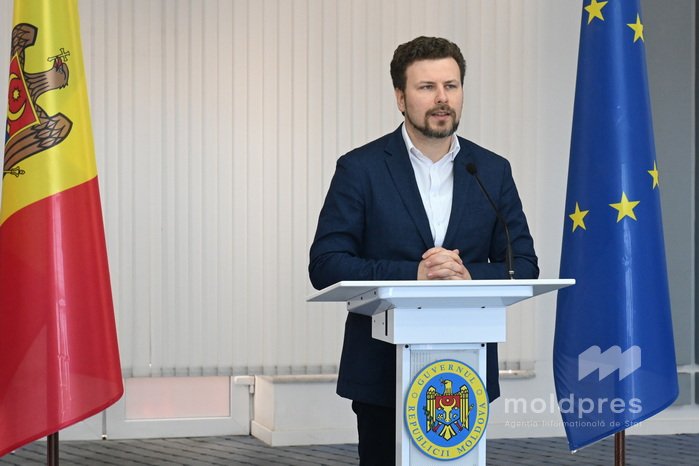
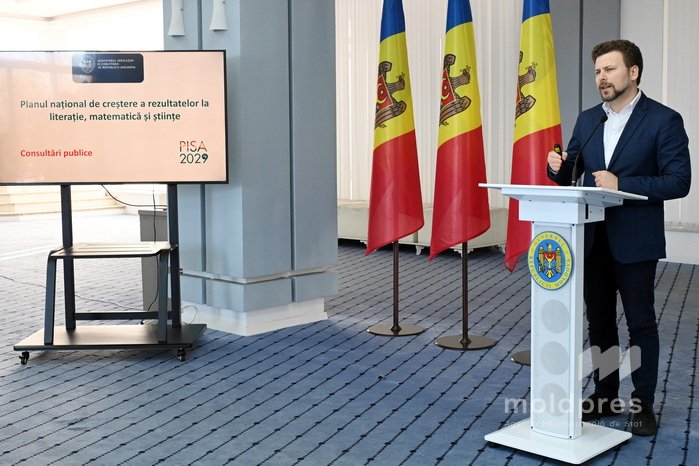
The Education and Research Ministry (MEC) has proposed a string of actions to be implemented in order to improve pupils’ skills in reading, mathematics and science. They will include one hour of critical reading per week for all pupils in Grades 1–9, equipping physics and chemistry laboratories, purchasing textbooks, additional mathematics classes to prepare for examinations, a compulsory STEAM subject in schools and training for teaching staff. The measures today were presented by Education and Research Minister Dan Perciun.

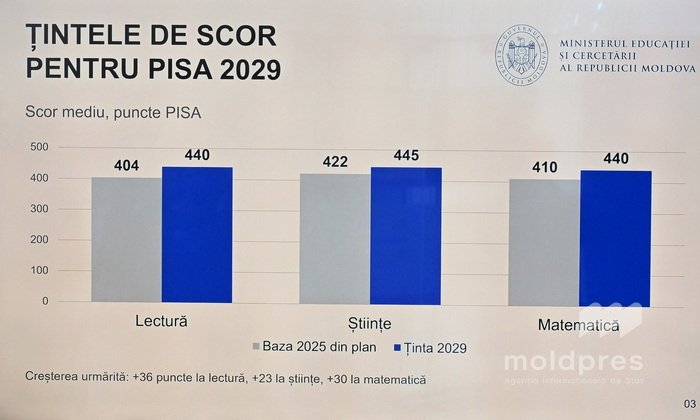
The action plan was developed based on an analysis of the results got by pupils c of Moldova at the international PISA assessment.

“Following the publication of the results of the international PISA assessment in September 2026, the ministry took some time to develop a plan to accelerate the improvement of these results. We are presenting it publicly today, so that it can be discussed over the next few weeks and approved by the end of this year. Through this document, we aim to provide clear answers to this question and explain the actions that will be carried out in the coming years, along with a clear investment budget. Taken together, these measures will lead to improved results,” said Dan Perciun.

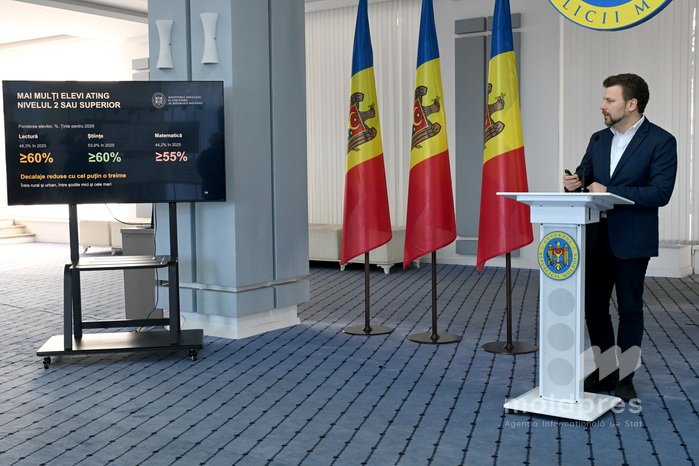
The analysis of the PISA results enabled the Education Ministry to develop a string of measures that would help students achieve better results in the next assessment, scheduled for 2029. The targets set by the MEC would allow the country to become a regional leader in terms of the quality of education and the skills developed among pupils.

“We are proceeding from the international PISA assessment. The next assessment will take place in 2029, with the results published in 2030, and we aim to improve the results of our pupils. This means having more young people develop basic and advanced skills in reading, mathematics and science. They are extremely ambitious targets. If we manage to achieve these scores, we will surpass more of our regional peers, and Moldova will become a regional leader when it comes to the quality of education and the skills developed among pupils. We will make every effort to make this a reality, based on extremely ambitious targets that will place us ahead of countries with larger budgets and economies than Moldova. We are setting out with confidence that if we all mobilize and accomplish what we have set out to do, we will achieve these results,” Dan Perciun said.

Thus, the interventions planned by the MEC include more areas focused on the curriculum, textbooks, assessment, teacher training, equipment, access and extracurricular activities.

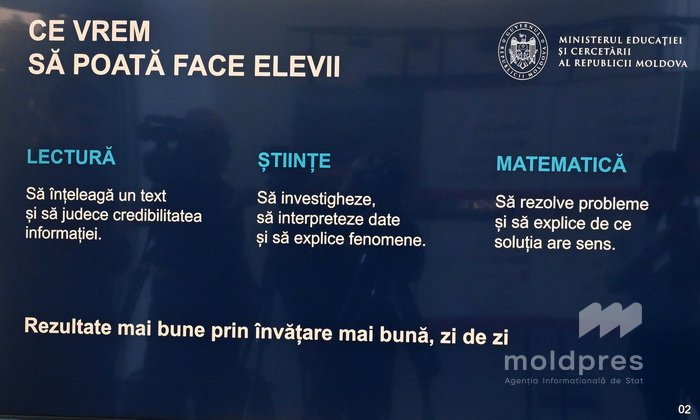
“The plan provides for investments in equipment, changes to the curriculum, changes to textbooks and certain developments in pupils’ assessment. Through these measures, we want young people to be able to understand a text and assess the credibility of information, to achieve a basic level of literacy, to work with data in science, explain certain phenomena and develop research skills. In mathematics, they should be able to solve problems, explain why the solutions they propose make sense, apply the theoretical knowledge they acquire to real-life situations and transfer that knowledge to other fields, rather than merely reproduce the rudimentary solving of equations,” said Dan Perciun.

Planned actions in the area of literacy:

• One compulsory hour of critical reading per week for all students in Grades 1–9.

• Teachers’ training.

• Purchasing books for kindergartens.

• Additional new books for pupils in Grades 1 and 2.

• Assessment of literacy skills at the Grade 9 examination.

• Organizing reading clubs and district competitions.

“Starting from September 2027, together with the new curriculum, we propose introducing one compulsory hour of critical reading in Grades 1–9. This means that all students will have dedicated time at least once a week to work on text comprehension. The new textbooks, which will be approved based on the new curriculum in 2027, will include such texts. As for assessment, beginning with 2027, the Grade 9 examination will include more items specifically aimed at assessing literacy, comprehension and the ability to work with text. In addition, this plan provides for the purchase of books, one of the largest investments we intend to make. We will purchase books for kindergartens throughout the country. We plan to purchase 10 books for each group, meaning one book for every two children, 10 books for each kindergarten group in 2027. In addition, we will extend the purchases to children in primary grades. Starting in September 2027, all children in Grades 1 and 2 are expected to receive two new books. We also want to make better use of the time dedicated to extracurricular groups that are currently financed from the state budget and propose clear activities within them. In the area of literacy, we will promote reading clubs and debate groups, and will also organize district and national competitions to promote this area as much as possible,” Dan Perciun noted.

Planned actions to develop mathematics skills

• New mathematics textbooks, based on Estonia’s experience.

• Additional classes for pupils in Grades 8 and 9 to prepare for the mathematics examination.

• Teachers’ training.

“In mathematics, we have more adjustments. The major change will come with the textbooks we are purchasing from Estonia, which will reach schools starting from September 2027. The new mathematics textbooks and the revised curriculum adapted to the Estonian textbooks will be introduced in Grades 1, 3, 5 and 8 starting in September 2027. In addition, we will expand the remedial programme through which Grade 9 pupils receive 60 free additional hours of mathematics preparation. In 2027, the programme will be extended to Grade 8 pupils. Regarding assessment, there will be certain changes in the format and types of items proposed for the Grade 9 examination. Several items will also be more directly focused on applying and transferring knowledge. As for teachers, we will provide additional training to familiarize them with the new curriculum and textbooks,” said Dan Perciun.

Planned actions in science

• Introducing science classes from Grade 1.

• Including a STEAM subject in schools for Grades 5–8.

• Integrated science assessment in Grade 8.

• Equipping physics and chemistry laboratories in 250 schools.

• Organizing robotics clubs.

“In science, the new framework plan extends the Science subject to Grade 1. This is an approach we have found in more countries. We will place greater emphasis on experimentation and application than on theoretical knowledge. In addition, starting next year, a compulsory STEAM subject will be introduced in schools for Grades 5–8, encompassing science, technology, engineering, arts and mathematics. This will enable knowledge from these areas to be used in joint interdisciplinary projects. As for assessment, an integrated assessment will be introduced on a pilot basis in Grade 8 in 2027, most likely in April or May. In science, equipment is extremely important. We need physics and chemistry laboratories, so our objective is to equip at least 500 laboratories in the next four years, in at least 250 schools. In terms of extracurricular activities, we will focus on expanding robotics clubs,” the education minister said.

The action plan will be subject to public discussion in the coming weeks. Its implementation will require more than 90 million lei in 2027 alone.
 Facebook
 Instagram
 X/Twitter
 Telegram
Pensions and other social benefits could be indexed by 8.2% in 2027
Police discover drone fragments in three localities across country
PHOTO // Police provide details about drone that exploded in Naslavcea: what specialists discovered at scene
Crisis Cell activated after 5.7 earthquake felt in Moldova
Republic of Moldova Shaken by Another Earthquake
Lyceum from north-eastern Moldova city renovated with U.S. support
PHOTO // National minorities involved in discussions about Moldova’s European future
International Students' Day: over 63,000 young people celebrate event in Moldova
PHOTO // Moldova’s public health system receives equipment worth over 500,000 dollars for emergency response, infections' detection
Breaking news
President of Moldova’s National Confederation of Trade Unions detained in corruption case; allegedly received 2,000 dollars
PHOTO // Eight border crossing points of Moldova endowed with modern equipment for verification of documents, biometric data
Moldova's passport ranks 74th worldwide, with access to 107 destinations
Republic of Moldova participated in dismantling three international malware networks
All public digital services restored on EVO portal
Foreign Minister at Bucharest Forum: We are strengthening resilience of Moldova to hybrid and security threats
PHOTO GALLERY // Journey into world of Chinese Folktales in Chișinău
Deputy Prime Minister holds meetings with representatives of Chamber of Deputies in Bucharest
Moldova to present negotiating positions for final two groups of EU accession chapters
 National Bank of Moldova

Moldovan PM encourages women entrepreneurs to leverage opportunities provided by artificial intelligence
Moldovan PM has dialogue with European journalists
Regulations on selecting candidates for Central Electoral Commission members appointed by Parliament approved
Summary of Parliament's plenary session of 19 November 2026
Moldovan president participates, alongside leaders of almost 40 countries, in Coalition of the Willing meeting in Berlin

Summary of Parliament's plenary session of 19 November 2026
Moldovan researchers present new technology for producing red wines with higher levels of biologically active compounds
PHOTO // Southern Moldova farmers trained in Comrat on agroforestry solutions to combat effects of drought
Moldova to be able to create own defense industry
Moldova and NATO sign arrangement on protection of classified information
Drone unauthorizedly flew through airspace of the Republic of Moldova
Moldovan parliament speaker supports cooperation with Romania, Ukraine on drones' interception: “We must be prepared for any scenario”
Moldovan president participates, alongside leaders of almost 40 countries, in Coalition of the Willing meeting in Berlin
PHOTO GALLERY // Prepared Moldova: practical exercises, resilience guide, emergency backpack presented at National Resilience Congress
Water level in Dniester River stays low: Moldovan environment minister makes call
Moldovan parliament votes to authorize Customs Service to conduct forensic examinations recognized as evidence in court
Moldovan PM visits company specializing in pastry production
Moldovan parliament appoints vice president of Court of Accounts
Moldovan parliament hears Court of Accounts' activity reports for 2024, 2025
Moldovan parliament appoints vice president of Court of Accounts
Moldovan customs laboratory's expert reports might be recognized as evidence in courts
Receive the latest news directly to your email

Receive the latest news directly to your email