
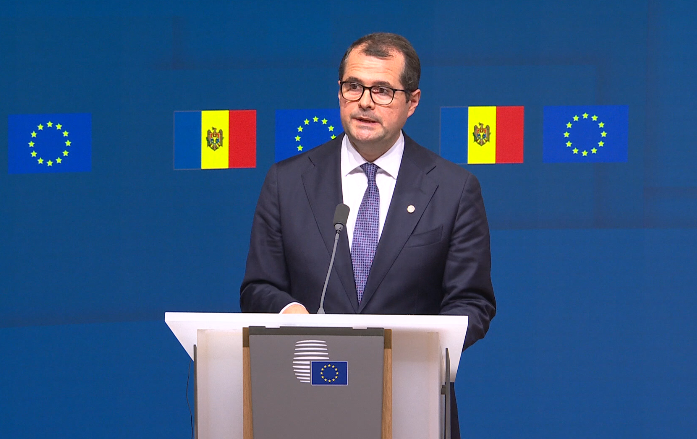
Speech by Prime Minister following EU–Moldova Association Council
Dear High Representative Kallas,
Dear Commissioner Kos,
Ladies and gentlemen,Thank you for today’s discussion.
This was the tenth EU–Moldova Association Council and my first one as prime minister.
Allow me to begin by thanking you, dear Kaja and dear Marta, and, through you, the Commission, the Member States and the teams working alongside us every day.
European integration is Moldova’s national project. The political, technical, financial and security support we receive from the European Union is essential to moving it forward. We are deeply grateful for this support and do not take it for granted.
I would highlight three points from today’s meeting.
First, the accession process continues to advance.
This summer, we opened Clusters 1 and 6. We are now working to open the remaining clusters and to assess the interim benchmarks in a timely manner.
Our objective is to complete the technical work required to conclude the negotiations by early 2028 and to prepare Moldova for membership by 2030.
It is an ambitious timeline. But we are not afraid of ambitious tasks.
We are not asking for lower standards or shortcuts. We believe in a predictable, merit-based process in which progress in reforms is followed by progress in negotiations.
Second, the implementation of the Growth Plan is moving forward.
During the latest reporting period, Moldova fulfilled 18 reform commitments. On this basis, the Commission is disbursing a further 157 million euros. We are very grateful for this support.
It directly increases our capacity to finance investments in the country – in transport, energy, water, healthcare, education and other areas.
I also appreciate the discipline built into the mechanism itself: reforms are completed, results are assessed, and funding follows.
But ultimately, these figures matter only if people can see the results.
So allow me to continue in Romanian and address directly those watching us from home.
Dear citizens,
I know that when you watch a press conference from Brussels, you ask yourselves what all of this means for you.
What is changing in the place where you live, in the business you run, in your family’s life?
It is the right question.
Today, another 157 million euros is being disbursed after the completion of the 18 reforms during the latest reporting period.
Under the Reform Agenda, we have so far completed approximately 95% of the measures planned for that period.
This money helps us finance investments in transport, energy, water and sanitation, healthcare and education.
Economic integration is already producing concrete results.
In the first half of the year, around two-thirds of Moldova’s goods exports went to the European Union – approximately 1.3 billion euros in exports, an increase of more than 10%, even amid a challenging global context.
This is a clear example of the critical importance the European Union has for our economy.
Through SEPA, the average cost of a euro transfer is now around 1 euro, compared with fees that previously started at 20 euros.
The Common Transit Convention simplifies the transport of goods. Roaming with the European Union is cheaper, allowing people to communicate more easily with their loved ones.
These are very concrete examples of European integration.
Both from the European Commission and the Member States, we have repeatedly heard that Moldova is a good student in this class of candidate countries – especially when we take into account our starting point.
But the closer we get to the finish line, the greater our responsibility becomes.
Brussels can offer us access to the market, funding, expertise and political support.
But Brussels cannot make our institutions function better. It cannot implement projects in our place. It cannot simplify our procedures.
This part of the work must be done in Chișinău.
And I want to thank the people who made today’s progress possible.
They are civil servants who canceled their holidays this summer, gave up time with their families and, during these months, worked many evenings, nights and weekends.
Behind every reform are people who prepare, verify, negotiate and remove obstacles.
We rarely know their names. But much of the progress we are discussing today is due to them.
We are in a decisive period. Just a few years ago, for many people the idea that Moldova could become an EU member seemed almost impossible.
Today, we are discussing concrete dates and targets to bring Moldova into the great European family and to fulfill this historic mission of our generation.
Opportunities like these come rarely. It is our responsibility not to miss them, and we will make every effort to do so.
Allow me to return to English for the third point – security and energy.
The security environment around Moldova has become more difficult.
The repeated violations of Moldova’s airspace by Russian drones and missiles represent a serious risk to our population and civilian infrastructure.
We are grateful for the EU’s support in strengthening Moldova’s resilience and defense capabilities through the European Peace Facility.
For us, air surveillance and air defense are clear priorities.
We also remain a devoted neighbor and friend of Ukraine, with which we share a 1,222-kilometer border – the longest among all countries west of Ukraine. This commitment also means making decisions that are not always easy domestically, including facilitating the transit of Ukrainian grain through Moldova. We do this because maintaining Ukraine’s access to export routes matters for regional stability and global food security.
And Moldova is contributing as well. Our personnel serve in EU missions, and we share with our European partners the experience we have gained in countering hybrid threats and electoral interference.
Energy is the other immediate concern.
We have prepared for the heating season and worked to ensure supplies. But security of supply is only part of the challenge. The more difficult issue this winter will be affordability.
Our responsibility as a government is to ensure supplies and protect the most vulnerable households from the impact of the energy price shock.
Here too, the European Union has stood by Moldova – helping us diversify our sources of supply, build interconnections, reform our energy market and protect vulnerable consumers.
And perhaps this is the most important conclusion from today.
A few years ago, much of what we discussed at this Association Council would have seemed distant: accession negotiations, integration into the European market, SEPA, European roaming, new energy interconnections and deeper cooperation in the field of security.
Today, these are concrete realities.
They are the result of tremendous work in Moldova, as well as the extraordinary support and trust of the European Union and its Member States.
We are grateful for this partnership.
We leave today’s Council with a clear work programme, but also with confidence. Moldova has made significant progress, the European Union has stood by us at every important stage, and now we have the opportunity to take the next steps together.
For Moldova, the task is to continue delivering results – in reforms, investments, security and protecting our citizens during the winter ahead.
And as we do so, we look forward to continuing this journey with the same close cooperation, trust and support that have brought us this far.
Thank you.
 Facebook
 Instagram
 X/Twitter
 Telegram
Moldovan deputy PM for reintegration attends 35th anniversary of founding of Lucian Blaga Theoretical Lyceum from Tiraspol
Moldovan PM, president of Clarke Energy company discuss new investment opportunities in energy sector
New measures to protect aquatic biodiversity: mandatory permit for introducing exotic fish species into fish farms
European support in disasters: draft law on Moldova’s participation in EU Civil Protection Mechanism passed in first reading
Passed by Parliament: Bălți mayor to be assisted by own cabinet
Parliament denounced two CIS Agreements that had not been implemented
Prime Minister attends launch of Prepared Moldova campaign
Legislation on producer organizations in agri-food sector aligned with EU standards
Legislative measures to streamline cooperation mechanism with EU member states in recovery of claims process adopted by Parliament
President to attend Coalition of Willing meeting in Berlin
Moldovan parliament's standing bureau approves agenda for plenary meeting due on November 19
Moldovan government's deputy secretary general discuss Council of Europe's support for local public administration reform in Strasbourg
Deputy PM for reintegration has meeting with Representative of Office of United Nations High Commissioner for Refugees in Moldova
Issues examined at meeting of Moldovan parliament's standing commissions on November 16-18, 2026
Jet-propelled drone repeatedly crossed state border amid Russian attacks on Ukraine
Professional internships for unemployed people without work experience
Preparing vehicles for cold season
PM attends event marking 20 years of activity of American Chamber of Commerce in Moldova
 National Bank of Moldova

30 high school students learn through games how to become active citizens and help transform communities
Reintegration process and respect for human rights in eastern districts discussed in Bucharest
PM attends event marking 20 years of activity of American Chamber of Commerce in Moldova
Moldova's reintegration process discussed in Bucharest
Moldovan PM has talks with North Carolina Secretary of State

Pensions, other social benefits for Moldovans living in Croatia; two states conclude negotiations on signing bilateral agreement
Moldova condemns violations of national airspace at OSCE, amid massive Russian Federation's attacks on Ukraine
Moldova's reintegration process discussed in Bucharest
Moldovan PM has talks with North Carolina Secretary of State
Moldovan government's deputy secretary general says gender equality test of governance's quality
Romanian PM reconfirms support for Moldova's European integration: “Bucharest’s door is always open”
Comment on release of citizens of Moldova Oleg Zaharov, Veaceslav Vasilitov
Moldova's State Chancellery engages in dialogue with young local elected officials on local public administration reform, European integration, EU funds
Defense Ministry: 17 aerial incidents recorded in Moldova in November
Prepared Moldova national campaign launched in Stefan Voda
PHOTO // Moldovan interior minister meets Romanian counterpart
Parliament speaker attends launch of Prepared Moldova campaign in country's southern region
Another drone flies unauthorized over airspace of Moldova
PHOTO // Unusual invitation to Expo Mobila 2026: Moldexpo exhibition center transforms trolleybus stop into relaxation space
Moldovan Education Ministry proposes actions to improve pupils’ skills in reading, mathematics, science
Moldovan parliament's delegation participates in Session of Europe Regional Assembly of Parliamentary Assembly of Francophonie, held in Brussels
Receive the latest news directly to your email

Receive the latest news directly to your email