
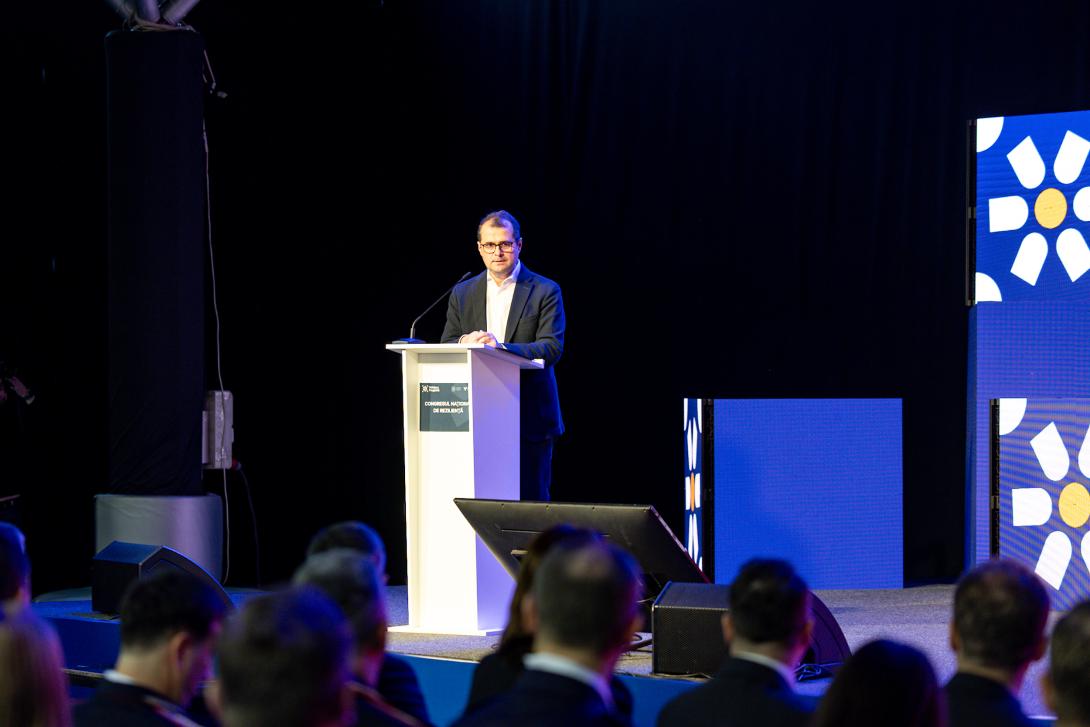
Prime Minister attends launch of Prepared Moldova campaign
Prepared Moldova campaign and Resilience Guide for families, communities and citizens were launched today during the National Resilience Congress, organized by the National Crisis Management Centre. The initiative aims to prepare the population for crisis situations and strengthen the ability of institutions and communities to respond effectively during the first 72 hours of an emergency.

Attending the event, Prime Minister Vasile Tofan emphasized the importance of developing a culture of prevention and responsibility that can provide citizens with greater safety and confidence in the face of unforeseen situations. The Prime Minister stressed that the campaign is not intended to cause concern, but to provide practical information and recommendations. At the same time, the Prime Minister clarified that the authorities are not preparing to interrupt electricity or water supplies, but are informing people about how to act if these essential services are disrupted.

“The first 72 hours are not hours in which we can afford to make mistakes. They are the most important hours, when we need clear preparation guidelines. A few basic supplies, a family plan and information about official sources can help us get through the beginning of a crisis more effectively. And when households are prepared, response teams can focus on those facing the greatest danger,” said the Prime Minister.

The Prime Minister noted that preparing for crisis situations is a practice applied in many countries, including France, Japan, Norway and Sweden, and urged citizens to take the authorities’ recommendations seriously. The head of government also highlighted the shared responsibility of state institutions, local authorities, the business community, schools, civic organizations and the media in strengthening society’s resilience.

“No community should be left to cope on its own. No family should be left to cope on its own, and the state has a duty to provide accessible information, coordinate institutions and support people who need additional assistance. We need exercises, cooperation between institutions and communities, tested plans and information that reaches people. ‘Prepared Moldova’ must become an everyday practice,” the Prime Minister emphasized.

One of the main tools presented as part of the campaign is the Resilience Guide, which provides practical recommendations for the first 72 hours of a crisis. The document explains what to do in the event of an electricity or water supply interruption, how to prepare essential supplies, establish a family plan and identify official sources of information. The guide also takes into account the specific needs of families with young children, older people, people with disabilities and those who have pets, while providing recommendations for supporting vulnerable people.

The emergency backpack was also presented during the event. It should contain essential supplies and items for the first 72 hours of a crisis. Participants learned how such a backpack can be prepared according to each family’s needs. It should contain a first-aid kit and essential medicines, a supply of water, cash, a portable radio, identification documents, non-perishable food, a power bank, a flashlight and a blanket.

At the same time, the Alerts and Notifications module was launched in the EVO application, a digital tool designed to inform citizens during risk and emergency situations. The module includes the Resilience Guide, featuring 48 crisis situations and 477 official recommendations, available in three languages and accessible even without an internet connection after the first access. Another component is an interactive checklist for preparing an emergency backpack. In addition, through the MNotify platform, citizens will be able to receive real-time notifications directly in the EVO application. This module will not replace the national MD-Alert warning system, which is to be developed by the authorities, but will serve as a complementary tool for informing the public.

The National Resilience Congress also included a presentation of the response capabilities of institutions responsible for managing emergency situations. Participants had the opportunity to learn how the 112 Service operates and to see the equipment of the General Inspectorate for Emergency Situations and the demining equipment used by the National Army.

Ambulances equipped with modern equipment were also displayed, including laboratories and devices for detecting chemical and radiological risks, collecting biological samples, including from the air, and carrying out decontamination.

The Congress programme includes two practical exercises simulating crisis situations: one focused on managing a pandemic and another involving a drone incident near critical infrastructure, with a radiological risk. The exercises aim to test alert, coordination, response and public communication mechanisms, as well as present recommendations for the population.

Two discussion panels are also being organized, focusing on the role of local authorities and the business community in preparing communities, as well as cooperation between the media, civil society and academia to strengthen society’s resilience. The agenda also includes the launch of the Community Resilience Platform initiative and a practical simulation exercise organized with the support of the UN Refugee Agency (UNHCR).

Prepared Moldova campaign takes place from 19 to 21 November 2026. Following the launch event in Chișinău, activities will continue in Ștefan Vodă on 20 November and in Edineț on 21 November. The regional meetings will present the Resilience Guide, the emergency backpack, the alerts module in EVO and the mechanisms for coordinating institutions and communities during crisis situations.

More information about the campaign, the Resilience Guide and recommendations for the first 72 hours of a crisis is available on https://72ore.md/.
 Facebook
 Instagram
 X/Twitter
 Telegram
Technical-military cooperation agreement between Moldova and Ukraine proposed for ratification
United States provides Moldova with grant worth 1.5 million dollars to strengthen cybersecurity
Over 50 young people of Moldova simulate parliamentary activities at 10th edition of Youth Parliament
Moldovan government's state secretary for reintegration pays working to Dubasari district
Public consultation on priorities of future Danube Region Programme 2028–2034 to be held in Moldova
Deputy Prime Minister for Reintegration in dialogue with Parliamentary State Secretary to Federal Ministry for Economic Cooperation and Development of Germany
Subcommittee set up to exercise parliamentary oversight of Intelligence and Security Service
Summary of Moldovan parliament's plenary meeting of November 16, 2026
Writers from Moldova at European Parliament: Moldovan literature helps Europeans get to know us
Report of inquiry commission on results of review of activities of certain state-owned enterprises presented in Moldovan parliament's plenum
Moldovan president, European officials discuss accession negotiations, security, defence cooperation in Brussels
Moldovan president, at EU Enlargement Forum, says Moldova can conclude accession negotiations by 2028, even exceed European Commission’s expectations
Over 172,000 public-sector employees to receive higher salaries; Moldovan parliament approves reform of unified pay system in first reading
Republic of Moldova joins International IDEA to strengthen electoral process integrity
Registration for the Wine of Moldova 2026 National Competition open; wineries can register till November 25
Speaker about Moldova Prepared campaign: Every citizen must know how to prepare for crisis situation and how to protect family
EVO App to add Alerts and Notifications Module: emergency information to reach around 200,000 users
DOC // Moldova Prepared: Resilience Guide with 477 recommendations for 48 crisis situations launched in Moldova
Republic of Moldova launches first-ever campaign to prepare population for crisis situations
0.5% tax on construction investments to be eliminated
Recipe for friendship and solidarity: Ukrainian refugees learn to make pizza alongside renowned Italian chef
 National Bank of Moldova

Passed by Parliament: Bălți mayor to be assisted by own cabinet
Parliament denounced two CIS Agreements that had not been implemented
Legislation on producer organizations in agri-food sector aligned with EU standards
Legislative measures to streamline cooperation mechanism with EU member states in recovery of claims process adopted by Parliament
President to attend Coalition of Willing meeting in Berlin

Republic of Moldova launches first-ever campaign to prepare population for crisis situations
0.5% tax on construction investments to be eliminated
Recipe for friendship and solidarity: Ukrainian refugees learn to make pizza alongside renowned Italian chef
PAS nearly decided on candidate for Chisinau city hall, but official announcement scheduled for November 29, says Igor Grosu
MOLDOVA PREPARED // Launch of national campaign to prepare population for crisis situations
President to attend Coalition of Willing meeting in Berlin
Moldovan parliament speaker says under what conditions Gagauzia’s new governor could join government
Moldovan parliament speaker comments on Tiraspol leader's return to Transnistrian region, travel restrictions
PHOTO GALLERY // Italian Cuisine Week in the World; Ukrainian refugee children cook pizza alongside renowned chef Luca Pappagallo
University professors of Moldova receive English language training to teach foreign students
Better conditions for social services' beneficiaries in two north Moldova settlements: institutions made more energy efficient with EU's support
Moldovan parliament's standing bureau approves agenda for plenary meeting due on November 19
Moldovan government's deputy secretary general discuss Council of Europe's support for local public administration reform in Strasbourg
PHOTO // Drone detected in north Moldova settlement identified as of Gerbera-2 model
Deputy PM for reintegration has meeting with Representative of Office of United Nations High Commissioner for Refugees in Moldova
Issues examined at meeting of Moldovan parliament's standing commissions on November 16-18, 2026
Receive the latest news directly to your email

Receive the latest news directly to your email