
Moldova's draft state budget for 2027 unveiled in parliament
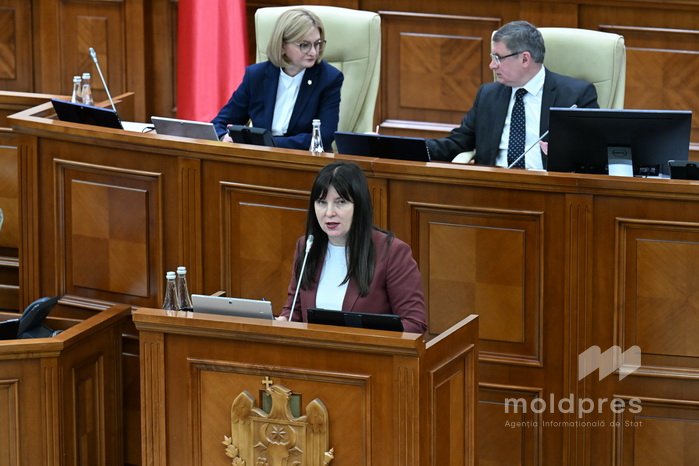
Finance Minister Victoria Belous today unveiled the draft state budget for 2027 in parliament. The document provides for revenues of 92.3 billion lei and expenditures of 112.25 billion lei, with an estimated deficit of 19.9 billion lei. Victoria Belous emphasized that the draft focused on the responsible use of public funds, economic development and investments in the economy and infrastructure, as well as social protection and support for citizens.

According to the draft, budget revenues will increase by 15 per cent next year, while expenditures will rise by 8.6 percent.

“We built this budget as a responsible one, taking into account the regional and national economic situation. What we can control, and will do through this budget, is to ensure a balance between economic constraints, the need for investments and the continuity of social support. The budget for next year has three goals: to collect budget revenues fairly, without suffocating the economy, while taxing harmful habits more heavily; to reduce waste of public money wherever possible; and to allocate funds to the essential priorities of citizens and the economy,” Victoria Belous said in the parliament’s plenum.

The finance minister emphasized that the 2027 budget was centered on the most important needs of citizens, as well as on increasing investments, in order to restart the economy.

“For 2027, we are presenting a responsible budget that takes into account economic realities, as well as the need to continue standing by people and implementing reforms. We have increased allocations for education, healthcare and roads, are developing major infrastructure projects and are reducing costs wherever possible. Fiscal and budgetary discipline, along with the prudent use of public debt, remain at the foundation of public spending. It is a realistic budget, focused on the most important needs of citizens, but also oriented toward increasing investments, in order to restart the economy,” Victoria Belous said.

In her speech, the finance minister explained how state budget resources would be distributed and where public funds would be primarily directed. They will target two major areas: sectors with a direct impact on citizens, such as social protection, education and healthcare, and a second area consisting of investments and economic development.

Education, healthcare and social protection account for 64 per cent of the budget

Allocations of 25.7 billion lei are earmarked for social protection, representing 22.9 per cent of total state budget expenditures. This amount is by 1.5 billion lei or 6.4 per cent higher than last year. The funds will go directly toward helping vulnerable people, reducing poverty and promoting social inclusion, strengthening child and family protection and providing compensation for heating.

Approximately 24.6 billion lei is allocated to education, an increase of 2.5 billion lei compared with 2026. The funds will be directed toward teachers’ salaries, increased scholarships for pupils and students, children’s meals, the purchase of textbooks and the modernization of schools.

Allocations of 10.8 billion lei are provided for healthcare, an increase of more than one billion lei compared with the previous year. The resources will ensure the financing of medical services provided to people insured by the government, the equipping of medical institutions, the renovation of hospitals and medical centers, and the continuous improvement of medical services.

At the same time, 14.8 billion lei is allocated to the economic sector, including support for entrepreneurs, infrastructure development and the strengthening of energy security.

“In addition to allocations for key areas, it is essential to restart the economy, so that we can increase budget revenues, reduce the deficit and achieve sustainable revenue growth. For the agricultural sector, we are allocating 2.4 billion lei to support agricultural producers, create friendly conditions for the sustainable development of the agricultural sector and its integration into the economy of the European Union, and improve living standards in rural areas, including 1.7 billion lei allocated to the subsidy fund. Among the main financing measures for other sectors of the economy, there are the Program 373, for which 250 million lei is allocated; the State Aid Programme for Investments, with 220 million lei; and the development of an electricity storage system using batteries, with 105 million lei,” Victoria Belous said.

Another major priority for the development of the real economy is the continued development of the transport and infrastructure system. For this purpose, expenditures of 5.2 billion lei are planned from the 2027 state budget, including 1.1 billion lei from external sources and approximately 4 billion lei for the repair and maintenance of national and local roads, around 1 billion lei more than in 2026.

“For regional and local development, we aim to directly support communities, especially rural ones, so that people can benefit from better living conditions and modern infrastructure. To this end, 3 billion lei is allocated to the National Regional and Local Development Fund. The money will be used to support community development projects, reduce disparities between regions and create better conditions for citizens. At the same time, 1.7 billion lei from this fund is earmarked for Stimulant 2, meant to support communities that have voluntarily amalgamated,” the finance minister said.

Another 2.6 billion lei is planned for the Energy Vulnerability Reduction Fund, in order to provide compensation during the cold season.

The draft also stipulates that, in 2027, with the support of external partners, 107 projects financed from external sources will be implemented, for which approximately 4.5 billion lei is allocated.

The minister emphasized that the budget draft was based on the forecast of macroeconomic indicators updated in July 2026 for 2027. It estimates nominal Gross Domestic Product (GDP) at 422.4 billion lei, economic growth of 2.8 per cent, annual inflation of 6.1 per cent and an increase in the average monthly salary of 10.7 per cent.

At the same time, the state budget deficit for 2027 is forecast at 19.9 billion lei.

“I know that one question and concern among people is how the financing of the budget deficit will be ensured. I would like to remind you that we estimate the 2027 state budget deficit at 19.9 billion lei, amounting to 4.72 per cent of GDP. The state budget deficit in 2027 will be financed predominantly from external sources, from the Economic Growth Plan, worth 10.5 billion lei, as well as from external loans intended to finance investment projects. In addition, the financing requirement will be covered from domestic sources, including through the issuance of government securities on the domestic market worth 4.5 billion lei, proceeds from the privatization of publicly owned assets and the use of available balances in budget accounts. Eighty-five percent external and 15 per cent domestic,” Victoria Belous explained.

After presenting the draft, the finance minister answered lawmakers’ questions. This stage will be followed by a vote on the draft in its first reading.
 Facebook
 Instagram
 X/Twitter
 Telegram
Moldova to be able to create own defense industry
Moldovan parliament appoints vice president of Court of Accounts
Registration for Wine of Moldova 2026 National Competition open; wineries can register till November 25
VIDEO // Chisinau Airport to be expanded under contract worth over 180 million lei; reconstruction works to start in next December
0.5% tax on construction investments to be eliminated
Moldovan government simplifies rules for entrepreneurs: over 70 authorizations to be eliminated or simplified, 150 permits to be reviewed
PHOTO // Twenty-four producers promote Moldovan wines, divins in Tokyo
Prime Minister about 2027 State Budget: Revenues will grow twice as fast as expenditures
Moldova's National Road Transport Agency warns carriers Estonia to close three border crossing points with Russia as of December 1
Japan to provide Moldova with loan of up to 8.6 billion yen for agricultural modernization
ANRE: Natural gas reserves for 2026–2027 cold season fully established
From Ungheni to Iasi on European-Gauge railway: Moldovan deputy PM provides details on project, construction timeline
Railway of Moldova enterprise separates infrastructure of freight transport from passenger one; deputy PM announces when reform to be completed
Report presented in Moldova's parliament: state-owned joint stock companies, enterprises generate profit of about 3.1 billion lei in 2025
Moldova's draft state budget for 2027 unveiled in parliament
Moldovan energy minister says natural gas from Neptun Deep project to be able to cover about one quarter of Moldova’s daily consumption
Revenue of 65.6 billion lei accumulated in Moldova's state budget in first ten months of 2026
Moldovan authorities investigate possible cases of illegal financing, voter bribery ahead of runoff election in Gagauzia
Speaker about Russian Embassy’s message on alleged anti-Russian provocation
16 Days of activism against gender-based violence campaign backed by Parliament
Moldova and Romania advance energy interconnection expansion: construction of Suceava–Bălți line to be accelerated
 National Bank of Moldova

Irrigation infrastructure of Moldova to be rehabilitated with financial support of European Bank for Reconstruction and Development
Ratified by Moldova's parliament: irrigation infrastructure to be rehabilitated with top European bank's financial support
Less bureaucracy and lower administrative costs for businesses: Parliament votes in first reading on new deregulation package
Better conditions for students in vocational and technical education
Introduction of digital identity wallets for citizens and businesses approved in first reading

16 Days of activism against gender-based violence campaign backed by Parliament
Introduction of digital identity wallets for citizens and businesses approved in first reading
Moldova and Romania advance energy interconnection expansion: construction of Suceava–Bălți line to be accelerated
Local Public Administration Reform in Moldova under review by Council of Europe’s Centre of Expertise
Old-calendar Orthodox Christians start Nativity Fast, which lasts 40 days
Chisinau denounces new “information diversions” by Moscow after Russian Embassy invoked alleged “anti-Russian provocation”
Council of Europe welcomes efforts to reform local public administration and praises amalgamation model chosen by the Republic of Moldova
More people should be deprived of citizenship of the Republic of Moldova because they do not respect and work against state, President says
Head of State about Prime Minister: I think he is doing well, despite all crises coming one after another
President rejects reports of possible federalization of country
PHOTO GALLERY // Behind-the-scenes moments from premiere of film “2438 km, or All Roads Lead to Rome”
Moldova building air defense system step by step
Moldovan president says Russia does not want to end war
Moldova expands energy communities: citizens, institutions, entrepreneurs join forces to produce, use renewable energy
PHOTO GALLERY // Performances in youth field, recognized at National Youth Awards Gala, held in Chisinau
Moldova's budgets for 2027, administrative-territorial reform, de-bureaucratization of business environment on agenda of November 26–27 plenary meetings
Receive the latest news directly to your email

Receive the latest news directly to your email