
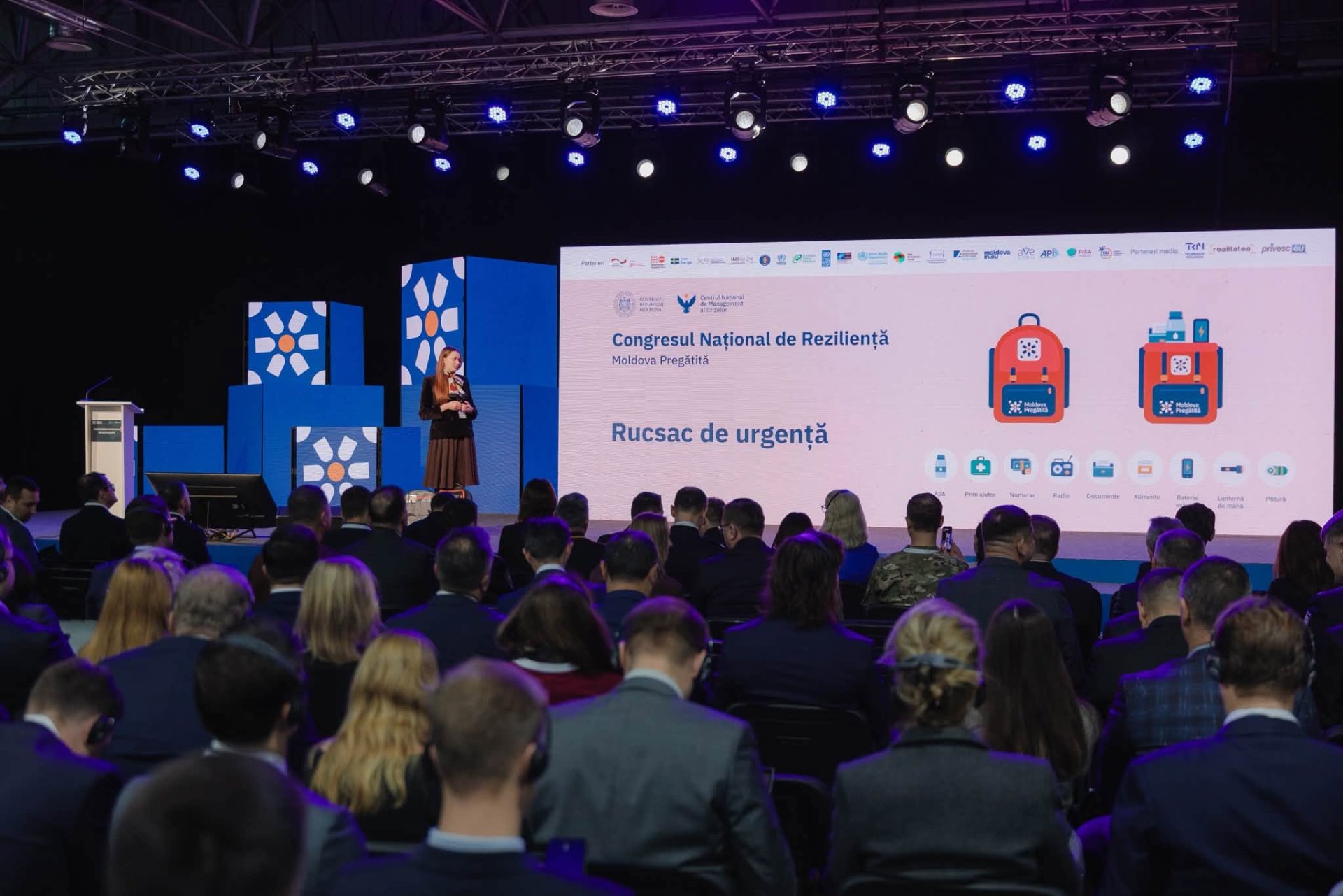
PHOTO // Authorities recommend preparing emergency backpack for first 72 hours of crisis
Citizens are urged to prepare in advance an emergency backpack containing water, medication, documents, cash, non-perishable food, a flashlight and other essential items for the first 72 hours of a crisis situation. The recommendation was presented today at the first National Resilience Congress, where Moldova Prepared campaign was launched to prepare the population for emergency situations.

According to representatives of the National Center for Crisis Management, the backpack should be prepared before a situation arises that could require the evacuation of the home, so that family members do not have to search hurriedly for the necessary items.

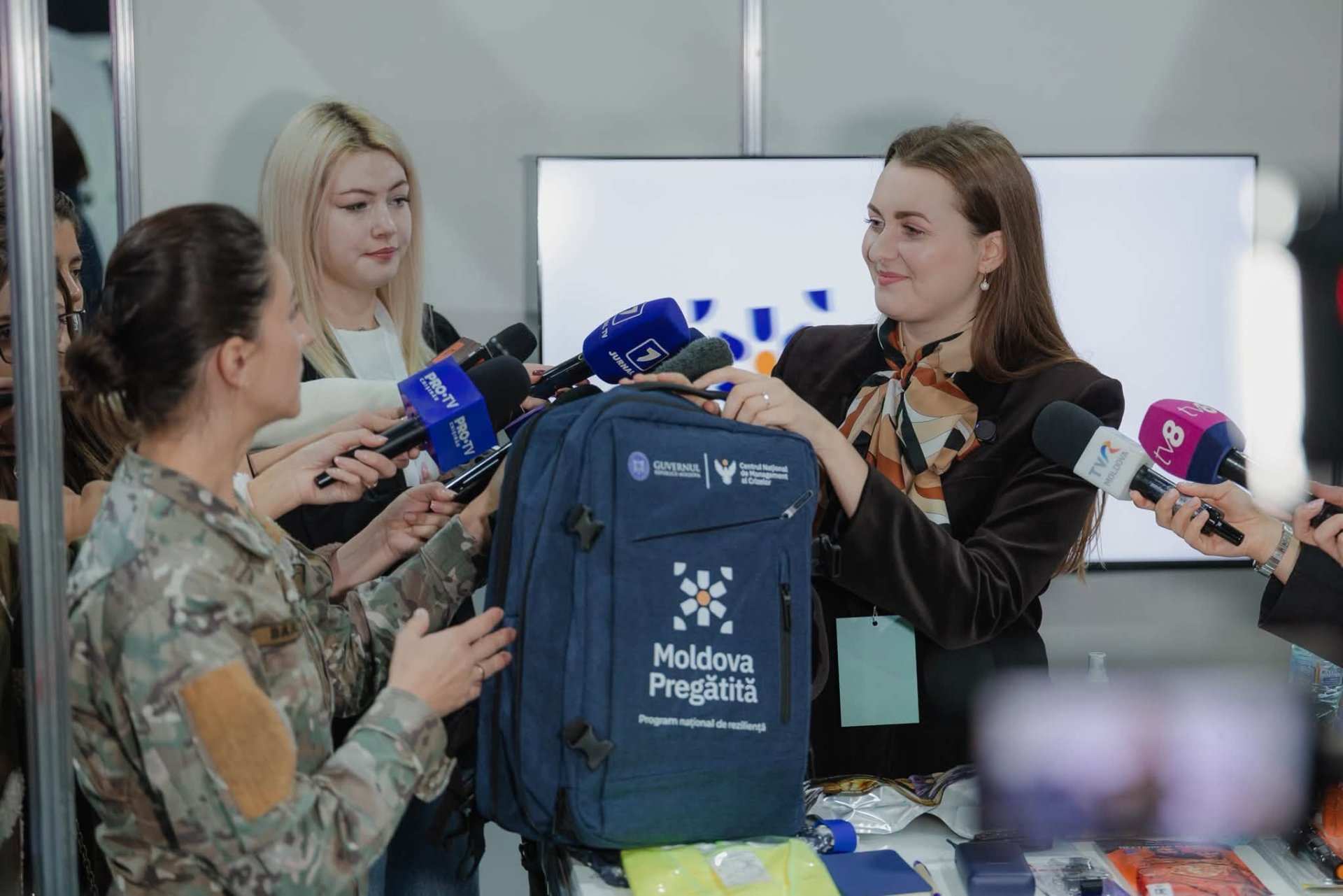
Cătălina Ceban, coordinator of external assistance and international relations at the National Center for Crisis Management explained that the idea of the backpack stems from the difficulties people face even in ordinary situations when they have to leave home quickly.


“We have all had several moments in life when we had to leave home urgently, whether we had to pick up the children from kindergarten, were late for work, or needed a product and had to rush to the store. In these situations, many people have probably found themselves unable to locate the house key, while someone else had taken the car keys and we did not know where they were, or we did not know where the cash was kept,” Cătălina Ceban said.


She pointed out that in a crisis situation, when people have to leave their homes quickly, the lack of a plan and the search for necessary items can complicate the evacuation.


“It is precisely from this perspective that the idea of an emergency backpack emerged. The emergency backpack should contain things that are not sophisticated, but items that we already have readily available at home,” the representative of the National Center for Crisis Management said.


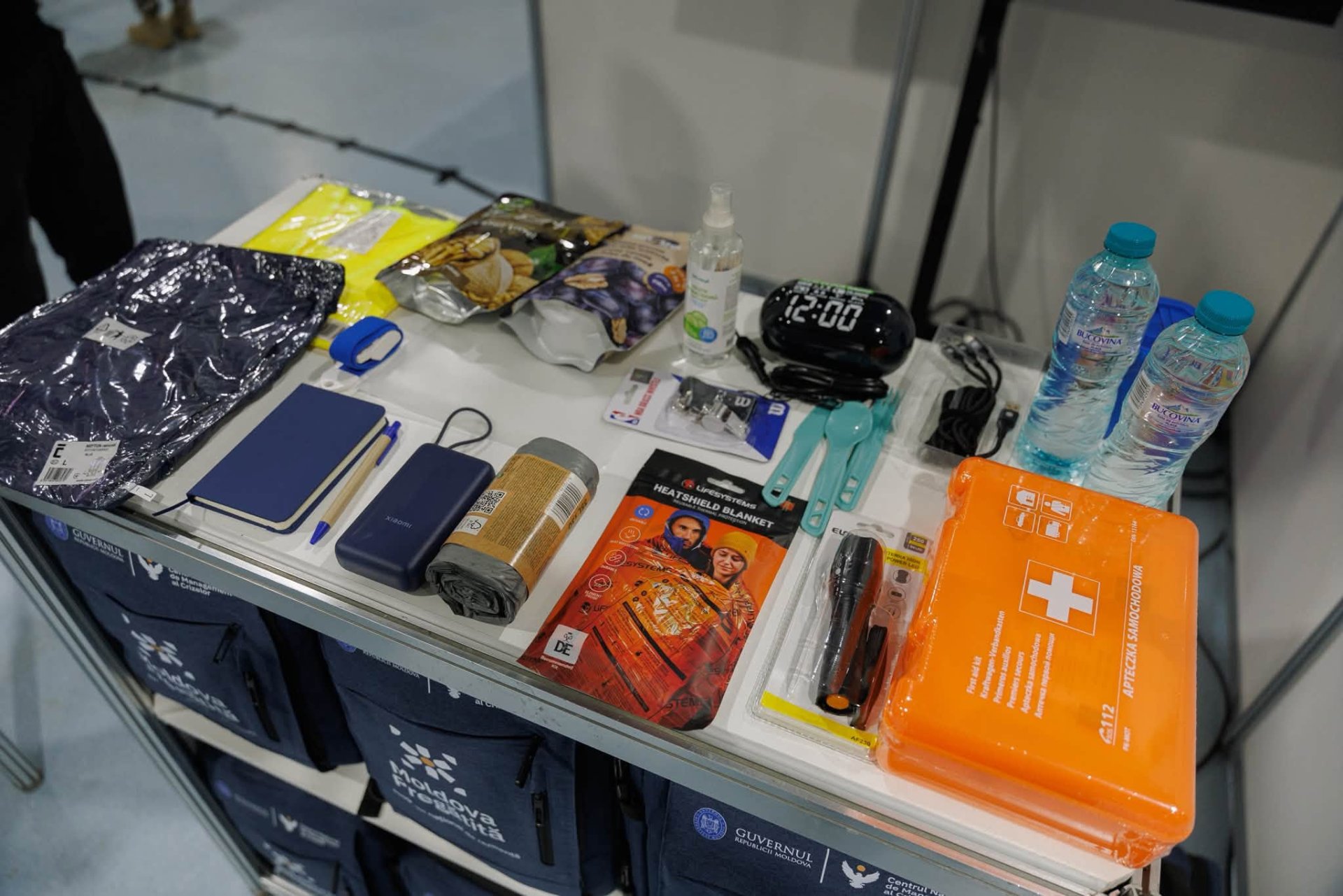
The recommended items include water, a first-aid kit, medication needed by family members, cash, a small and compact radio, identity documents, non-perishable food, a power bank for the phone, a flashlight and a blanket.

The cash should cover the family’s needs for approximately three days. The food should be non-perishable, and its expiration date should be checked regularly, with the products replaced when necessary.

The power bank is also necessary to keep the mobile phone operational and to communicate with family members or close contacts, while the compact radio can enable people to receive official information if other means of communication are unavailable.


“A power bank, so that we can charge the phone and call our loved ones, while looking after our community; a flashlight, so that we can see during the day and at night everything happening around us; and a blanket, so that we can stay warm and feel safe,” Cătălina Ceban explained.


Another important aspect is where the backpack will be kept. It should be accessible, and all household members should know where it is so that they can quickly take it in the event of an evacuation.


“It is very important to have this emergency backpack readily available at home, in a place known to everyone in the household. That way, in an emergency, we can take it quickly,” the representative of the National Center for Crisis Management said.


Cătălina Ceban emphasized that the backpack should not be prepared according to an identical list for every family, as its contents must be adapted to the household’s composition and the needs of each member.

Thus, families with young or older children, elderly people, individuals with special medical needs and households with pets should also include the items required by these groups.


“The emergency backpack is like a distinct identity for each family and household, because some families have young or older children. Some people live with pets, while others are elderly, and all of these situations come with needs adapted to the specifics of their lives,” Cătălina Ceban explained.


During the presentation, the organizers also showed how such a backpack can be prepared through a practical exercise. Several opinion leaders and content creators were challenged to gather, in just five minutes, the most important items they would take from home in the event of an evacuation.

The exercise demonstrated how difficult it is to quickly select the necessary items under stressful conditions. Participants tried to gather documents, phones, chargers, hygiene products and food, while some reactions showed that, without prior preparation, even choosing basic items can become a challenge.

The video material presented at the congress emphasized that an emergency backpack is not a travel bag, but should contain the items needed for the first 72 hours.

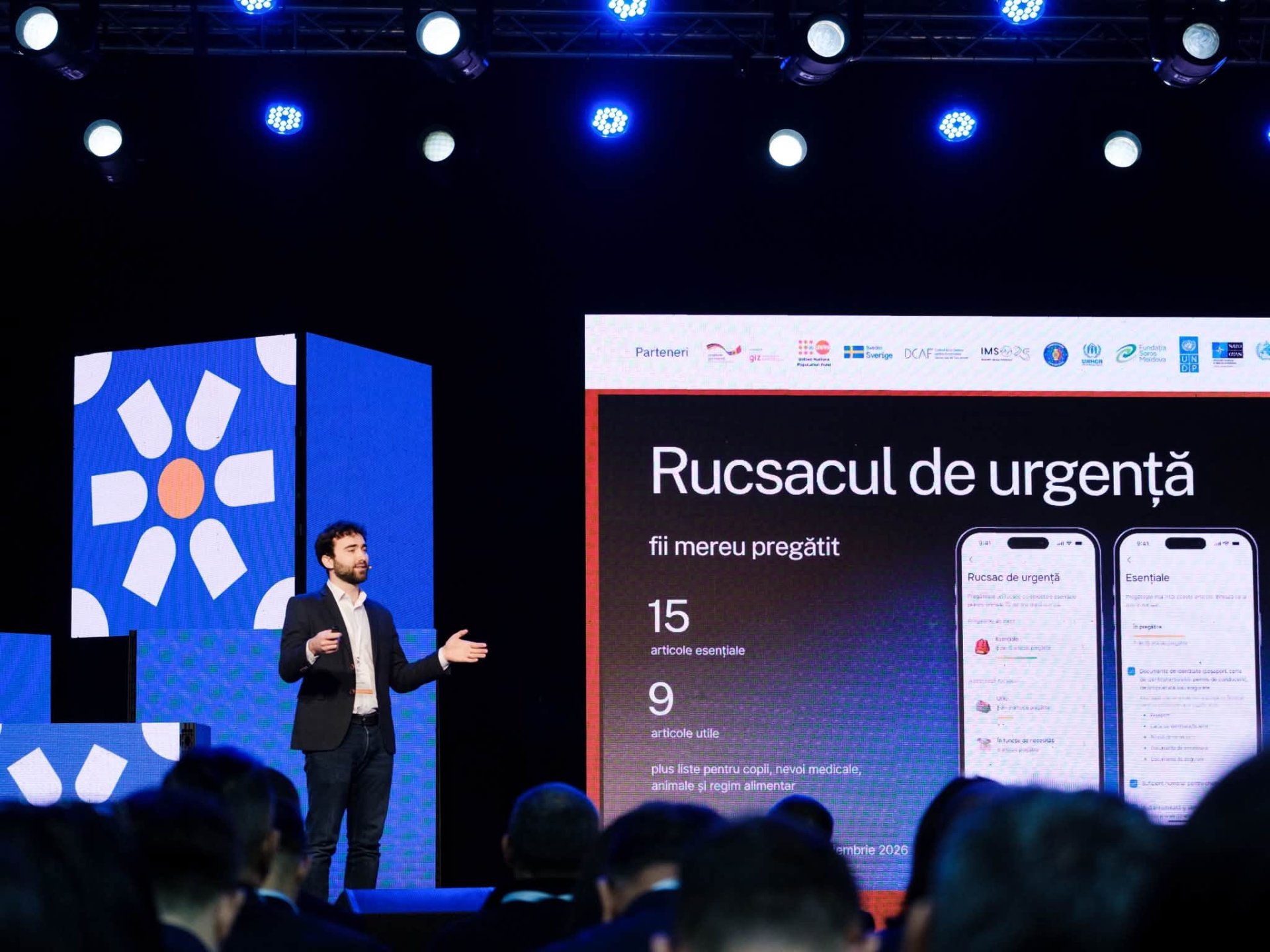
The list of recommended items is also integrated into the EVO app, in the new “Alerts” module. According to Valeriu Poia, head of the Digital Products and Experiences Directorate within the Electronic Governance Agency, users will have access to an interactive list of 15 essential items and nine useful items.

It also includes lists adapted for families with young children, people with special medical needs and those who have pets.


“What is important is that in EVO this becomes an interactive list. You tick items off and track your progress, knowing exactly how many things you still need to collect to have the backpack ready,” Valeriu Poia explained.


He urged citizens to begin preparing in advance, noting that he himself had not yet completed his backpack but had started gathering the necessary items.


“To be honest, I have not prepared the backpack yet, but I have started gathering the essential items in one place. That will probably be the next thing I do,” the representative of the Electronic Governance Agency said.


Preparing an emergency backpack is one of the three tools of Moldova Prepared campaign, launched during the first National Resilience Congress. The initiative also includes the Resilience Guide for families, communities and citizens, as well as the “Alerts” module in the EVO app, through which authorities will be able to send notifications directly to people’s phones.
 Facebook
 Instagram
 X/Twitter
 Telegram
International Students' Day: over 63,000 young people celebrate event in Moldova
PHOTO // Moldova’s public health system receives equipment worth over 500,000 dollars for emergency response, infections' detection
Breaking news
President of Moldova’s National Confederation of Trade Unions detained in corruption case; allegedly received 2,000 dollars
PHOTO // Eight border crossing points of Moldova endowed with modern equipment for verification of documents, biometric data
Moldova's passport ranks 74th worldwide, with access to 107 destinations
Republic of Moldova participated in dismantling three international malware networks
All public digital services restored on EVO portal
Ukrainian refugee children supported in learning Romanian and integrating into schools in Moldova
Foreigners in Moldova to be able to access information about residence, employment and public services on digital platform
Moldovan Civil Aviation Authority explains presence of aircrafts in Chisinau's airspace: “There are three SR-20 aircrafts that flew from Czech Republic”
False fire alarm at Chisinau Airport; operations proceed as normal at airport
VIDEO // More than 2,000 people take part in reforestation campaign in central Moldova settlement
PHOTO GALLERY // Forest Generation campaign in Poganesti: more than 3,000 hectares to be afforested in Moldova this autumn
Moldova, Czech Republic strengthen cooperation in social assistance; RESTART reform supported through new partnership
Registration for the Wine of Moldova 2026 National Competition open; wineries can register till November 25
Speaker supports collaboration with Romania to protect Moldova’s airspace, proposed by Renato Usatîi
Government Secretary-General: Community resilience can be strengthened by supporting vulnerable people and frontline workers
PHOTO // Authorities recommend preparing emergency backpack for first 72 hours of crisis
Speaker about Moldova Prepared campaign: Every citizen must know how to prepare for crisis situation and how to protect family
EVO App to add Alerts and Notifications Module: emergency information to reach around 200,000 users
DOC // Moldova Prepared: Resilience Guide with 477 recommendations for 48 crisis situations launched in Moldova
 National Bank of Moldova

New measures to protect aquatic biodiversity: mandatory permit for introducing exotic fish species into fish farms
European support in disasters: draft law on Moldova’s participation in EU Civil Protection Mechanism passed in first reading
Passed by Parliament: Bălți mayor to be assisted by own cabinet
Parliament denounced two CIS Agreements that had not been implemented
Prime Minister attends launch of Prepared Moldova campaign

Prime Minister attends launch of Prepared Moldova campaign
Legislation on producer organizations in agri-food sector aligned with EU standards
EVO App to add Alerts and Notifications Module: emergency information to reach around 200,000 users
Legislative measures to streamline cooperation mechanism with EU member states in recovery of claims process adopted by Parliament
DOC // Moldova Prepared: Resilience Guide with 477 recommendations for 48 crisis situations launched in Moldova
Republic of Moldova launches first-ever campaign to prepare population for crisis situations
0.5% tax on construction investments to be eliminated
Recipe for friendship and solidarity: Ukrainian refugees learn to make pizza alongside renowned Italian chef
PAS nearly decided on candidate for Chisinau city hall, but official announcement scheduled for November 29, says Igor Grosu
MOLDOVA PREPARED // Launch of national campaign to prepare population for crisis situations
President to attend Coalition of Willing meeting in Berlin
Moldovan parliament speaker says under what conditions Gagauzia’s new governor could join government
Moldovan parliament speaker comments on Tiraspol leader's return to Transnistrian region, travel restrictions
PHOTO GALLERY // Italian Cuisine Week in the World; Ukrainian refugee children cook pizza alongside renowned chef Luca Pappagallo
University professors of Moldova receive English language training to teach foreign students
Better conditions for social services' beneficiaries in two north Moldova settlements: institutions made more energy efficient with EU's support
Receive the latest news directly to your email

Receive the latest news directly to your email