
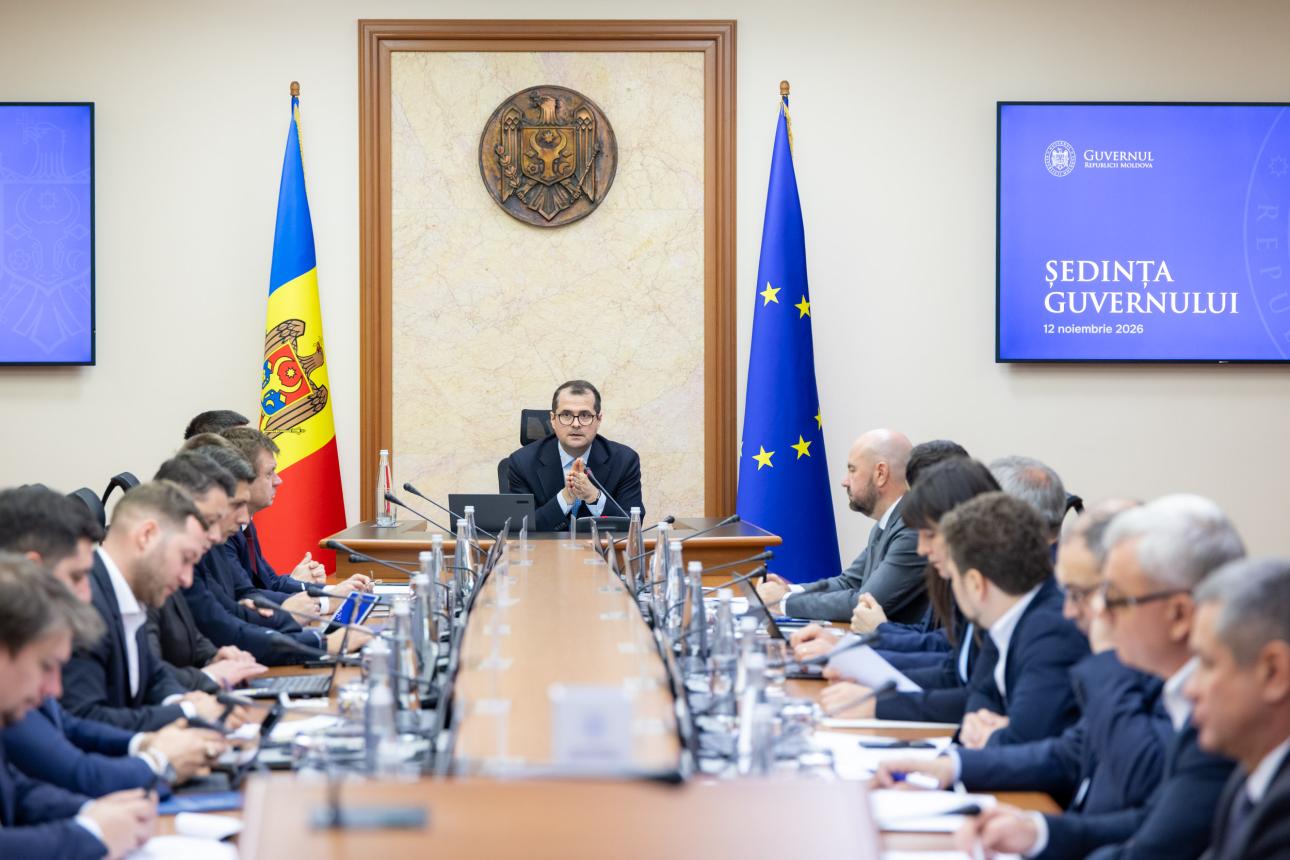
Government approves public sector pay reform: higher and fairer salaries for 172,000 employees
The Government has approved the draft law on reforming the unified public sector pay system. The new law aims to eliminate pay inequalities, increase base salaries, and remunerate employees according to the complexity and responsibility of their positions. The reform will cover approximately 172,000 public sector employees, whose salaries are expected to increase by an average of 15.7%.

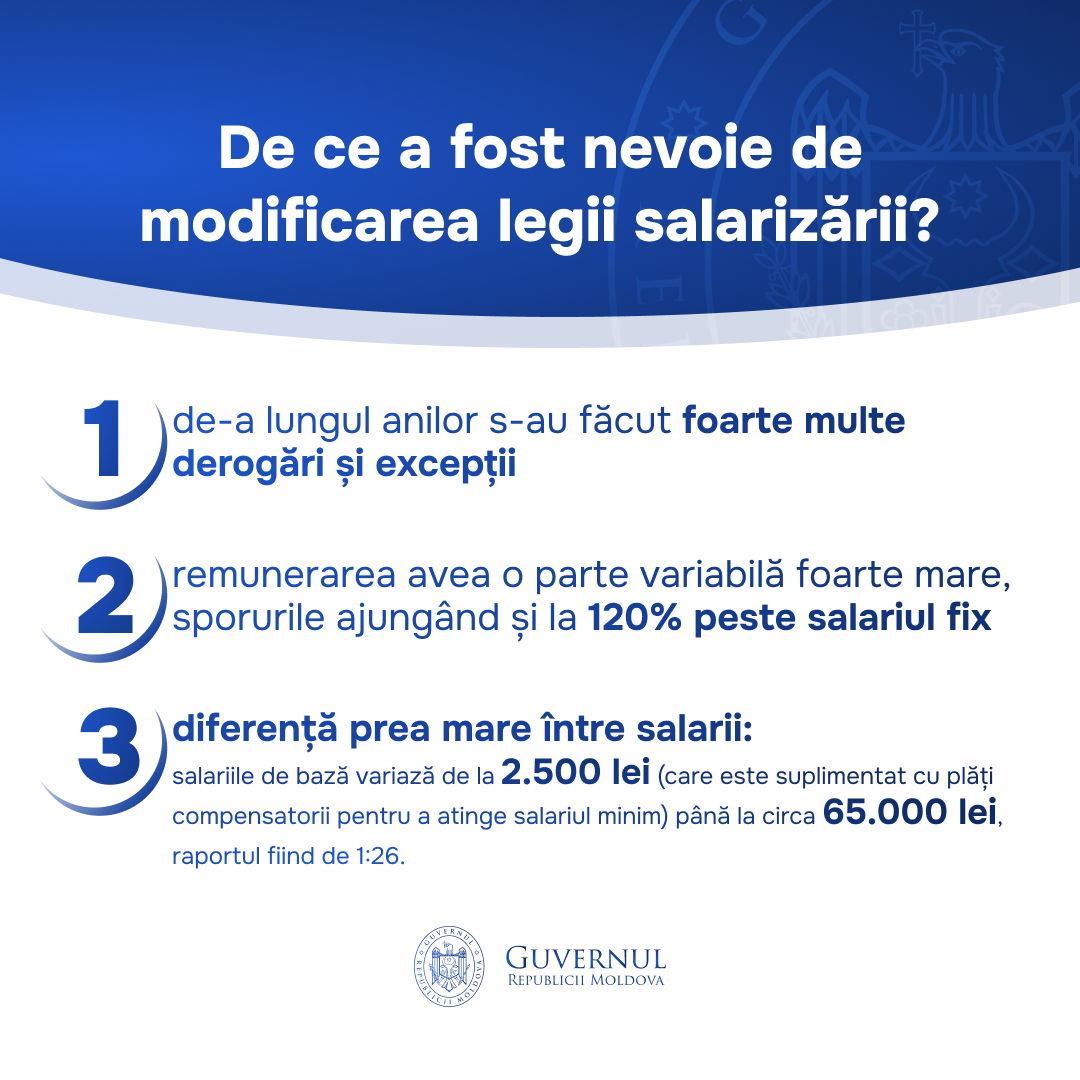
The reform is necessary because, over the years, the pay system has accumulated numerous derogations and exceptions that have created significant differences between employees’ incomes. Currently, base salaries range from 2,500 lei, supplemented by compensatory payments up to the minimum wage, to approximately 65,000 lei. In some cases, allowances account for up to 120% of the fixed salary.

The new law will create a fairer and more transparent pay system in which the base salary will carry greater weight, while the ratio between the lowest and highest base salary will be 1:10.5. The new pay scale will take into account the complexity of duties, level of responsibility, qualifications, and length of service. Derogations and exceptions will also be reduced, as will the number of reference values used to calculate salaries—from 10 currently to no more than 6 in 2027 and 4 by 2032.

The largest additional financial allocations are planned for education and technical and auxiliary staff. In education, approximately 60,000 employees will benefit from an average salary increase of 14.4%, requiring estimated additional allocations of 1 billion lei. For approximately 50,000 employees in the technical sector and the worker category, the average increase will be 19.3%, with an estimated allocation of 845 million lei.

Increases are also planned for approximately 20,000 public administration employees, with an average increase of 15.3%, as well as for approximately 17,000 employees in public order institutions, with an average increase of 15%. In healthcare and social assistance, the estimated average increase is 14.9%, while in culture and sports it is 14.1%. Salaries will also increase, on average, by 20.6% in the national defense sector and by 14.1% in the judiciary.

The reform will bring concrete salary increases for several professional categories. Here are some examples of average salary increases:

General education teacher, second degree: from 13,030 to 14,828 lei (+13.8%);

Military unit soldier: from 10,566 to 13,104 lei (+24%);

Social worker with higher education: from 9,798 to 11,844 lei (+20.9%);

University professor at public institutions: from 19,816 to 23,919 lei (+20.7%);

Teacher assistant: from 6,811 to 9,140 lei (+34%);

Support teaching staff member: from 11,341 to 13,742 lei (+21%);

Community police officer: from 13,024 to 15,675 lei (+20%);

Investigation officer: from 13,246 to 17,421 lei (+31%);

Medical assistant: from 10,300 to 12,800 lei (+24.3%);

Social care worker: from 6,780 to 8,178 lei (+21%);

Cook: from 6,459 to 9,039 lei (+40%);

Driver: from 7,395 to 9,419 lei (+27%).

The new law also provides for increases in certain allowances. For eligible research and higher education staff, the allowance for holding the scientific title of habilitated doctor or the scientific-didactic title of university professor will increase from 1,100 to 2,500 lei, while the allowance for holding a doctoral degree or the title of associate professor will increase from 600 to 1,500 lei. For teaching staff in general and vocational technical education, as well as for employees in other fields who hold scientific titles corresponding to the duties of their positions, the allowances will amount to 50% of the respective amounts.

Starting in 2028, allowances for teaching grades will also be increased: from 4,000 to 4,600 lei for the highest grade, from 2,800 to 3,100 lei for the first grade, and from 1,500 to 1,800 lei for the second grade. A new allowance for qualification grades in social assistance will also be introduced, ranging from 750 to 2,000 lei.

Another component of the reform concerns rewarding professional performance. Performance bonuses will be granted based on the results of individual evaluations, amounting to 10–15% of the base salary for an “excellent” rating and 5–7% for a “very good” rating. Specific rules will apply to education and research staff.

Also starting in 2028, a competitiveness coefficient ranging from 1.1 to 1.3 may temporarily be applied when calculating the base salary for hard-to-fill positions. The mechanism aims to attract and retain specialists in fields where public institutions face recruitment difficulties.

The draft law also includes transitional income protection mechanisms for employees in situations where the application of the new pay scale would result in a reduction in their income.

The law is expected to enter into force on the date of its publication in the Official Journal, while the new provisions will be applied mainly starting on January 1, 2027. Some measures are scheduled for 2028, following the adoption of the draft law by Parliament.

The financial impact of the reform is estimated at 3.2 billion lei in 2027.
 Facebook
 Instagram
 X/Twitter
 Telegram
President's message at annual conference on European Union enlargement – 2026 Enlargement Package
Parliament hosts visit by delegation from Seimas of the Republic of Lithuania
President: Energy independence means being able to decide for ourselves where we buy energy
President's message at launch event of Vulcănești–Chișinău power line project
Deputy Prime Minister for Reintegration meets with Ambassadors of Ireland, Italy, United Kingdom, Romania, United States and Netherlands accredited to OSCE
Moldova through eyes of Independence generation: painting, sculpture exhibition at parliament
Moldova's parliamentary factions consulted on legislative package for local public administration's reform
Moldova’s progress in EU accession process examined at meeting of Council of Experts under commission for European integration
National Security Council approves measures to strengthen cybersecurity of Moldova
Press statements made following meeting of Moldova's National Security Council
Additional funding for development of solid waste management infrastructure in several regions of country
Meeting of Moldova's National Security Council convened for November 6, at 10:00
Human rights, bringing two banks of Dniester closer together discussed at German Bundestag
Moldovan deputy PM for reintegration discusses developments in Transnistrian settlement process in Berlin
VIDEO // Prime Minister about public-sector pay reform: New law will bring higher salaries and more order to sector
Moldova's Foreign Minister meets with Lithuanian parliamentary delegation
VIDEO // Voluntarily amalgamated city halls to be able to access 3.4 billion lei for infrastructure projects in 2027–2028
Ministry of Education and Research to have new state secretary
Austrian writer in Chisinau: meeting on literature’s power to explore reality
VIDEO // Moldovan president in Dublin says years legally worked in Ireland to be taken into account when calculating pensions
Moldovan PM, at COP31, says Moldova aims to reduce greenhouse gas emissions by 75 per cent by 2035
 National Bank of Moldova

Government updates Register of state-protected monuments to better safeguard heritage
14 students and pupils with outstanding academic results proposed for President’s Scholarship
Social security agreement between Moldova and Ireland signed in Dublin, in presence of Moldovan president
Moldovan PM's speech at UN Conference on Climate Change (COP31)
Moldovan PM participates in UN Climate Change Conference

Moldovan PM, at COP31, says Moldova aims to reduce greenhouse gas emissions by 75 per cent by 2035
Moldovan PM's speech at UN Conference on Climate Change (COP31)
Moldovan PM participates in UN Climate Change Conference
District hospitals from three cities of Moldova receive modern ultrasound diagnostic systems
Moldovan PM, president of European Bank for Reconstruction and Development discuss cooperation between Moldova and top bank
Moldovan parliament's library hall to be named after Vasile Stroescu
PHOTO // Moldovan PM attends UN Climate Change Conference COP31 in Turkey
Moldovan PM has meeting with Vice President of Turkey
ARMENPRESS: Armenia and Finland discuss trade and economic cooperation
Foreign Ministry condemns violation of national airspace by two cruise missiles
Defense Ministry warns of intensifying disinformation regarding draft special legal regimes: Initiative does not provide for forced return of diaspora
PHOTO GALLERY // Shakespeare in new production at Satiricus Theater
Moldova and Kazakhstan seek to strengthen economic cooperation, especially in energy sector
Employee of Embassy of the Republic of Moldova in Moscow to be expelled by Russian authorities
President to attend European Political Community Summit in Dublin
Ilan Shor sent to trial in case involving organization of illegal financing of ALDE with over $452,000
Receive the latest news directly to your email

Receive the latest news directly to your email