
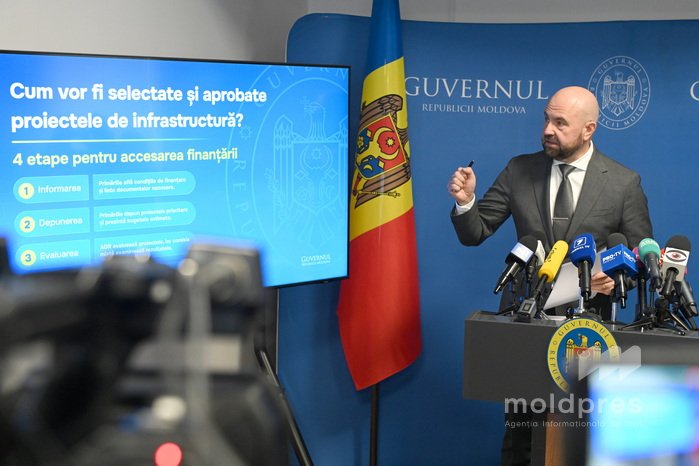
VIDEO // Voluntarily amalgamated city halls to be able to access 3.4 billion lei for infrastructure projects in 2027–2028
Voluntarily amalgamated city halls will benefit in 2027–2028 from 3.48 billion lei for investments in local infrastructure, such as water and sewage networks, roads, public lighting, schools and kindergartens. The funds will be allocated in two equal installments, 50% for each year, and the projects may be implemented either directly by the city halls or with the support of the Regional Development Agencies (RDAs), Deputy Prime Minister, Minister of Infrastructure and Regional Development Vladimir Bolea announced today.


According to the minister, the amalgamation fund represents a continuation of government programs supporting the development of localities and aims to strengthen the administrative capacities of municipalities that have undergone the voluntary amalgamation process.


“The total amount of this amalgamation fund is approximately 3.49 billion lei, which will go toward various projects such as local roads, water pipelines, public lighting, the repair and construction of schools and kindergartens, the development of public spaces and communal infrastructure,” Vladimir Bolea said.


The official specified that the program would have two implementation methods, depending on the administrative capacity of the city halls. In the first case, local public authorities will organize the tenders and monitor the execution of the projects. In the second case, these responsibilities will fall to the Regional Development Agencies, which will work together with the city halls.


“Not all city halls in the Republic of Moldova, especially the newly amalgamated and newly established ones, have the capacity to manage a project from start to finish. We are offering the option whereby the city hall implements the project independently, as well as a second option, whereby the Ministry of Infrastructure’s regional development agency implements it together with the city halls,” the deputy prime minister explained.


When the project is managed by the city hall, it will organize the tender and oversee the works. If implementation is handled by an RDA, the agency will conduct the procurement procedures and monitor the execution of the project. The Ministry of Infrastructure will establish a committee to oversee implementation in both cases and authorize payments.

Vladimir Bolea explained that this approach is necessary to account for differences in capacity among local administrations. He gave the example of the city of Ungheni, which is already managing a project portfolio worth approximately 200 million lei through the Ministry of Infrastructure’s programs, while a newly formed municipality bringing together five or six localities could face difficulties in independently managing investments.


“In this context, it is extremely important that implementation be successful. In other words, people must feel the positive results of using these financial resources,” the minister emphasized.


According to the allocation presented by Vladimir Bolea, the Northern Development Region will receive approximately 1.268 billion lei for 62 clusters and 223 city halls. The Central Region will benefit from 1.486 billion lei for 60 clusters and 208 city halls. The Chișinău Region is set to receive 116 million lei for three clusters and ten city halls, while the Southern Region will be allocated 613 million lei for 36 clusters and 115 city halls.

The minister specified that the total amount of 3.4 billion lei would be distributed over two years in equal parts: 50% in 2027 and 50% in 2028. Thus, citty halls will be able to plan and implement projects within a multi-year program.


“Everything is very familiar to mayors, and this is extremely beneficial for city halls and mayors. [...] We are not changing the way we work,” Bolea said, referring to the experience accumulated through previous investment programs.


After the government decision is approved, which is expected in December 2026, the Regional Development Agencies will organize meetings with city halls to establish priorities, examine documentation and assess the level of project readiness. Starting on January 1, 2027, city halls will be able to submit applications to the RDAs, and their review will take approximately one and a half months.

The money may be used exclusively for investments and may not be directed toward the payment of salary debts, loan repayments or other expenses unrelated to investment projects.


“All of this money is going toward investment programs that must improve people’s lives,” the minister said.


Vladimir Bolea mentioned that priorities would include the continuation of projects already underway, especially those involving water supply, sewage and educational infrastructure. He emphasized that ongoing projects must be completed before localities move on to the next stages of investment.


“If a water supply project has been started in a locality, we must continue that water supply project. To move on to the next stage, you must complete the first project. If a sewage project has been started, obviously it must be completed before moving on to the next stage,” the minister said.


During the conference, responding to a question about the size of the fund and the amounts allocated for each stage, Bolea said that the total amount was 3 billion 484 million 300 thousand 506 lei and that it would be divided between 2027 and 2028.


“The amalgamation fund amounts to 3.4 billion, which is divided over two years. In 2027, there is 1 billion 750 million. In the second year, 2028, there is another 1 billion 750 million,” the minister said.


He rejected claims that the Government was reducing investments intended for citizens and said that the authorities were seeking to reduce administrative expenses.


“The Government of the Republic of Moldova is not reducing investments that benefit people. The Government of the Republic of Moldova is reducing expenses, travel costs and many other activities that are subject to control and verification. The expenses made by the Government of the Republic of Moldova for regional and local development remain a priority,” Vladimir Bolea said.


The minister noted that the amalgamation fund is part of a series of investment programs launched beginning in 2022, including “Europe Is Close.” According to him, this program includes approximately 579 projects with a total value of more than 2.69 billion lei, targeting roads, sidewalks, bridges, culverts and other elements of local infrastructure.


“The purpose of the actions undertaken by the Government of the Republic of Moldova since 2022 is [...] to develop the Republic of Moldova, strong municipalities full of people, beautiful localities that make us proud to be citizens of that locality or city, and to develop them—this is a phrase I have already repeated many times—to create beautiful localities where people want to live and from which they do not want to leave,” Vladimir Bolea concluded.


The reform of local public administration was launched by the Government at the beginning of 2026 and aims to strengthen the administrative capacity of city halls and improve public services.
 Facebook
 Instagram
 X/Twitter
 Telegram
Fresh Moldovan sweet cherries can be exported to China now: protocol on phytosanitary requirements signed
Expansion of cooperation and new joint projects discussed at meeting of Moldovan-Chinese intergovernmental commission on trade and economic cooperation
Estonia granted Moldova 50 additional permits for occasional international passenger transport
Further drop in fuel prices
PHOTO // Chinese experts assess phytosanitary conditions for importing grape seeds from Moldova
Strengthening cooperation between central banks of Moldova and Bulgaria discussed by Anca Dragu and Dimitar Radev in Sofia
Moldova to participate in China International Import Expo for the first time
Business associations of Moldova can benefit from grants for exports' promotion: new funding call under BRIDGE Export Programme
Wine of Moldova to be promoted in South Korea, China, Japan in November
Moldova gets 50 additional permits for passenger road transport in Estonia
Energy efficiency in figures: 50,000 ecovouchers issued and home renovation projects
Russian gas and promises of low prices: What Energy Minister says
Vulcănești–Chișinău power line could become operational next week
Customs Service collected over 905 million lei last week
Moldova's Foreign Minister meets with Lithuanian parliamentary delegation
VIDEO // Voluntarily amalgamated city halls to be able to access 3.4 billion lei for infrastructure projects in 2027–2028
Ministry of Education and Research to have new state secretary
Austrian writer in Chisinau: meeting on literature’s power to explore reality
VIDEO // Moldovan president in Dublin says years legally worked in Ireland to be taken into account when calculating pensions
Moldovan PM, at COP31, says Moldova aims to reduce greenhouse gas emissions by 75 per cent by 2035
Moldovan PM participates in UN Climate Change Conference
 National Bank of Moldova

Government approves public sector pay reform: higher and fairer salaries for 172,000 employees
Social security agreement between Moldova and Ireland signed in Dublin, in presence of Moldovan president
Moldovan PM's speech at UN Conference on Climate Change (COP31)
Moldovan PM participates in UN Climate Change Conference
Moldovan PM, president of European Bank for Reconstruction and Development discuss cooperation between Moldova and top bank

District hospitals from three cities of Moldova receive modern ultrasound diagnostic systems
Moldovan PM, president of European Bank for Reconstruction and Development discuss cooperation between Moldova and top bank
Moldovan parliament's library hall to be named after Vasile Stroescu
PHOTO // Moldovan PM attends UN Climate Change Conference COP31 in Turkey
Moldovan PM has meeting with Vice President of Turkey
ARMENPRESS: Armenia and Finland discuss trade and economic cooperation
Foreign Ministry condemns violation of national airspace by two cruise missiles
Defense Ministry warns of intensifying disinformation regarding draft special legal regimes: Initiative does not provide for forced return of diaspora
PHOTO GALLERY // Shakespeare in new production at Satiricus Theater
Moldova and Kazakhstan seek to strengthen economic cooperation, especially in energy sector
Employee of Embassy of the Republic of Moldova in Moscow to be expelled by Russian authorities
President to attend European Political Community Summit in Dublin
Ilan Shor sent to trial in case involving organization of illegal financing of ALDE with over $452,000
PHOTO // NATO provided IGSU with specialized equipment worth more than 750,000 euros
PHOTO GALLERY // Moments captured on second day of EU Enlargement Conference
Two cruise missiles entered airspace of the Republic of Moldova
Receive the latest news directly to your email

Receive the latest news directly to your email