
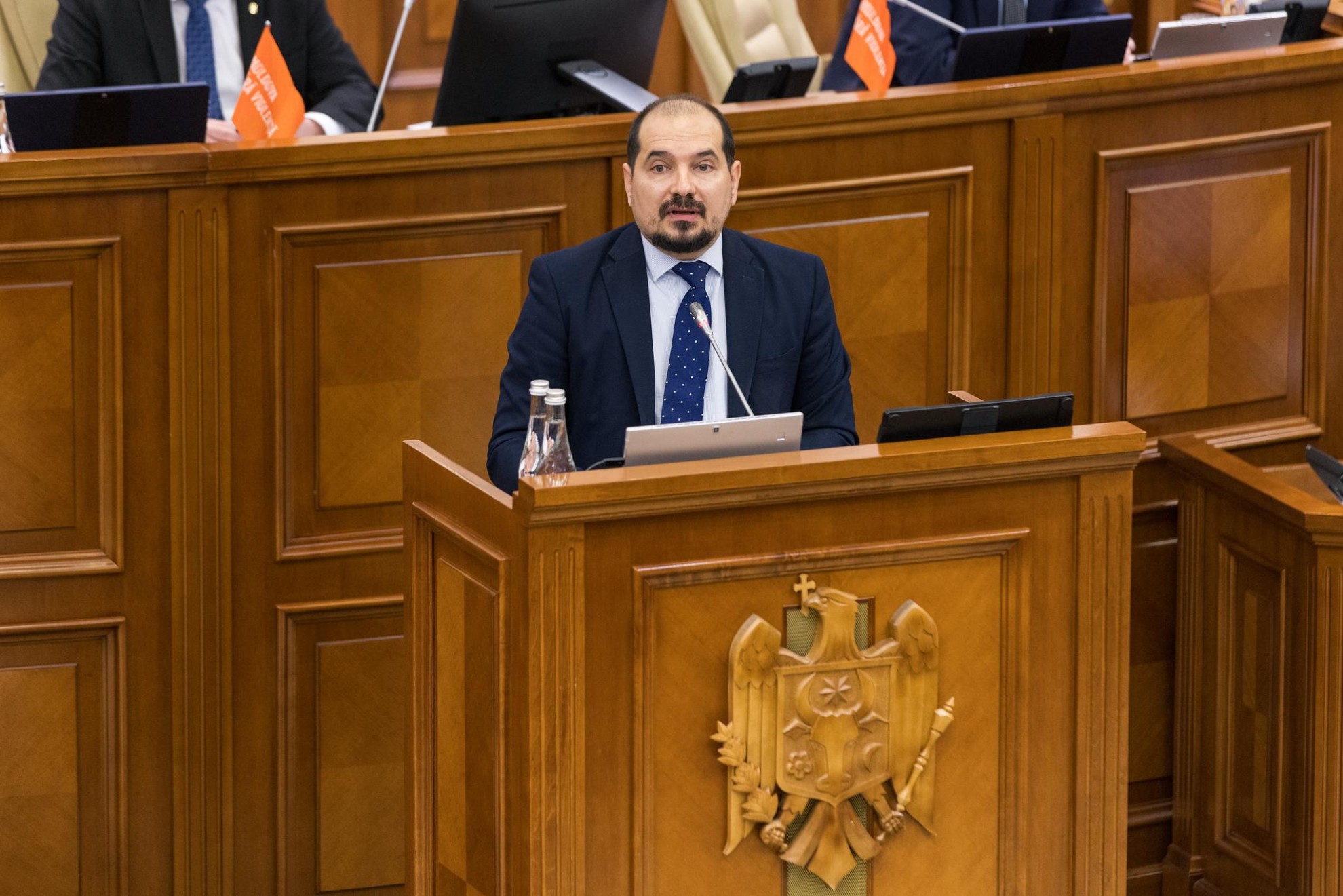
Moldovan parliament votes on administrative-territorial reform in first reading
Chisinau, November 27, 2026 – The parliament has approved, in the first reading, two draft laws laying the foundations for the administrative and territorial reform of Moldova. The new structure provides for reducing the number of city halls to 275 and reorganizing the 32 districts into three administrative regions: North, Central and South. The reform aims to strengthen local public administration, attract investments, support local development projects and improve the services provided to citizens.
The first draft establishes the new administrative and territorial organization of Moldova and seeks to ensure that each administrative unit has sufficient financial, demographic and administrative resources to effectively exercise its local autonomy.
At the first level, the reorganization will be carried out through the voluntary and mandatory amalgamation of localities, with a minimum threshold of 3,000 inhabitants established for the creation of an administrative and territorial unit. The authors of the draft say that it will strengthen the institutional and financial capacity of the mayoralties, enabling them to manage public services more efficiently and respond to community needs. Following the reform, Moldova will have 275 mayoralties.
At the second level, the 32 districts will be reorganized into three administrative regions, with larger territories and increased capacity to coordinate regional development projects.
The North Region will bring together the territories of 11 districts: Briceni, Donduseni, Drochia, Edinet, Falesti, Floresti, Glodeni, Ocnita, Rascani, Sangerei and Soroca. It will have a population of 514,105 inhabitants, and the headquarters of the regional authorities will be located in the municipality of Balti.
The Central Region will include 13 districts: Anenii Noi, Calarasi, Criuleni, Dubasari, Hancesti, Ialoveni, Nisporeni, Orhei, Rezina, Soldanesti, Straseni, Telenesti and Ungheni. The region will have a population of 670,088 inhabitants, and the headquarters of the regional authorities is planned to be located in the Chisinau municipality.
The South Region will comprise seven districts: Basarabeasca, Cahul, Cantemir, Causeni, Cimislia, Leova and Stefan Voda, with a total population of 280,237 inhabitants and the headquarters of the regional authorities located in the Cahul municipality.
The Taraclia district will be reorganized as the municipality of Taraclia, with the status of a second-level administrative and territorial unit. The municipalities of Chisinau and Balti will keep their current status, while the Autonomous Territorial Unit of Gagauzia will retain its special legal status. None of these four units will be included in the three administrative regions.
The second draft, approved by the parliament in the first reading, regulates the work of local public authorities following the reorganization. The document establishes the competences of local and regional administrations, their areas of activity, as well as cooperation mechanisms.
Thus, mayoralties will manage local services, such as water supply and sewage, waste collection, maintenance of local roads, street lighting and local public transport. The regions, on the other hand, will play a more prominent role in regional development, attracting investments and European funds, implementing joint projects and supporting mayoralties in carrying out development projects.
According to the drafts, the administrative and territorial reorganization will not require citizens to change their identity documents, civil status documents, licenses, certificates or property titles.
Information regarding domicile and temporary residence will be updated automatically in state registers. At the same time, the network of Unified Public Service Centers (CUPS) will be expanded and adapted, so that residents of the reorganized localities can continue to access public services.
The two bills were drafted by the State Chancellery and are to be examined by the parliament in the second reading. The new provisions will enter into force on the date of the first round of the 2027 general local elections. During the transition period, the government and local authorities will prepare the transfer and inventory of assets, the integration of databases and registers, as well as the reorganization of teams, so that public services can be provided without interruption.
Citizens can view the new administrative and territorial map by accessing the platform: www.primariiputernice.gov.md.
Communication and Public Relations Directorate of Moldova’s Parliament

 Facebook
 Instagram
 X/Twitter
 Telegram
Moldovan parliament to examine state social insurances budget draft for 2027 in first reading
Less bureaucracy, lower administrative costs for businesses in Moldova: parliament to examine new de-bureaucratization package
More support for pupils with special educational needs: Moldovan government changes way inclusive education is financed
Efficient resources' management for roads' maintenance, preparations for winter season in Moldova discussed at Road Fund Council's meeting
Families receiving energy compensation to be protected from disconnection during cold season
Legal framework for national spatial data infrastructure to be harmonized with European legislation requirements
EBRD investments to modernize irrigation systems in Moldova
Clearer rules for practising as psychologist
Local Public Administration Reform: 275 city halls, three regions and services closer to citizens
Fines for illegal parking in public parking lots
Dormitories, workshops and laboratories of vocational education institutions to be modernized with support from Council of Europe Development Bank
Government updates traffic rules to enhance road safety
Enhanced protection for domestic violence victims and harsher penalties for perpetrators
Speaker: Albania’s experience in developing sports infrastructure important for Moldova
Two airspace violations recorded in Moldova during one week
VIDEO // Moldovan PM: “Our mission is to help people. Fake news does not heat any home and does not reduce any invoice”
Moldovan parliament approves local public administration reform in first reading: 275 mayoralties, reorganization of districts into three regions
PHOTO GALLERY // Sculpture by Constantin Brancusi presented in Moldova for the first time
Moldova's National Army to be equipped with state-of-the-art integrated air surveillance, air defense system; project financially supported by Germany
PHOTO // Customs Service of Moldova, UN Women promote gender equality in public institutions
Legislative package for local public administration reform presented in Parliament
 National Bank of Moldova

Moldovan parliament approves new measures to streamline justice system, ensure continuity of external evaluation
Summary of Parliament Plenary Session held on 26 November 2026
Draft state social insurance budget law for next year passed in first reading
Passed in first reading: Increased funding in 2027 for medical services, compensated medicines and hospital modernization
Moldovan parliament approves draft state budget for 2027 in first reading; supporting population, economic recovery, investments in infrastructure among priorities

Legislative package for local public administration reform presented in Parliament
Prime Minister intends to serve term until 2029
Summary of Parliament Plenary Session held on 26 November 2026
Republic of Moldova could produce interceptor drones
Draft state social insurance budget law for next year passed in first reading
Passed in first reading: Increased funding in 2027 for medical services, compensated medicines and hospital modernization
Prime Minister explains how budget deficit to be covered: Moldova relies on European support and external grants
Moldova prepares law to protect citizens from deepfakes, identity theft
Moldovan PM says Kremlin has well-laid plans for Moldova
Moldovan energy minister says Vulcanesti–Chisinau line prevents nationwide blackout in Moldova, after Russian attacks on Ukraine’s energy infrastructure
PHOTO GALLERY // From Alexander the Great’s gold to electronic cards: story of money captured at National History Museum of Moldova
More than 300 coins displayed at National History Museum of Moldova; two ancient hoards presented for the first time
Moldovan parliament approves draft state budget for 2027 in first reading; supporting population, economic recovery, investments in infrastructure among priorities
Moldova's draft state budget for 2027 unveiled in parliament
Irrigation infrastructure of Moldova to be rehabilitated with financial support of European Bank for Reconstruction and Development
Moldovan energy minister says natural gas from Neptun Deep project to be able to cover about one quarter of Moldova’s daily consumption
Receive the latest news directly to your email

Receive the latest news directly to your email