
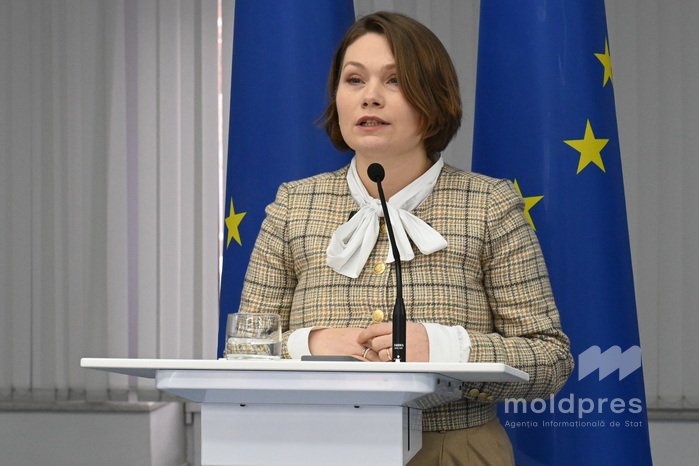
Moldova prepares law to protect citizens from deepfakes, identity theft
Moldova is preparing a legislative framework to regulate artificial intelligence, which will establish rules for the development and use of these technologies, particularly in areas affecting citizens’ rights and safety.

European provisions will be transposed gradually, allowing authorities and companies to prepare for the implementation of the new requirements. Michelle Iliev, State Secretary at the Ministry of Economic Development and Digitalization, has made statements to this effect at the In Context programme on Moldova 1 Tv channel.

The official said that regulation was necessary, given that artificial intelligence can be used for cyberattacks, data and identity theft or the creation of deepfake materials that can affect a person’s image and identity.

“At present, the field of artificial intelligence is in a jungle, with complete independence. When cyberattacks created with the help of artificial intelligence occur and pose risks to citizens through data theft, identity theft or deepfakes that greatly distort a person’s identity, naturally there must also be sanctions for this. And you cannot impose sanctions on something that is not regulated on paper,” Michelle Iliev said.

The state secretary noted that Moldova would not adopt the entire European Artificial Intelligence Act in a single stage, but would implement its provisions gradually. During the first stage, the authorities will identify the institution responsible for overseeing the field and create a register of artificial intelligence products developed locally, particularly by IT companies, including the ones meant for export or the business environment.

“For the first stage, we have identified and will put into operation, first of all, the authority that will regulate the field—who will monitor what happens in our space and who develops products locally, especially IT companies. At the same time, a register will be created in which products intended largely for export or business, and which are to be sold, will have to be entered in a special register, in order to keep track of them,” Michelle Iliev noted.

Another important aspect concerns the testing of systems before they are launched on the market, especially when they may affect sensitive areas, such as education. According to the official, artificial intelligence solutions must be evaluated in special environments, in order to identify potential risks and their effects on users.

“Because of the significant risks and unpredictability they may involve, artificial intelligence solutions need special environments. For example, if we are talking about education, you cannot develop a solution and suddenly put it on the market, because it will affect children, while we do not know what the final impact will be. Therefore, you must first isolate it, test it, and only then release it into the wider world,” the state secretary said.

Michelle Iliev emphasized that, regardless of the technology’s capabilities, the final decision must remain with humans, and users must be informed when interacting with artificial intelligence systems.

During the same programme, the official also discussed the digital wallet, a project meant to change the way citizens interact with state institutions and provide better protection for personal data. According to her, the digital wallet will allow documents to be stored electronically, in accordance with European Union standards and with an enhanced level of security.

At the European Union level, artificial intelligence is regulated by the Artificial Intelligence Act (AI Act), the world’s first comprehensive legislative framework dedicated to this field.

The regulation establishes obligations based on the risks posed by technologies, bans utilizations considered unacceptable, such as manipulating human behavior and certain forms of biometric surveillance, and imposes strict requirements on high-risk systems, including the ones used in education, healthcare and recruitment.

It also establishes transparency rules, so that people know when they are interacting with artificial intelligence and can identify images, audio recordings or videos that have been artificially generated or modified.
 Facebook
 Instagram
 X/Twitter
 Telegram
Pensions, other social benefits for Moldovans living in Croatia; two states conclude negotiations on signing bilateral agreement
Defense Ministry: 17 aerial incidents recorded in Moldova in November
Another drone flies unauthorized over airspace of Moldova
Moldovan Education Ministry proposes actions to improve pupils’ skills in reading, mathematics, science
Moldova and NATO sign arrangement on protection of classified information
Drone unauthorizedly flew through airspace of the Republic of Moldova
Water level in Dniester River stays low: Moldovan environment minister makes call
Moldovan parliament votes to authorize Customs Service to conduct forensic examinations recognized as evidence in court
Yellow, orange wind warnings issued in Moldova; gusts to reach up to 23 m/s
PHOTO GALLERY // New conditions for patients, medical staff of Mother and Child Institute of Moldova; three sections inaugurated, following repair, modernized
Why aren’t drones violating Moldova’s airspace shot down? Explanations by Defence Ministry's representative
Government Secretary-General: Community resilience can be strengthened by supporting vulnerable people and frontline workers
PHOTO // Authorities recommend preparing emergency backpack for first 72 hours of crisis
EVO App to add Alerts and Notifications Module: emergency information to reach around 200,000 users
Moldova prepares law to protect citizens from deepfakes, identity theft
Moldovan PM says Kremlin has well-laid plans for Moldova
Moldovan energy minister says Vulcanesti–Chisinau line prevents nationwide blackout in Moldova, after Russian attacks on Ukraine’s energy infrastructure
PHOTO GALLERY // From Alexander the Great’s gold to electronic cards: story of money captured at National History Museum of Moldova
More than 300 coins displayed at National History Museum of Moldova; two ancient hoards presented for the first time
Moldovan parliament approves draft state budget for 2027 in first reading; supporting population, economic recovery, investments in infrastructure among priorities
Moldova's draft state budget for 2027 unveiled in parliament
 National Bank of Moldova

Moldovan parliament approves draft state budget for 2027 in first reading; supporting population, economic recovery, investments in infrastructure among priorities
Irrigation infrastructure of Moldova to be rehabilitated with financial support of European Bank for Reconstruction and Development
Ratified by Moldova's parliament: irrigation infrastructure to be rehabilitated with top European bank's financial support
Less bureaucracy and lower administrative costs for businesses: Parliament votes in first reading on new deregulation package
Better conditions for students in vocational and technical education

Moldovan authorities investigate possible cases of illegal financing, voter bribery ahead of runoff election in Gagauzia
Ratified by Moldova's parliament: irrigation infrastructure to be rehabilitated with top European bank's financial support
PHOTO GALLERY // Over 60 companies participating in Expo Mobila 2026, opened at Moldexpo
Less bureaucracy and lower administrative costs for businesses: Parliament votes in first reading on new deregulation package
Speaker about Russian Embassy’s message on alleged anti-Russian provocation
Better conditions for students in vocational and technical education
16 Days of activism against gender-based violence campaign backed by Parliament
Introduction of digital identity wallets for citizens and businesses approved in first reading
Moldova and Romania advance energy interconnection expansion: construction of Suceava–Bălți line to be accelerated
Local Public Administration Reform in Moldova under review by Council of Europe’s Centre of Expertise
Old-calendar Orthodox Christians start Nativity Fast, which lasts 40 days
Chisinau denounces new “information diversions” by Moscow after Russian Embassy invoked alleged “anti-Russian provocation”
Council of Europe welcomes efforts to reform local public administration and praises amalgamation model chosen by the Republic of Moldova
More people should be deprived of citizenship of the Republic of Moldova because they do not respect and work against state, President says
Head of State about Prime Minister: I think he is doing well, despite all crises coming one after another
President rejects reports of possible federalization of country
Receive the latest news directly to your email

Receive the latest news directly to your email