
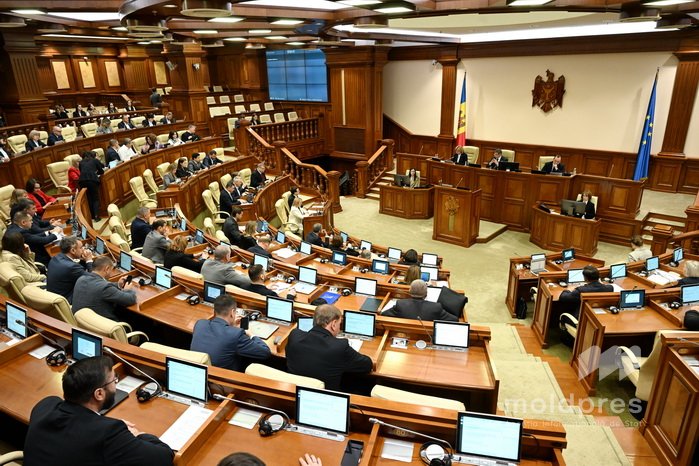
Moldovan parliament approves local public administration reform in first reading: 275 mayoralties, reorganization of districts into three regions
The number of mayoralties in Moldova will be reduced from 892 to 275, while the 32 districts will be reorganized into three regions: North, Center and South. This is provided for in the legislative package on local public administration reform, approved by the parliament in its first reading today, with the votes of 54 lawmakers, after approximately seven hours of debate.

The new administrative and territorial structure will be implemented together with the 2027 general local elections.

Government Secretary-General Alexei Buzu unveiled the legislative package in parliament’s plenum. The official stressed that the reform was necessary, given the current excessive fragmentation of mayoralties, which leads to administrative costs per capita that are several times higher for small mayoralties compared with large ones.

“We have this paradox in most mayoralties across the country. From the perspective of administrative costs, small mayoralties cost the most per capita and have the most staff per capita, but at the same time, they have the fewest resources for development, the fewest development opportunities and the fewest opportunities to employ specialized staff,” Alexei Buzu said.

Alexei Buzu also said that the main goal pursued by the government through local public administration reform was to create strong mayoralties with greater financial resources, well-trained specialists and greater capacity to provide public services and implement local development projects. According to Alexei Buzu, this is also important for the European integration process, as the country’s mayoralties must be consolidated and well-prepared to access the pre-accession funds that will be made available to Moldova.

“We have a responsibility to citizens, families, local elected officials and our colleagues in local public administration to give them strong mayoralties and not leave them prisoners of an outdated, weak and obsolete system. Every effort to reform, modernize and improve public and local administration must begin with this problem. If we do not solve the problem of hyper-fragmentation, nothing will succeed,” the government’s secretary-general said.

According to the draft law, the new administrative and territorial structure provides for reducing the number of mayoralties from 892 to 275, reorganizing the 32 districts into three regions—North, Center, and South, granting the municipality of Taraclia the status of a second-level administrative-territorial unit and establishing a minimum threshold of 3,000 residents for the creation of a first-level administrative and territorial unit.

“Following local public administration reform, Moldova will have 275 more consolidated, stronger mayoralties, better able to accelerate development, provide better services and deliver modern infrastructure to citizens,” Alexei Buzu said.

Following the reform, Moldova will also have 19 cities with municipality status, with a population threshold of 20,000 introduced for cities to get the municipality status.

After Alexei Buzu presented the legislative package, heated discussions took place in parliament’s plenum and the official answered lawmakers’ questions. During the debates, lawmakers were divided: the parliamentary majority emphasized the need to implement the reform, while opposition lawmakers criticized the initiative, arguing that it would not resolve the problems existing at the local level.

“Citizens and local elected officials have been waiting for this reform for a long time,” lawmakers from the Party of Action and Solidarity said. “The reform is not an attack on the identity of villages. It will bring financial resources to villages, make it easier to attract investors and provide better services,” said Veronica Cupcea, a lawmaker from the Action and Solidarity Party’s (PAS) parliamentary faction.

The opposition, meanwhile, responded with criticism and opinions that the reform would have negative effects. Answering the opposition’s questions, Alexei Buzu addressed the costs of the reform. According to him, the cost required to implement the reform is lower than the “cost of inaction.”

“There will be reorganization and redundancy costs and we are ready to cover them. Are incentives costs or investments? We intend to digitize all databases, including the land registry records held by mayoralties. Is that a cost or an investment? We will invest in equipment, if necessary, and we will invest in unified service delivery centers. The new mayoralties will have to invest in furniture and equipment; there will be costs for everything. These costs will exist, yes, but they are lower than the cost of inaction. I have explained how many opportunities we will miss—and are already missing—because of this fragmentation,” Alexei Buzu emphasized.

Alexei Buzu also responded to statements by Adrian Domentiuc, a lawmaker from the Moldovan Party of Communists (PCRM), who said that the reform would lead to the “destruction of villages.”

“I do not believe you have credibility when you say that we want to destroy villages. You have no credibility, and I do not think anyone believes you. But we share the same vision of what it means for a village to develop. Yes, a village develops when people live there. But if, over the past ten years, one-third of the residents of those villages have moved to larger localities, then it is clear that there are problems there, and it is clear that we need to intervene. That is why, we are making these changes,” Alexei Buzu emphasized.

The government’s secretary-general also explained what would happen to employees of the current mayoralties. “We are trying to find a solution for every person,” Alexei Buzu assured.

Ana Turcan-Oboroc, a lawmaker from the Democracy at Home faction, said that she supports the idea of amalgamation, but according to her, the process has sparked heated debates in some cases at the local level. In the context, the lawmaker advocated the possibility of holding referendums to approve amalgamation decisions. “I support amalgamation, but this process has set everyone against one another,” Ana Turcan-Oboroc said. In response, Alexei Buzu explained that organizing referendums would have been difficult or even impossible, considering the particularities of each individual case.

The draft law will also be examined and approved by parliament in its second reading.

The new administrative and territorial structure will be implemented together with the 2027 general local elections. Until then, the government, together with local public authorities, will prepare the transition, including by taking inventory of assets, integrating databases and registers, preparing teams and ensuring the continuity of public services.
 Facebook
 Instagram
 X/Twitter
 Telegram
Moldovan Central Electoral Commission restores budget funding for two parties after sanctions are served
His Royal Highness Prince Radu of Romania visits Moldova's Foreign Affairs Ministry
DOC // Moldova prepares to align with EU sanctions against Russia and Belarus
DOC // Order on aligning with EU sanctions against Syria published in Official Journal
DOC // Moldova aligns with EU restrictive measures on Iran’s military support for Russia
Republic of Moldova prepares to align with EU sectoral sanctions against Russia and Belarus
Secretary General of North Atlantic Alliance says NATO to continue political dialogue, cooperation with Moldova
PHOTO GALLERY // Historic anniversary: Romania’s Royal Family in Chisinau
President receives 2026 Women for Peace and Security Award for outstanding contribution to promoting peace and strengthening resilience
President at NATO Parliamentary Assembly plenary: For Moldova, joining EU means strengthening democracy, reinforcing security and ensuring country can develop in peace and freedom
Gagauzia CEC confirms mandates of 13 MPs elected in first round
Moldova condemns violations of national airspace at OSCE, amid massive Russian Federation's attacks on Ukraine
Romanian PM reconfirms support for Moldova's European integration: “Bucharest’s door is always open”
PHOTO // Moldovan interior minister meets Romanian counterpart
Moldovan parliament approves local public administration reform in first reading: 275 mayoralties, reorganization of districts into three regions
PHOTO GALLERY // Sculpture by Constantin Brancusi presented in Moldova for the first time
Moldova's National Army to be equipped with state-of-the-art integrated air surveillance, air defense system; project financially supported by Germany
PHOTO // Customs Service of Moldova, UN Women promote gender equality in public institutions
Legislative package for local public administration reform presented in Parliament
Prime Minister intends to serve term until 2029
Republic of Moldova could produce interceptor drones
 National Bank of Moldova

Summary of Parliament Plenary Session held on 26 November 2026
Draft state social insurance budget law for next year passed in first reading
Passed in first reading: Increased funding in 2027 for medical services, compensated medicines and hospital modernization
Moldovan parliament approves draft state budget for 2027 in first reading; supporting population, economic recovery, investments in infrastructure among priorities
Irrigation infrastructure of Moldova to be rehabilitated with financial support of European Bank for Reconstruction and Development

Passed in first reading: Increased funding in 2027 for medical services, compensated medicines and hospital modernization
Prime Minister explains how budget deficit to be covered: Moldova relies on European support and external grants
Moldova prepares law to protect citizens from deepfakes, identity theft
Moldovan PM says Kremlin has well-laid plans for Moldova
Moldovan energy minister says Vulcanesti–Chisinau line prevents nationwide blackout in Moldova, after Russian attacks on Ukraine’s energy infrastructure
PHOTO GALLERY // From Alexander the Great’s gold to electronic cards: story of money captured at National History Museum of Moldova
More than 300 coins displayed at National History Museum of Moldova; two ancient hoards presented for the first time
Moldovan parliament approves draft state budget for 2027 in first reading; supporting population, economic recovery, investments in infrastructure among priorities
Moldova's draft state budget for 2027 unveiled in parliament
Irrigation infrastructure of Moldova to be rehabilitated with financial support of European Bank for Reconstruction and Development
Moldovan energy minister says natural gas from Neptun Deep project to be able to cover about one quarter of Moldova’s daily consumption
Revenue of 65.6 billion lei accumulated in Moldova's state budget in first ten months of 2026
Moldovan authorities investigate possible cases of illegal financing, voter bribery ahead of runoff election in Gagauzia
Ratified by Moldova's parliament: irrigation infrastructure to be rehabilitated with top European bank's financial support
PHOTO GALLERY // Over 60 companies participating in Expo Mobila 2026, opened at Moldexpo
Less bureaucracy and lower administrative costs for businesses: Parliament votes in first reading on new deregulation package
Receive the latest news directly to your email

Receive the latest news directly to your email