
Moldova's judges, prosecutors to be able to continue external evaluation after submitting resignation application; parliament to amend legislation following Constitutional Court's ruling
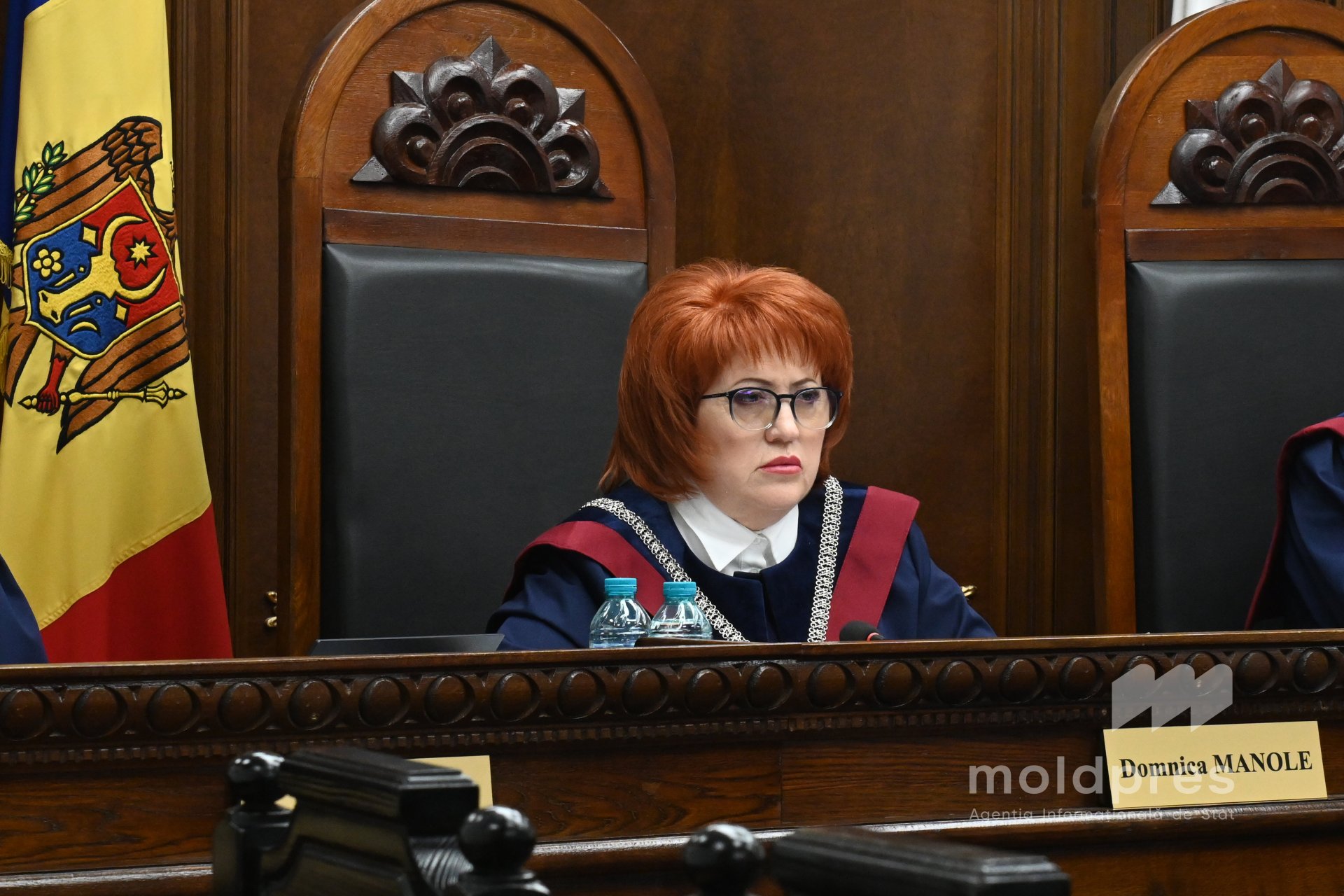
The Constitutional Court (CC) today declared unconstitutional the provision stipulating that the resignation of judges and prosecutors after the expiry of the 20-day period from the initiation of the external evaluation automatically results in failing the evaluation, regardless of the reason invoked. The parliament is to amend the regulatory framework, and until then, the evaluation may continue at the request of the person who submitted his/her resignation.

At a news briefing, CC President Domnica Manole emphasized that the High Court ruled on a complaint based on two objections of unconstitutionality. Thus, the first objection was raised by a panel of the Supreme Court of Justice (CSJ), while the second was raised by the lawyer representing the interests of Veronica Dragalin, former chief prosecutor of the Anti-Corruption Prosecutor’s Office and the claimant in the proceedings before the CSJ.

“The authors of the objections said that equating a resignation submitted after the expiry of the 20-day period from notification of the initiation of the evaluation with failing the evaluation, in the absence of an assessment of the subject’s ethical and financial integrity, has serious consequences for their professional reputation and career. If the person subject to the evaluation submits a resignation application and asks for the evaluation procedure to be completed, the law should not automatically result in a finding that the evaluation was failed and the subsequent imposition of a ban on holding certain positions for a period of up to five years. If the resignation application is submitted after the expiry of that period, the authorities must find that the evaluation was failed. This would create a presumption that the person being evaluated does not meet the integrity criteria and is not considered worthy of holding a position of public dignity. The claimant’s lawyer said that the person subject to the evaluation is forced to remain in office against his/her will, in order to avoid the consequences of resignation. In her opinion, the law should have provided for the possibility of terminating or completing the evaluation procedure in relation to persons who resign from their position after the expiry of the 20-day period from notification of the initiation of the evaluation,” Domnica Manole said.

She pointed out that the High Court had conducted the constitutional review on the basis of Articles 28, 39 and 43 of the Constitution, which guarantee the right to respect for private life, the right of citizens to participate directly in the administration of public affairs and the right to work.

“The CC established that setting, as a general rule, a deadline for submitting a resignation application, for withdrawing it, as well as establishing the legal consequences when the deadline is exceeded, are meant to make the work of the evaluation commissions more efficient and, at the same time, to prevent cases of evasion of the evaluation procedure. This ensures achievement of the general purpose of the integrity evaluation process, namely restoring public confidence in the judicial system. The Court found that failing the evaluation has serious repercussions for the careers of resigning subjects. The ban on holding vacant positions for a period of five to seven years applies to positions of public dignity. The Court emphasized that the challenged provision forces persons subject to evaluation who want to resign for personal reasons either to refrain from changing their professional status during the evaluation process or to accept the imposition of a ban on holding positions as judges or prosecutors, as well as other positions of public dignity, for a period of five to seven years,” the CC president noted.

Domnica Manole specified that, during its examination, the Court had noted that, by establishing an absolute measure, the parliament failed to distinguish between resignation used to avoid the evaluation and resignation prompted by objective, serious and verifiable reasons, applying the consequences of failing the evaluation in all cases.

“The CC established that the phrase ‘regardless of the reason invoked’ in the provision under review is rigid and does not allow the evaluation to continue at the subject’s request under any circumstances. Through the mechanism for evaluating the integrity of serving judges and prosecutors, the parliament sought to reform the justice system and remove from it persons who do not meet the ethical and financial integrity criteria. However, applying the consequences of failing the evaluation in connection with resignation and refusing to allow the evaluation to continue at the subject’s request represents a disproportionate measure in relation to the goal declared by the state authorities. By automatically establishing that the evaluation had been failed, regardless of the reason invoked, the legislature did not allow an assessment of the individual circumstances of the person resigning, nor did it allow the evaluation to continue at that person’s request. Consequently, the Court declared unconstitutional the phrase ‘regardless of the reason invoked’ from Article 3(4) of Law No. 252/2023, because it contravenes Articles 28, 39, 43 and 54 of the Constitution,” Domnica Manole said.

The Constitutional Court established a provisional solution under which, until the parliament amends the regulatory framework, if a resignation request is submitted after the expiry of the 20-day period from notification of the initiation of the evaluation, the evaluation commissions will continue the integrity evaluation procedure, if the person subject to the evaluation requests that the procedure continues. In this regard, the Court issued an address to parliament.
 Facebook
 Instagram
 X/Twitter
 Telegram
LIVE // European Commissioner for Enlargement delivers speech in Moldova's parliament
Over 380,000 applications registered for energy compensation in Moldova
Moldovan justice minister, at annual conference on EU enlargement, says government reaffirms commitment to continuing justice reforms
VIDEO // U.S. Ambassador: New embassy and power line demonstrate Washington’s commitment to Moldova
President at annual EU Enlargement Conference: Moldova aims to conclude EU accession negotiations by 2028
EU enlargement conference begins today in Chișinău
Moldovan foreign affairs minister meets Romanian counterpart
Moldovan Central Electoral Commission accredits 32 international observers to monitor elections in Gagauzia autonomy
Moldovan Central Electoral Commission confirms legality, results of local referendum in central Moldova village
Moldovan foreign affairs minister says Moldova set to open negotiations for final two clusters, counts on support of EU member states
EU Commissioner for Enlargement to visit Moldova
Over 450,000 citizens of Moldova affected by cyberattack; Moldovan president says Electronic Governance Agency to notify concerned citizens by email, banks to be informed
Working group led by Moldovan PM to propose solutions for strengthening cybersecurity
Moldovan president comments on ban imposed on unrecognized Transnistria's leader
VIDEO // President after EPC summit in Dublin: Moldova has friends in Europe, alongside whom we work shoulder to shoulder
DOC // Government decision on ratification of Moldovan-Ukrainian Agreement on military-technical cooperation published in Official Journal
Moldovan Ambassador, Chinese officials discuss country’s inclusion in China’s tourist destinations program
DOC // Foreign nationals in Moldova to benefit from Romanian-language courses and integration support
Moldova wins seven medals at competition in Turkey
PHOTO // National Bank of Moldova launches commemorative coin dedicated to Nadia Comăneci and first perfect 10 in gymnastics history
Moldovan president, European leaders in Dublin focus on Moldova's security, next steps in EU accession process
 National Bank of Moldova

Deputy Prime Minister for Reintegration meets Ambassador of Türkiye
Two-million-dollar grant for energy renovation of public buildings in Moldova
Moldovan president, European leaders in Dublin focus on Moldova's security, next steps in EU accession process
Moldovan government's secretary general participates in annual Interreg 2026 event in Brussels
Joint commission for decentralization resumes work in Moldova: local public administration reform, investments' financing on agenda of discussions

Moldovan government's secretary general participates in annual Interreg 2026 event in Brussels
Moldovan president, at EPC Summit in Dublin: “We discussed the next steps in the country’s accession to the EU”
Moldova's judges, prosecutors to be able to continue external evaluation after submitting resignation application; parliament to amend legislation following Constitutional Court's ruling
Joint commission for decentralization resumes work in Moldova: local public administration reform, investments' financing on agenda of discussions
Proposals for 2027–2030 public administration reform's implementation programme discussed at workshop in Moldova
Moldovan economic development minister, U.S. Ambassador to Moldova discuss opportunities to deepen bilateral economic relations
National Bank of Moldova: annual average inflation rate trended upward in third quarter of 2026, driven by external factors
VIDEO // Man prosecuted for illegally collecting information for Russian special services
ARMENPRESS: Armenia joins EU Customs and Fiscal programs
Yellow Code for strong winds forecast in Moldova; gusts to reach 20 m/s
Moldovan government approves harsher penalties for cyberattacks on information systems part of critical infrastructure
VIDEO // Moldovan president attends European Political Community Summit in Dublin; European path, security partnerships on agenda
Deputy Prime Minister held courtesy meeting with U.S. Ambassador to Moldova
Environment Minister urges people to join this autumn’s reforestation program
DOC // Government approves ratification of Moldova-Ukraine Agreement on military-technical cooperation
Electricity from European and Romanian markets reaching Chisinau Electricity Center via Vulcănești–Chisinau Power Line for more than 48 hours
Receive the latest news directly to your email

Receive the latest news directly to your email