
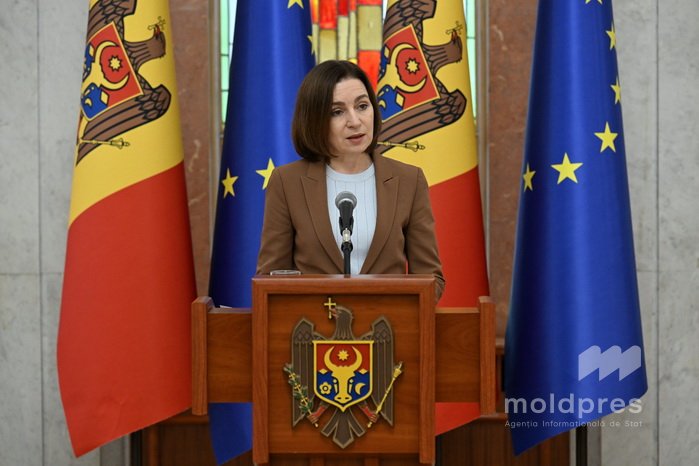
Over 450,000 citizens of Moldova affected by cyberattack; Moldovan president says Electronic Governance Agency to notify concerned citizens by email, banks to be informed
More than 450,000 citizens of Moldova have been affected by the massive cyberattack on the national governmental system. The Electronic Governance Agency (AGE) will inform those affected by email, while banks will be notified about the individuals concerned, so they can carry out additional checks in the event of potential operations or transactions. President Maia Sandu today presented information to this effect following a meeting of the National Security Council (CNS).

According to the official, representatives of state institutions presented to the CNS the investigations conducted into the scale of the attack, the attackers’ way of operation, the vulnerabilities exploited, the measures taken immediately during those days, as well as proposals to strengthen the country’s cybersecurity and ensure a higher level of protection for digital governmental services.

“The incident occurred in infrastructure administered by AGE, affecting more services. The underlying cause was structural and related to governance: the systems verified only the application requesting the data, not the identity of the user or their right to access the information. Thus, a single application with incorrectly configured access opened the registers of at least ten institutions. The attacker, possessing a set of IDNPs, entered the system and extracted data that was subsequently used to gain further access and extract complete files. The incident is the consequence of an architecture in which data from all registers is accessible through a single point, without control by the holders of those registers and without volume limitations. There was also no control over the volume of data extracted, meaning there was no automatic alert when a certain extraction threshold was exceeded,” Maia Sandu said.

Automated requests originating from more than 638 IP addresses that concealed their true source began on the evening of October 19. The most intense day was October 20, when approximately one million requests were recorded in a single day—30 times more than the average. Also on October 20, more than 260,000 records concerning relatives were extracted.

“On October 21, AGE stopped the extraction of data concerning relatives. On October 23, the blocking of the attackers began. On October 24, all attacks had been blocked, and the attackers were no longer able to steal data. Attempts continued, but were repeatedly blocked by the institutions. Communication by state institutions about the incident was delayed and did not address all of the people’s concerns. In addition, the lack of a communication protocol for such a situation led to hesitation regarding the roles and responses of the institutions. The latest assessments show that the data of more than 450,000 citizens was accessed. This is a smaller number than the one circulated in recent days, but it is still a large figure. These people are to be notified by AGE,” Maia Sandu noted.

Following the attack, AGE disconnected all electronic services and platforms integrated with MPay, and after the problems were resolved, they were gradually restarted.

“The problem in the authentication and access control service have been resolved. It is being verified whether the source requesting the data is the holder of the right to access it. Access points have been secured through mandatory authentication, while responses have been limited to providing only the strictly necessary data. The administrators of all systems integrated with MPay received instructions and underwent an additional verification test implemented as an emergency measure,” the official said.

The president also said that the cyberattack had not compromised the integrity of banking data. Nevertheless, banks will be informed about the individuals whose data was accessed, so they can carry out additional checks in the event of potential transactions initiated in their names.

“Even though IBAN data was extracted, this information is not sufficient to access bank accounts. The risk lies in the fact that the extracted data may be used in combination. For example, an IDNP, information about relatives, or data from a driver’s license, sometimes together with an IBAN, may be used to contact various people for fraudulent purposes. In other words, someone who has access to certain data about you may call or write to you, pretending to be a representative of a bank or the police, in order to request additional information. Dear citizens, no state institution or bank will ask you by phone or SMS for PIN codes, passwords or card details. If you receive such a call, hang up and call the concerned bank or the police directly, using the phone numbers displayed on the institutions’ official websites, not the number from which you were contacted. It is better to reject a call than to fall victim to fraud. AGE has published phone numbers and other contact details that citizens can use, if they suspect an attempted fraud or need information about their personal data. For immediate assistance, call 112,” Maia Sandu said.

She noted that improving our cybersecurity depended both on the state’s ability to secure its infrastructure and on each individual’s ability to protect their data.

“We have agreed with the institutions, including the Education and Research Ministry, to prepare framework lessons for middle and high school students, during which young people will be taught more basic rules regarding the protection of personal data. They include avoiding the use of overly simple passwords or the same password for multiple platforms, as well as changing them regularly. The lessons will also address enabling two-factor authentication for email, social networks, and other applications, paying increased attention to suspicious links or free offers, as well as other technical solutions. We hope that, later on, young people will also be able to help their parents become more vigilant and better protected. At the same time, the Cybersecurity Agency will prepare a data protection guide with clearly explained steps for all citizens,” Maia Sandu emphasized.

The head of state added that the theft of data had been stopped, but institutions must continuously adapt, in order to reduce the risk of similar attacks in the future.

“One of the most serious consequences is, in fact, the weakening of trust in the country’s cybersecurity and in the safety of digital services. It is precisely in this area that the responsible state institutions must act immediately and sustainably. The most important changes concern limiting the data accessible without authentication, security testing of all services, and the reengineering of the infrastructure, in order to ensure a uniform and secure digital architecture. However, another problem that must be addressed is the fragmentation of responsibilities among governmental actors, which delayed the detection of the problem and, consequently, the coordination of the response to the incident. We have agreed to create a working group led by Prime Minister Vasile Tofan. Within one month, this group will propose systemic solutions to cybersecurity-related problems. In three months, we will meet again, in order to monitor the progress made during this period. At the same time, we must also establish expiration dates for information systems. We are happy when we launch a new system, but institutions sometimes forget to establish its service life and the date on which it must be replaced. We also discussed the need to reform the procurement system in the information technology sector. We must better secure this process and work with trusted partners. Another objective is to strengthen cybersecurity through periodic testing, updates, continuous 24-hour monitoring, anomaly detection, the identification and rapid remediation of vulnerabilities, including through the use of artificial intelligence-based tools,” Maia Sandu said.

Similar cyber incidents have occurred in more countries around the world, including states with significant financial resources and advanced technologies, such as Denmark, Norway, France, Poland, Spain and South Korea. In Europe alone, more than 8,000 cyber incidents have occurred this year.

“Cyberattacks have become increasingly frequent and are often part of the hybrid warfare arsenal used by Russia against Europe. Unfortunately, they have become a new normal, a chronic threat. Moldova must adapt as it goes and learn how to prevent such incidents, and when defense mechanisms are bypassed or compromised, detect the attacks and intervene quickly, restoring the functionality of the affected services. Cyberattacks represent a national security problem and I urge politicians to avoid turning this subject into a spectacle. Cybersecurity and national security must be handled by specialized institutions, not by those who want to create a spectacle. Information technologies are developing at a pace that is difficult to keep up with. They can be used for beneficial purposes, but they can also serve malicious individuals or states. We must invest in defense, including cyber defense, in digital education, and we must be as cautious as possible. Risks cannot be eliminated, but we can learn and prepare better to face them, and when they materialize, we must be able to respond in an organized and rapid manner. And, of course, we must not give up on digitalization and the use of digital services, especially in a small country, such as Moldova. Digitalization contributes to increased efficiency and improved access for citizens to public services,” the president concluded.

The National Security Council today assembled, after a cyberattack had targeted information systems between October 19 and 23, 2026. A criminal case has been opened in connection with the incident.
 Facebook
 Instagram
 X/Twitter
 Telegram
PHOTO GALLERY // One hundred days of government: Moldovan PM presents results of cabinet’s activity
Moldovan PM tells opposition lawmakers all should row in same direction, country needs solutions, not gimmicks
Moldovan foreign affairs minister pays visit to Bucharest; official to attend annual meeting of Central European Initiative's foreign ministers
Speaker: Moldova made progress in all 33 EU negotiation chapters
Reintegration Bureau: Vadim Krasnoselski to be banned from leaving Moldova for five years
Bill to suspend President not to be on Parliament’s agenda
Special parliamentary session on November 9: European Commissioner to address MPs
CEC and TikTok to cooperate to combat information manipulation in Gagauzia elections
Moldovan Central Electoral Commission accredits five international observers to monitor elections in Gagauzia autonomy
Mayoral elections to be repeated in south Moldova settlement on November 15
Moldovan president says Moldova makes progress in all 33 chapters of negotiations with EU
2026 Enlargement Report // Moldovan PM says country's goal to provisionally close negotiations in early 2028 ambitious, but achievable
Moldovan parliament speaker says Moldova made progress in all 33 EU negotiation chapters, reforms must be felt in people’s lives
Moldovan foreign affairs minister has meeting with Political Director of European External Action Service
Moldova records 69 airspace violations since early 2026
National Security Council approves measures to strengthen cybersecurity of Moldova
Moldovan foreign affairs minister says Moldova set to open negotiations for final two clusters, counts on support of EU member states
EU Commissioner for Enlargement to visit Moldova
Over 450,000 citizens of Moldova affected by cyberattack; Moldovan president says Electronic Governance Agency to notify concerned citizens by email, banks to be informed
Working group led by Moldovan PM to propose solutions for strengthening cybersecurity
Moldovan president comments on ban imposed on unrecognized Transnistria's leader
 National Bank of Moldova

National Security Council approves measures to strengthen cybersecurity of Moldova
Press statements made following meeting of Moldova's National Security Council
Additional funding for development of solid waste management infrastructure in several regions of country
Meeting of Moldova's National Security Council convened for November 6, at 10:00
Human rights, bringing two banks of Dniester closer together discussed at German Bundestag

Expert: Chisinau’s decision regarding Krasnoselski could thwart scenario prepared in Moscow
Chisinau and Bucharest deepen joint infrastructure and energy projects
PHOTO GALLERY // Reception hosted by Azerbaijani Embassy in Chișinău to mark Victory Day: messages of peace and recital of Azerbaijani music
New EcoVoucher Program session: Around 3,000 families to be able to purchase energy-efficient appliances
PHOTO // Republic of Moldova represented for first time with national pavilion at China International Import Expo
Gasoline, diesel to become cheaper over weekend
Additional funding for development of solid waste management infrastructure in several regions of country
Chișinău and Kyiv strengthen cooperation on European integration
Moldova and Romania to implement joint measures to streamline truck traffic at border
Government reacts to PSRM threat of motion
Moldovan spirits win 12 medals at international competition in Brussels
PHOTO GALLERY // Great Emil Loteanu in MOLDPRES’ photo chronicle: rare pictures from film sets at 90th anniversary of birth
Prime Minister: Moldova must maintain good relations with US, regardless of election results
President at Noroc band concert: It kept Romanian language and dignity of generation that won independence alive
What strategic alignment with European Union's values entails: deputy PM for European integration explains benefits Moldova can gain
Moldovan PM gives himself grade 7 for first 100 days in office
Receive the latest news directly to your email

Receive the latest news directly to your email