
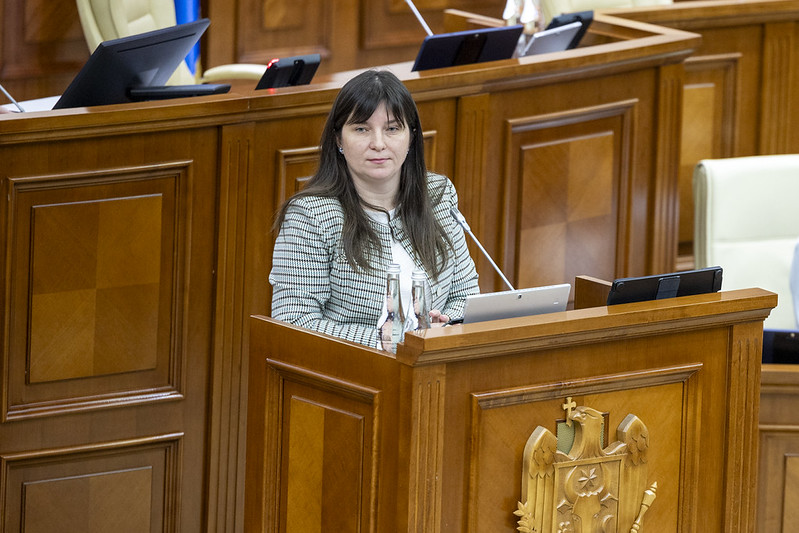
Reform of public-sector pay system examined by Parliament: higher salaries for about 172,000 employees
The bill on reforming the unified pay system in the public sector was presented today in Parliament by Finance Minister Victoria Belous. The initiative provides for average salary increases of 15.7% for approximately 172,000 public-sector employees. To implement it, 3.2 billion lei will be allocated from the state budget.

The Finance Minister emphasized that the reform is necessary given that the current law has been subject to numerous derogations and exceptions year after year.


“For example, there are situations in which the variable component—various allowances, bonuses and awards—accounts for more than 120% of the salary established by law. There are also pay differences between employees with comparable positions and responsibilities. Obviously, in certain cases, this can lead to salary abuses. We also have other situations in which the differences between the lowest and highest levels have become enormous. For example, we may see a salary of 2,500 lei, which the state supplements monthly to reach the established minimum wage, and a top-level salary of approximately 65,000 lei. This ratio of 1 to 26 between salary levels is not fair. The bill seeks to correct this injustice,” the minister said during the plenary session of Parliament.


Victoria Belous acknowledged that the new law “will not satisfy” all categories of employees, but emphasized that the changes are important for providing clarity, fairness and predictability. The authorities’ aim is to create a fairer, more transparent and more competitive pay system in which salaries better reflect the complexity of work, the responsibilities involved and the value of the positions held.

The minister said that this is the largest salary increase in recent years, particularly for positions with the lowest salaries, with an estimated average salary increase of 15.7%.

The bill provides for an increase in the base salary and the inclusion of most variable supplements in it. The variable component may not exceed 30%, while the fixed salary will account for 70%. The 1,300-lei supplement will be incorporated into the base salary.

The initiative also provides for the gradual reduction of the number of reference values from ten in 2026 to no more than six in 2027 and no more than four in 2032. The six reference values to be applied from January 1, 2027, are: 4,200, 4,700, 5,000, 5,300, 6,200 and 6,900 lei. At the same time, the authors of the document propose bringing salary levels for comparable positions closer together and reducing the ratio between the minimum and maximum salaries in the pay scale from 1 to 26 to no more than 1 to 10.5.

At the same time, the mechanism for granting performance bonuses will be revised. Victoria Belous emphasized that it will be more clearly linked to the results of professional evaluations, so that actual performance is recognized and rewarded.


“Until now, it was granted to more than 90% of employees as a form of salary supplementation. We are also standardizing specific bonuses and introducing tools to make hard-to-fill positions more attractive, including through a distinct pay mechanism for information technology specialists,” the Finance Minister explained.


Additional resources of approximately 3.2 billion lei from the state budget are allocated for salary increases in 2027.


“I want to explain this 3.2 billion lei figure. Previously, I said that 5 billion lei would be needed. That estimate was based on contributions to the Social Insurance Fund in the public sector of 29%, compared with 24% for the rest of the country. Through the fiscal policy, we standardized and reduced the basic contributions from 29% to 24%; consequently, the current estimate of the cost of the salary reform has decreased to 3.2 billion lei,” the minister explained.


Salary increases will vary depending on the field of activity and personnel category, with an emphasis on correcting imbalances and improving the pay of employees with lower salaries. According to estimates, the average increases by sector will be as follows: approximately 19% for technical, support and manual staff; 20.6% in national defense; 15% in public order; over 15% in public administration; over 14% in education, culture and sports; and 13% in healthcare and social assistance.
- In education and culture, a university professor will have an estimated salary of 23,919 lei, compared with 19,816 lei currently, an increase of approximately 21%.
- An assistant educator’s salary will reach 9,140 lei, compared with 6,811 lei, representing an increase of approximately 34%.
- A support teacher will earn 13,742 lei, compared with the current 11,349 lei, approximately 29% more.
- A ballet dancer’s salary will reach 14,300 lei, compared with 10,500 lei, an increase of approximately 36%.
- In the public order sector, the salary of a sector police officer will increase from 13,024 lei to 15,675 lei, by approximately 20%.
- An investigative officer’s salary will reach 17,429 lei, compared with 13,246 lei, an increase of approximately 31%.
- A doctor in a public institution will have an estimated salary of 32,389 lei, compared with 26,104 lei, approximately 24% more.
- A nurse’s salary will reach 12,800 lei, compared with 10,300 lei, an increase of approximately 24%.
- A social worker will earn 8,178 lei, compared with 6,780 lei, approximately 29% more.
- In public administration and auxiliary services, the salary of a local council secretary will increase from 16,503 lei to 29,267 lei, by approximately 29%.
- A chief accountant in a local public authority will earn 18,659 lei, compared with 15,389 lei, an increase of approximately 29%.
- The salary of a driver will increase by approximately 27%, while that of a cook will rise by around 40%.
Victoria Belous noted that the bill establishes transitional guarantees for employees and does not provide for nominal salary reductions for any category of personnel.
“I know that more is still needed, but these examples show that the reform brings significant increases, including for technical and auxiliary positions and for employees who have so far had lower salary levels. When we talk about increases, we must also take into account the available budget. An important principle of the reform is the protection of existing incomes. Thus, the bill establishes transitional guarantees for employees and does not provide for nominal salary reductions for any category of personnel. Therefore, changing the pay scale will not lead to a reduction in the salary currently received by a public-sector employee,” Finance Minister Victoria Belous emphasized.
The reform will be implemented in stages. Most provisions will enter into force on January 1, 2027.
Victoria Belous added that the reform is not only about salary increases; it also means a fairer system in which work, responsibility and qualifications are more accurately reflected in pay.
“Through investments of more than 3.2 billion lei, we aim to improve the remuneration of approximately 172,000 people employed in the public sector, reduce unjustified disparities and make the public sector more attractive to specialists. We want the people who ensure the functioning of public institutions and the provision of services to citizens to benefit from a fair, predictable and motivating pay system,” the official concluded.
After the bill was presented, Victoria Belous answered questions from the MPs. This stage will be followed by a vote by Parliament on the initiative.
 Facebook
 Instagram
 X/Twitter
 Telegram
Measures to streamline border traffic: two additional control lanes put into operation at Giurgiulești–Galați crossing
Five wine producers from Moldova awarded at Asia Wine Trophy 2026
PHOTO // Republic of Moldova represented for first time with national pavilion at China International Import Expo
Gasoline, diesel to become cheaper over weekend
Moldovan spirits win 12 medals at international competition in Brussels
Moldovan government announces completion of 88 km of national roads in first 100 days in office
Moldova negotiates access of animal origin products to market of Qatar
BNM raises base rate applied to main short-term monetary policy operations
PHOTO // Hâncești–Lăpușna–M1 road rehabilitated along 37 kilometers
DOC // Simpler rules and lower costs for entrepreneurs: draft measures to reduce bureaucracy published in Official Journal
Moldova's exports exceed 63 billion lei in first ten months of 2026; imports reach 176 billion lei
Fresh Moldovan sweet cherries can be exported to China now: protocol on phytosanitary requirements signed
Expansion of cooperation and new joint projects discussed at meeting of Moldovan-Chinese intergovernmental commission on trade and economic cooperation
Estonia granted Moldova 50 additional permits for occasional international passenger transport
Deputy Speaker calls for explanations regarding opposition MPs' visit to Russia
Ukrainian refugee children supported in learning Romanian and integrating into schools in Moldova
Citizens can invest in government securities: new subscription round launched
Head of State visits Brussels: meetings with European officials and discussions on advancing accession negotiations
 National Bank of Moldova

Republic of Moldova joins International IDEA to strengthen electoral process integrity
Bootcamp for 6.2 edition of paid public service internships: two days for learning and professional development
Forest Generation 2026 in Moldova: 33,000 poplar saplings planted across 40 hectares
Moldovan PM to attend Francophonie Summit in Phnom Penh
Moldovan parliament joins national #ForestGeneration Autumn 2026 campaign this year too

Elections in Gagauzia: CEC verifies 100% of polling station protocols in the election for the position of Governor of the autonomy
Alexandr Stoianoglo and Fiodor Gagauz to face each other in the second round of elections for the position of Bashkan of Gagauzia
BTA: From Coffee Imports to High-End Fashion: The Adaptive Model of a Cooperative for People with Disabilities in Burgas
Promo-LEX: Violations of ballot secrecy, voting on behalf of other voters and suspicions of voter bribery during elections in Gagauzia
Preliminary results: Independent candidate Alexandr Stoianoglo leads the race for the position of Governor (Bashkan) of Gagauzia
Low voter turnout in Taraclia district village; almost 200 people participate in repeat election
Polling stations closed; approximately 49,000 citizens cast ballots at elections in Autonomous Territorial Unit of Gagauzia
Moldovan Civil Aviation Authority explains presence of aircrafts in Chisinau's airspace: “There are three SR-20 aircrafts that flew from Czech Republic”
Transnistria's leader returns to Chisinau; Moldovan government's spokesperson: “He will be banned from leaving the country for five years”
Promo-LEX association of Moldova identifies 56 incidents at regional elections
Repeat election in Novosiolovca village: voter turnout reaches 17.44 per cent by 18:00
Over 43,500 citizens participate in elections in Autonomous Territorial Unit of Gagauzia by 18:00
Moldovan Central Electoral Commission's head says election validity threshold exceeded in 29 of 35 electoral districts from Autonomous Territorial Unit of Gagauzia
Over 170 voters participates in election held in Taraclia district village by 15:00
Elections in Gagauzia: about 25 per cent of voters cast ballots by 15:00
Moldovan Central Electoral Commission warns about risk of false information emerging on regional election day; citizens urged to consult official sources
Receive the latest news directly to your email

Receive the latest news directly to your email