
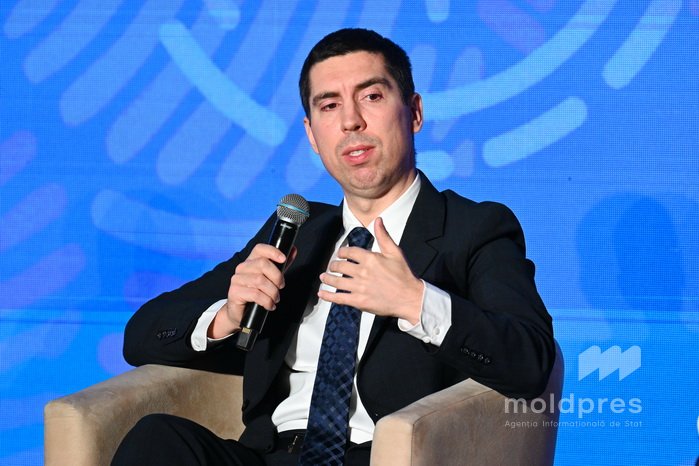
Moldovan foreign affairs minister says constitutional neutrality must not be impediment to strengthening country’s defense capabilities
The constitutional neutrality must not be an impediment to strengthening the country’s defense capabilities. Moldova must make use of opportunities for cooperation with the European Union in the field of security. In recent years, the support provided through the European Peace Facility (EPF) has increased from 7 million euros in 2021 to 120 million euros in 2026. Deputy Prime Minister, Foreign Affairs Minister Mihai Popsoi has made statements to this effect during the annual conference on European Union enlargement, held today in Chisinau.

According to the official, in recent years, the EPF has provided transformational support to the security and defense sector.

“The amounts granted are colossal for the defense budget of Moldova, a sector that was neglected for decades. Given the horrors Ukraine has been going through for almost five years and their repercussions on the entire region, we must understand that a neutral country must invest more in its own defense than other states that have the peace, security and luxury of belonging to a collective defense alliance. Within the great European family, security cooperation, the strengthening of the defense industry and the development of logistical networks are mechanisms that Moldova wants to be part of. We must understand that neutrality does not mean being incapable of defending yourself. Nor does it represent an obstacle to strengthening defense capabilities and making investments in the field of defense, which we are making and will continue to make,” Mihai Popsoi said.

The minister emphasized that, in addition to the EPF, the European Union also supported programmes in the civilian sector, which play an important role in strengthening societal security.

“I am referring to the European Union Partnership Mission in Moldova. This mission has helped us enormously to strengthen our capabilities in the field of information security and crisis management. The Crisis Management Center and the strengthening of its capabilities are part of our accession commitments. Therefore, the existing cooperation mechanism, which is continuously developing, represents a major opportunity for Moldova to strengthen its defense and security sector, as well as society’s resilience as a whole. A state can succeed, only if every citizen and institution contributes to defending society against foreign interference. Our citizens have become aware of the danger to which we are exposed and, every time, we have proved our ability to defend our democratic choices, our right to choose our own destiny and to continue efforts to enhance the resilience of our society. This undoubtedly demonstrates our internal capacity to respond to these challenges, but it is also the result of substantial EU support,” Mihai Popsoi added.

For his part, Stanislav Secrieru, the president’s chief adviser on defense and national security, noted that, under the UN Charter, every independent and sovereign state has the right to self-defense; however, in order to exercise this right, it must have the necessary means.

“At present, we notice that, in the European Union, some states are investing in defense and increasing their military budgets. At the same time, neutral countries also contribute to the EPF, from which Moldova benefits through defense resources. Therefore, being neutral does not mean being passive, indifferent or failing to take care of one’s own defense capabilities. Threats in the air domain are evolving every two or three weeks. Modernizing airspace surveillance capabilities is a lengthy process, as drones flying at low altitudes require specialized radars. Moreover, even if Moldova had the financial resources, the delivery of equipment would not be immediate, as manufacturers are prioritizing orders for Ukraine, where the situation is more serious. Another challenge concerns training and retaining in service specialists capable of operating increasingly sophisticated equipment,” Stanislav Secrieru said.

A 120-million-euros-worth assistance package is being provided by the European Union through the European Peace Facility (EPF) and is meant to strengthen the country’s defense capabilities. Moldova is the second-largest beneficiary of EU assistance provided through the EPF, after Ukraine. Thus, the total support provided to the country amounts to 317 million euros for the period 2021–2026.
 Facebook
 Instagram
 X/Twitter
 Telegram
PHOTO GALLERY // Reception hosted by Azerbaijani Embassy in Chișinău to mark Victory Day: messages of peace and recital of Azerbaijani music
Chișinău and Kyiv strengthen cooperation on European integration
Government reacts to PSRM threat of motion
Prime Minister: Moldova must maintain good relations with US, regardless of election results
President at Noroc band concert: It kept Romanian language and dignity of generation that won independence alive
Moldova invests 120 million euros in strengthening defense; PM says neutral state does not mean weak state
Moldovan convenes National Security Council; measures needed to strengthen state’s cybersecurity on agenda
Moldovan foreign affairs minister says Moldova's resilience result of national efforts, solidarity of European partners
PM says all reforms initiated by Moldova's government have common direction: European integration
Moldovan PM says government can build cleaner institutions only if country carries justice reform through
LIVE // Government's activity report for first 100 days
Moldovan PM speaks about visit to Moscow by Transnistria's leader
PHOTO GALLERY // One hundred days of government: Moldovan PM presents results of cabinet’s activity
Moldovan PM tells opposition lawmakers all should row in same direction, country needs solutions, not gimmicks
Moldovan PM, European Commissioner for Enlargement attend event marking 15 years of European Business Association
Moldovan foreign affairs minister says constitutional neutrality must not be impediment to strengthening country’s defense capabilities
Moldovan government's deputy secretary general, at annual conference on EU enlargement, says aim of local public administration reform to ensure that quality public services reach every citizen
PM, European Commissioner for Enlargement discuss Moldova's progress, priorities on European agenda
Moldovan PM says money of 30-million-euros-worth support, announced by EU, to go directly to people for payment of invoices in next winter
Message of unity delivered by European Commissioner for Enlargement in Moldovan parliament: “Moldova has shown that it makes Europe stronger”
Moldovan parliament speaker: “The current parliament will be the Parliament of European integration. We will continue working, so that every law adopted brings us closer to the EU”
 National Bank of Moldova

Moldovan PM, European Commissioner for Enlargement attend event marking 15 years of European Business Association
Moldovan government's deputy secretary general, at annual conference on EU enlargement, says aim of local public administration reform to ensure that quality public services reach every citizen
PM, European Commissioner for Enlargement discuss Moldova's progress, priorities on European agenda
President Maia Sandu’s Address at the Connectivity Platform Meeting
European Commissioner for Enlargement announces additional 30 million euros in support for Moldova to alleviate energy costs

PHOTO GALLERY // ClassFest 2026, opened in Chisinau
EU to provide Moldova with 30 million euros in support to reduce energy vulnerability, assist citizens during cold season
LIVE // European Commissioner for Enlargement delivers speech in Moldova's parliament
Moldovan president, at Connectivity Platform meeting: “Together and connected, even small countries are safer”
Moldova to launch first national campaign to prepare population for crisis situations
Over 380,000 applications registered for energy compensation in Moldova
Moldovan justice minister, at annual conference on EU enlargement, says government reaffirms commitment to continuing justice reforms
Moldovan deputy PM for reintegration has meeting with Head of International Committee of Red Cross Mission
Prime Minister at Digital Connectivity Platform meeting: For small country like Moldova, digitalization - competitive necessity
Energy system of the Republic of Moldova operated stably over past week, with no major incidents - Energy Ministry says
Cristina Gherasimov for MOLDPRES: 2027 decisive for EU accession. Moldova could close negotiations on 25 chapters
President: Moldova aims to conclude EU accession negotiations by 2028 and calls for stronger European mechanisms to protect rule of law after accession
Republic of Moldova to receive loan of about 976 million lei from Japan to invest in agricultural modernization
Measures to streamline border traffic: two additional control lanes put into operation at Giurgiulești–Galați crossing
VIDEO // U.S. Ambassador: New embassy and power line demonstrate Washington’s commitment to Moldova
VIDEO // Deputy Prime Minister: Moldova has made progress in all EU negotiation chapters. 25 of them have higher level of readiness for accession
Receive the latest news directly to your email

Receive the latest news directly to your email