
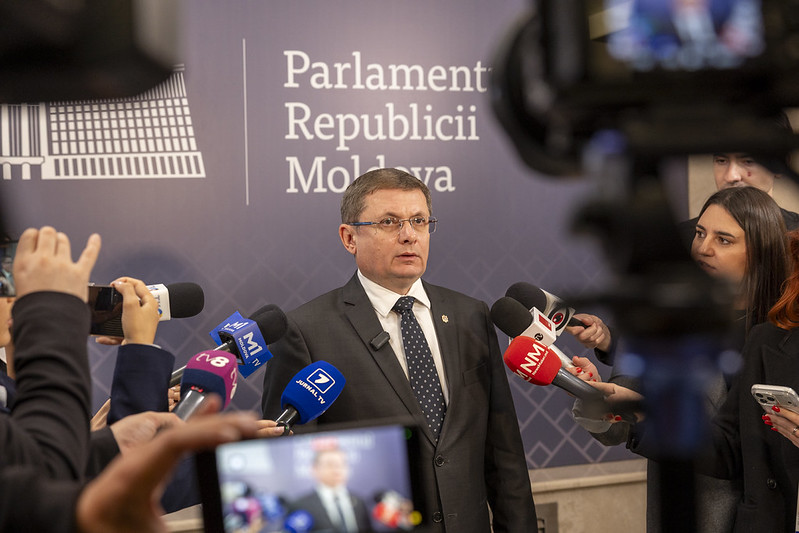
Moldovan parliament speaker explains need for state of emergency
Parliament Speaker Igor Grosu has explained the need to declare a state of emergency in the energy and hydrological sectors by the need for the government to be able to intervene quickly in the event of unpredictable developments on the energy market, supply problems or a worsening hydrological situation. The speaker made statements to this effect ahead of the plenary meeting today, during which the parliament is examining the government’s request.

According to Igor Grosu, the state of emergency will allow the authorities to respond more quickly to potential problems involving the supply of water, electricity natural gas or fuel.

“There is a provision requiring the Government, within no more than 72 hours, to inform parliament about any purchases it makes to ensure supplies of water, electricity, gas, fuel and so on. So, there are all necessary instruments on both sides: for the government to act and for parliament to monitor and exercise parliamentary oversight,” Grosu noted.

The parliament speaker said that the measure was also necessary, given the volatility of energy prices and resource availability, as well as the worrying water level in the Dniester. The state of emergency regime also gives the government the possibility to intervene more quickly through fiscal measures, depending on developments in fuel, gas and electricity prices.

“The government receives this instrument to intervene through excise duties or value added tax (VAT) when it considers that upward price fluctuations require it. (...) Outside a state of emergency, it would have to initiate a draft amendment to the budgetary and fiscal policy, consult it with all ministries, send it to parliament, and then we would have to conduct another consultation process and put it to a vote a month later. So, the train is leaving,” Grosu explained.

Another example cited by the parliament speaker concerns the fee for establishing emergency stocks of oil products. Grosu said that, once the state of emergency expires, this fee would be reflected in the price of a liter of gasoline and diesel, while declaring a state of emergency would allow the authorities to intervene, so that this cost is not immediately passed on to consumers.

Igor Grosu also emphasized that, under the state of emergency regime, decisions issued by the government or the Commission for Emergency Situations become mandatory for the operators concerned.

“Decisions in a state of emergency are mandatory. (...) You cannot disconnect supplies. (...) The two operators—the one in the north and the central-southern one—are required to ensure electricity supplies at specified voltages. They are required to ensure the water supply as well,” the parliament speaker said.

The parliament is examining today, in an extraordinary meeting, the government’s request to declare a state of emergency in the energy and hydrological sectors. The measure is proposed amid risks concerning the supply of energy resources and the decline in the Dniester’s flow rate.

The situation on the international energy market, regional vulnerabilities, Moldova’s preparations for the 2026–2027 cold season and the measures needed to ensure the country’s uninterrupted supply of energy resources were examined at a September 21 meeting of the National Security Council (NSC), chaired by President Maia Sandu.
 Facebook
 Instagram
 X/Twitter
 Telegram
Estonia to continue providing expertise to Moldova in EU accession process
Joseph Mark Burkhalter sworn in as U.S. Ambassador to Moldova
Speaker about protests in Transnistrian region: Reintegration process irreversible
Moldovan parliament speaker provides details on administrative and territorial reform
Moldovan parliament speaker, after meetings in Budapest, says Hungary supports Moldova in its efforts
Moldovan parliament speaker explains need to create Moldova Project: “We must concentrate expertise in a single entity”
Lithuania to support Moldova’s European path during Presidency of Council of EU
Family members of Moldovan and Danish diplomats to gain access to paid work under new agreement
Brussels sends important message to countries moving forward with reforms
Moldova condemned repeated violations of airspace to OSCE
Moldovan parliament speaker in Budapest says Moldova, Hungary can open new chapter in relations between parliaments of two countries
President at Forum on justice reform and fighting corruption: Building rule of law most complicated commitment in EU accession program
Republic of Moldova among countries in EU enlargement perspective
Ministry of Economic Development and Digitalization has new state secretary
Moldovan parliament speaker explains need for state of emergency
Moldovan-American sectoral cooperation discussed at Moldova's Defense Ministry
Moldovan energy minister gives explanations on how Transnistrian region to be supplied with energy resources during next cold season
Moldovan PM says situation on Dniester must not be turned into subject of political speculation
Moldovan PM presents draft law establishing state of emergency in parliament
Moldovan government negotiates direct contracts with major gas producers; PM makes clarifications
Moldovan PM says over 620,000 households might benefit from energy compensation during this season
 National Bank of Moldova
Moldovan PM's speech at parliament's plenary meeting on establishment of emergency state
Moldovan president, delegation of Czech senators discuss Moldova’s European path, bilateral cooperation
Government improves financing mechanism for regional and local development projects
National railway infrastructure program for 2026–2030 approved by Government: Railway to be modernized and passenger transport expanded
Crime victims to gain easier access to support and compensation

Bypass road of over 7 km to be built in Cimislia town of Moldova under a 43.3 million-euros-worth contract
Moldovan president, delegation of Czech senators discuss Moldova’s European path, bilateral cooperation
Moldova establishes diplomatic relations with Togo
Energocom company's leadership rules to give up part of salary payments, postpone string of investments, with estimated savings of 17.5 million lei
Moldova's Foreign Minister discusses expanding bilateral cooperation with Chilean and Tunisian counterparts in New York
Czech Senator: Moldova belongs at European table and is part of European project
Environment Minister on Dniester situation: Water reserves three times lower than discharges, situation worsened
Energy Minister on declaring state of emergency: We must be prepared to act quickly
Council of Europe Office to UN inaugurated in New York
Government improves financing mechanism for regional and local development projects
National railway infrastructure program for 2026–2030 approved by Government: Railway to be modernized and passenger transport expanded
Crime victims to gain easier access to support and compensation
Chisinau's Triumphal Arch to be restored
Government begins reorganization of central public administration to reduce expenditures
Serghei Diaconu on state of emergency: Any scheme in procurement procedures applied in crisis situations ruled out
Moldova and India expand cooperation: investments, exports and new agreements on bilateral agenda
Receive the latest news directly to your email

Receive the latest news directly to your email