
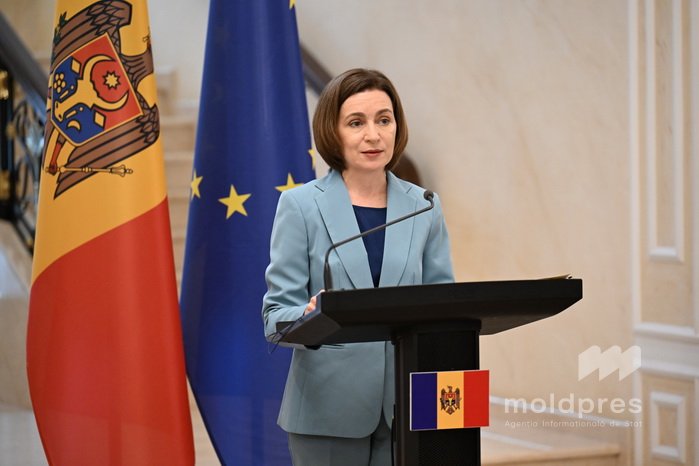
VIDEO // President about energy and hydrological crises: Government will do everything possible to mitigate consequences
The Government will do everything possible to mitigate the consequences of the energy and hydrological crises. Every time, we try to intervene, negotiate, and obtain the best solutions for our citizens. Under these conditions, the Republic of Moldova must become more resilient and be prepared for any challenge. President Maia Sandu made the statement to this end.

The official noted that the situation could worsen if, in the near future, there is not enough rainfall to restart the electricity-generating power plants in the region.


“Even though so far we have had a fairly good summer, with bearable temperatures and even rain, the drought on the continent in general, and the very high temperatures have caused these situations. This is where the energy crisis and the water crisis come from. The Government will do everything possible to mitigate their consequences, but we have to be aware that there are no magic solutions. If it does not rain in the near future so that the electricity-generating power plants in the region can be restarted, then we will face more difficult situations than today,” Maia Sandu said.


The official urged citizens to save resources, especially during the periods when the deficit is greatest.


“Our message is to consume as efficiently as possible. If we are talking about electricity, we know that at certain hours we buy it at very high prices. That is why we must all try to use less energy during these intervals and try to use it in the hours when energy is cheaper, because otherwise we will all pay very high tariffs. This will affect us all,” Maia Sandu noted.


The head of state also called on citizens to use water rationally and save this resource, in the context of the severe deficit caused by drought.


“We must use water with great care. I know that many people need water not only for consumption, but also for irrigation, and I understand that they have worked, they have grown crops and they want a good harvest in order to earn some money. Still, I believe we can save. It is a complicated situation, not only in the Republic of Moldova, and we must be very responsible, save where we can, especially when the deficit is greatest,” Maia Sandu stressed.


The President emphasized that, in the context of armed conflicts and international instability, the Republic of Moldova must strengthen its resilience in order to cope with challenges in the energy and economic sectors.


“As long as we have war on the continent, wars that influence the regions from which these energy resources come, and now, obviously, I refer to the war in Iran, such situations of uncertainty, price increases and fluctuations will remain possible. We are trying to increase our resilience, but we do not have our own resources. We must become more efficient, substitute, where possible, certain types of energy with others. Each time such a situation arises, we try to intervene, negotiate, and obtain the best solutions for our citizens. We must become more resilient and be prepared for any challenge,” Maia Sandu concluded.


At the end of July, the Government introduced, for a period of 30 days, a state of alert in the energy sector and a hydrological state of alert, in order to prevent risks to the country’s fuel and water supply.

The state of alert in the energy sector was declared in the context of disruptions on the regional fuel market. Rising international prices for oil and diesel, the conflict in the Middle East, the temporary interruption of Kazakh crude oil deliveries through the Novorossiisk terminal, and the low level of the Danube have affected supply chains.

At the same time, the hydrological state of alert was established following a significant reduction in water resources in the Dniester basin. Thus, the water level in the reservoir at Novodnestrovsk, Ukraine, has reached 112.9 meters, more than four meters lower than in the same period last year, when it was 117 meters. In recent days, an average of about 30 cubic meters of water per second has been flowing into the reservoir, while outflows amount to about 85 cubic meters per second, a threshold that could affect the operation of intake stations and water supply.

Due to drought, the very low flow of the Danube reduces the capacity of several power plants to operate at normal parameters, since water is essential for cooling installations. The Republic of Moldova is part of the regional energy market and depends on imports, so when there is a deficit in the region, it also affects the quantities of energy that we can purchase.
 Facebook
 Instagram
 X/Twitter
 Telegram
Deputy Prime Minister at Crimea Platform Summit: Russia’s aggression affects security and stability of all Europe
Corneliu Dudnic, Alexandr Stoianoglo file documents to run for office of Gagauzia's bashkan
Moldova, Mongolia abolish visa requirements for holders of diplomatic, service passports
DOC // Decision on declaring state of emergency in energy and hydrological sectors published in Official Journal
StratCom analyzes main vulnerabilities of regional information environment ahead of elections in Gagauzia
Prime Minister visits New York: bilateral meetings and address to plenary of UN General Assembly
Moldova and Kazakhstan strengthen cooperation
Moldovan parliament approves establishment of state of emergency in energy, hydrological sectors for 60 days
Moldovan parliament speaker explains need for state of emergency
Moldovan PM presents draft law establishing state of emergency in parliament
LIVE // Moldovan PM in parliament: government calls for establishing state of emergency in energy, hydrological sectors
Moldova, Austria strengthen cooperation; Moldovan parliament speaker meets new Austrian ambassador
Moldova establishes diplomatic relations with Togo
Moldova's Foreign Minister discusses expanding bilateral cooperation with Chilean and Tunisian counterparts in New York
PHOTO // PM in New York tells Diaspora government willing to turn experience of Moldovans from United States into projects for country
Moldovan foreign affairs minister at UN says Moldova strengthening capacity to respond to health threats
Moldova under emergency state in energy, hydrological sectors as of September 26; what measures take effect
PHOTO // PM promotes Moldova's investment opportunities in New York
Balti Clinical Hospital to receive ultrasound machine through grant provided by government of Japan
Japan supports modernization of Balti Clinical Hospital with grant worth over 95,000 dollars
Moldovan parliament speaker urges students not to be afraid to express their ideas, wishes
 National Bank of Moldova
Strengthening Moldova’s cooperation with UNDP, UNOPS discussed in New York
Moldova's National Crisis Management Commission approves new measures to ensure energy security, protect water resources
Moldovan PM, U.S. investors, companies discuss potential projects in Moldova
Head of state says Moldovans must build economy where well-educated people can find opportunities at home
Moldova represented at Interparliamentary Conference on Stability, Economic Coordination and Governance in European Union

Moldova's Border Police receive six special vehicles on behalf of FRONTEX
Head of state says Moldovans must build economy where well-educated people can find opportunities at home
Moldovan president attends events dedicated to 35th anniversary of foundation of Academy of Economic Studies
New charges brought against former Moldovan president Igor Dodon in “Kuliok” case; prosecutors seek harsher sentence
Moldova represented at Interparliamentary Conference on Stability, Economic Coordination and Governance in European Union
ARMENPRESS: EU Commissioner Kos promotes Armenian products after trade measures adopted
VIDEO // Parliament speaker conveys message to coaches of Moldova
Public buildings of Moldova to undergo energy renovation with World Bank's support
Mircea Eșanu on nomination to lead Moldova Project: More information could become known in October
President’s speech at ASEM’s 35th anniversary
PHOTO GALLERY // Moldova's new passport presented by Public Service Agency
VIDEO // Moldova to introduce new passport model as of October 15; document to feature more than 100 security elements
DOC // Regulation on e-Consulat System published in Official Journal
National Award for Seniors: 15 people winners in 2026 edition
PHOTO // Moldova’s protected areas strengthened through restoration works, planting and new management tools
Moldovan, Dutch Prime Ministers discuss European path and investments
Receive the latest news directly to your email

Receive the latest news directly to your email