

Over 90% of food products tested in 2025 compliant. ANSA publishes pesticide residue report
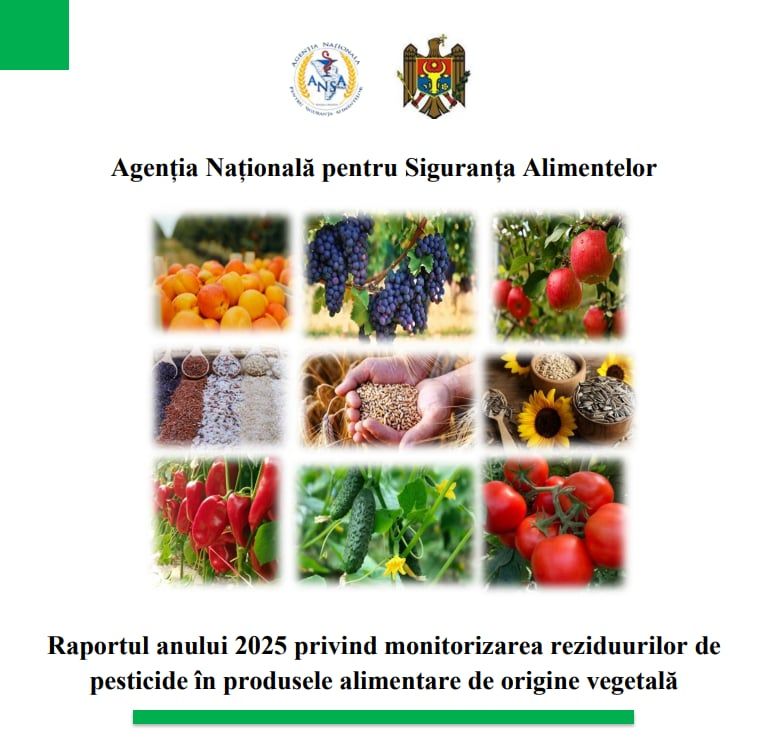
The National Food Safety Agency (ANSA) has published the Annual Report on the Monitoring of Pesticide Residues in Plant-Based Food Products for 2025, a document showing that most of the analyzed foods comply with legal food safety limits. According to the results, 91.7% of the samples tested were compliant, indicating a high level of safety for products sold on the market of the Republic of Moldova.

The report provides an overview of the pesticide residues identified in food products placed on the market, highlighting both the level of compliance and any non-compliances detected. The document also includes recommendations on risk management in cases where maximum permissible limits were exceeded.

Significantly higher number of samples tested

In 2025, ANSA intensified control and monitoring activities, analyzing 2,108 food samples, 962 more than in 2024. Monitoring covered both domestic and imported products and was carried out to assess consumer exposure to potential risks and to verify compliance with applicable sanitary standards.

The analyses were conducted under several control programs:

- 237 samples were analyzed under the monitoring program for domestically produced plant-based foods, of which four samples (1.7%) were declared non-compliant;

- 356 samples were analyzed for imported plant-based foods, with 34 non-compliant samples confirmed (9.6%);

- 1,477 samples were examined as part of intensified controls at border inspection posts, where 138 samples (9.3%) were non-compliant;

- 38 samples were analyzed for organic plant-based foods, all of which were compliant.

Measures taken for non-compliant batches

Following the detection of products exceeding the maximum permissible levels of pesticide residues, ANSA inspectors carried out unannounced inspections at the operators concerned and ordered a series of measures to manage the non-compliant situations.

Actions taken included: - destruction or recycling of batches of pomegranates, dill, parsley, buckwheat, carrots, rice, tea and peppers, totaling 217,760.8 kg; - conditional use for biogas production or incineration of 720 kg of rice; - use for sowing of a batch of 3,000 kg of oats; - non-marketing and leaving in the field of batches of strawberries, dill and parsley, totaling 270 kg; - return to the exporter of batches of tea and rice, totaling 50,034.51 kg; - withdrawal from the market of already sold batches of pomegranates, tomatoes, dill, parsley and figs, totaling 54,229.8 kg.

Compliance with sanitary regulations is mandatory for business operators

Under Government Decision No. 867/2023, which approves the sanitary regulation on maximum residue levels of pesticides in or on food and feed of plant and animal origin, as well as Ministry of Health Order No. 20/2024, placing on the market food products that exceed the maximum permissible limits is strictly prohibited.

National regulations transpose the requirements of Regulation (EC) No 396/2005, applied at European level, setting strict standards for consumer protection.

The report published by ANSA thus highlights the role of official controls in ensuring food safety and in preventing the marketing of products that may pose health risks to the population. At the same time, the continuous monitoring of pesticide residues contributes to increased transparency and to strengthening consumer confidence in the food products available on the market of the Republic of Moldova.
 Facebook
 Instagram
 X/Twitter
 Telegram
USA to implement new visa restriction policy: authorities ban entry of individuals involved in cybercrime, online scams, sextortion
MOLDATSA state enterprise of Moldova has new interim administrator
General Police Inspectorate of Moldova records new phone fraud cases; losses exceed one million lei
VIDEO // Moldovan firefighters extinguish new forest fire nearby Thessaloniki
Attention, travelers! Increased traffic at Sculeni customs post on exit from Moldova
VIDEO // University admissions start in Moldova; education minister announces higher scholarships, better conditions for students
MOLDOVA IS ME // Far from home – close to Moldova. Snejana Teclia invites Diaspora to discover country through art, stories
New opportunities for tourism cooperation between Moldova and China
Persons concerned in abusive legal actions to benefit from enhanced protection in Moldova
Persons harmed in criminal or contravention proceedings to be able to request compensation from state for damages caused in Moldova
Criminal liability to be able to be transferred after reorganization of legal entities in Moldova
Adopted by parliament: more judicial procedures to be digitalized to improve access to justice in Moldova
Voted by parliament: Moldova to integrate into European system for recognition of professional qualifications
PHOTO // Moldova's National Public Security Inspectorate's subdivisions equipped with five vehicles through project co-financed by European Union
Moldovan PM meets members of Moldova IT Park Council
PHOTO // Better conditions for students of Ion Creanga State Pedagogical University of Moldova: dormitory modernized with World Bank's support
Moldovan PM has meeting with ambassadors accredited to Moldova
New traffic rules in Greece: authorities tighten penalties for offences endangering road safety
Moldova to modernize 134 km of road with funding from top European bank
VIDEO // Fuel stocks replenished with new imports of petrol, diesel in Moldova
Moldova's Energy Ministry explains main measures applied during state of alert
 National Bank of Moldova
Moldovan PM meets members of Moldova IT Park Council
Moldovan PM has meeting with ambassadors accredited to Moldova
Around 130 million euros to be invested in modernizing irrigation infrastructure of Moldova
Independence that Unites Us: Moldovan government approves schedule of events dedicated to 35the anniversary of Independence
New rules for authorizing strategic transport infrastructure projects in Moldova

Chisinau advocates replacing current peacekeeping format with civilian mission; Moldovan deputy PM for reintegration says this might contribute to country’s reintegration process
Moldova to first ever have national digital sports register
Young people willing to continue studies at Moldova's universities to be able to choose six new specialties
Independence that Unites Us: Moldovan government approves schedule of events dedicated to 35the anniversary of Independence
About 85 per cent of Moldova's mayoralties start voluntary amalgamation: normative amalgamation begins in next August
Chisinau proposes new 1+1 negotiations; deputy PM for reintegration says he receives evasive answers or refusals
Moldovan PM requests de-bureaucratization measures for entrepreneurs
Moldova denounces Commonwealth of Independent States agreement on cooperation in information field
New rules for authorizing strategic transport infrastructure projects in Moldova
More investment opportunities, agriculture's modernization through Moldova's Orchard II project
New measures taken in Moldova for energy renovation of residential apartment buildings
Moldova to mark 35th anniversary of Declaration of Independence with string of events
State to cover half of expenses of companies training students through dual education in Moldova
Medicine stocks of Moldova to be monitored daily at national level
State aid for companies involved in dual education: Moldovan government improves mechanism
Moldova's Constitution Day: updated edition of Supreme Law, published by AIS MOLDPRES, available at Agency’s headquarters, at government’s branded merchandise store
Receive the latest news directly to your email

Receive the latest news directly to your email