
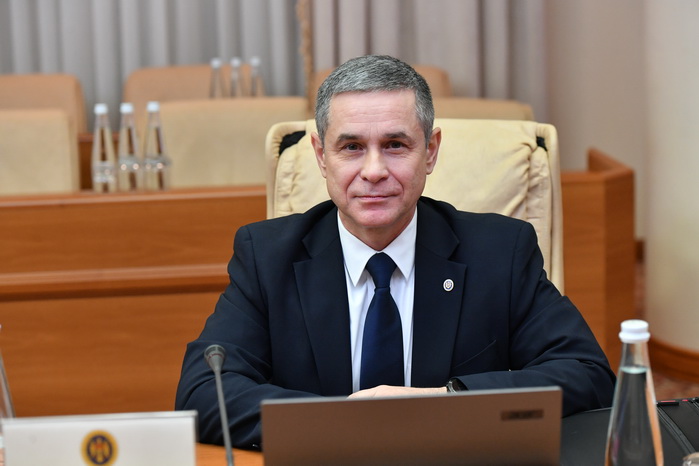
INTERVIEW MOLDPRES // Moldovan defense minister says Russia's war in Ukraine highlighted vulnerability of defense sector, need of building strong, prepared, resilient army to current challenges
Moldova is strengthening its defense capabilities in the regional context marked by the war in Ukraine and increased security risks, through investments in modern equipment, military technology, advanced technologies and continuous training of military personnel. Defense Minister Anatolie Nosatii has made statements to this effect in an exclusive interview with the MOLDPRES State Information Agency.

MOLDPRES: Mr. Minister Anatolie Nosatii, Moldova has been in a difficult regional context for more years. The war in Ukraine has strained the situation at the country's borders. How has the defense system changed during this period?

Anatolie Nosatii: Changes in the security environment in recent times, particularly around the Black Sea basin, have imposed the need to strengthen defense capabilities, adapting to regional realities to fulfil our constitutional missions, respond promptly and effectively to threats, and, most importantly, protect our country and citizens. The Russian Federation's war in Ukraine has accentuated the defense sector's vulnerability and the need to build a strong, prepared and resilient army to confront current challenges.

Thanks to joint efforts, budgetary allocations for defense and support from external partners, the Army is changing for the better. We have invested in new equipment, technology and weaponry, so that our military personnel can perform their missions at the highest level.

As a result, the National Army's engineers carry out demining missions with modern equipment and technology, including robots and drones, which ensure maximum safety. At the same time, infantry units are equipped with protective gear, as well as new armored vehicles and carriers, which provide increased mobility, better protection and efficiency in carrying out missions.

With the shift in the security paradigm, we have focused on modern technologies and consolidating cyber defense capabilities. The Army is now equipped with new communication and IT systems, that ensure the quick transmission of information and immediate response to any situation. Presently, military personnel use drones to perform various tasks according to their purpose.

We have strengthened surveillance, monitoring and air defense capabilities, contributing to effective risk management in airspace protection. Consequently, units are now better prepared, more mobile and adapted to the demands of an increasingly complex security environment.

We have strengthened cooperation with our partners in the European Union and the North Atlantic Alliance, allowing us to learn from their experiences, train together, and receive technical and logistical support. The result is an army that can respond more effectively to challenges and provide citizens with security. However, much remains to be done in this field, because modernization is a long-term and costly commitment.

MOLDPRES: We know that a new radar is expected to arrive in the country in 2026. How many such pieces of equipment does Moldova need, in order to secure its airspace, and when will the new radar become operational?

Anatolie Nosatii: Airspace surveillance and protection have become a priority, given the current security situation in the context of the Russian Federation's war against Ukraine. Accordingly, we put emphasis on improving early warning capabilities, which involve equipping with new systems that provide real-time information to competent structures, contributing to continuous and effective monitoring of the aerial situation.

The new radar you refer to was acquired with support on behalf of the European Union, through the European Peace Facility (EPF), and is expected to arrive in the country in the first half of 2026. We aim for the operationalization process to be as swift as possible. In this regard, we have already begun training military personnel responsible for operating and maintaining the new equipment.

Measures taken have contributed to improving the situation, but do not fully meet the needs in this area. We will continue to work in this direction, using budget resources and close cooperation with external partners, in order to develop and modernize the national air defense system.

MOLDPRES: Last year, the defense budget was increased, and the National Army received more equipment from external partners. What are the needs for the 2026 year?

Anatolie Nosatii: As provided in the current policy documents, the process of the National Army’s modernization is complex and ongoing. Thanks to political commitment, we are gradually implementing measures outlined in the National Security Strategy, the National Defense Strategy and the Military Strategy, aiming for a gradual increase in the budget up to 1 per cent of Gross Domestic Product (GDP) by 2030.

Nevertheless, even with this increase, the budget is insufficient for the army's situation to change as we want. Hence, we heavily rely on external assistance programmes and bilateral cooperation. Thanks to these partnerships, in 2025, the National Army received more batches of assistance, including new transport units and armored vehicles.

For 2026, we aim to continue ongoing projects and identify new ones that meet the current needs of the National Army. Additionally, next year, we will receive other deliveries of equipment, technology and modern systems as part of ongoing projects.

I reiterate that all these efforts are directed towards strengthening the country's defense capabilities and raising the level of citizens’ safety.

MOLDPRES: As for the training of servicemen and reservists, what are the plans for 2026?

Anatolie Nosatii: Training is a continuous process and a priority in the National Army's activities. In 2026, we will focus on its quality. Personnel will participate in multiple national and international exercises, as well as joint training with colleagues from other national defense institutions.

As for reservists’ training, in 2026, we will continue it. It is clear that all these exercises are aimed at training the capabilities that reservists have learned during military service and, most importantly, familiarizing them with new equipment and modern weaponry in the National Army's inventory.

We have noticed changes in citizens’ attitudes and perceptions towards these forms of training. Initially seen as intimidation and "preparation for war," they have gradually started to be perceived as a normal element of training and civic responsibility. At the same time, last year's experience showed an increase in reservists' interest in these forms of training, which is gratifying to me.

MOLDPRES: You have previously mentioned your wish for a professional army. How do you envision this?

Anatolie Nosatii: As outlined in the government's activity programme, EU, Peace and Development, to consolidate national security, it is essential for Moldova to have a modern, professional and well-equipped army, capable of effectively responding to contemporary challenges.

If I were to speak of personnel, then professional contract-based military should represent the core component of the National Army, because professionalism stems from years of training and experience. This personnel must be motivated, have various training opportunities, perform their missions in modern working conditions and enjoy competitive salaries. At the same time, other forms of citizens’ training should be maintained, such as conscription or reserve training exercises, adapted to current realities and conditions, similar to practices in many European states.

MOLDPRES: Could you provide us with a top five achievements for 2025 and priorities for the next year?

Anatolie Nosatii: All 2025's achievements focused on citizens’ safety, aimed at maintaining peace and stability for the benefit of people and the entire country.

The most important include:

1.  We approved the Military Strategy for 2025-2035, a document that had not been updated for a long time. Today, the Strategy fully meets current security requirements and reflects the vision and efforts for modernizing and transforming the Armed Forces, in accordance with existing legislation.

2.  In terms of modernization, the National Army was equipped with new artillery and anti-air systems, new transport units, personal protective equipment, engineering and medical equipment.

3.  Significant steps were taken in renovating military infrastructure. Consequently, we created better conditions for personnel to enhance the attractiveness of military service and public trust in the institution.

Thus, in 2025, 17 military infrastructure facilities underwent significant repairs in various units across the country. One notable example is the Codru Engineer Battalion from Negresti, where troops now enjoy modern facilities for training, accommodation, and dining.

Moreover, we continued construction works in the military unit in Bacioi. In 2025, 26 more buildings were constructed there.

4.  We increased the operational capacity of the National Army. Military personnel participated in numerous exercises, both domestically and abroad, alongside colleagues from other armies. Also, we continued conducting reserve preparation exercises, implementing new training procedures and modern equipment available.

5.  Significant progress was recorded in enhancing international security contribution. Our presence in international peacekeeping operations continued with the deployment of new contingents to missions like KFOR in Kosovo, UNIFIL in Lebanon and EUFOR ALTHEA in Bosnia and Herzegovina. This clearly shows that our military personnel are highly trained, showcasing excellent performance in missions’ fulfillment and interaction with other contingents.

Going forward, I wish for these results to be even more visible, so that Moldova has real defense capabilities and quick response to any threats. We will continue investing in the development of the National Army and strengthening cooperation with international partners for integration into the European security architecture.

Social protection for military personnel and their families will stay a constant concern, because a motivated and respected force is essential for any professional army's efficiency. We will improve service conditions, access to training and professional development opportunities and certainly explore possibilities to raise salaries.

Also, in 2026, we will initiate legislative amendments concerning reserve preparation and mobilization of the Armed Forces.

We will continue to maintain open and transparent communication with society, in order to ensure that citizens are correctly informed about the defense domain, National Army activities and its role. Combating misinformation remains a priority, so people understand that the army is a responsible institution, always ready to defend the country and its citizens.

Ultimately, we all want peace and tranquility, as well as a stable, prosperous and European future.

MOLDPRES: Mr. Minister Anatolie Nosatii, thank you for the interview.

Reporter: Alina Zara.
 Facebook
 Instagram
 X/Twitter
 Telegram
MOLDPRES INTERVIEW // Customs Service Director: Moldova has necessary experience to contribute to development of European customs system
MOLDPRES INTERVIEW // ANSC Director: We make sure that path of public money to hospitals, schools or infrastructure fair and transparent
MOLDPRES INTERVIEW // Vice President of Romanian Academy says academic, research environment of Moldova advanced, can be efficiently integrated into European, international structures
MOLDPRES INTERVIEW // Rector of University from Romanian city says if someone overturns your history, national identity, it means you don’t have enough knowledge
MOLDPRES INTERVIEW // Director of South Regional Development Agency says Agency creating better living conditions, easier life for thousands of residents
MOLDPRES INTERVIEW // Lithuanian Ambassador about prospects of Moldova’s EU accession: If you make things real, they will become achievable
MOLDPRES INTERVIEW // Moldovan finance minister says government aims to modernize financial system for benefit of businesses, citizens
MOLDPRES INTERVIEW // Ambassador of State of Qatar to Moldova: We are working to improve ways of attracting Qatari investors to Moldovan market
MOLDPRES INTERVIEW // President of Moldova's Chamber of Commerce and Industry says country must use opportunities provided by European integration to attract investments, become competitive
MOLDPRES Interview // Minister of Internal Affairs: Interior Ministry applies European security standards and is ready to advance in EU accession process
MOLDPRES INTERVIEW // Moldovan energy minister says foremost interest citizens to have secure energy at affordable prices
Moldovan justice minister says, according to European Commission’s Report, Moldova made greatest progress among EU candidate states, including in justice field
INTERVIEW WITH MOLDPRES // Deputy PM says wants Moldova where a child from any village has same opportunities as a child from Chisinau
INTERVIEW MOLDPRES // Deputy Prime Minister on Ukraine Peace Agreement: No discussion about Moldova can take place without Chișinău's participation
Moldovan Prime Minister in talks with Ukrainian President
Prime Minister's message of appreciation for Ukraine: Your resistance allows us to live in peace
Anti-Corruption Prosecutor Vadim Prisacari fails external evaluation
Technical-military cooperation agreement between Moldova and Ukraine signed in Kyiv
 National Bank of Moldova
Moldovan Prime Minister in talks with Ukrainian President
Prime Minister following meeting with Ukrainian counterpart: Every day Ukrainians defend their cities, families and freedom, they also contribute to security of Moldova
Speech by Prime Minister following meeting with Ukrainian counterpart
Prime Minister attends Kyiv International Economic Forum
Prime Minister's speech at Kyiv International Economic Forum

Speech by Prime Minister following meeting with Ukrainian counterpart
Moldova's European path and regional security discussed by Foreign Ministers of Moldova and Cyprus
Republic of Moldova fully covered electricity consumption on October 19–25
Romania’s Prime Minister to visit Chișinău on Tuesday
VIDEO // Ukrainian citizen illegally crossed border into Moldova by motorized paraglider and requested asylum
Powered paraglider illegally entered airspace of the Republic of Moldova
Republic of Moldova to promote tourism offering at WTM London 2026
Republic of Moldova and Cyprus seek to deepen interparliamentary cooperation
Prime Minister attends Kyiv International Economic Forum
Prime Minister's speech at Kyiv International Economic Forum
Moldovan parliament speaker, Metropolitan of Moldova Vladimir discuss spiritual values, society's unity
Moldovan Education Ministry introduces mandatory training to prevent plagiarism, fraud at universities
Foreign affairs minister of Moldova, President of Cyprus discuss strengthening Moldovan-Cypriot relations, Moldova’s European agenda
VIDEO // Moldovan PM in Kyiv says Moldova reconfirms firm support for Ukraine
Online services for submitting, issuing permits restored after cyberattacks in Moldova
Chisinau Airport to operate direct flights to 61 destinations during next winter season
Receive the latest news directly to your email

Receive the latest news directly to your email