
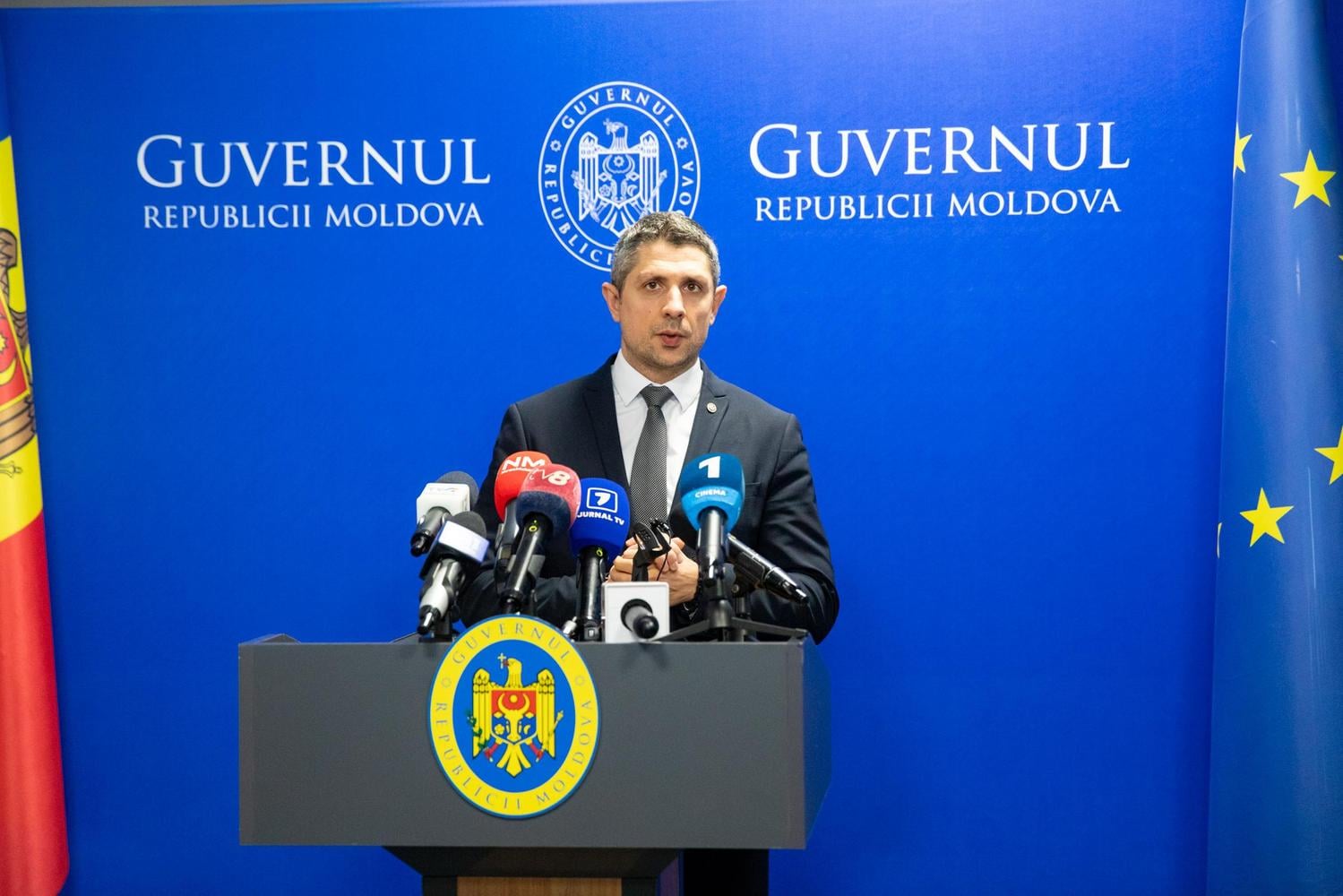
Moldovan justice minister says, according to European Commission’s Report, Moldova made greatest progress among EU candidate states, including in justice field
Moldova has made the greatest progress among the candidate states for accession to the European Union, including in the justice field, according to the European Commission’s November 2025 Report. Justice Minister Vladislav Cojuhari made statements to this effect in an exclusive interview given with MOLDPRES. The official stressed that the justice reforms, including the pre-vetting and vetting of judges and prosecutors, although complex and at times difficult, were already producing visible effects: the system is becoming more transparent, citizens are starting to regain confidence in the act of justice and old practices, affected by corruption and external influences, can no longer be reintroduced.
MOLDPRES: Mr. Minister, Moldova is in the middle of a process of assessing the compatibility of national legislation with the European Union’s one. What does our country need to do, in the justice field, in order to be compatible with the EU acquis?
Vladislav Cojuhari: According to the European Commission’s November 2025 Report, Moldova has made the greatest progress among the candidate states for accession to the European Union, including in the justice sector. This confirms that the direction of the reforms is correct, but also that the effort must be continued.
In 2026, the Justice Ministry will be fully involved in the process of aligning national legislation with the European Union acquis. Specifically, we will draft and amend normative acts, so that they meet both the best European standards and ensure the enforcement of the case law of the Court of Justice of the European Union.
This process does not provide for derogations for candidate states, but it is essential for consolidating a genuine rule of law and for a more predictable and fair justice system for citizens. The Justice Ministry is ready to carry this exercise through to the end, in close cooperation with European partners.
MOLDPRES: The justice system is presented in all public speeches as the most problematic area. The process of evaluating judges and prosecutors is progressing rather slowly. Are you satisfied with the pre-vetting and vetting process? Are these evaluations bearing fruit?Vladislav Cojuhari: If we look at the situation dynamically, the difference compared to five years ago is substantial. Back then, we were talking about a justice system deeply affected by corruption, external influences and widespread distrust on behalf of citizens. Today, we are at a different stage, in which the justice system is going through a difficult, but necessary process of cleansing and institutional consolidation.
The external evaluation of judges and prosecutors is neither a comfortable nor a quick exercise, and this is natural for a reform of such magnitude. Even if there are still problems, delays or resistance within the system, the direction is clearly positive and the changes are visible in the way institutions operate.
The most important thing is that citizens are starting to regain trust in justice. This process does not happen overnight and will still take time, but we are at an irreversible stage, in which a return to the practices of a few years ago is no longer possible.
MOLDPRES: The construction of a new prison has been discussed for some time. What is the situation in this respect and what else needs to be done?
Vladislav Cojuhari: The construction of a new prison remains a strategic objective for the Justice Ministry and is part of the effort to modernize the entire penitentiary system, in line with European standards. It is a project necessary both for respecting human rights and for enhancing the safety and efficiency of the detention system.
The project is being implemented with the support of the United Nations Office for Project Services, which provides expertise in the management of investments and procurement. During 2025, the stage of assessing compliance with the European Prison Rules was completed, and the next stage involves launching the procurement procedures for construction works and the effective start of the construction.
According to the schedule agreed with international partners, the construction of the prison is planned to be completed by the end of 2028, with commissioning in 2029. The Justice Ministry’s focus remains on quality, sustainability and compliance with international standards, so that the new prison meets both the needs of the system and the expectations of society.
MOLDPRES: In recent years, especially after the external evaluations, many prosecutors and judges have left the system. How many positions remain vacant and how do you plan to address the staffing shortage?
Vladislav Cojuhari: Departures from the system must be regarded in the context of the external evaluation process, which is complex and inevitably generates changes. It is true that some courts have felt these departures more acutely, but the situation is not apocalyptic and does not endanger the working of the justice system as a whole.
Reforms entail a transition period, and our focus is on stabilizing the system and ensuring the continuity of the act of justice. In parallel, we are seeing growing interest on behalf of legal professionals in joining the system, which contributes to the gradual rebalancing of human resources.
As for prosecutors, the external evaluation falls within the same general framework of justice reform. The processes are managed by the competent institutions, and concrete data on vacant positions fall under the responsibility of self-governing authorities. What is important is that this exercise aims to strengthen integrity and professionalism, even if its effects materialize over time.
Training new generations remains a constant priority. The National Justice Institute is in a continuous process of improving its programmes and training mechanisms, with a new management team, and the impact of these efforts will be felt gradually, in the medium and long term.
MOLDPRES: Finally, please present a top 5 of achievements for 2025 and priorities for 2026.
Vladislav Cojuhari: In 2025, the Justice Ministry focused on consolidating justice reforms and advancing the European agenda of Moldova. A major goal was preparing and supporting the negotiation process on the chapters related to the rule of law, as well as continuing the external evaluation of judges and prosecutors as a central element of cleansing the system. At the same time, the foundations were laid for modernizing infrastructure and digitizing legal services.
For 2026, our priorities are clear. We will focus on aligning national legislation with European Union law, accelerating the digitalization of justice and strengthening institutions, so that the act of justice becomes more efficient, more predictable, and closer to the citizen. The ultimate goal remains increasing public confidence in a functional and integrity-based justice system.
Mr. Minister Vladislav Cojuhari, thank you for the interview.
Reporter: Alina Zara.

 Facebook
 Instagram
 X/Twitter
 Telegram
MOLDPRES INTERVIEW // Customs Service Director: Moldova has necessary experience to contribute to development of European customs system
MOLDPRES INTERVIEW // ANSC Director: We make sure that path of public money to hospitals, schools or infrastructure fair and transparent
MOLDPRES INTERVIEW // Vice President of Romanian Academy says academic, research environment of Moldova advanced, can be efficiently integrated into European, international structures
MOLDPRES INTERVIEW // Rector of University from Romanian city says if someone overturns your history, national identity, it means you don’t have enough knowledge
MOLDPRES INTERVIEW // Director of South Regional Development Agency says Agency creating better living conditions, easier life for thousands of residents
MOLDPRES INTERVIEW // Lithuanian Ambassador about prospects of Moldova’s EU accession: If you make things real, they will become achievable
MOLDPRES INTERVIEW // Moldovan finance minister says government aims to modernize financial system for benefit of businesses, citizens
MOLDPRES INTERVIEW // Ambassador of State of Qatar to Moldova: We are working to improve ways of attracting Qatari investors to Moldovan market
MOLDPRES INTERVIEW // President of Moldova's Chamber of Commerce and Industry says country must use opportunities provided by European integration to attract investments, become competitive
MOLDPRES Interview // Minister of Internal Affairs: Interior Ministry applies European security standards and is ready to advance in EU accession process
MOLDPRES INTERVIEW // Moldovan energy minister says foremost interest citizens to have secure energy at affordable prices
INTERVIEW MOLDPRES // Moldovan defense minister says Russia's war in Ukraine highlighted vulnerability of defense sector, need of building strong, prepared, resilient army to current challenges
INTERVIEW WITH MOLDPRES // Deputy PM says wants Moldova where a child from any village has same opportunities as a child from Chisinau
INTERVIEW MOLDPRES // Deputy Prime Minister on Ukraine Peace Agreement: No discussion about Moldova can take place without Chișinău's participation
Moldovan Prime Minister in talks with Ukrainian President
Prime Minister's message of appreciation for Ukraine: Your resistance allows us to live in peace
Anti-Corruption Prosecutor Vadim Prisacari fails external evaluation
Technical-military cooperation agreement between Moldova and Ukraine signed in Kyiv
 National Bank of Moldova
Moldovan Prime Minister in talks with Ukrainian President
Prime Minister following meeting with Ukrainian counterpart: Every day Ukrainians defend their cities, families and freedom, they also contribute to security of Moldova
Speech by Prime Minister following meeting with Ukrainian counterpart
Prime Minister attends Kyiv International Economic Forum
Prime Minister's speech at Kyiv International Economic Forum


Speech by Prime Minister following meeting with Ukrainian counterpart
Moldova's European path and regional security discussed by Foreign Ministers of Moldova and Cyprus
Republic of Moldova fully covered electricity consumption on October 19–25
Romania’s Prime Minister to visit Chișinău on Tuesday
VIDEO // Ukrainian citizen illegally crossed border into Moldova by motorized paraglider and requested asylum
Powered paraglider illegally entered airspace of the Republic of Moldova
Republic of Moldova to promote tourism offering at WTM London 2026
Republic of Moldova and Cyprus seek to deepen interparliamentary cooperation
Prime Minister attends Kyiv International Economic Forum
Prime Minister's speech at Kyiv International Economic Forum
Moldovan parliament speaker, Metropolitan of Moldova Vladimir discuss spiritual values, society's unity
Moldovan Education Ministry introduces mandatory training to prevent plagiarism, fraud at universities
Foreign affairs minister of Moldova, President of Cyprus discuss strengthening Moldovan-Cypriot relations, Moldova’s European agenda
VIDEO // Moldovan PM in Kyiv says Moldova reconfirms firm support for Ukraine
Online services for submitting, issuing permits restored after cyberattacks in Moldova
Chisinau Airport to operate direct flights to 61 destinations during next winter season
Receive the latest news directly to your email

Receive the latest news directly to your email