
VIDEO // Growing budget deficit, record investments in 2026: Moldovan finance minister gives explanations
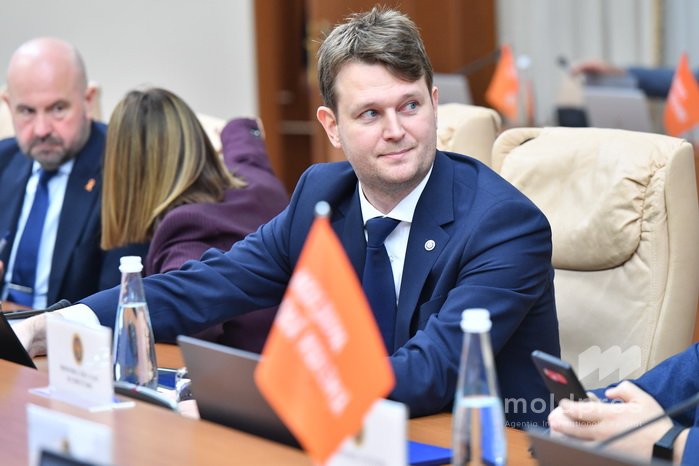
Moldova will enter 2026 with a budget deficit estimated at over 20 billion lei, a high level that requires fiscal responsibility measures and sustainable financing solutions. Finance Minister Andrian Gavrilita made statements to this effect at a news conference following the today's cabinet meeting, during which he presented the budget outlook for next year.
According to the minister, the budget revenues are estimated at around 80 billion lei, while expenditures will reach 100 billion lei. The difference is to be covered from both internal sources and external financing, including investments on behalf of development partners.
Increasing financing costs: “The deficit would not be a problem, if loans were cheap”
The minister said that the main challenge was the high cost of domestic debt, which has risen from 7–9 per cent in previous years, significantly affecting the state's ability to borrow cheaply.
“The deficit itself would not be a problem, if we had a reduced financing cost. At this moment, costs are high, especially for domestic debt. Reducing these costs is a key priority”, said Gavrilita.
The official highlighted the constructive discussions with the European Union, IMF and other international partners, focused on finding refinancing solutions to reduce budget pressure.
Record investments in 2026: “We will not stop any project”
Despite budgetary pressures, the government does not intend to reduce investments – on the contrary, 2026 will witness a record level of investments.
“We assume to go with this deficit, so as not to stop any investment that can be made next year. Half of the additional expenditures will go into investments”, emphasized the minister.
From the economic growth programme agreed with the European Union alone, Moldova will benefit from 5.6 billion lei - the largest allocation so far.
The minister listed the main areas that will benefit from additional funding: small and medium enterprises: over 1 billion lei; energy storage and generation: 560 million lei; agriculture and rural environment: almost 500 million lei; local and regional development: 280 million lei; rail infrastructure: approximately 200 million lei; energy efficiency in the residential sector: 185 million lei.
“The number one priority in the energy sector stays reducing invoices through investments in energy efficiency, followed by increasing population’s incomes, so that the transition from compensations to real savings is sustainable”, said Gavrilita.
Negotiations with IMF: no salary cuts or layoffs
When asked about potential measures required by the IMF for budget adjustment, the minister was firm.
“We will not allow salary cuts. We will not resort to layoffs where they are not justified. The solution comes not from cuts, but from growth of revenues and refinancing expensive debts”, the minister also said.
Gavrilita specified that the government was set to propose reforms that will bring additional revenues to the budget, without shocks or unpredictable measures for citizens and businesses.
The new salary law: more equity and correcting discrepancies
The minister confirmed that the cabinet was working intensively on a new salary law, with the ambition to present it in a few months and enforce it starting from September 1, 2026.
The main goal: more equity in the system.
“Today, there are top state executives with low salaries and, at the same time, individuals with incomes ten times higher. I’m not saying it should be the reverse, but we certainly need uniformity. In some agencies, salaries are exaggerated, and these discrepancies need correction”, stressed Andrian Gavrilita.
The new law will focus on increasing salaries for employees with low incomes, while some positions with very high remunerations might be adjusted.
Outlook for 2026–2027: stability, predictability and responsibility
The Ministry of Finance intends to finalize both the 2027 budget and the fiscal policies in the first half of 2026, in order to ensure predictability for the business environment and citizens.
“We will not make sudden or unpredictable changes. The objective is a uniform and sustainable growth, supported by own revenues and advantageous financing”, summarized the finance minister.

 Facebook
 Instagram
 X/Twitter
 Telegram
VIDEO // Moldovan National Roads Administration's update: winter driving conditions on national roads; restrictions for heavy transport on more routes
Goods exports increased by 6.4 percent in 2025
Public Property Agency says procedures of expropriation for land of future U.S. Embassy in Moldova almost completed
VIDEO // Chișinău International Airport: snowfall and blizzards disrupt flights as snow removal equipment operates continuously
Naval maneuvers in Giurgiulesti Port of Moldova temporarily suspended over adverse weather conditions
Energy Minister: No significant adjustment to electricity tariff
Railway of Moldova enterprise enters reorganization: assets to be evaluated before company is split into two entities
UPDATE 10:50 // Traffic of heavy vehicles temporarily suspended on Căușeni – Anenii Noi route
Direct flights from Chișinău to Korea
Facilities for Moldovans returning to live at home: Government-approved decision
Moldelectrica enterprise to be reorganized
Moldova and Korea strengthen bilateral economic cooperation: agreement signed in Chișinău
VIDEO // Work continues on Moldova's largest water main: central region’s water supply project moves forward
All consumers affected by 15–16 February glaze ice reconnected to power grid
PHOTO // Moldovan parliament's building illuminated in colors of Ukrainian flag
Call to the parliament of Romania: two academicians call for adoption of law on branch of Romanian of Academy in Chisinau
Moldovan president has meeting with delegation of Denmark's parliament
PHOTO // Support worth 20 million euros on behalf of Denmark; Moldova to strengthen defense sector, mechanisms to counter disinformation
Support for export promotion: Bridge Export Programme, with budget of 60 million lei, launched in Chisinau
Road workers of Moldova to carry out extensive repair works on national routes as soon as weather conditions allow
Stolen Billion file: former leader of Moldovan Democratic Party appears before court, makes statements on case
 National Bank of Moldova
Moldovan president has meeting with delegation of Denmark's parliament
Moldovan deputy PM for reintegration has meeting with special envoy of Ukraine's Foreign Affairs Ministry
Moldovan deputy PM for reintegration meets members of Danish parliament's foreign policy committee
Prime Minister at FIRST Tech Challenge Moldova: Young people who choose to create, experiment and work for their ideas - strongest investment in future of Moldova
Consultations on local public administration reform: reform vision discussed in another nine districts of Moldova

Women made up majority of voters at last two parliamentary elections; Moldovan Central Electoral Commission notes increase in turnout
Republic of Moldova could become hub in Ukraine’s reconstruction process
AUDIO // Five people detained after dozens of searches in case of embezzlement of infrastructure funds
Prime Minister at FIRST Tech Challenge Moldova: Young people who choose to create, experiment and work for their ideas - strongest investment in future of Moldova
Deputy Prime Minister to pay working visits to Switzerland and Austria
Presidency issues clarifications on pardon of convict and subsequent revocation of pardon decree
CNA conducts over 40 searches at multiple town halls, economic operator in case involving embezzlement of infrastructure funds
Members of Foreign Affairs Committee of Seimas of Lithuania on visit to Moldova
Orthodox Christians enter Easter Fast
VIDEO, PHOTO // Discover Moldova with #MOLDPRES: Văleni village, Cahul, promoted as European rural tourism destination
Thousands of students from Moldova convey messages of solidarity to children in Ukraine through campaign, Letter can replace hug
VIDEO // Moldovan and Ukrainian authorities dismantle criminal group planning assassinations in Ukraine
Republic of Moldova becomes European indoor archery champion
Accurate information matters: Government and Police platforms for verified news
Branch of Romanian Academy to be set up in Chișinău
Moldovan police announce detention of another suspect in case of planned assassinations in Ukraine
Receive the latest news directly to your email

Receive the latest news directly to your email