
MOLDPRES INTERVIEW // Vice President of Romanian Academy says academic, research environment of Moldova advanced, can be efficiently integrated into European, international structures
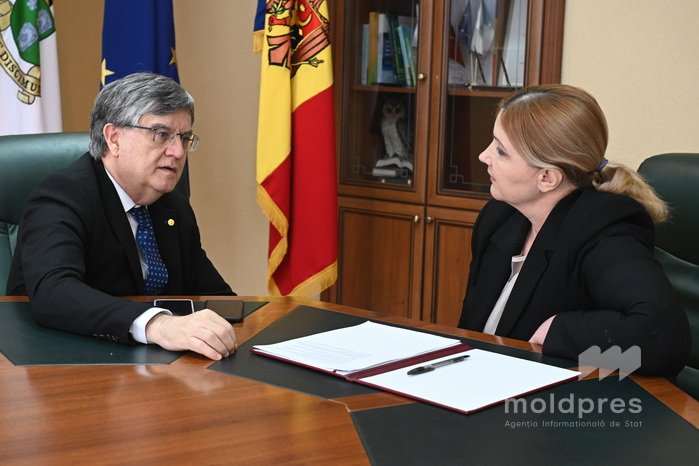
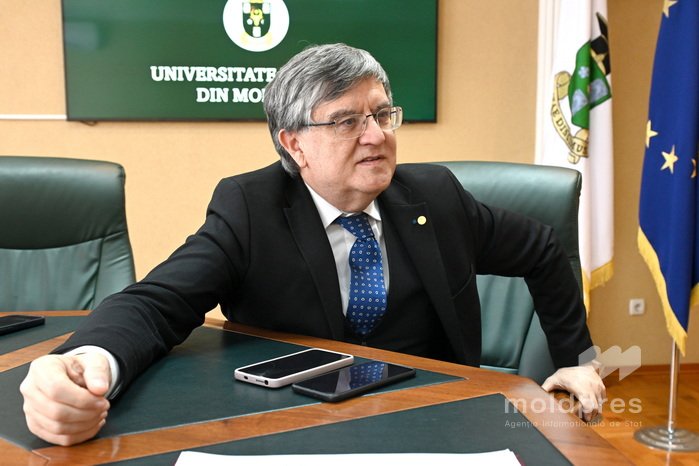
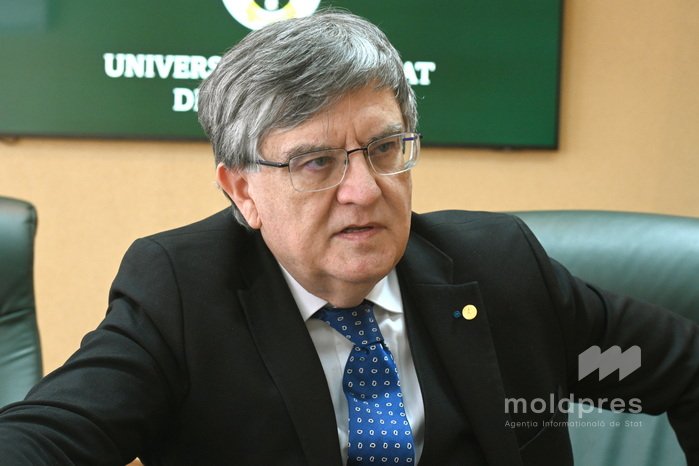
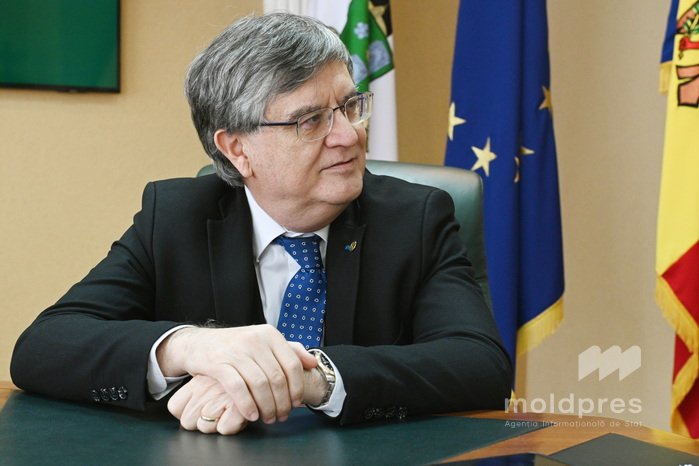
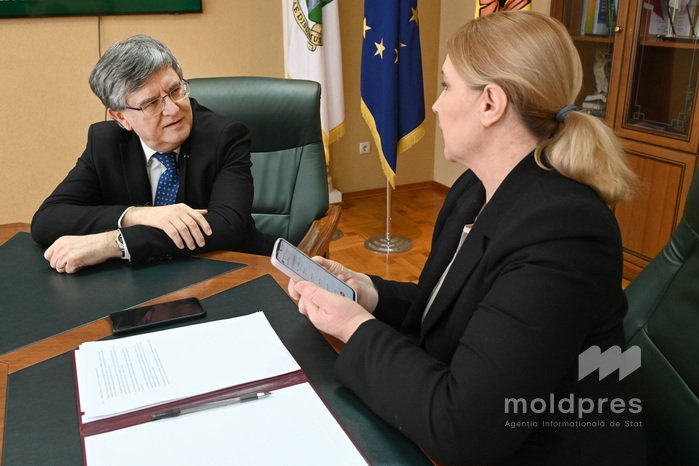
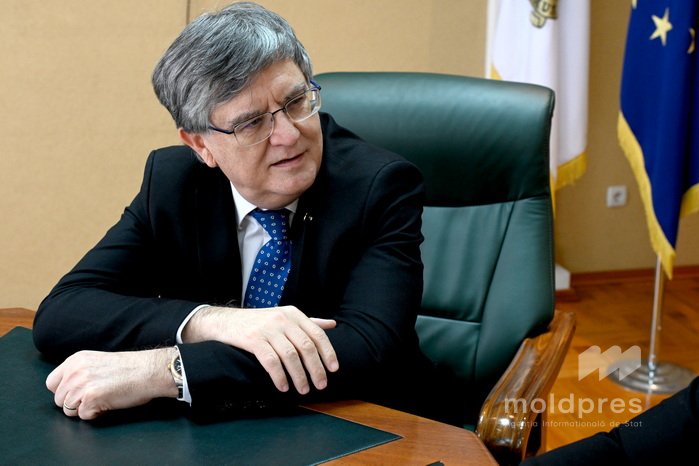
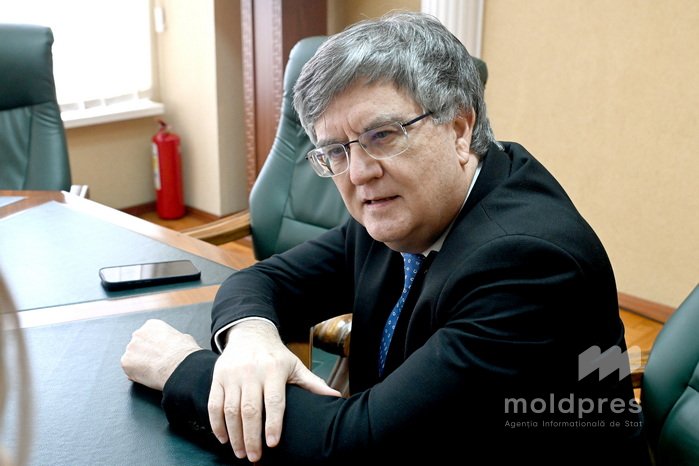
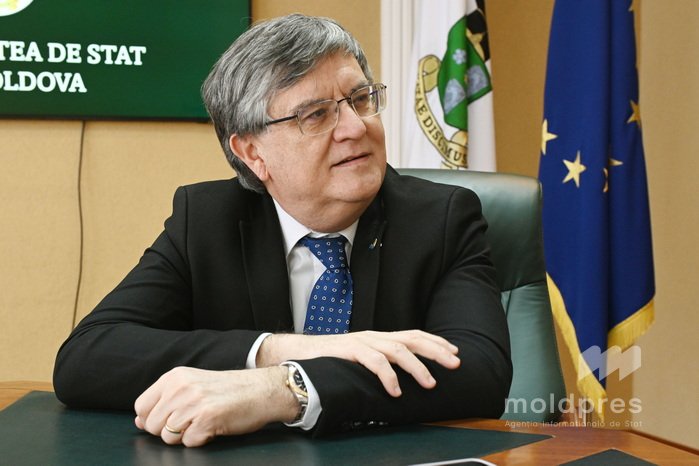
Vice President of the Romanian Academy, academician Mircea Dumitru, in an exclusive interview given to the MOLDPRES Agency, says that “the future of Moldova lies alongside Romania, first and foremost in the European Union”, He emphasized that the country’s European project and trajectory are “already certainties”, and that the coming years must bring full compatibility of the Moldovan institutions with European ones.
The Romanian professor believes that universities and the research environment of Moldova are sufficiently advanced to quickly integrate into a European and international academic structure. In the context, he announces that the Romanian Academy could open a branch in Chisinau— an initiative with symbolic and strategic value, considering that the institution currently has branches only in three major historical centers in Romania: Iasi, Cluj and Timisoara.
In the interview with MOLDPRES, Mircea Dumitru also comments on President Maia Sandu’s statement regarding a possible unification with Romania, noting that rapprochement between the two states can also be achieved through concrete cooperation between institutions.
“Unification can also be achieved in the way in which the institutions of the two countries can work together,” the academician says. Moreover, in a counterfactual exercise, he declares that, if Maia Sandu were to run for the presidency of Romania, he would vote for her “with both hands”.
On a philosophical and civic level, the vice president of the Romanian Academy draws attention to the importance of natural rights, stressing that the right to freedom, dignity, property and a happy life are non‑negotiable and cannot be reduced to mere political arrangements.
Referring to the academic cooperation between Moldova and Romania, Mircea Dumitru evokes both the symbolism of the “bridges of flowers” and the need to strengthen institutional and university “bridges”. “Perhaps just as important or even more important are the bridges we create at the level of academic programmes and university integration. With this in mind, we have worked and will continue to work with our colleagues from Chișinău,” the academician underlines.
MOLDPRES: Mr. Academician Mircea Dumitru, in the context of the European path of Moldova, how do you see the role of academic and cultural cooperation between Chișinău and Bucharest in shaping a common future of Moldova and Romania in the European Union, and what responsibility lies with the university and scientific community in this process?Mircea Dumitru: I would like to stress, from my point of view, that I am not a highly qualified political commentator and I am not active in politics. My opinion is that the future of Moldova lies alongside Romania, first and foremost in the European Union. The European project and trajectory of Moldova are already certainties, and we are waiting for this period of a few more years until accession to conclude with a perfect compatibility of Moldova’s institutions with European institutions.
From this perspective, I can say that I greatly value and feel an intellectual and moral comfort when I see President Maia Sandu presenting and representing Moldova and the common cultural and historical roots of Romanians in Romania and in Moldova. I value her very much and believe she is a remarkable political figure who appeared, historically speaking, exactly when we most needed such a personality, such a public stance and such an outstanding, not only political, but I would say even cultural, personality as President Sandu has.
On the other hand, in my current capacity as Vice President of the Romanian Academy, I have contributed and continue to contribute to the development of relations between the two academies — the Romanian Academy and the Academy of Sciences of Moldova.
There are very important projects underway. One of them has been recently put into action by the two presidents, Ioan-Aurel Pop from Bucharest and Ion Tighineanu from Chișinău, regarding the integration and development of joint projects between the two academies, including through our attempt and our wish in Bucharest — which will likely become legal reality once the new Law of the Romanian Academy is adopted by the Parliament of Romania — to open a branch of the Romanian Academy in Chisinau.
In this way, without being in competition, we will be in a very fruitful alliance, highly productive for scientists both in Chisinau and in Bucharest. The draft law is under debate in the Romanian Senate, and one of the points is precisely this one. When it is adopted and approved — and I see no reason for it to be rejected, especially this article in the draft law — the Romanian Academy will be able to open a branch in Chisinau, just as it currently has branches only in three major historical cities of Romania: Iasi, Cluj and Timisoara.
We do not have many branches; the fourth branch will be here in Chisinau, once the law is approved by the Parliament of Romania.
MOLDPRES: Will this be an opportunity for researchers from Moldova to access European research funds?
Mircea Dumitru: Certainly, provided that by then — and I have no doubt — the Moldova will be part of the European Union. I hope that this branch and the relationship between the two academies will be a priority.
MOLDPRES: In January, President Maia Sandu said in a podcast with British journalists that, if there were a referendum, she would vote for unification with Romania. Since this objective does not enjoy broad support within the political class of Moldova, European integration is the best option, Maia Sandu argued. How can we understand this statement by Maia Sandu? What is its significance?Mircea Dumitru: I believe President Sandu was speaking in a completely counterfactual scenario in which a referendum on this topic could be held. I know that some opinion polls made public in Moldova do not show a very high level of support for such a political formula of unification between the two countries, but I also believe that, in a substantial and real sense, if not in a legal-political sense, unification can also be achieved through the way in which institutions of the two countries can work together.
For instance, consider the way in which the Romanian Academy from Bucharest works with the Academy of Sciences of Moldova, and the exceptional relations between the two academy presidents, academician Ioan-Aurel Pop and Mr. Ion Tighineanu from Chisinau. Such things already represent steps toward unification, but we are obviously not speaking — and I do not think President Maia Sandu, who is a consummate politician, has in mind at this moment — a referendum for a political union between the two countries.
I have not listened to the entire podcast, but I think I can comment along these lines, understanding the logic of this viewpoint as the one of a desirable and counterfactual discourse. If we are talking about such matters, allow me to tell you what I, Mircea Dumitru, in Bucharest, would do if I were placed in a, for now, counterfactual situation in which President Maia Sandu would run for the Presidency of Romania. I must tell you very honestly that, judging by what I have seen so far and having no reason to believe I will be disappointed in the future, I would vote for President Maia Sandu for the Presidency of Romania with both hands, so to speak. That is how much trust and respect I have for this person.
MOLDPRES: You gave a lecture at the Moldovan State University (USM) on grounding moral judgment in a society marked by polarization and relativism. In your talk you defended a realist position regarding the existence of natural rights as moral limits to political power. How topical is this debate in a global context marked by polarization and moral relativism?
Mircea Dumitru: I chose this topic, as I consider it very important. As a research subject, it may not be as visible today as it was in the past. Here we are talking about the history of philosophy, which nevertheless has a long timespan behind it; we are speaking of a two-thousand‑year history of philosophy as we practice it, starting from the Greeks in the 4th century BC and reaching what we study today.
However, I believe that especially in the current context, in which there are so many situations where individuals, ordinary people are placed in circumstances where our rights are questioned, doubted or even violated, it is very important to advocate the idea that certain rights — such as people’s right to be free, the right to preserve their own integrity and dignity, the right to property, the right to a happy life — are not negotiable. They are not the result of political or legal arrangements; they are rights that mark, within the social fabric, the importance, position and significance of people as human beings, not only as citizens of one country or another. This is the natural law tradition, as I see it.
MOLDPRES: How important, in your opinion, are moral philosophy and the theory of natural rights for consolidating democracy and civic culture in Eastern European societies?Mircea Dumitru: Interpreted in a broadly liberal manner, as I have also interpreted it — and I use the term “liberal” not in the partisan sense of a liberal party, but in the philosophical sense in which it was used in the 19th century in political philosophy — this perspective is very important for consolidating democratic life. When citizens feel valued, are respected and their dignity is not violated, they feel the need to contribute to democratic life, because they understand and feel that their voice is heard, that they are not seen merely as instruments for certain goals of politicians with inclinations that are rather antidemocratic or totalitarian.
MOLDPRES: After your public lecture at the Moldovan State University, what impression did the students and young researchers from Moldova leave on you? How do you assess their level of preparation and openness to contemporary philosophical debates?
Mircea Dumitru: I know the academic environment from Chisinau and throughout the republic very well, and I am very glad and deeply honored by the invitation I received from Rector Igor Sarov to give this public lecture and to enter into a dialogue with Rector Daniel David.
I also know the academic environment, because almost ten years ago — it was January 10 of that year — as Rector of the University of Bucharest, I initiated efforts that ultimately led to the creation of shared institutions between the University of Bucharest and the Moldova State University.
I have in mind, first of all, the fact that, on my initiative together with Rector Ciocanu at that time, the late professor, we ruled to associate USM with the status of associate member of the Universitaria Consortium of Romania, the consortium of the most important universities in Romania. At that time, there were five member universities; since then, a few more have joined. I considered it very important for the university from Chisinau to be a partner in this university structure in Romania.
Then, together with colleagues from the Faculty of History and Philosophy, I initiated joint degree programmes with double diplomas issued by the Moldova State University and the University of Bucharest in the field of History. These programmes still function today at master’s level and are very important, especially from the perspective of stabilizing students of Moldova and offering the possibility to study in Romania without leaving Moldova. Students followed these programmes simultaneously in Chisinau and in Bucharest. The diploma is valid both in Romania and in Moldova. In this way, we are helping our colleagues of Moldova, because students will no longer be so motivated or tempted to leave the country permanently.
On the other hand, a joint seminar on culture and national identity continues to function. One year it is organized in Bucharest, and the following year in Chisinau. In April 2026, we will hold the seminar at the University of Bucharest, at the Faculty of Philosophy. It is a seminar that primarily involves our younger colleagues, professors who are very interested in developing these cultural and academic relations.
My appreciation for the teaching staff here and for what they do is very high, considering that they have not always worked under the most favorable conditions for academia. However, they have been very strong, very resilient and trustworthy partners for this kind of joint project.
MOLDPRES: Can we regard these as actions of integration into the European educational system?
Mircea Dumitru: Absolutely. I have never thought of this relationship as being one‑sided, in the sense that we have something to offer and you only have something to receive. On the contrary, it is a two-way relationship. On a certain occasion, when I was invited here to give a lecture and received the title of Doctor Honoris Causa of USM, I expressed this thought in a metaphorical form. I said that the bridges of flowers, symbolic bridges that reflect our common history, are very important, especially now in the context of the European Union. But perhaps just as important or even more important are the bridges we build at the level of academic programmes and university integration. With this in mind, we have worked and will continue to work with our colleagues from Chisinau.
MOLDPRES: From the perspective of your experience as Minister of Education of Romania, how do you assess the development of the educational system of Moldova and the process of alignment with European standards? Do you consider that young people are sufficiently well‑trained to face international academic competition?Mircea Dumitru: I believe that the common future of Romania and Moldova is a future we are building within the European Union, and I very much hope that, in a concrete way, Moldova will become a full member of the European Union and thus further develop this very important path, which has not been without difficulties for your country either, along this Euro‑Atlantic trajectory.
I also believe that universities, the academic environment and the research environment are very advanced and can be integrated fairly quickly and easily into a European and international framework. All the topics we research, study and teach our students have an international, European, even global vocation. They are not merely subjects strictly linked to a local context. People working in research, education and culture, by the very nature of their work — teaching and research — are much more open to this process of internationalization.
MOLDPRES: What connects you personally and professionally to Moldova, and how do you see the development of academic cooperation between institutions of Moldova and the ones of Romania?Mircea Dumitru: I do not have roots in Moldova; I have no family members originally from here. But in these 10–12 years in which I have come very often to Moldova, especially to Chișinău, I have made many friends. I have said more times, including on the occasion of this meeting, that in Chisinau, and especially at this university, I do not feel only “as if I were at home”, but I feel at home — and you can of course sense the difference; this “as if” is very important for us. In Romanian, when you say that you feel “as if at home”, in fact you are not at home, you feel familiar with things, but you are not in your own home. When you say, however, that “I feel at home”, it is a much more complete feeling.
This feeling has grown over the years because here I have friends and colleagues in my profession or in related academic fields who are very good specialists and outstanding people. Beyond the fact that they are good professors or researchers, they are true people and true friends.
MOLDPRES: Mr. Academician Mircea Dumitru, thank you for your openness and willingness to give this interview with the MOLDPRES Agency and for the reflections you shared on the common European future of Moldova and Romania.
Mircea Dumitru: I thank your news agency for taking the time for this discussion.
Mircea Dumitru is one of the most important contemporary Romanian philosophers. A university professor at the Faculty of Philosophy of the University of Bucharest, he has distinguished himself through his contributions in such fields as the philosophy of language, philosophical logic, metaphysics and the philosophy of mind. His work is closely linked to the defense of the idea of objective truth, the analysis of the relationship between language and reality, and reflection on the moral foundations of the modern society.A full member of the Romanian Academy since 2014, Mircea Dumitru currently serves as Vice President of the supreme forum of scientific and cultural recognition in Romania. During his career, he has also played an important role in the administration of the academic environment, serving as Rector of the University of Bucharest between 2011 and 2019, a period during which he promoted academic integrity and standards of excellence in education and research.
In addition to his academic activity, Mircea Dumitru has had a significant public role, serving as Minister of Education in 2016, when he supported reforms oriented toward meritocracy and the strengthening of quality in the education system.
With doctoral studies carried out in the United States and a constant activity in the international academic environment, Mircea Dumitru is recognized for his contributions to analytic philosophy and for his efforts to bring philosophical reflection into dialogue with the contemporary challenges of the democratic society.


 Facebook
 Instagram
 X/Twitter
 Telegram
MOLDPRES INTERVIEW // Lithuanian Ambassador about prospects of Moldova’s EU accession: If you make things real, they will become achievable
MOLDPRES INTERVIEW // Moldovan finance minister says government aims to modernize financial system for benefit of businesses, citizens
MOLDPRES INTERVIEW // Ambassador of State of Qatar to Moldova: We are working to improve ways of attracting Qatari investors to Moldovan market
MOLDPRES INTERVIEW // President of Moldova's Chamber of Commerce and Industry says country must use opportunities provided by European integration to attract investments, become competitive
MOLDPRES Interview // Minister of Internal Affairs: Interior Ministry applies European security standards and is ready to advance in EU accession process
MOLDPRES INTERVIEW // Moldovan energy minister says foremost interest citizens to have secure energy at affordable prices
Moldovan justice minister says, according to European Commission’s Report, Moldova made greatest progress among EU candidate states, including in justice field
INTERVIEW MOLDPRES // Moldovan defense minister says Russia's war in Ukraine highlighted vulnerability of defense sector, need of building strong, prepared, resilient army to current challenges
INTERVIEW WITH MOLDPRES // Deputy PM says wants Moldova where a child from any village has same opportunities as a child from Chisinau
INTERVIEW MOLDPRES // Deputy Prime Minister on Ukraine Peace Agreement: No discussion about Moldova can take place without Chișinău's participation
INTERVIEW MOLDPRES // Moldovan agriculture and food industry minister says European integration fundamentally changes way leadership supports agriculture
INTERVIEW MOLDPRES // Romania's Ambassador in Chisinau says Moldova to never be alone in its efforts, Romania to stand by its side
MOLDPRES INTERVIEW // Romanian culture minister says culture adds value, rebuilds trust
MOLDPRES interview // IGP head: Russia whether through Ilan Shor or other means to constantly try to find ways to create disorder and destabilization
PHOTO // PM in New York tells Diaspora government willing to turn experience of Moldovans from United States into projects for country
Moldovan foreign affairs minister at UN says Moldova strengthening capacity to respond to health threats
Moldova under emergency state in energy, hydrological sectors as of September 26; what measures take effect
PHOTO // PM promotes Moldova's investment opportunities in New York
Balti Clinical Hospital to receive ultrasound machine through grant provided by government of Japan
Japan supports modernization of Balti Clinical Hospital with grant worth over 95,000 dollars
Moldovan parliament speaker urges students not to be afraid to express their ideas, wishes
 National Bank of Moldova
Strengthening Moldova’s cooperation with UNDP, UNOPS discussed in New York
Moldova's National Crisis Management Commission approves new measures to ensure energy security, protect water resources
Moldovan PM, U.S. investors, companies discuss potential projects in Moldova
Head of state says Moldovans must build economy where well-educated people can find opportunities at home
Moldova represented at Interparliamentary Conference on Stability, Economic Coordination and Governance in European Union

Moldova's Border Police receive six special vehicles on behalf of FRONTEX
Head of state says Moldovans must build economy where well-educated people can find opportunities at home
Moldovan president attends events dedicated to 35th anniversary of foundation of Academy of Economic Studies
New charges brought against former Moldovan president Igor Dodon in “Kuliok” case; prosecutors seek harsher sentence
Moldova represented at Interparliamentary Conference on Stability, Economic Coordination and Governance in European Union
ARMENPRESS: EU Commissioner Kos promotes Armenian products after trade measures adopted
VIDEO // Parliament speaker conveys message to coaches of Moldova
Public buildings of Moldova to undergo energy renovation with World Bank's support
Mircea Eșanu on nomination to lead Moldova Project: More information could become known in October
President’s speech at ASEM’s 35th anniversary
PHOTO GALLERY // Moldova's new passport presented by Public Service Agency
VIDEO // Moldova to introduce new passport model as of October 15; document to feature more than 100 security elements
DOC // Regulation on e-Consulat System published in Official Journal
National Award for Seniors: 15 people winners in 2026 edition
PHOTO // Moldova’s protected areas strengthened through restoration works, planting and new management tools
Moldovan, Dutch Prime Ministers discuss European path and investments
Receive the latest news directly to your email

Receive the latest news directly to your email