
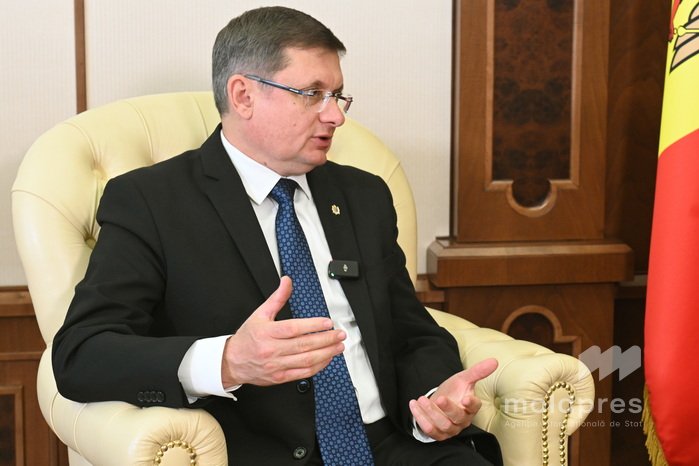
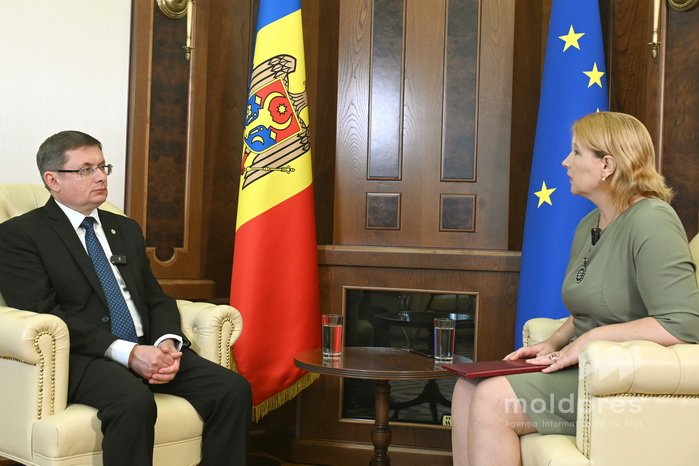
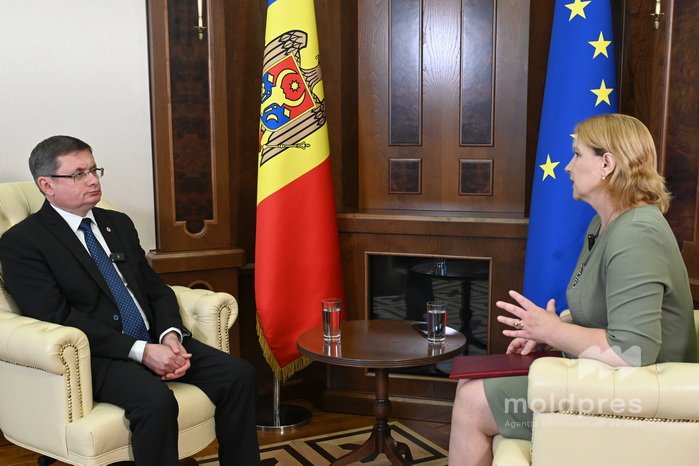
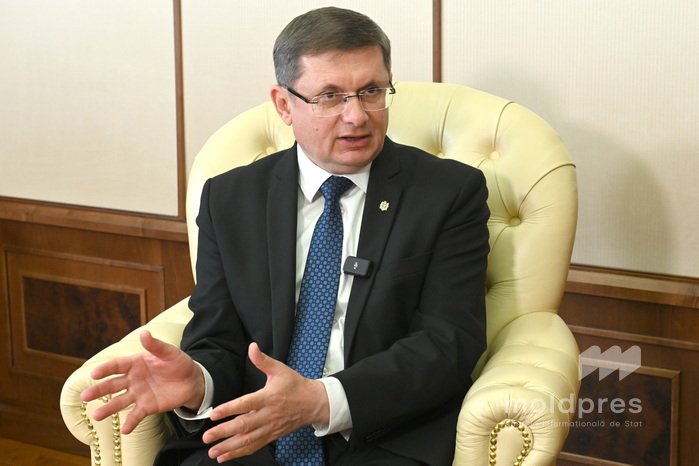
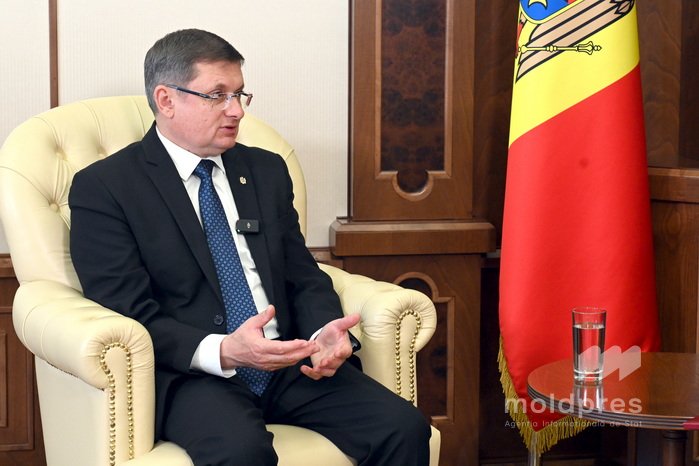
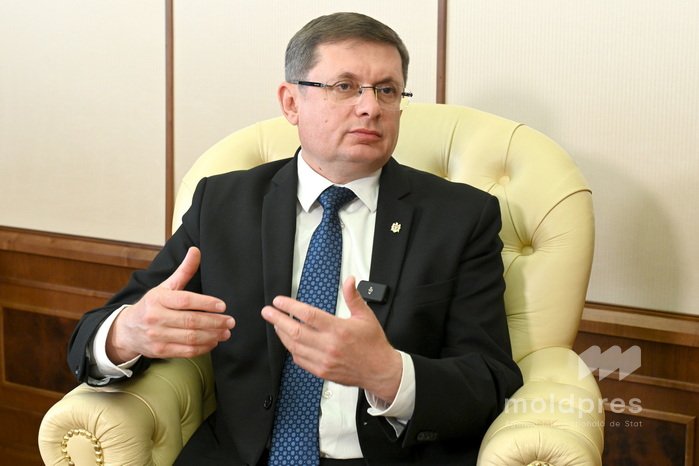
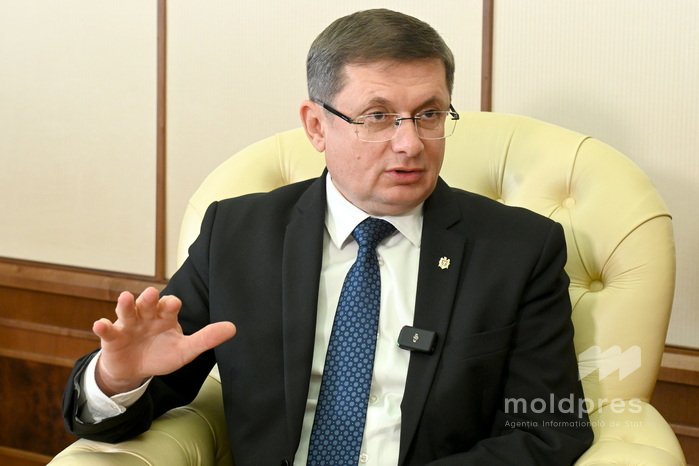
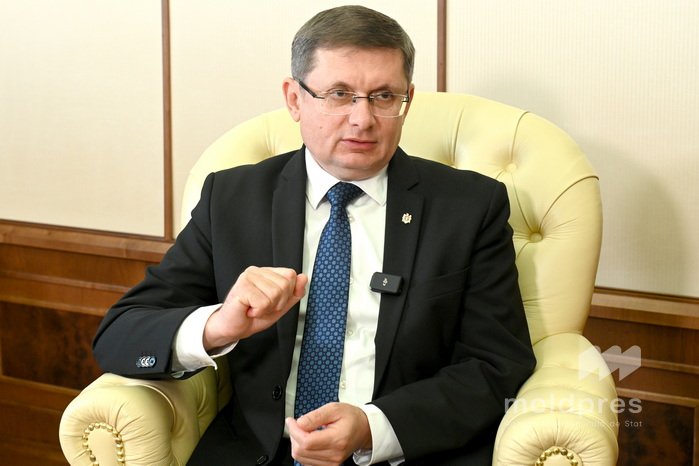
VIDEO // MOLDPRES INTERVIEW // Moldovan parliament speaker: “We must persuade each member state that Moldova deserves to be in the European Union”
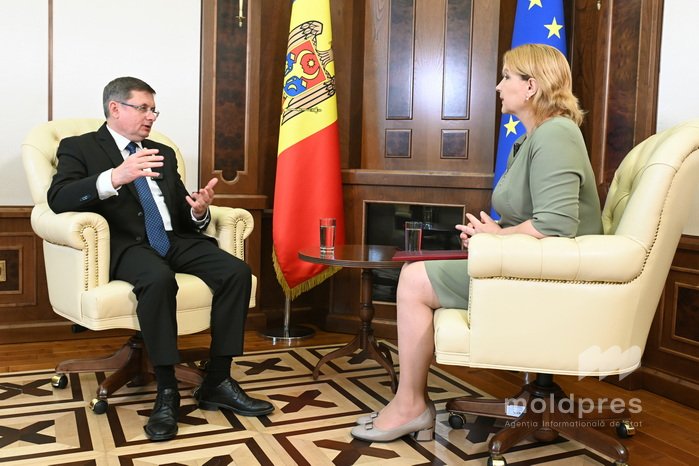
Parliamentary diplomacy will play an essential role in the European path of Moldova. In an exclusive interview with the State Information Agency MOLDPRES, Parliament Speaker Igor Grosu explains how cooperation with the European Parliament and with the parliaments of the EU member states can contribute to advancing the accession process.

At the same time, the speaker refers to the strategic partnership with Romania and the important role of the Diaspora in promoting Moldova and strengthening European support for our country.

Igor Grosu takes stock of the parliament’s activity during the ordinary spring–summer session and analyses the main challenges of the next stage of European integration.

The discussion focuses on the reforms needed for accession to the European Union, legislative support for the new government led by Vasile Tofan, the administrative and territorial reform, strengthening the security of Moldova in the context of the war in Ukraine, developments regarding the natural gas tariff and the situation in the Transnistrian region.

“Our argument is very simple: the European Union needs a predictable, stable country with institutions that function properly, where people have jobs, and through our policies we are proving exactly that” Igor Grosu stated.

The interview was conducted on 29 July 2026.


MOLDPRES: Mr. Speaker, we meet again after a year marked by important events on the European path of Moldova. The parliament has had an essential role in implementing the commitments undertaken in the process of European integration. How do you assess this period? What do you consider to be the most important achievements of Parliament over the past year and at what stage is Moldova today on the road to accession to the European Union?

Igor Grosu: Welcome back to Parliament. It is a pleasure to resume our discussion. This has been, and continues to be, a very important year, full of significant developments, especially in terms of European integration. I would highlight one major achievement – the opening of negotiations on two very important clusters: "Fundamentals" and "External Relations."

These are the first and the sixth clusters. Altogether, we have more than 30 chapters grouped into six clusters. In two cases, we succeeded in obtaining the political decision of the European Union Member States and officially opened these negotiations. This was important because, at the technical level, we continued to fulfill our commitments.

There was no official decision at that time, but we decided not to lose time, not to put everything on hold while waiting for the EU Member States to formally open the negotiations. I believe that was the right decision. We took certain risks, but in the end they proved justified, exactly as we had planned. We managed to convince the EU Member States, and two negotiation clusters were officially opened.

We still have four clusters remaining, and it is important to open them by the end of this year. Discussions and negotiations among the EU Member States are still ongoing, and I remain optimistic. At this stage, Parliament bears the greatest responsibility in the entire process, because the hundreds of laws that must be adopted, approved, or amended in line with European directives and our commitments to the European Union ultimately arrive in Parliament.

This is where they are examined, debated, and voted on. That is why we must be as well organized and as predictable as possible, although we do not always succeed. For this reason, even though we are at the end of the parliamentary session, I asked my colleagues to consider reconvening for an extraordinary session in August.

We will return during the week beginning on August 24–25 because there are a number of laws that must be adopted and enter into force before September 1. We are also referring to the interim report that we received previously. Last year, the European Commission's Report assessed the Republic of Moldova positively in comparison with other candidate countries.

Our ambition is for this year's report to be at least as good as last year's, but our intention and our efforts are focused on making it even better. This report will have a major impact on our future progress in the accession negotiations, on the process of signing the Accession Treaty, and ultimately on the Republic of Moldova becoming a Member State of the European Union. There is still a great deal of work ahead. We must mobilize and do everything possible to meet the deadlines we have set for ourselves.

MOLDPRES: What are the most important benefits of European integration and how should people feel them?

Igor Grosu: I believe that the things people feel most directly in their everyday lives are related to the payment and money transfer system. Let us take some very common examples: the SEPA payment system, which allows citizens to make transfers to European Union member states or receive transfers from EU countries back home at significantly lower fees and costs than before. This is something we can all experience in our daily lives – many of us have relatives abroad or children studying there.

Another example that people feel directly is roaming. We live in an era in which daily communication is essential. We need to stay in touch with our parents, children and relatives living in European Union member states, and roaming enables our citizens to pay much less for these phone services. Achieving all these benefits required negotiations, legislative alignment, amendments to our national legislation, and commitments on our part.

We had to demonstrate that our banking system is secure, that payments are protected, and that we have all the necessary instruments to prevent money laundering and various types of non-transparent financial transfers from questionable sources. We have already experienced situations during election campaigns when certain political actors received or used increasingly sophisticated payment systems to finance illegal activities in the Republic of Moldova.

All these measures together, and, if we speak about the first cluster – the justice reform – show that our work must continue. Even though we have already evaluated a number of judges from the Courts of Appeal and the Supreme Court of Justice, we must continue. Our commitment has been, and remains, to continue this process in the case of prosecutors as well.

There is a large number of laws that we are adopting while, at the same time, denouncing agreements that we have concluded or signed within the CIS framework. Just yesterday, Parliament denounced one such agreement. Naturally, this sparks controversy every time, especially from the pro-Kremlin opposition, which reacts very sharply to these decisions, while remaining untroubled by propaganda coming from the Kremlin.

Next come the areas of education, environment, agriculture, and compliance of our products with European standards. It was difficult, but the effort was worthwhile – our producers are now able to export poultry meat. These achievements required considerable effort. We had to prove that our laboratories are accredited and that the permits and certificates they issue regarding product quality and safety can be trusted. Behind all these results that every citizen experiences in everyday life stands the tremendous work of civil servants in the Government and Parliament, ministers, state secretaries and our diplomats. It is not enough simply to say that we have adopted a package of laws.

Parliamentary diplomacy plays an extremely important role. Our task is to maintain dialogue with our colleagues in the parliaments of all EU member states. Some are more open towards the Republic of Moldova and, more broadly, towards EU enlargement.

Others are more reserved, so we must carefully direct our efforts, invite them to visit us more often and, yes, travel more frequently ourselves whenever we receive official invitations.

However, we have adjusted our approach somewhat. We encourage them to come to Moldova because it is an excellent opportunity for them to experience the atmosphere firsthand, speak with our people and public officials, and visit not only Chișinău but the entire Republic of Moldova.

MOLDPRES: There are a few European states that are reluctant to the advancement of Moldova and Ukraine on the path of European integration. How do you intend to convince these countries to support us, given that we have big plans – we want to sign the Accession Treaty in 2028?

Igor Grosu: Work, work at the level of diplomats, at the level of Parliament, and at the level of friendship groups. Every contact and every opportunity should be used. If any politician has a good relationship with the president of a respective country, its prime minister, or the speaker of parliament, then yes, we reach out, raise awareness, invite them, and present our arguments. Because, incidentally, this enlargement is not only about economic development. Above all, under the current geopolitical circumstances and in the times we are living through, enlargement is a matter of security for the whole of Europe.

And here we are talking about the Russian Federation’s invasion of Ukraine. The overwhelming majority of EU member states, including those in Western Europe, view enlargement through the lens of security. And here our argument is very simple: the European Union needs a predictable, stable country with institutions that function properly, where people have jobs, and through our policies we are proving exactly that.

Let us look at the period since 2022, from the beginning of the war: all the challenges, all the crises—the refugee crisis, the security crisis, the energy crisis, and many others. We have succeeded in demonstrating that we are a reliable partner, that we are predictable, stable, that we honour our commitments, and that we are true Europeans. And yes, we also need cultural diplomacy, because we come and say that we have our own heritage, which we can bring to the great European family.

MOLDPRES: Are you confident that we will have total support?

Igor Grosu: Let me give you an example.

There was a period before the opening of the first cluster when Hungary's position was not directed at specific questions or requests concerning the Republic of Moldova, but rather at Ukraine. Since we embarked on this path together from the very beginning, it inevitably affected us as well. It took considerable effort to convince our Hungarian friends, and we succeeded.

We have seen progress in the dialogue between Ukraine and Hungary, but we must continue our efforts in the major European capitals – France, Germany, Poland, and Bulgaria – because every country also has its own priorities and domestic agenda. Every country has its own electoral cycle, and we cannot ignore that. We need to build relationships not only with the political forces currently in government, but also to engage, inform, and maintain dialogue with opposition parties, because political power changes through electoral cycles. That is exactly what we are doing.

Of course, Romania is a special case. We have a special relationship with Romania, as is only natural. Romania supports us, and we continue to count on its support throughout our European integration and accession process.

MOLDPRES: The parliament has given a vote of confidence to a new government headed by Vasile Tofan. We have a prime minister coming from the business environment, with a track record of investment initiatives, job creation and development of the economy of Moldova. How does the parliament intend to support these initiatives of the government?

Igor Grosu: The Government should be the institution from which the largest number of draft laws should come. I have no reservations about MPs, who can also come up with legislative initiatives, but the most important and the greatest number of initiatives should come from the Government and ministries, because they have institutional memory and expertise in their respective areas of competence, compared, with all due respect, to a sectoral parliamentary committee, where we must acknowledge that there are fewer human resources and less expertise.

Of course, the Government has our full support, especially from the parliamentary majority. Mr. Tofan brings a new impulse, new dynamics and energy to the Executive. Yes, we insisted on having a Prime Minister with such a profile, because the focus is placed on economic growth, and he has extensive experience in various enterprises, international companies and investment funds. He knows the field, has invested significantly abroad – in Ukraine, Romania and the United States – and, of course, he is well suited for this mission of attracting investors and doing this as quickly as possible, because he has a level of credibility that allows him to directly contact the leaders or owners of major companies he knows, explain to them the great opportunities that we can offer, and help drive economic growth.

You have also heard and seen that he has a very appropriate approach towards state assets. I am referring to those state-owned enterprises that the state is not always able to manage effectively, and in such cases it is appropriate for some of these enterprises to be privatized, so that businesspeople can invest.

Laws, yes, any initiative that, first and foremost, corresponds to the commitments we have undertaken within our European Union accession plan, as well as other legislative initiatives that would simplify the procedure for starting a business, investing, and so on. The Parliament is open to continuing to support the Government, just as it has done so far.

MOLDPRES: Mr. Grosu, how do you think the “public sector salary paradox” can be managed? On the one hand, there is public pressure against the high salaries in some public institutions, and on the other hand, we face a serious staff shortage because salaries are not competitive compared to the private sector. What, in your opinion, is the right compromise to ensure an efficient administration that is also fair in the eyes of citizens?

Igor Grosu: Look, there are two things that will happen in the very near future.

The first will be an intervention, as the Prime Minister announced, by July 31. The State Chancellery will come up with proposals regarding interventions in cases of excessive salaries, and I know that the State Chancellery has already prepared proposals in this regard.

The Prime Minister, as I mentioned, will come forward with proposals regarding salaries that are excessive in the public sector. Second, we are talking about the salary law, which is currently under consideration and being discussed, where we are trying to correct the imbalances that appeared or were created starting from 2018, when the government at that time made its last intervention regarding the salary system. Over time, eight years have passed since then and, rightfully, imbalances have emerged. I see this in the institution I lead, and we see the same thing in other institutions as well. At the same time, obviously, there is a lot of manipulation.

There are justified criticisms, but there is also a lot of manipulation. And here we need to understand very clearly, because there are positions and areas that are extremely sensitive and important for our state. For example, IT systems, cybersecurity, or certain competencies and positions in the healthcare sector that require very good training. In these areas, the public sector is constantly competing with the private sector. An IT specialist, if you do not pay them well or at least close to the salaries offered in the private sector, you will lose them.

They can easily choose to work for an IT company or in the private sector and there, probably with less daily pressure, earn a much higher salary than in the public sector. Imagine, dear citizens, what kind of inconvenience this could cause, for example, if a system stopped working or failed. Let’s take the system for checking documents when crossing the border. Imagine that, God forbid, something happens there, or a payment system fails, or the electronic signature system, which is becoming increasingly popular, stops working. We no longer stand in queues or travel to the Tax Service or other institutions; instead, we sign documents electronically: I sign, many people sign electronically, from the office or from home, and we make payments from home. So, imagine that such a system is affected. Today, cyberattacks are a daily reality, at a time when criminal groups and malicious actors are attacking our infrastructure. There are states that deliberately target our critical systems.

Elections — imagine that someone comes up with such an idea: criminal groups, behind which there may be states such as the Russian Federation, could try during elections to attack our system, the voters’ database. The people who maintain this entire system are highly skilled professionals, and it is not easy at all to identify them, convince them to come, motivate them and keep them in the sector. That is why we need to offer them competitive salaries, comparable to those on the labor market, because otherwise, God forbid, such an incident could have enormous costs — whether we are talking about air traffic, land border traffic, other services, payments, the energy system and so on.

 But where there are indeed situations in which certain positions do not deserve to be paid at this level, there we must intervene decisively and correct them. Why should an accountant in one institution be paid more than an accountant in another institution? This is precisely what the salary law aims to address — the workload or responsibilities performed by a specialist who holds the same position across different institutions. We cannot allow such visible disparities and very large differences.

MOLDPRES: And now let’s talk about natural gas tariffs. On the one hand we have protests organized by the parliamentary opposition, and on the other hand there is ANRE’s intention to increase the tariff. Many citizens are wondering whether they will be able to cope with these price rises. Will the state help citizens?

Igor Grosu: Before explaining how the state will help, I would first explain how the price is formed. It is based on two components.

The first is the price on the commodity exchanges, where we purchase our energy resources. It depends on market quotations and international developments. And here I must say that the war, as well as the situation in the Strait of Hormuz and the Black Sea, obviously have a tremendous impact. The Republic of Moldova has no domestic energy resources. Everything we consume—natural gas, diesel fuel, gasoline, and liquefied petroleum gas (LPG)—is imported. Therefore, we depend on international market prices. Naturally, we have done everything possible to diversify our sources of supply so that we are no longer dependent on a single supplier, as we were until 2021, namely the Russian Federation. Back then, even if you had a contract, deliveries could be gradually reduced at any moment—usually in winter, when energy resources were needed most—without any explanation. It was a dependency used as a geopolitical weapon against those who were not obedient.

The second component concerns transportation and management costs. This is where, although we cannot influence the exchange price itself, we can influence the costs of distribution and transportation. That part is within our control. I believe that tomorrow (July 30, editor's note), Parliament will consider a proposal to amend the Gas Law, if I am not mistaken, through which we will try to optimize certain costs that are repeatedly passed on to Energocom by Moldovagaz. Because, beyond the excessive salaries—such as the director receiving 377,000–378,000 lei in April, for example, or members of the Board of Directors and advisers earning around 90,000 lei each—I believe these figures are excessive for the Republic of Moldova. And this is not only the case at Moldovagaz; there are other institutions as well, and we will see what proposals the State Chancellery presents.

Twelve enterprises across the country, twelve directors, twelve accountants, twelve deputy directors, and so on. I believe that under today's conditions, a single enterprise could manage these responsibilities. We have modern IT solutions that allow monitoring, transfers, and management of all these activities from one single entity. By analogy, take Moldsilva: it currently has 19 forestry enterprises, but there should be just one. Yes, one single entity could manage the entire sector. This is where we can intervene to reduce administrative costs, which could have an impact on lowering the tariff—that is what I mean.

Someone may say the reduction will be only five percent, or one or two percent. It does not matter. It is our money, and if we can optimize and reduce expenses, then we should do it. Why shouldn't we? Is it only a small amount? Even that small amount should be saved rather than wasted. Now, of course, just as we have done in previous years, during the cold season—the five winter months—the Government will come forward with solutions and proposals to compensate part of these costs.

Clearly, we cannot leave people to face these price increases alone. We are talking about November and December of this year, and January, February, and March of the following year. So yes, the Government and the Ministry of Labour and Social Protection will come forward with proposals, and we will discuss them. We will see what can be improved in the compensation mechanism, including consumption thresholds and other aspects. Most likely, this year we will return to the system of applying compensation directly on utility bills.

I believe that our first experience with direct compensation on bills was more successful than the approach we used this year. So yes, my answer is yes—the state will intervene and will help citizens. But I also have one important request: let us save energy. If we are not using a room, we should not leave the lights on. These are our resources, and this applies both to public institutions and to energy consumption in our homes and apartments.

The latest decision of the Commission for the Management of Crisis Situations requires public institutions to reduce fuel expenditures by 20 percent, especially diesel consumption, because we are going through a more difficult period and we must overcome it together, acting as responsibly as possible.

MOLDPRES: We are now in the middle of the voluntary amalgamation of municipalities, as part of the administrative–territorial reform. There are hundreds of municipalities that have agreed to amalgamate, but there are also ones that oppose it. Why is it important for this reform to be completed by 2026?

Igor Grosu: That's correct. We have calculated this taking into account the fact that the next electoral cycle begins in 2027 and starts with local elections. That is why it is important to finalize this reform in 2026—not just sometime during 2026 in general, but around October or early November—because the previous local elections took place four years earlier, in 2022, in October–November, if I remember correctly.

This is why we need to adopt the law this autumn, in order to provide one year of predictability for citizens, local communities, candidates, and the political parties that will, of course, participate in the election campaigns. This is about the principle of predictability. And if you ask me about Gagauzia, the same principle applies. We have kept the current electoral system because it is not right to change the rules of the game while the process is already underway. The election date there has already been announced, and you cannot now switch to a different, proportional electoral system.

To return to the main point—yes, hundreds of mayoralties have initiated the voluntary amalgamation process, and a significant number of them have already completed it. This means they will benefit from the incentives that they will use to invest in the future merged municipality, or, as we call it, a cluster of mayoralties.

For your information, beginning in September, the mayoralties that have voluntarily amalgamated will start working together with the Ministry of Infrastructure and the State Chancellery on project development and future financing projects, so that these can be approved starting in 2027.

MOLDPRES: What will happen to municipalities that have not amalgamated voluntarily?

Igor Grosu: Those that have not undergone voluntary amalgamation will go through the statutory procedure. Obviously, they cannot remain in limbo. There is a minimum threshold of 3,000 residents per administrative-territorial unit. They will naturally gravitate toward the existing mayoralties so that we achieve uniformity with regard to this minimum threshold of three thousand residents.

MOLDPRES: Is Gagauzia also being discussed?

Igor Grosu: Let me explain. In Gagauzia, the process will be delayed somewhat. Why? Because, in the case of Gagauzia, the final authority responsible for approving the future cluster or the new mayoralties is the People's Assembly. Since the People's Assembly is currently non-functional, with its mandate having expired, and the elections have been scheduled for November 15—at least that is the official date—the process will be delayed. A new People's Assembly must first be elected. However, discussions between mayoralties can, of course, already take place, and I have information that some mayoralties are already engaged in such discussions.

MOLDPRES: Mr. Speaker, Secretary General of the Government Alexei Buzu said that the administrative amalgamation process would have a different timetable in the Transnistrian region, considering that the constitutional authorities do not control that territory. However, there are localities under Chisinau’s jurisdiction. Do you consider that, in their case, the voluntary amalgamation process should also be encouraged?

Igor Grosu: If we are talking about the localities in the Security Zone, then yes, in the case of the Dubăsari district, as far as I know, the process is moving forward actively. The mayors are holding discussions, and the outlines of future arrangements are beginning to take shape.

After all, there are not many localities there—fewer than ten. Wherever it is possible, where the localities are located on the right bank of the Dniester and are under the control of the constitutional authorities of the Republic of Moldova, we will be able to move forward. Where we cannot intervene fully or exercise our authority to its full extent, we will obviously have to postpone the process.

But yes, inevitably, both on the left bank and on the right bank, we are facing the same demographic trends. At present, the economic situation on the left bank is very difficult. Around 40,000 citizens commute every day from the left bank to the right bank for work. They have found jobs here in private companies, state-owned enterprises, public institutions, and so on.

So, unfortunately, the economic situation there is indeed very difficult, and we must take these realities into account. Many people rely on our healthcare system. Annual expenditures—I recall seeing a figure, if I may mention it—amount to around 280 million annually. This includes the documents they request from the Public Services Agency (ASP), healthcare services, the pension system, and so on. This, by the way, is why we decided to establish the Convergence Fund, because all of these things come at a cost. Integration has a cost. In addition to the political cost—the political or geopolitical dimension, by which I mean the withdrawal of the Russian army illegally stationed on our territory and the removal of its ammunition—there is also an economic cost.

That is why this convergence must be achieved gradually, through the application of a single tax framework across the entire territory of the Republic of Moldova, on both the right and the left banks, step by step. As you have all seen, we are starting with non-essential products associated with harmful consumption—cigarettes, alcohol, excise goods, and so on—and, gradually, we will bring the left and right banks closer together.

MOLDPRES: For almost four and a half years, the citizens of Moldova have been living with the fear of war. If at the beginning this fear was more pronounced, today people seem to have become used to it, but concerns persist. We see drones increasingly often falling on the territory of Moldova and similar incidents also occur in Romania. What measures are the authorities in Chișinău taking to protect citizens?

Igor Grosu: We will continue doing what we announced from the very beginning of our term in office – investing in our armed forces, which had been neglected for many, many years since independence. The army was not a priority; it was always at the bottom of the list. Unfortunately, our adversaries succeeded in instilling the idea that if you are a neutral state, you do not need to invest in your military, as if someone would respect your neutrality, come to your aid, and defend you with their own soldiers. No, that is not how things work.

Countries that are constitutionally neutral do invest in their own defense and think about their own security. That is exactly what we must do, and what we are doing. First and foremost, we are continuing to invest in our airspace monitoring and air defense capabilities—costs that we cannot bear on our own.

That is why we are grateful to the European Union for its support, both in helping us acquire airspace surveillance equipment and, in the future, the tools that will allow us to intercept aerial threats, bring them down, so to speak, and protect our critical infrastructure, our country, and our cities and villages.

And yes, you are right: the war is not far away—it is very close. It is not an abstract threat. Just look at the incidents in Romania last week: three consecutive airspace violations that prompted a very firm response from the Romanian Armed Forces. We are talking about cooperation between Moldova, Ukraine, and Romania because, naturally, both of our neighbors possess far more sophisticated and advanced technical capabilities for monitoring airspace. It is equally important that whenever such a flying object is detected and identified, the information is shared promptly so that timely decisions can be made to protect our citizens and our critical infrastructure.

We will continue to invest. I repeat: if you want to receive support and have reliable friends—and having friends matters a great deal—you must also demonstrate that you are investing yourself, that you are contributing, and that you are not relying solely on the assistance of your neighbors or of the European Union.

MOLDPRES: In the public space, concerns persist about a possible escalation of the security situation, including in the Transnistrian region. How high is the risk of developments that could affect Moldova and what guarantees can you offer citizens that the situation remains under control?

Igor Grosu: I do not see, nor have I seen recently, particularly since the outbreak of the conflict and Russia's invasion of Ukraine, any change in this regard. I have observed a cautious approach on the part of the so-called authorities on the left bank of the Dniester.

Most likely, reason prevailed, along with the instinct for self-preservation and survival. Yes, reason prevailed, and they understood that participating, in one form or another, on Russia's side against Ukraine would bring undesirable consequences for the so-called authorities on the left bank of the Dniester, and that is a positive thing. Ukraine, other international actors, the European Union, the United States of America, and, of course, we ourselves, through the 1+1 format, regularly send very clear messages to the left bank.

Our interest is to preserve peace and stability, to refrain from any actions that could lead to escalation, and to bring the country closer together and ultimately reunify it. There is simply no other option for the left bank. It is far better to build institutions, invest in villages, towns and enterprises, create jobs, than to deal with the consequences of war and endure the trauma that the Ukrainian people are suffering.

I can see that people there understand this. Beyond the other issues that divide us, particularly with regard to respect for human rights, where there are clearly serious shortcomings and where people are illegally arrested, unlawfully detained, and so on, it is encouraging that they understand the risks associated with any potential escalation.

Obviously, Russia wanted them to become more belligerent and more aggressive. It is a good thing that those on the left bank did not respond to that call, and that even the soldiers who are illegally stationed there, as far as we understand, are not eager or enthusiastic about becoming cannon fodder for Putin's adventures and crimes.

MOLDPRES: The parliament also has an important role in promoting international cooperation. Once European integration was declared a strategic objective of Moldova, the activity of the Legislature has increasingly focused on strengthening relations with the parliaments of EU member states and with the European Parliament. What concrete results have you achieved in this area and how do they contribute to bringing Moldova closer to the European Union? Also, in May you announced that a delegation of chairs of parliamentary committees would pay a working visit to the European Parliament to take over good practices. What benefits did this visit bring?

Igor Grosu: Yes, that visit took place. Parliamentary colleagues, the chairpersons of parliamentary committees, went to the European Parliament. We have a partnership agreement, a memorandum of cooperation with the European Parliament, so we have a very good institutionalized relationship, communication at the level of the President (the President of the European Parliament, Roberta Metsola, ed. note), and at the level of the political groups in the Parliament. We have meetings periodically.

We have a group of friends among Romanian Members of the European Parliament who are very active: Siegfried Mureșan, Victor Negrescu, Dan Barna, Eugen Tomac. They are the ones who support us and always make sure that Moldova benefits from the attention of the European Parliament.

When the first crisis related to the pollution of the Dniester River occurred, I was at the European Parliament, and the very next day the session was scheduled to begin and a declaration was to be adopted. They insisted, and our case was reflected in that declaration, which was later voted on by the European Parliament. This is what concerns the European Parliament.

Of course, we have a very clear plan and interaction with the European Union member states. All 27 states are, so to speak, classified: there are countries where we only need to maintain interest in the Republic of Moldova, because this interest is alive and there is very good openness; and there are countries where we still need to make efforts to better inform them and familiarize them with the processes in our country, with the realities and so on.

And here, parliamentary committees and friendship groups between the Republic of Moldova and the respective countries try, above all, to invite them to visit us. A visit of several days is not only a visit to Parliament and official meetings, but also an opportunity for them to visit localities, communicate with people and with local public authorities.  The Czechs, for example, discover their compatriots here, or the Germans discover former colonies, so these are elements that we must explore and highlight.

We participate on all platforms. I attend the annual meetings of the speakers of parliament of the European Union member states, to which candidate countries, those in the accession process, are also invited. I participate every time, and it is a good opportunity to meet my colleagues or, even if it is a broader format, to hold bilateral meetings, to convey certain messages and requests, while they ask me about developments here and so on.

I confirm that the role of Parliament is very important, because ultimately the citizens of the European Union member states will have to make the decision: whether to accept a new member into the great European family or not. This is why our diaspora is very important, because they are the first messengers at the local level. When we are on visits, we always meet with them. We have mentioned them in our speeches at all meetings with officials, and we encourage our people to be active not only in cultural and economic life, but also in political life. I am pleased to see in Ireland, the United Kingdom, Italy and Germany that our compatriots are being elected as local councilors in the municipalities where they live.

This is very good: our people on the ground, connected to certain political forces and certain processes, and through them we can convey messages, communicate about the European integration process of the Republic of Moldova, establish relations and create partnerships between communities.

In the Czech Republic, we discovered two compatriots – a sculptor and a painter – who are well-known there and have a very good relationship with local public administration. We must make use of every opportunity: business people who have managed to establish companies there, in a different environment, with different legislation, being foreigners, and have succeeded in making a name for themselves. We have three colleagues in our parliamentary faction – one from the United Kingdom, another from Ireland and one from Germany – who succeeded: they emigrated many years ago, opened businesses there, employed people in the construction sector and in IT, and this is a very good connection that must be capitalized on.

MOLDPRES: The parliament is ending its spring–summer session. Have you managed to achieve everything you set out to do? And after this intense period of activity, will you manage to take a few days of vacation?

Igor Grosu: We have not accomplished everything we set out to do. As usual, our plans are ambitious, and some things remain unfinished. That is why we will meet once again in August—yes, that is the reason.

Towards the end of this session, we will vote on a number of laws in the first reading, and then we will reconvene on 24, 25, and 26 August to adopt them in the second reading, so that these laws can enter into force on 1 September.

A very busy autumn lies ahead of us, especially since there are many draft laws related to the approximation of legislation. Once again, both the Government and the Parliament will have to be very well organized, coordinate our communication, and fulfill all of our commitments.

As for my vacation, I will most likely stay in the Republic of Moldova. We also have beautiful places here. I will go to the countryside, visit one mother, then the other. If we do travel, it will only be for a few days, somewhere nearby in Romania, and then back home.

MOLDPRES: Finally, what is your message to the citizens of Moldova?

Igor Grosu: Let us believe in our country, let us believe in our own strength. The Republic of Moldova has succeeded in building a very good reputation among the member states of the European Union. Let us remain united whenever crises arise.

We have already demonstrated that we are open, ready to help when needed, and believe me, dear citizens, this matters greatly. When Europeans see that Moldovans keep their word, are trustworthy, and carry out these reforms sincerely, genuinely, and not merely to tick boxes, they recognize it very quickly.

Believe me, this is something that becomes evident very fast, and they have the ability to draw the right conclusions.

As for the rest, everything depends on us. We have friends, we have supporters, and we must do everything possible—and we will—to ensure that the Republic of Moldova becomes a member state of the European Union as soon as possible.
 Facebook
 Instagram
 X/Twitter
 Telegram
MOLDPRES INTERVIEW // Lithuanian Ambassador about prospects of Moldova’s EU accession: If you make things real, they will become achievable
MOLDPRES INTERVIEW // Moldovan finance minister says government aims to modernize financial system for benefit of businesses, citizens
MOLDPRES INTERVIEW // Ambassador of State of Qatar to Moldova: We are working to improve ways of attracting Qatari investors to Moldovan market
MOLDPRES INTERVIEW // President of Moldova's Chamber of Commerce and Industry says country must use opportunities provided by European integration to attract investments, become competitive
MOLDPRES Interview // Minister of Internal Affairs: Interior Ministry applies European security standards and is ready to advance in EU accession process
MOLDPRES INTERVIEW // Moldovan energy minister says foremost interest citizens to have secure energy at affordable prices
Moldovan justice minister says, according to European Commission’s Report, Moldova made greatest progress among EU candidate states, including in justice field
INTERVIEW MOLDPRES // Moldovan defense minister says Russia's war in Ukraine highlighted vulnerability of defense sector, need of building strong, prepared, resilient army to current challenges
INTERVIEW WITH MOLDPRES // Deputy PM says wants Moldova where a child from any village has same opportunities as a child from Chisinau
INTERVIEW MOLDPRES // Deputy Prime Minister on Ukraine Peace Agreement: No discussion about Moldova can take place without Chișinău's participation
INTERVIEW MOLDPRES // Moldovan agriculture and food industry minister says European integration fundamentally changes way leadership supports agriculture
INTERVIEW MOLDPRES // Romania's Ambassador in Chisinau says Moldova to never be alone in its efforts, Romania to stand by its side
MOLDPRES INTERVIEW // Romanian culture minister says culture adds value, rebuilds trust
MOLDPRES interview // IGP head: Russia whether through Ilan Shor or other means to constantly try to find ways to create disorder and destabilization
VIDEO // Message in Romanian delivered by Prime Minister from UN rostrum
PHOTO // U.S. Ambassador-designate to Moldova arrives in Chisinau
Moldovan Prime Minister holds talks with Croatian and Slovenian counterparts
VIDEO // Prime Minister for Fox News Podcasts: Moldova can be export and trade hub for entire region
 National Bank of Moldova
Prime Minister at UN: Moldova may never become great power, but it can certainly become great country
Speech by Prime Minister at 81st Session of United Nations General Assembly
Prime Minister discusses European integration and strengthening economic cooperation with Croatian and Slovenian counterparts in New York
“A Night Written in Red” - documentary performance about courage, resistance and freedom staged in Parliament square
Strengthening Moldova’s cooperation with UNDP, UNOPS discussed in New York

Strengthening Moldova’s cooperation with UNDP, UNOPS discussed in New York
PHOTO // PM in New York tells Diaspora government willing to turn experience of Moldovans from United States into projects for country
Moldovan foreign affairs minister at UN says Moldova strengthening capacity to respond to health threats
Moldova under emergency state in energy, hydrological sectors as of September 26; what measures take effect
Moldova's National Crisis Management Commission approves new measures to ensure energy security, protect water resources
PHOTO // PM promotes Moldova's investment opportunities in New York
Balti Clinical Hospital to receive ultrasound machine through grant provided by government of Japan
Moldovan PM, U.S. investors, companies discuss potential projects in Moldova
Japan supports modernization of Balti Clinical Hospital with grant worth over 95,000 dollars
Moldovan parliament speaker urges students not to be afraid to express their ideas, wishes
Moldova's Border Police receive six special vehicles on behalf of FRONTEX
Head of state says Moldovans must build economy where well-educated people can find opportunities at home
Moldovan president attends events dedicated to 35th anniversary of foundation of Academy of Economic Studies
New charges brought against former Moldovan president Igor Dodon in “Kuliok” case; prosecutors seek harsher sentence
Moldova represented at Interparliamentary Conference on Stability, Economic Coordination and Governance in European Union
ARMENPRESS: EU Commissioner Kos promotes Armenian products after trade measures adopted
Receive the latest news directly to your email

Receive the latest news directly to your email