
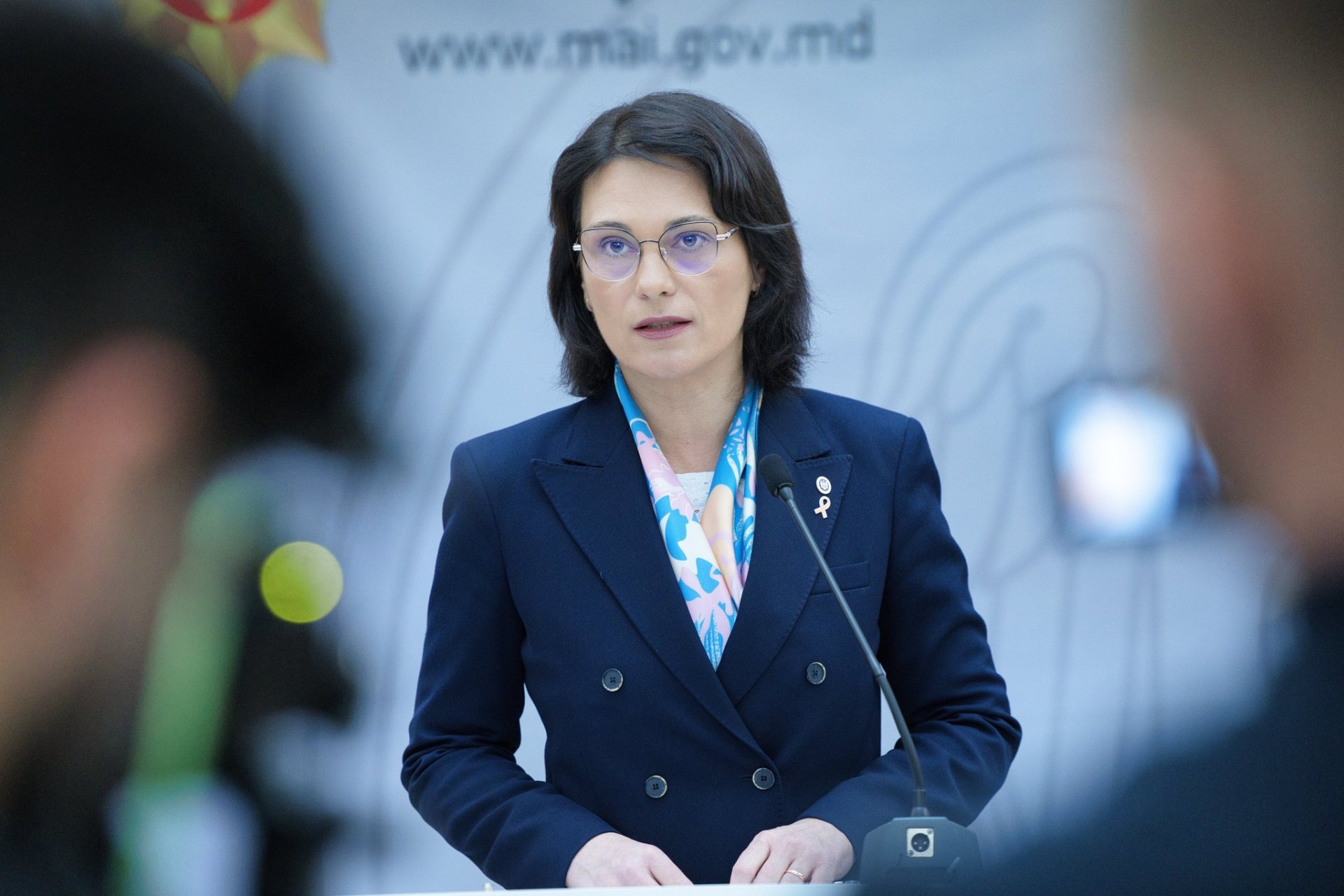
MOLDPRES Interview // Minister of Internal Affairs: Interior Ministry applies European security standards and is ready to advance in EU accession process
Minister of Internal Affairs Daniella Misail-Nichitin gave an exclusive interview to the State News Agency “MOLDPRES”. In this interview, the official spoke about the strategic cooperation platforms between the Ministry of Internal Affairs and European institutions, mechanisms for protecting the population, easing traffic at border crossing points, new measures regarding the regime of weapons and ammunition, the implementation of the e-File system, as well as salary increases for employees of the Ministry of Internal Affairs.
MOLDPRES: The Republic of Moldova is approaching a decisive stage in its European path. At this important moment, how prepared is the Ministry of Internal Affairs, in the areas it manages, to face a new stage of accession?
Daniella Misail-Nichitin: Thank you for your interest in the internal affairs and for the opportunity to discuss Moldova’s preparedness in the accession to the European Union.
Under Chapter 24 – Justice, Freedom and Security, the Ministry of Internal Affairs has a central role and disposes of a solid institutional basis for launching and supporting the negotiation process, in close cooperation with national and international partners.
The ministry has advanced substantially in aligning its legislation and operational practices with the acquis of the European Union in key areas such as border management, migration and asylum, police cooperation, combating organized crime, trafficking in human beings, and internal security.
In the field of integrated border management, the Republic of Moldova is already applying European procedures and standards. Border control, cross-border cooperation with Romania, data exchange and the use of modern IT systems contribute to securing the state border and preparing for the future external border of the European Union.
In the area of migration and asylum, the regulatory framework is being progressively harmonized with EU legislation, and institutional capacity has been strengthened to manage migration flows, including in crisis situations. Procedures are oriented towards respect for fundamental rights and the application of European standards.
Police cooperation is another pillar of Chapter 24. The MAI is actively developing operational partnerships with EU Member States and European agencies, using modern mechanisms for information exchange and strengthening capacities to prevent and combat cross-border crime, including organized and cybercrime.
As regards internal security, the MAI is implementing policies focused on prevention, increased institutional resilience and the protection of citizens. The digitalization of services, the interoperability of databases and the modernization of intervention systems contribute directly to meeting the European requirements under this chapter.
At the same time, the MAI has dedicated structures for coordinating the European integration process, expertise acquired in the implementation of EU-funded projects and the necessary administrative capacity to support negotiations on Chapter 24.
Through these concrete actions, the Ministry of Internal Affairs demonstrates that it is already applying European standards in the field of justice, freedom and security and is ready to advance in the EU accession process.
MOLDPRES: Two years ago, the Republic of Moldova joined the EU Civil Protection Mechanism, becoming part of the strongest international cooperation network for disaster prevention and management. How do you assess this cooperation? What benefits does it bring to citizens and to what extent has it contributed to strengthening national prevention and emergency response capacities?Daniella Misail-Nichitin: Moldova’s accession to the European Union Civil Protection Mechanism was a strategic step that required extensive work. Cooperation with European states allows us to intervene more quickly and effectively in emergencies, reduce risks to citizens’ lives and property and maintain the functioning of essential public services even in critical moments.
In practice, citizens benefit directly from European support in difficult situations: for example, in January 2025, the Republic of Moldova received 42 electric generators and 31 air conditioning units for critical institutions, in order to ensure their continued operation in the context of strengthening energy security. Interventions coordinated with European partners reduce reaction times and limit the impact of emergencies on the population.
At the same time, the Republic of Moldova is not only a recipient of assistance, but also a provider: our rescuers participate in international missions, including for extinguishing vegetation fires in other states, demonstrating professionalism and European solidarity.
Through these mechanisms, the national civil protection system becomes stronger, more modern and better prepared to respond quickly to any emergency, and citizens can tangibly feel that their safety is a priority.
MOLDPRES: One of the priorities announced by the Border Police is easing traffic at the crossing points on the border with Romania and Ukraine. What measures are to be implemented jointly with partners to improve traffic management given the increase in the flow of people and goods?Daniella Misail-Nichitin: For the Government, the mobility of citizens and freight transport is a clear priority, established in the National Plan for EU Accession. Wherever there is mobility, there is business, and this contributes directly to improving the quality of life of citizens, which is what we want for our country.
To speed up the safe and efficient movement of persons and goods, we are in the process of extending and strengthening coordinated control with the Romanian border authorities and joint control with Ukraine. Thus, at the Moldovan-Romanian border, coordinated control is already operational at two points: Leușeni-Albița and Giurgiulești-Galați, and in the coming period it will be extended to Cantemir-Fălciu, Sculeni and Lipcani-Rădăuți Prut.
At the Moldovan-Ukrainian border, joint control is legally regulated at nine crossing points, seven of which are functional. Two points remain suspended due to the war in Ukraine. The extension of control to other Moldovan-Ukrainian border points is not currently planned.
In addition to extending coordinated and joint controls, we are implementing several measures to ease traffic: digitalizing control procedures, supplementing frontline staff, opening additional lanes where infrastructure allows, applying the “Reverse” procedure when necessary and maintaining permanent cooperation with the Customs Service and neighboring border authorities.
Referring to infrastructure, the Border Police is implementing the Government’s Growth Plan through the purchase of special equipment, including IT for biometric checks and surveillance, as well as for the modernization of existing points and the construction of new border crossing points. Thus, for 2026, the completion of the construction of Otaci SPF and the launch of DR Nord headquarters are planned. Together with Romania, by 2030 we have planned the construction of four new bridges over the Prut River. In the future, we intend for each district to have at least one bridge over the Prut, built in partnership with counties and regions in Romania.
All these measures aim to ensure faster, safer and more predictable cross-border traffic, while protecting citizens’ security and facilitating trade and the mobility of persons between countries.
MOLDPRES: A truck loaded with weapons was detected on 20 November at the Leușeni–Albița border crossing point. Law enforcement established that the smuggled goods were loaded in the municipality of Chișinău and were to reach Israel. Have the law enforcement bodies uncovered the smuggling scheme? What versions is the police examining?
Daniella Misail-Nichitin: The case concerning arms smuggling detected on 20 November at the Leușeni–Albița border crossing point is being handled by the Prosecutor’s Office for Combating Organized Crime and Special Cases (PCCOCS), which is leading the entire criminal investigation. According to the prosecutors, the ammunition was taken in several instalments from an unidentified warehouse in Ukraine, from unknown persons, brought camouflaged into the Republic of Moldova and then taken over by accomplices. Five people have already been arrested in this case.
Employees of the General Police Inspectorate, including INI and CTCEJ are supporting the investigation with expertise and specialized actions, ensuring operational cooperation with partners. Any new information will be officially communicated by the Prosecutor’s Office, which remains the main provider of data on the state of the investigation.
MOLDPRES: MAI has announced a new package of regulations providing for the introduction of the European firearms passport and the creation of a stricter control system for ammunition and explosives. What new measures are being applied in relation to weapon holders?
Daniella Misail-Nichitin: The new measures regarding the regime of weapons and ammunition, introduced by Law No. 301 of 12 December 2025, create a safer and stricter framework for firearms holders. The main changes include the full digitalization of weapons records through the State Weapons Register, the introduction of the European firearms passport and stricter rules on permits, mandatory training and restrictions for certain categories of persons.
Thus, citizens must comply with clear rules: they may not hold night-vision or thermal imaging scopes, acoustic, signalling, theatrical or tranquilizer weapons, and access to lethal or non-lethal weapons is restricted for persons under criminal investigation, previously sanctioned or residing in regions not controlled by the constitutional authorities. Weapons permits will be renewed every three years, and holders must attend a theoretical and practical training course of at least 40 hours.
Also, in the event of a refusal to surrender or deactivate weapons when there is a legal basis to do so, they will be seized by the police and managed by the State Commission for Evaluation and Compensation. For legal entities authorized in the field of security, the regulations allow the use of short non-lethal weapons, such as pistols or revolvers with rubber projectiles, for the protection of premises and property.
The new regulations aim to reduce the risk of violence, accidents and other incidents, offering citizens a safe framework in which they can exercise their legal right to own weapons.
The amendments concern Law No. 130/2012 on the regime of weapons and ammunition for civilian use, transpose Directive (EU) 2021/555 and will enter into force on 1 July 2026. The implementation of the European firearms passport will coincide with Moldova’s accession to the European Union.
MOLDPRES: Moldovan citizens living in Italy, Latvia, Spain, the United Kingdom, Greece, Israel, Turkey, Albania and Lithuania can exchange their driving licences without taking theoretical or practical exams. With which other countries are negotiations underway so that similar procedures can be applied?Daniella Misail-Nichitin: At present, the Republic of Moldova is engaged in procedures with four states to facilitate the mutual recognition of driving licences:
1. The Republic of Latvia – the agreement was signed in May 2025 and has entered into force, but it cannot yet be applied, as it is necessary to implement an additional agreement on the transfer and protection of personal data.
2. The French Republic – the treaty has been signed but is not yet in force, as the French side is in the process of finalizing the necessary internal procedures.
3. The Republic of Ireland – we are in the negotiation process.
4. The United Arab Emirates – we are in the negotiation process.
5. Romania – we are in the negotiation process.
For the countries where the procedure has already entered into force, exchanging a driving licence without taking theoretical and practical tests means that citizens no longer have to sit traffic legislation and driving exams for the specified categories, based on bilateral agreements.
Here are the details by country and subcategory, so that citizens know exactly for which types of driving licences they do not need to take theoretical and practical tests and for which categories they must complete the legal procedures according to the specific requirements of the country where they are located:
• Italy, Turkey, Albania and Greece – both exam tests are recognized for all licence categories.
• United Kingdom – for category B, both tests are recognized; for sub/categories A, A1, A2, AM, B1, BE, C1, C1E, C, CE, D1, D1E, D, citizens will have to take both tests.
• Israel – for subcategories A, A1, A2, AM, B, both tests are recognized; for subcategories BE, C1, C1E, C, CE, D1, D1E, D, both tests will have to be taken.
• Lithuania – for subcategories A, A1, A2, AM, B, B1, both tests are recognized; for subcategories BE, C1, C1E, C, CE, D1, D1E, D, both tests will have to be taken.
• Spain – both tests are recognized for:
– Moldovan licences issued from 1 November 1995 to 31 December 2010 – A, B, C, D, E;
– Moldovan licences issued from 15 July 2008 to 31 August 2015 – A1, A2, A, B, C1, C, D1, D, BE, C1E, CE, D1E, DE;
– Moldovan licences issued from 1 September 2015 to 31 December 2019 – A1, A2, A, B, C1, C, D1, D, BE, C1E, CE, D1E, DE;
– Moldovan licences issued from 1 January 2020 – AM, A1, A2, A, B, C1, C, D1, D, BE, C1E, CE, D1E, DE.
For categories C1, C1+E, C, C+E, D1, D1+E, D and D+E, they will have to complete a test to check skills and behavior on a closed track and a driving test on public roads open to general traffic, using a vehicle or combination of vehicles for which they hold the respective driving licences.
• Germany – according to the Joint Declaration signed in 2022, only the theoretical component is recognized. The MAI is in discussions with the German side to extend the Declaration by recognition by the German authorities of the practical component of the exam as well.
Thus, Moldovan citizens already benefit from important facilities in several European states and we are continuing negotiations with other countries to extend these procedures, simplifying the process and offering rapid recognition of driving licences.
MOLDPRES: The authorities intend to implement the e-File system, which will allow the electronic management of criminal and contravention cases. It concerns the creation, storage, consultation and transfer of electronic documents between the police, the prosecution service, the courts and other authorities. When will this system be operational and what changes will it bring for citizens and the competent authorities?
Daniella Misail-Nichitin: The e-File information system is designed, first and foremost, to simplify and speed up the way criminal and contravention cases are managed, so that citizens can interact more easily with state institutions and be less affected by bureaucracy.
It will allow the electronic creation, storage, consultation and transfer of documents between the police, the prosecution office, courts and other authorities. For citizens, e-File means fewer trips to institutions, fewer paper documents and faster and more predictable procedures. Case files will be transmitted digitally, eliminating the risk of documents being lost or damaged and significantly shortening the time needed to examine cases.
The system will also bring increased transparency, as every action in the file will be clearly recorded, giving citizens more confidence in the way cases are managed. Access to e-File is strictly regulated, and information can be consulted only by authorized persons, with maximum protection of personal data.
Full operationalization of the system will take place gradually, as technical developments, testing and interconnection with other state systems are completed, the legal framework already being approved. Through e-File, citizens will benefit from faster, safer and more modern public services, in line with European standards and the digitalization of public administration.
MOLDPRES: Cars involved in traffic accidents will automatically send a call to the 112 Service, which will announce the location and the severity of the accident. This will be possible with the implementation of the Next Generation eCall project, financed by the EU. How will this project work at national level?
Daniella Misail-Nichitin: The Next Generation eCall project, financed by the European Union, will allow vehicles equipped with this system, in the event of a serious road accident, to automatically call the single emergency number 112, without the intervention of the driver or passengers.
At national level, the system will work as follows: the vehicle will automatically transmit to 112 essential data for rapid intervention – the exact location of the accident, the number of persons in the vehicle, the severity of the impact, the VIN code of the car (the unique vehicle identification number) and the type of engine (petrol, diesel, hybrid or electric). This information allows emergency services to dispatch the appropriate resources in the shortest possible time.
The eCall system has been mandatory for vehicles produced for the EU market since 2018.
In the Republic of Moldova, the 112 Service is already testing the receipt of eCall calls. From March 2026, the 112 Service will be technically ready to receive signals, and by June 2026 telecom operators will ensure the full transmission of calls. Moldtelecom already has this capability, and the other operators are due to implement it by the set deadline.
The necessary legislative framework will be adjusted by the end of 2026. For citizens, this system means faster interventions, higher chances of saving lives and an emergency response better tailored to each situation.
MOLDPRES: One of the main causes of road accidents nationwide remains driving under the influence of alcohol. What measures will the MAI impose to prevent such cases?
Daniella Misail-Nichitin: People must be responsible behind the wheel. No matter how many efforts the authorities make, if drivers do not respect the rules and are unaware of the risks, serious accidents will unfortunately continue to occur.
Data from 2025 clearly show the scale of the problem: more than 2,200 road accidents were registered, and drunk driving remains one of the constant causes of traffic tragedies. Just last year, 138 accidents were caused by drivers under the influence of alcohol, resulting in loss of life and hundreds of injured people. At the same time, almost 7,000 drivers were found driving while intoxicated, a worrying increase compared to the previous year.
In this context, the General Police Inspectorate is intensifying prevention and control measures. Systematic checkpoints and surprise operations in traffic will be organized, particularly on high-risk segments and at high-risk times. The aim is clear: to discourage drinking and driving, increase road discipline and reduce the number of accidents.
At the same time, the MAI relies on prevention and education, not only on sanctions. We are investing in road safety education from school age, so that children understand from an early age what responsibility in traffic means – both as pedestrians and as future drivers. A safety culture is built over time, through information, proper examples and respect for life.
In the end, I would like to make a sincere appeal to all citizens: do not drive after consuming alcohol. A decision taken in a moment can change lives forever – your lives, your families’ lives and those of innocent people. Road safety starts with each of us. Out of respect for life, for your loved ones and for other road users, choose responsibility.
MOLDPRES: In 2026, will the salaries of people working in MAI subdivisions be increased? Will they ensure employees the income they need and keep them in the system?
Daniella Misail-Nichitin: The process of increasing salaries falls under the Government’s financial policy. When the Government decides to raise salaries in the public sector, this is done within the framework of financial policy, taking into account budgetary sustainability, the impact on the economy and compliance with other relevant financial and social criteria. According to the state budget law for 2026 adopted by Parliament, the minimum salary in the budgetary sector was increased from 5,500 lei to 6,300 lei starting from 1 January 2026, and the budget also provides for compensatory payments for budget employees whose salaries are below this threshold, so that the difference between the current remuneration and the new minimum salary level is covered.
In the case of the MAI, a small part of employees benefit from this increase in the minimum salary, namely only civilian staff. In addition, for criminal investigation and prosecution officers we have a 10% salary increase starting from 1 January 2026, following amendments to Law No. 270/2018 on the unified pay system in the budgetary sector.
For 2026, the Government is examining options to update the pay framework in order to align it with economic realities and the needs of the public sector. Possible adjustments will be considered within this process, including in relation to the public sector and the field of internal affairs.
Until then, we continue to focus on creating better working conditions, better equipment and ensuring the current salary package for employees, including housing rental allowances, free transport, specialized medical assistance and access to training and professional development courses.
MOLDPRES: Name the five most important achievements of 2025 and five priorities for next year.
Daniella Misail-Nichitin: The year 2025 was, for the Ministry of Internal Affairs, a year of consolidation and modernization. We started from the foundations – we updated the MAI Strategy until 2030, so that the institutions in the system can respond better to current risks and provide safer and faster services to citizens. This strategic direction is already reflected in more efficient interventions, better-protected borders and a more visible presence of law enforcement in communities.
An important result was the reduction of bureaucracy. More and more MAI services can be accessed online – from criminal records, available in 24 languages, to residence permit applications. For citizens, this means fewer trips to counters and more time saved.
Also in 2025, we laid the foundations for reorganizing public order structures to be closer to people. The legal provisions launching the process of regionalization of the Police and Carabineers were approved, and the first mobile Carabineer intervention companies became operational, with the capacity to intervene quickly wherever the situation requires it. In parallel, we strengthened our capacity to combat organized and cybercrime, including through the use of digital tools and advanced technology.
Another major step forward was made at the border. We expanded surveillance, introduced advance passenger checks and applied coordinated controls with Romania, which are already reducing waiting times. All these measures contributed to safer and more efficient border control. At the same time, we invested in infrastructure and equipment – new special vehicles for the Police and the General Inspectorate for Emergency Situations, modern equipment and improved facilities for interventions.
Last but not least, 2025 demonstrated the capacity of MAI institutions to ensure the conduct of parliamentary elections in conditions of full legality, with respect for citizens’ right to vote freely.
For 2026, our priorities are aimed at consolidating these results. We aim for safer communities, with police and carabineers more mobile and closer to citizens, increased road safety through the use of modern technologies, more effective combating of crime, especially online and cross-border crime, as well as a modern border, aligned with European standards.
In parallel, we will invest in civil protection and emergency response capacity, so that people are quickly informed and protected when risks arise. All these priorities have a common objective: a safer state, more efficient public services and a better life for our citizens.
MOLDPRES: Madam Minister, thank you for the interview.
Author: Ala Ciobanu
 Facebook
 Instagram
 X/Twitter
 Telegram
MOLDPRES INTERVIEW // Vice President of Romanian Academy says academic, research environment of Moldova advanced, can be efficiently integrated into European, international structures
MOLDPRES INTERVIEW // Rector of University from Romanian city says if someone overturns your history, national identity, it means you don’t have enough knowledge
MOLDPRES INTERVIEW // Director of South Regional Development Agency says Agency creating better living conditions, easier life for thousands of residents
MOLDPRES INTERVIEW // Lithuanian Ambassador about prospects of Moldova’s EU accession: If you make things real, they will become achievable
MOLDPRES INTERVIEW // Moldovan finance minister says government aims to modernize financial system for benefit of businesses, citizens
MOLDPRES INTERVIEW // Ambassador of State of Qatar to Moldova: We are working to improve ways of attracting Qatari investors to Moldovan market
MOLDPRES INTERVIEW // President of Moldova's Chamber of Commerce and Industry says country must use opportunities provided by European integration to attract investments, become competitive
MOLDPRES INTERVIEW // Moldovan energy minister says foremost interest citizens to have secure energy at affordable prices
Moldovan justice minister says, according to European Commission’s Report, Moldova made greatest progress among EU candidate states, including in justice field
INTERVIEW MOLDPRES // Moldovan defense minister says Russia's war in Ukraine highlighted vulnerability of defense sector, need of building strong, prepared, resilient army to current challenges
INTERVIEW WITH MOLDPRES // Deputy PM says wants Moldova where a child from any village has same opportunities as a child from Chisinau
INTERVIEW MOLDPRES // Deputy Prime Minister on Ukraine Peace Agreement: No discussion about Moldova can take place without Chișinău's participation
INTERVIEW MOLDPRES // Moldovan agriculture and food industry minister says European integration fundamentally changes way leadership supports agriculture
INTERVIEW MOLDPRES // Romania's Ambassador in Chisinau says Moldova to never be alone in its efforts, Romania to stand by its side
VIDEO // Moldovan president in Helsinki says war reaching territory of Moldova; Finnish head of state: ''Moldova’s place is in the EU”
Moldova does not rule out expelling Russia’s Ambassador after drone incidents; Moldovan parliament speaker says everything possible
Moldovan PM meets Ambassador of Azerbaijan
PHOTO // Energy Minister presents investors with objectives of Energy Strategy 2050: Energy directly influences companies’ competitiveness
MOLDPRES INTERVIEW // Moldexpo Exhibition Centre on threshold of major transformation; director Zinaida Popa: “Business must meet and create connections”
Speaker: Administrative-territorial reform must ensure predictable transfer of powers and resources
Environment Ministry announces stabilization of Dniester water level near Cosăuți station
 National Bank of Moldova
Moldovan PM meets Ambassador of Azerbaijan
Press statements by President Maia Sandu in Helsinki
Moldova's regulatory framework for irrigation, drainage infrastructure updated to facilitate investments in agriculture
Fruiting of horticultural plantations to be established according to clearer criteria in Moldova
Moldova transposes European rules, conditions governing activities in postal communications sector into national legislation

Moldova's Civil Code amended to strengthen legal framework applicable to commercial agency relationships
Speaker: Administrative-territorial reform must ensure predictable transfer of powers and resources
Five vehicles donated in Ungheni and Căușeni for cultural, sports and charitable activities, exempt from import duties
Environment Ministry announces stabilization of Dniester water level near Cosăuți station
Foreign Minister receives new U.S. Ambassador: We want to further strengthen and develop partnership
National legislation on direct taxation and excise duty calculation to be aligned with European Union rules
Foreign Minister at opening of Honorary Consuls’ Meeting: Moldova made clear and irreversible choice to join European Union
Teachers from Moldova applauded in Parliament
Over 100 producers expected at 25th edition of National Wine Day
Moldova seeks to attract more freight to TRACECA corridor and proposes facilities for carriers
VIDEO // Moldovan president to attend Security Forum
Three water pumps from state reserves made available to Apă-Canal Chișinău
Government delivers three more pumps to Apă-Canal Chișinău for water intake from Dniester
Energy Minister: Gas prices in Moldova not highest in Europe
PHOTO // About 145 people enrolled in just three weeks at University of Third Age
Energocom company of Moldova estimates gas price for October at 76.35 euros/MWh
Receive the latest news directly to your email

Receive the latest news directly to your email