
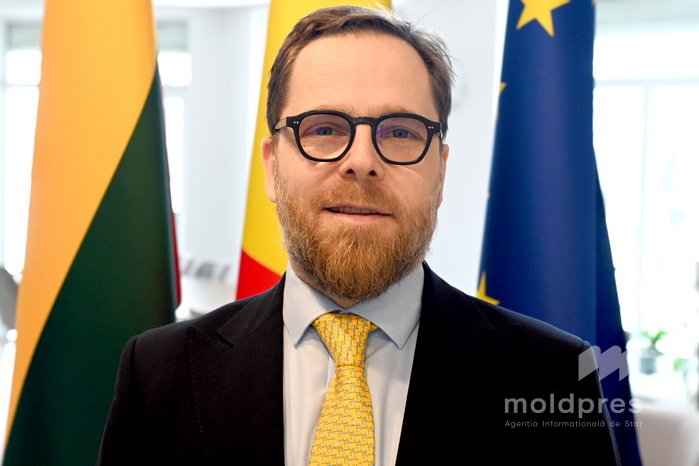
MOLDPRES INTERVIEW // Lithuanian Ambassador about prospects of Moldova’s EU accession: If you make things real, they will become achievable
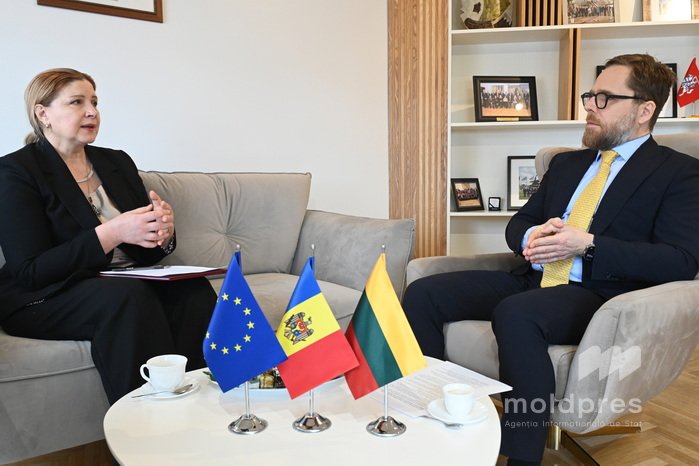
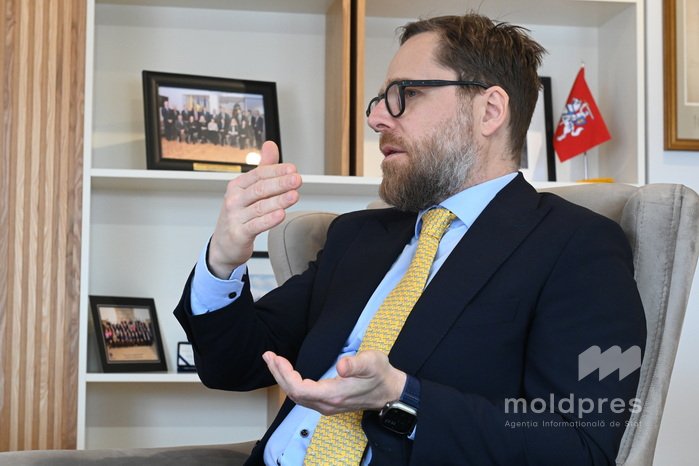
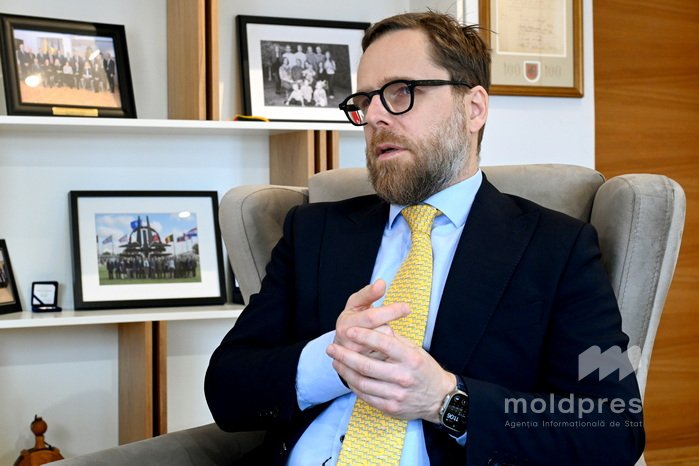
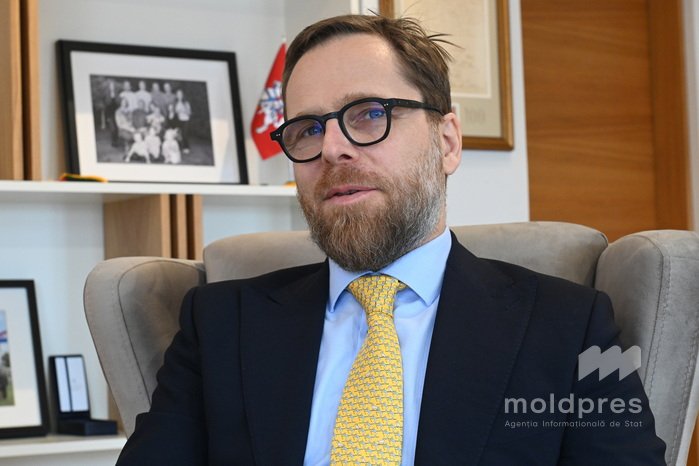
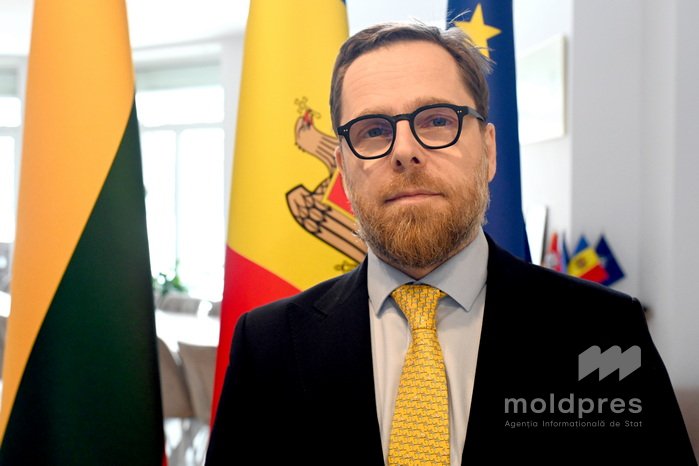
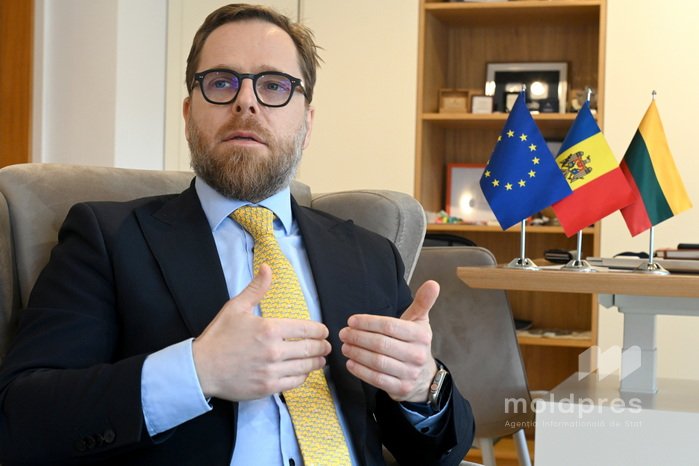
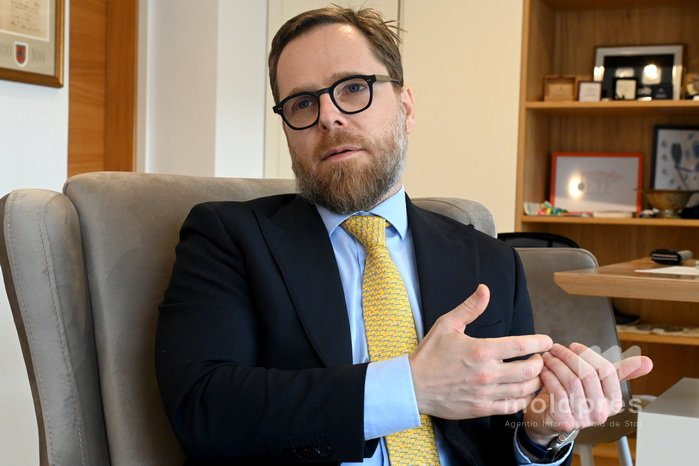
Ambassador of Lithuania to the Republic of Moldova Tadas Valionis gave an exclusive interview to MOLDPRES, in which he discussed Lithuania’s experience in the process of joining the European Union and the lessons that could be useful for the Republic of Moldova. Valionis emphasized that all reforms — from combating corruption and strengthening the justice system, to adapting agriculture and protecting the environment — are essential for obtaining EU member state status, and that their success depends on rigorous and sustained implementation.
The ambassador also spoke about the benefits of EU membership for citizens, comparing living standards in Lithuania and Moldova, including pensions and salaries, and offered insights regarding Chișinău’s proposed timeline for European integration by 2030.
MOLDPRES: The Republic of Lithuania celebrates its National Day on February 16. Whatis the historical significance of this date, and how is it usually celebrated by Lithuanian citizens?Tadas Valionis: We have several Independence Days. The first one dates back centuries to the coronation of our first king. February 16th marks the day we restored our independence after the collapse of the Russian Empire during the First World War. On that day, we re-established Lithuania’s historic path toward independence. However, we lost it again during the World War II.
We also celebrate another Independence Day on March 11th. On March 11th, 1990, we declared the restoration of our independence, becoming the first Soviet republic to break away from the Soviet Union.
Officially, we have three Independence Days, but February 16th is probably the closest to our hearts, because it represents the restoration of Lithuania as a national state — not as part of the Commonwealth with Poland. That was also a great chapter in Lithuania’s history, but February 16th marks the birth of the modern Lithuanian state. Modern Lithuania traces its roots to that date.
Usually, we hold official celebrations: the President delivers a speech, Parliament commemorates the occasion, and there are formal receptions. Here in Chișinău, we will also organize a similar event to mark the day. Since we have three important dates to celebrate — and Lithuania is well loved in Moldova — I personally prefer celebrating the coronation of the king, because it takes place in summer.
In Moldova, summer is the perfect season for a proper celebration, especially on terraces and outdoors. We will also host a small gathering at home for Lithuanians and open an exhibition on Tuesday at the Chișinău water tower to mark the occasion. In Vilnius, however, it will be a major national celebration.
MOLDPRES: Lithuania and the Republic of Moldova share a similar past, with both countries declaring independence in 1991. How did Lithuania manage to break away from its Soviet past and build a European identity?
Tadas Valionis: The Lithuanian state that existed between the First and the Second World Wars was extremely important to us, because an entire generation had grown up during that period and remembered what independence meant.
We maintained a long resistance movement, which continued even into the 1970s and 1980s. So our struggle lasted for decades. We eventually declared our independence in 1990 — a year before most others did. We were the icebreakers.
We took the risk of declaring independence on March 11, 1990. The other Baltic republics, Latvia and Estonia, followed somewhat later. Moldova was the first country to recognize our independence. On March 31, 1990, while still the Moldavian Soviet Socialist Republic and not yet independent itself, your parliament recognized Lithuania’s independence.
We had very deep connections. Some underground publications were printed in Latin script in Lithuania, and also in Latvia. Lithuanian representatives spoke at your mass rally in the central square, in front of nearly a million people. There was a strong and genuine bond between us.
How did we achieve independence? Partly through determination, partly through luck, and partly because Russia was weak at that moment. Force was used against us — tanks and troops were deployed, and several officers were killed. Soviet forces took over certain buildings, including the television tower and the police academy.
For a time, people with heavy Russian accents appeared on television broadcasts, attempting to present the situation differently. There were many anecdotes from that period. Yet somehow, society resisted.
People protected the parliament building and built barricades. This tense situation lasted almost a year. Although some strategic buildings were seized, the parliament remained under Lithuanian control. By 1991, as the Soviet Union began to collapse, we were prepared.
In July 1991, we signed a mutual agreement with Russia, which recognized our independence. We did not participate in the Belovezh Accords, because by that time we already considered ourselves fully outside the Soviet Union.
MOLDPRES: What were the biggest challenges faced before and after joining the European Union, and which reforms proved to be the most difficult, but decisive in getting the EU membership?Tadas Valionis: Which reform is the most important? In reality, you have to change everything — so every reform is crucial. EU membership comes as a package. You have to fight corruption, adjust your agricultural sector, maintain fiscal discipline, ensure that the justice system functions properly, and implement all environmental regulations. It is a comprehensive process.
Probably the most difficult reforms are the largest and most complex ones. Traditionally, the agricultural sector is among the most challenging, because it involves quotas and extensive environmental requirements. Environmental protection is also a major and very important policy area within the European Union.
However, in Moldova’s case, I would single out corruption and the justice system. I believe it is obvious to everyone that if you want to advance in negotiations and successfully implement reforms, you need a functioning and credible justice system. Once that is in place, institutions will work properly, investors will gain confidence in Moldova, and they will be more willing to come and invest here.
MOLDPRES: To what extent are the benefits of Lithuania’s EU membership felt today by the citizens of your country?
Tadas Valionis: I think everyone realized how much we have to lose when the war in Ukraine started. People began to reflect, sitting in their kitchens at home, and to truly appreciate how good our lives are. Just look at our two countries.
As we mentioned, we declared independence at almost the same time. We regained independence at almost the same time. Lithuania joined the European Union; Moldova did not. If you look at the size of our populations, they are roughly comparable. Lithuania now has almost three million people — especially as many are returning home. Moldova has around two and a half million. In that sense, our countries are similar.
But if you look, for example, at pensions in Lithuania, the average pension is now over 800 euros net — that is what people actually receive in their bank accounts. By law, pensions increase in line with salaries. In practice, this means they grow by approximately 8–10% every year. If the average pension is 800 euros this year, next year it will be close to 900 euros. The minimum pension is around 600 euros, while some pensions can reach 2,000 euros, depending on how much a person has contributed during their working life. And these increases are guaranteed by law every year.
If we had not joined the EU, we would not be able to afford this. Take salaries as another example. The average net salary of a teacher is around 2,000 euros per month — that is the amount received after tax. The average salary of a doctor ranges between 3,000 and 3,500 euros net per month.
So you can compare for yourselves. When it comes to quality of life and economic standards, the difference is significant — in some areas three to five times higher.
MOLDPRES: The Moldovan authorities have set 2030 as the target year for Moldova’s accession to the European Union. From Lithuania’s experience, do you consider this timeline realistic?Tadas Valionis: If you make it real, it will become realistic. It’s that straightforward when you look back at the past. We started negotiations in 2000 and finished in 2002, so we completed them in just two years. Although I should mention that, as soon as we declared independence, we began aligning our laws with the European Union.
So it wasn’t only those two years that we were reforming — we were always moving toward the European Union. We had cooperation agreements, something like the DCFTA, and we were consistently progressing toward EU standards.
By the way, Moldova was moving in the same direction. You signed the Association Agreement in 2013 in Vilnius, which also impacted Moldova, because you had to change some laws to meet European standards and gain access to the European market. So you were also advancing in this direction.
I think it is realistic, but it requires a lot of effort and hard work from public administration. It could happen in 2030, it could be 2035, but it could also be 2027. For example, when you look at the peace negotiations in Ukraine, if the next enlargement is part of the peace deal, it could happen even sooner.
So it makes sense to be ready as soon as possible and do everything necessary to be able to join the European Union. We live in an unpredictable world, so you have to be prepared to take advantage of opportunities as they arise.
MOLDPRES: How were Russian-speaking communities of Lithuania persuaded that joining the EU and NATO would bring greater benefits than maintaining “privileged” relations with Russia?
Tadas Valionis: We didn’t have a privileged relationship with Russia. The first thing they did when we declared independence was cut off our energy supply, so we lived in cold houses for about a year before we were able to adjust.
I should also say that, when we were preparing to join the European Union, the Russian population in Lithuania was relatively small — around 6.3% at that time. They were the third-largest nationality: the largest group, about 83%, were Lithuanians, the second-largest, around 7.7%, were Poles, and the third were Russians. I don’t have exact data on how the Russian population voted, but I would assume their votes reflected Lithuanian society as a whole, since they are well integrated.
Of course, there are Russian schools and cultural institutions, but overall, engaging with the Russian community in Lithuania has been less of a challenge than in some other countries. Many of my Russian friends consider themselves Lithuanian citizens and have invested heavily in the country.
Although I don’t have precise data on how they voted, Lithuanians supported EU membership in the referendum with over 90% of the vote. This level of support was unprecedented — we have never seen anything similar in any referendum or other vote since then.
MOLDPRES: What lessons learned by Lithuania in the process of joining the EuropeanUnion do you consider relevant for the Republic of Moldova at this point? From Lithuania’s perspective, what are the most important reforms that Moldova needs to accelerate, in order to advance on the path of EUintegration?Tadas Valionis: Today, I believe the most important thing is to build a strong structure made up of competent people. We need to train many specialists and also encourage qualified professionals to return from Romania and other countries, because they represent a huge potential. Many young Moldovans have left, received a very good education, and gained valuable experience. They could come back and become part of the team responsible for negotiations and reforms.
That, in my view, is the number one priority, because the quality of your negotiations will depend on the quality of your team. Negotiations with the European Union are, to a large extent, technical exercises. You take European legislation and adapt it to Moldova. However, there are areas that will be crucial in the long term — for example, agricultural quotas, agricultural subsidies, and other provisions that will affect your economic life after accession. That is why it is important not only to implement reforms well, but also to negotiate effectively.
So the first step is to build a strong and professional team.
I would also say that a public information campaign is extremely important, so that people understand what the process truly means. Governments should explain that reforms are not carried out for the sake of the European Union, but for Moldova itself. In some countries, there has been a tendency to blame Brussels — to say, “We are doing this because Brussels is forcing us.” I worked in Brussels myself for four years, and I know how easy it can be to shift responsibility in this way.
But in reality, reforms are needed for Poland, for Lithuania, and for any country that wants to modernize — not for Brussels. Sometimes unpopular decisions are necessary for the country’s own long-term benefit. If people are encouraged to believe that Brussels is to blame, it can lead to frustration, as we saw with Brexit and similar movements in other countries.
European legislation will form only a part of the framework. Brussels will not run your country. Your laws will be implemented and enforced by your own institutions for decades to come.
Justice reform is essential. Economic reforms are equally important — everything related to sustainable economic growth. Why join the European Union if you do not grow and develop afterward? Growth must be a priority, and everything connected to strengthening the economy is crucial.
That is probably the key message.
MOLDPRES: Which areas do you consider a priority for Moldovan-Lithuanian cooperation in the context of European integration, and what suggestions could you provide to Moldova’s authorities to accelerate reforms and bring the country closer to the EU?
Tadas Valionis: Yes, Moldova currently enjoys strong support from the European Union. There is very close cooperation. You are receiving millions — even billions — of euros in funding for various projects. Out of the 27 EU member states, 20 already have embassies in Chișinău, so almost everyone is present.
There is also substantial bilateral support, and virtually all sectors are covered. As a small country, we carefully assess where our expertise can add value and try to contribute in areas where support is still needed.
At present, we are implementing EU-funded projects in border management. We are assisting with the reform of the Ministry of Internal Affairs and the police. We are also working extensively on the development of a DNA database. Together with several European countries, and with EU support for equipment procurement and expert training, we are helping establish a modern DNA database for police investigations.
In addition, we have strong defense cooperation. We have launched a three-year program under which we have committed €2 million annually to support the reform of Moldova’s armed forces. We are also implementing a battalion “twinning” initiative. We selected a battalion in Lithuania located far from the capital, facing challenges similar to those of a battalion in Cahul, also distant from Chișinău. Through this partnership, we are helping develop their structures and providing most of our military assistance at that level.
We also have Lithuanian experts working in Moldova in the field of agriculture, including within the Ministry of Agriculture. We have experts supporting justice reform, currently working on anti-money laundering.
In addition, together with the EU, we are involved in projects supporting competition authorities. Alongside Slovakia, Germany, and Latvia, we are implementing a major project on public finance management in Moldova.
And this is only part of the picture. A great deal is happening here every day. We are doing our best to contribute without overlapping with other partners or competing with them. At the same time, it is important to make full use of the available support, because many countries are actively helping Moldova.
That is the current situation.
MOLDPRES: How would you assess the current level of the bilateral relations between theRepublic of Moldova and Lithuania? Are there any concrete projects or jointinitiatives that are planned to be launched in the near future?Tadas Valionis: Political relations could hardly be better. Our presidents know each other very well. During my term, our president has already visited Moldova twice. Last year, our Prime Minister also paid a visit. Just last week, our Minister of Foreign Affairs was in Chișinău. We also initiated a visit by the three Speakers of the Baltic parliaments to Chișinău, which took place last week. Next month, our Minister of Agriculture is planning to visit as well. So we are very actively engaged.
Last week, we transferred €200,000 to support the establishment of a crisis management and communication room at the Ministry of Foreign Affairs of Moldova. This project is being implemented together with the Nordic and Baltic countries — that is, the Nordic states and the three Baltic states — and we have provided our contribution accordingly.
On the purely bilateral level, as I mentioned, our defense cooperation amounts to a total of €6 million. This is a significant contribution. However, we are primarily focusing on EU-led initiatives, as this is the best way to ensure coordination. Moldova’s goal is to join the European Union, which will shape the country’s future for the next hundred years. That is why we are concentrating on this objective. Our long-term goal is also to expand the area of prosperity and security in Europe, and we are working together with other EU countries to achieve this.
MOLDPRES: How does Lithuania’s Embassy cooperate with the Lithuanian Diaspora in the Republic of Moldova?
Tadas Valionis: Thanks to our good relations, we also hold joint celebrations here at the embassy. We participate every September in Chișinău’s Ethnic Communities Day, together with the Lithuanian community. I also occasionally visit Lithuanians living in Transnistria, where there is a small community of Lithuanian nationals and citizens.
Overall, the community is quite small. Fewer than 300 Lithuanian citizens are registered in Moldova, and around 20 of them actively participate in events and come to vote in our elections. Although the community is small, it is very warm and welcoming. I truly enjoy spending time with them.
MOLDPRES: Lithuania has been a NATO member for almost two decades. How important was joining the Alliance for the country’s security, and how safe does Lithuania feel today, considering its proximity to Russia? How do you assess the security situation in the region and its impact on Eastern Europe?Tadas Valionis: We joined NATO one month before joining the European Union — on March 29, 2004. Shortly afterward, the first NATO air policing aircraft landed in Šiauliai. At that time, the NATO Air Policing Mission had just been launched, and the first F-16 fighter jets from the Belgian Air Force arrived in Lithuania. That marked the beginning of our NATO membership in practical terms.
As for how this has affected Lithuania’s security and the security of Eastern Europe, I would respond with a question. Try to imagine what this region would look like today, during the war in Ukraine, if Lithuania were not a NATO member — if Poland were not a NATO member, if Romania were not a NATO member. Would we have dared to support Ukraine to the extent that we have? Would Ukraine still exist? Would Moldova still exist? How would Lithuanians have had to act? How threatened would we feel? What difficult choices would our nations be facing in light of Russia’s aggression against Ukraine, if similar threats were directed at all of us?
I believe the situation would be entirely different. We would be less free and far more insecure. I think our societies would be much more traumatized. And for Ukraine, the consequences would likely have been even more devastating.
MOLDPRES: What message would you convey to the Moldovan authorities, but especially to the citizens of the Republic of Moldova who stay skeptical about EU accession, invoking costs or the loss of national identity?
Tadas Valionis:
I wouldn’t say that poverty is part of national identity. I think we prefer to be rich nationalists rather than poor nationalists, and the European Union helps a lot in achieving that. It’s a pure myth that joining the EU might make you lose your national identity. To preserve your identity, you need to be strong — a strong state, strong institutions — then you are truly free to be yourself. This has been proven right in Lithuania. Lithuanians today are stronger than ever, richer than ever, and freer than ever. I don’t see any way back to the world we lived in before EU enlargement or before the collapse of the Soviet Union. No one wants to go back.
For those who are skeptical, just look at the map and consider your position. Are you Europeans? How do you want to trade? How do you envision your future? Where do you want your children to study and live? Do you want freedom, or do you want to live under Russian influence and a world of illusions? Look around, look at your neighbors, see what the European Union offers — and no one wants to go back.
Even among minorities, I’m sure that everyone in Lithuania wants to stay in the EU. I gave you the numbers on salaries. I have five children, and two of my daughters studied abroad because they had the perfect opportunity. One studied in Belgium, the other in the Netherlands, and they were treated as if they were locals, without paying more than we would have spent supporting them in Vilnius. Now they are free to choose where to live — one is working in Vienna, the other is returning to Lithuania.
If you want to be prosperous, you need to be open to the world. You need to bring the best from the world here, not just stay at home, hold your hands, sing national songs, and eat national food. That’s not what identity is. Our identity today is launching satellites — we have Lithuanian companies manufacturing satellites. Our identity is not only in national songs, but also in strength in biotech and fintech. Our identity is having a strong military and strong allies. We are not alone, and we are strong together with the entire region and our neighbors.
MOLDPRES: Your Excellency, thank you for your time and for your willingness to share your perspectives in this interview for MOLDPRES Agency.
 Facebook
 Instagram
 X/Twitter
 Telegram
MOLDPRES INTERVIEW // Customs Service Director: Moldova has necessary experience to contribute to development of European customs system
MOLDPRES INTERVIEW // ANSC Director: We make sure that path of public money to hospitals, schools or infrastructure fair and transparent
MOLDPRES INTERVIEW // Vice President of Romanian Academy says academic, research environment of Moldova advanced, can be efficiently integrated into European, international structures
MOLDPRES INTERVIEW // Rector of University from Romanian city says if someone overturns your history, national identity, it means you don’t have enough knowledge
MOLDPRES INTERVIEW // Director of South Regional Development Agency says Agency creating better living conditions, easier life for thousands of residents
MOLDPRES INTERVIEW // Moldovan finance minister says government aims to modernize financial system for benefit of businesses, citizens
MOLDPRES INTERVIEW // Ambassador of State of Qatar to Moldova: We are working to improve ways of attracting Qatari investors to Moldovan market
MOLDPRES INTERVIEW // President of Moldova's Chamber of Commerce and Industry says country must use opportunities provided by European integration to attract investments, become competitive
MOLDPRES Interview // Minister of Internal Affairs: Interior Ministry applies European security standards and is ready to advance in EU accession process
MOLDPRES INTERVIEW // Moldovan energy minister says foremost interest citizens to have secure energy at affordable prices
Moldovan justice minister says, according to European Commission’s Report, Moldova made greatest progress among EU candidate states, including in justice field
INTERVIEW MOLDPRES // Moldovan defense minister says Russia's war in Ukraine highlighted vulnerability of defense sector, need of building strong, prepared, resilient army to current challenges
INTERVIEW WITH MOLDPRES // Deputy PM says wants Moldova where a child from any village has same opportunities as a child from Chisinau
INTERVIEW MOLDPRES // Deputy Prime Minister on Ukraine Peace Agreement: No discussion about Moldova can take place without Chișinău's participation
Moldovan Prime Minister in talks with Ukrainian President
Prime Minister's message of appreciation for Ukraine: Your resistance allows us to live in peace
Anti-Corruption Prosecutor Vadim Prisacari fails external evaluation
Technical-military cooperation agreement between Moldova and Ukraine signed in Kyiv
 National Bank of Moldova
Moldovan Prime Minister in talks with Ukrainian President
Prime Minister following meeting with Ukrainian counterpart: Every day Ukrainians defend their cities, families and freedom, they also contribute to security of Moldova
Speech by Prime Minister following meeting with Ukrainian counterpart
Prime Minister attends Kyiv International Economic Forum
Prime Minister's speech at Kyiv International Economic Forum

Speech by Prime Minister following meeting with Ukrainian counterpart
Moldova's European path and regional security discussed by Foreign Ministers of Moldova and Cyprus
Republic of Moldova fully covered electricity consumption on October 19–25
Romania’s Prime Minister to visit Chișinău on Tuesday
VIDEO // Ukrainian citizen illegally crossed border into Moldova by motorized paraglider and requested asylum
Powered paraglider illegally entered airspace of the Republic of Moldova
Republic of Moldova to promote tourism offering at WTM London 2026
Republic of Moldova and Cyprus seek to deepen interparliamentary cooperation
Prime Minister attends Kyiv International Economic Forum
Prime Minister's speech at Kyiv International Economic Forum
Moldovan parliament speaker, Metropolitan of Moldova Vladimir discuss spiritual values, society's unity
Moldovan Education Ministry introduces mandatory training to prevent plagiarism, fraud at universities
Foreign affairs minister of Moldova, President of Cyprus discuss strengthening Moldovan-Cypriot relations, Moldova’s European agenda
VIDEO // Moldovan PM in Kyiv says Moldova reconfirms firm support for Ukraine
Online services for submitting, issuing permits restored after cyberattacks in Moldova
Chisinau Airport to operate direct flights to 61 destinations during next winter season
Receive the latest news directly to your email

Receive the latest news directly to your email