
State Budget for 2026 approved by Parliament in first reading
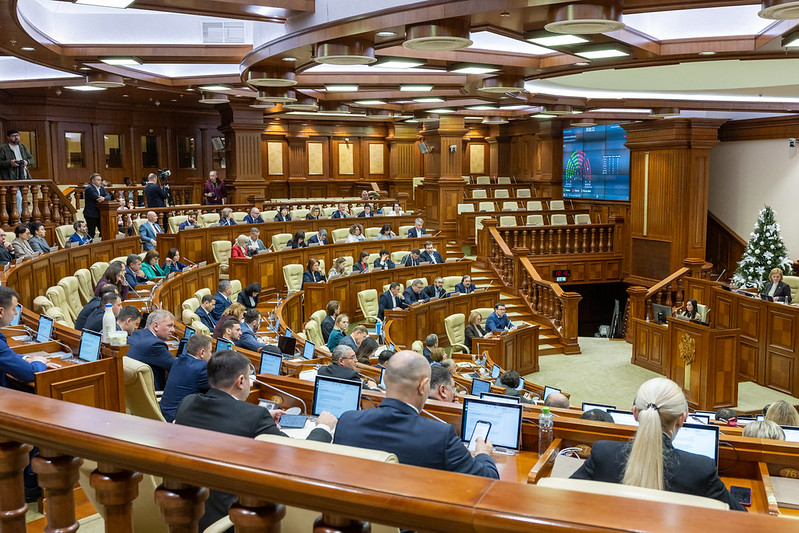
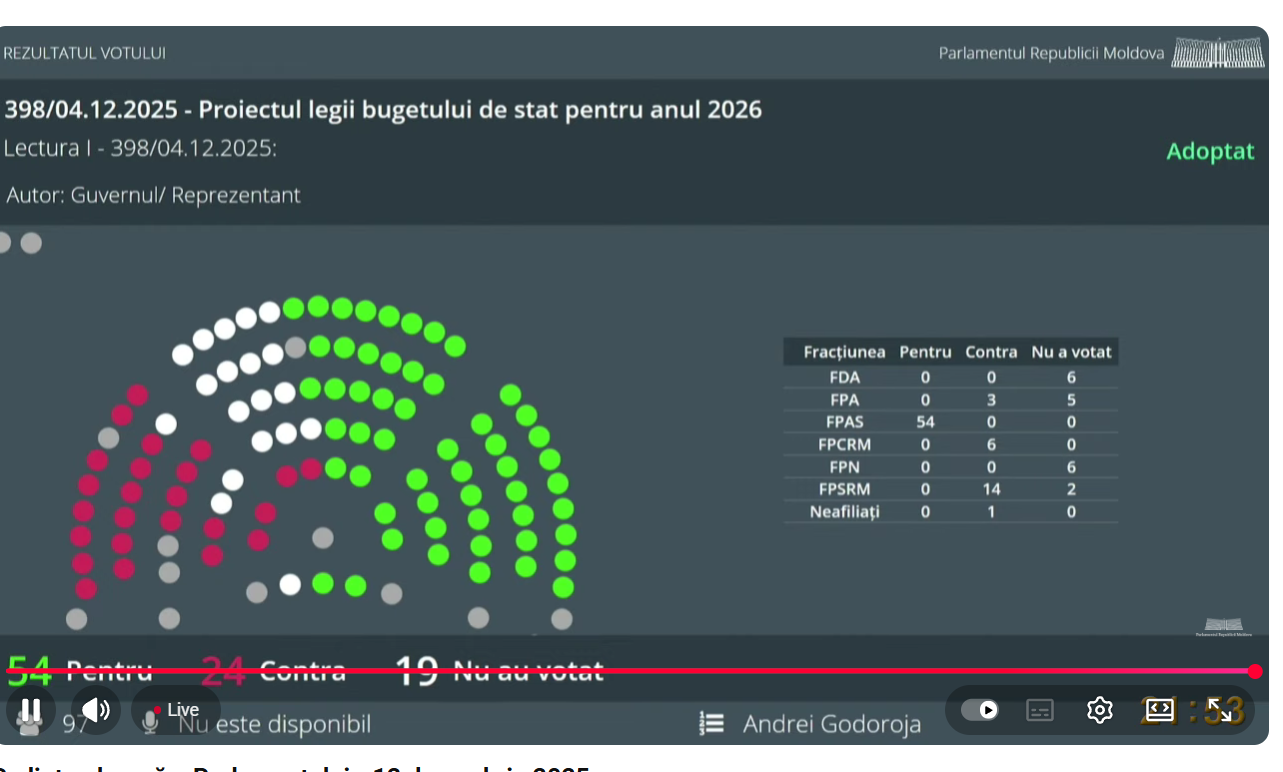
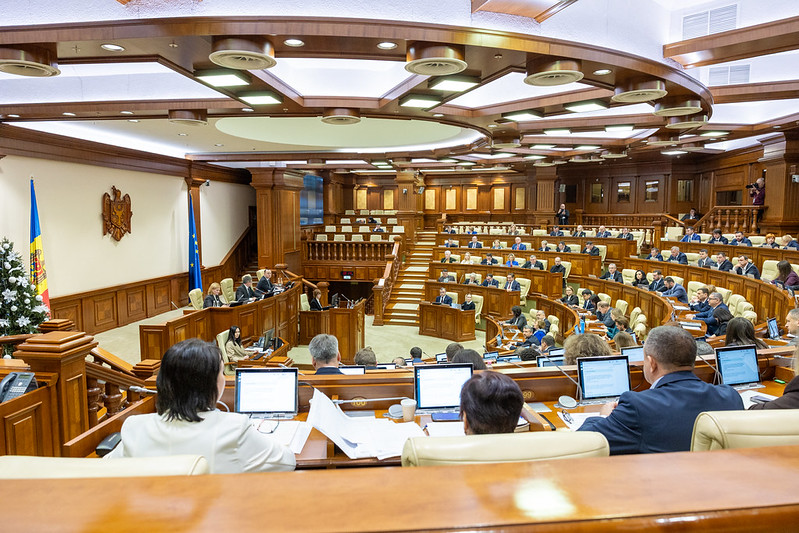
The state budget for 2026 was approved today by the Parliament in the first reading with the vote of 54 deputies from the parliamentary majority, after six hours of debates in the plenary session. The communist and socialist deputies, as well as an independent deputy, voted against it. The document, called the “budget for responsible investments,” foresees revenues amounting to 79.67 billion lei and expenditures of 100.57 billion lei, with a deficit of 20.9 billion lei, focusing on record investments and salary increases.
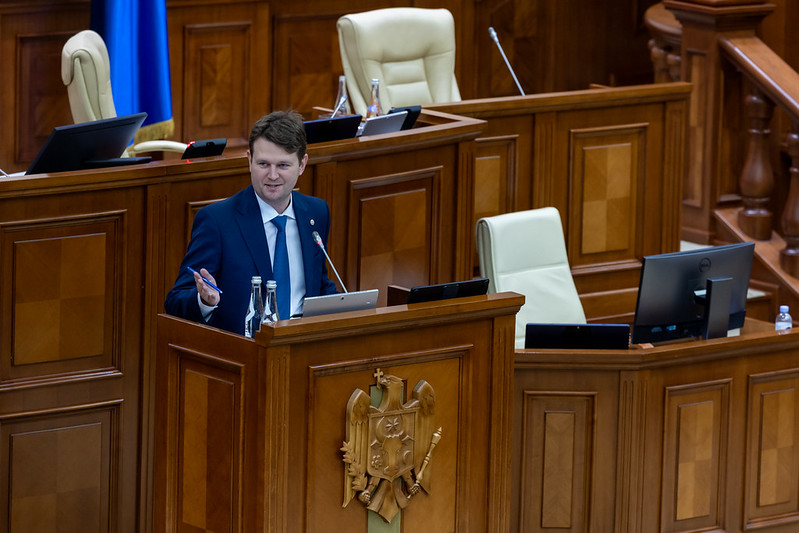
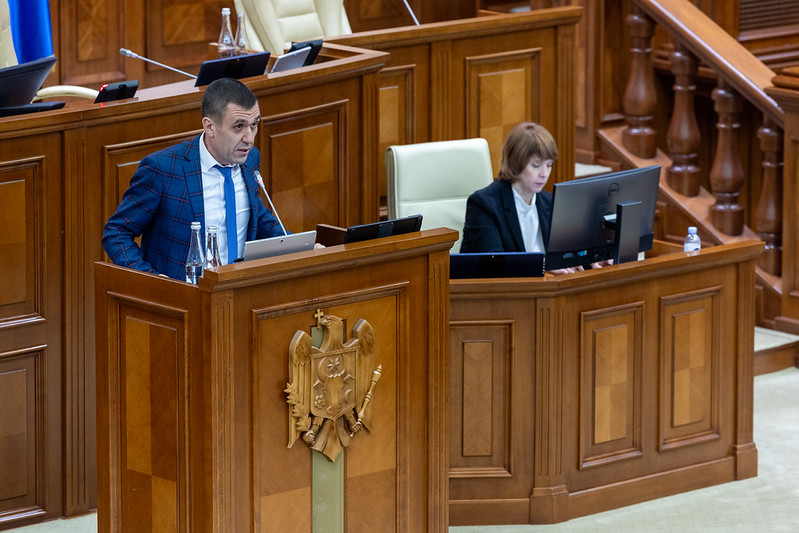
The document was presented in the parliamentary plenary session by Minister of Finance Andrian Gavriliță, who outlined the main indicators underpinning the budget.
“We are coming out of a few extremely difficult years, it is only in the last seven quarters that we have seen the return of private investments, this is the first horizon in which we can say that we see economic growth awaiting us starting next year,” the minister declared.
Andrian Gavriliță stated that “this budget is based on an economic growth of 2.4%, a nominal GDP of 377 billion lei, an average annual inflation of 4.3%, and an average monthly salary of 17,400 lei, up by 11% compared to the previous year.”
“On the revenue side, we have over 79.67 billion lei, 3.87 billion lei more than last year. Expenditures are planned at 100.57 billion lei, 6.57 billion lei more than in 2025. The deficit will be 20.9 billion lei, or 5.5% of GDP. We call it the budget of responsible investments because we ensure as much as possible of this deficit goes into investments and that no public investment projects are stalled or have not been initiated, despite all existing difficulties,” Andrian Gavriliță declared.
The official pointed out that capital investments will be increased by more than 55%, to about 3 billion lei for 85 projects, and capital expenditures will exceed a total of 11.4 billion lei.Additionally, the Economic Growth Plan valued at 1.9 billion euros funded by the European Union includes about 5.6 billion lei for infrastructure modernization, economic development, support for the business environment, agriculture, and rural development.
“For infrastructure, I'll give a few figures: local roads - 650 million lei, European localities - 450 million lei, railway infrastructure - 300 million lei economy, 200 million lei - FACEM program, 200 million lei - program 373, 150 million - multifunctional industrial platforms, 250 million lei - state aid for industry and services, 60 million lei for supporting the capital market,” the Minister of Finance stated.
Additionally, 600 million lei will be allocated supplementary for the fund for farmers, which will reach 2.2 billion lei.
Another 470 million lei will be allocated additionally for the National Afforestation Program, which will reach 675 million lei, 500 million lei will be allocated for energy efficiency in the residential sector, and 110 million lei for the interconnection of energy systems.
“What we will have in 2026 will be a positive change,” the minister concluded.
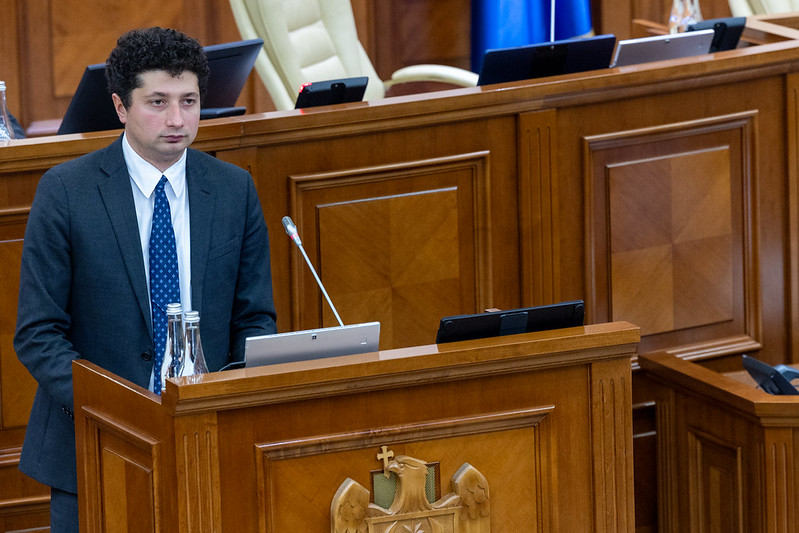
The president of the Parliamentary Committee for Budget and Finance, Radu Marian, declared in the plenary session of the Parliament that the State Budget Law project for 2026 was supported within the committee by a majority of votes and proposed the project for adoption in the first reading.
In his statement held in the plenary session of Parliament, Radu Marian called on deputies to take responsibility to support the “Budget of Responsible Investments.”
“Through the Budget of Responsible Investments, we are introducing measures that aim at generating sustainable economic growth so that later we can significantly and consistently increase revenues. The plan is to have a sufficiently large budget to increase incomes for everyone - teachers, police officers, doctors, officials, and all those who work honestly,” Radu Marian declared.
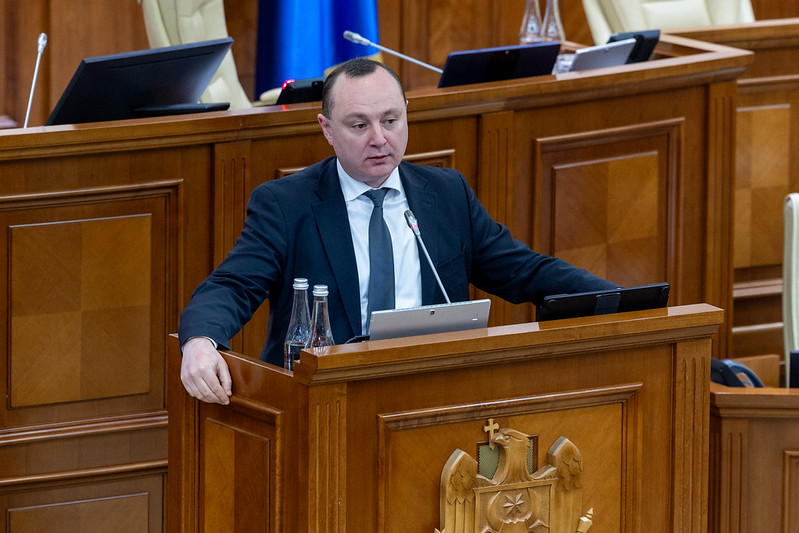
Opposition deputies criticized the 2026 Budget, calling it antisocial. In particular, they invoked the overly large budget deficit, increased expenditures for defense, and other state institutions.“What good is it that you can name billions as you wish, how much money has been executed for agriculture? I've heard many numbers, but the budget is not executed. The 2026 budget will not be executed just like the 2025 budget was not executed. Where do we go from here? It is clear that the Republic Moldova is dependent on loans, debts, and cannot produce anything. The Socialists' faction will vote against this budget and we will come with a series of amendments so that farmers and schools receive what is theirs,” declared socialist deputy Vlad Bătrîncea, vice-president of Parliament.
“In total, indirect taxes constitute 75% of the projected revenues. Compared to the income level, people with lower incomes will bear a greater burden, while high-income taxpayers will continue to benefit from so-called optimization mechanisms. The rich will get richer, and the poor will get poorer. The State Budget Law remains a political tool and confirms the inefficiency of the current government,” said deputy from the PCRM faction, Andrei Godoroja.
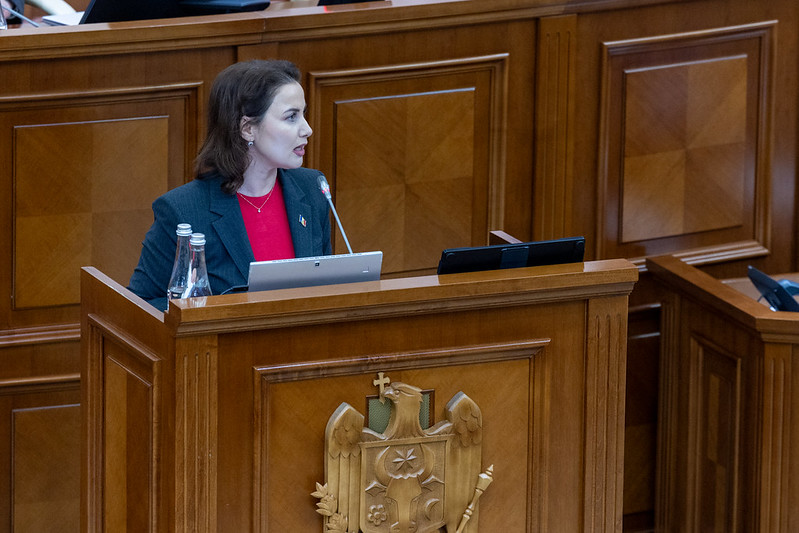
In the first reading, the State Budget Law project for 2026 was supported by the majority faction deputies who stressed the considerable investments that will be made in developing localities, improving citizens' quality of life, and ensuring energy security.“Someone from this hall asked why the 2026 Budget is the budget of responsible investments. I give you an answer - because previous governments, that is, you here, have left the Republic of Moldova energy vulnerable without an alternative and without real investments. We are changing this reality - we are building energy lines interconnecting Moldova and Romania's systems. The Vulcănești-Chișinău energy independence line is almost completed. In 2026 we are allocating 110 million lei for the Bălți-Suceava line, for network rehabilitation, and the construction of the Bălți electric station. In addition, 200 million go into large energy storage systems - something you should have done. This is how we build energy security, this is how we protect every family and you from the risk that a criminal might press a button at Cuciurgan and leave the country in darkness,” declared PAS deputy, Larisa Novac.
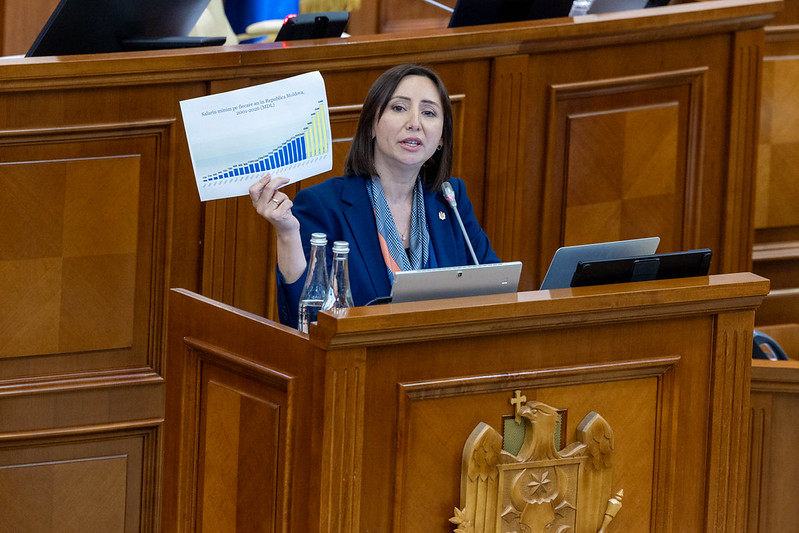
“Since PAS has been in power, the minimum wage has increased by 114%. We understand that this amount is not large. Even so, we have a better situation than in some post-Soviet countries that are not EU members, surpassing the Russian Federation and many other states in the region. In the Republic of Moldova, the minimum wage will be 370 US dollars in 2026. In comparison with Russia, which has a minimum wage of 250 dollars, Azerbaijan - 235 dollars, Belarus - 222 dollars, Ukraine - 193 dollars. Before us are only the Baltic States, where the minimum salary ranges from 800 to 1200 dollars. To reach this level, we all have to work to become EU members,” declared PAS deputy, Marina Morozova.
Against the project of the State Budget Law for 2026, 14 socialist deputies, six communist deputies, and three deputies of the Alternative Faction, as well as an unaffiliated deputy, voted. Deputies from the Democracy at Home and Our Party abstained from voting. Also, two socialist deputies and five from the Alternative did not vote.
The president of the Parliamentary Commission for Economy, Budget, and Finance, Radu Marian, urged deputies to propose amendments to the State Budget Law project for 2026 by December 18.
 Facebook
 Instagram
 X/Twitter
 Telegram
Fuel prices are going down in Moldova; petrol price drops below threshold of 31 lei
State to be able to respond more quickly in event of energy emergency
Moldovan carriers to receive additional 300 permits for routes to Azerbaijan
Import duties on energy storage batteries and wind turbines to be abolished
Moldovan energy minister calls for compliance with deadlines for completing works needed to start energizing Vulcanesti–Chisinau power line
Moldova to receive 150 million euros to modernize strategic roads
Moldovan energy minister says every leu invested in energy efficiency generates significant economic impact
Energy compensations to be maintained in next cold season
Agriculture Minister after farmers’ protest: I will continue to focus on dialogue to identify solutions to all demands
Fuel prices drop: diesel falls below 29 lei
VIDEO // State introduces new incentives for green energy
Energy cooperation between Moldova and Romania discussed at conference in Chișinău
PHOTO // Investment opportunities of Moldova presented at Economic Diplomatic Club Bucharest; Moldovan ambassador to Romania says Moldova stays open to investments
Romania accelerates strategic Vulcanesti–Chisinau project: “A pillar of Moldova’s energy security and European future”
Right to fair trial – most frequently reported problem by Moldovan citizens in 2025: Ombudsman’s report presented in parliament
Moldovan parliament sets up inquiry committee on phone, online scams: damages exceeding 270 million lei
Moldovan parliament speaker describes Russia’s intention to move Russian Center of Culture to Tiraspol as political provocation
Stricter rules for taxi platforms: payments to be required to obligatorily go through banks of Moldova
Moldovan parliament speaker says each day of delay of elections in Gagauzia works against autonomy
Voted in parliament: Moldovan citizens who worked legally in Canada to be able to receive social benefits
Moldovans working in Ukraine to be able to receive pensions, other social benefits
 National Bank of Moldova
Over 1 billion euros in new investment partnerships, financing announced for Moldova
Topical issues addressed at meeting of Joint Control Commission
Moldovan president, European Commissioner for Enlargement discuss reforms, next steps in accession process
Moldova strengthens institutional capacity to counter hybrid threats with support of EU Partnership Mission in Moldova
President’s speech at joint press conference with European Commissioner for Enlargement

Over 1 billion euros in new investment partnerships, financing announced for Moldova
Labour legislation aligned with European standards: citizens of Moldova to be able to receive unemployment benefits in EU countries
VIDEO // ARBOM offers 80 tickets for Moldova - Bulgaria match to supporters from Taraclia
Moldovan head of state says Russia’s interference constant, efforts must be made to counter it
Moldova secures additional funding for connection to European Road Network
ARMENPRESS: EU to provide additional support to Armenia amid Russian import restrictions
Moldova attracts over 1 billion euros in investments through new strategic partnerships announced at first Moldova–EU Investment Conference
Topical issues addressed at meeting of Joint Control Commission
Moldovan president, European Commissioner for Enlargement discuss reforms, next steps in accession process
EU Commissioner for Enlargement says Moldova on first position in its preparations for European Union membership
Moldovan president says all EU member states reconfirm Moldova ready to open accession negotiations
Moldova strengthens institutional capacity to counter hybrid threats with support of EU Partnership Mission in Moldova
Departed well-known composer of Moldova honored in Chisinau: maestro’s music returns to salon bearing his name
VIDEO // Moldova and Ukraine reaffirm: Our future in EU
President’s speech at joint press conference with European Commissioner for Enlargement
VIDEO // News from Brussels on starting preparations for Cluster I in accession negotiations of Moldova to European Union applauded in Parliament
Receive the latest news directly to your email

Receive the latest news directly to your email