
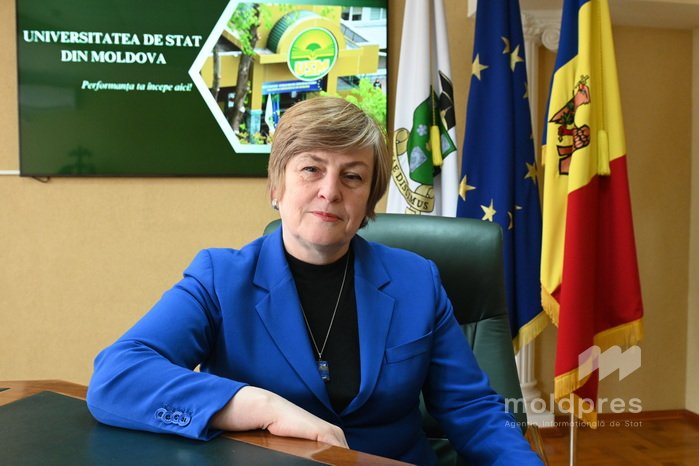
MOLDPRES INTERVIEW // USM Rector: We aim to strengthen our position as key player on educational services market
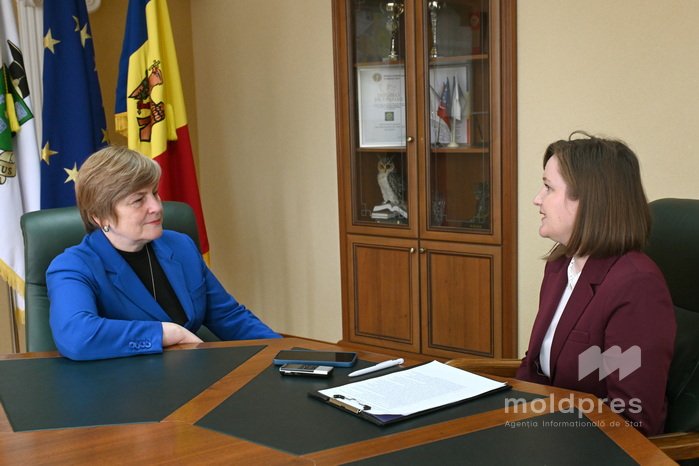
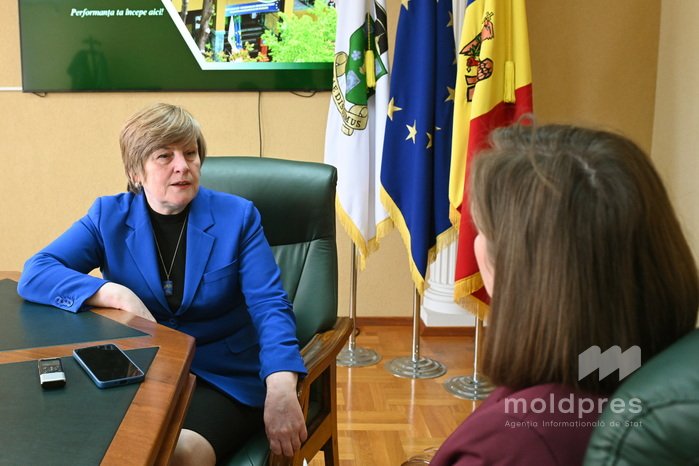
In a context marked by rapid transformations in education and on the labor market, Moldova State University (USM), the largest higher education institution in the country is redefining its priorities in order to remain a benchmark of higher education. With over 15,000 students and a diversified educational offer, the university aims to consolidate its position on the educational services market, to reshape the scientific research process, to modernize its infrastructure and to respond more effectively to labor market demands. New rector of USM Otilia Dandara provided details in an exclusive interview for MOLDPRES about the priorities of mandate, the novelties of admission 2026–2027, internationalization and strategic directions that will define the institution’s future.
MOLDPRES: You have recently taken over the position of rector of USM, one of the most prestigious higher education institutions in the Republic of Moldova. What priorities have you set for your mandate in order to ensure the continuity of the institution’s modernization process?
Otilia Dandara: There are several, and in fact they reflect the strategic directions of Moldova State University, aligned with the mission of this university. First of all, I strongly wish, together with my colleagues and the new team at the rector’s office, to succeed not only in remaining, but also in strengthening our position as a very important player on the educational services market.
At present, we are the largest university in the country; we offer the largest number of study programs, at bachelor’s, master’s and doctoral level, with a large number of students at all three cycles. We also have a good image and consolidated programs, and I would very much like us to further strengthen them. This means updating them, as well as a closer alignment of learning outcomes with the competences required by labor market stakeholders.
In addition, we will continue to diversify the modalities of professional training. We offer full-time studies and I am very glad that most of our students are full-time. This is a good quality indicator, because full-time students, regardless of age, are the core of the student body: they are the ones you interact with, those who create the atmosphere and who allow more detailed curricular and extracurricular activities. We want to motivate young people to enroll in full-time studies. Besides that, we have part-time programs and distance learning programs, which we launched last year and will continue to consolidate both in terms of programs and student numbers.
An achievement of the university in the field of distance education is that we have managed to attract more than 30 students from the diaspora, which makes us very happy. We believe that the diaspora is a still underused pool that the university could attract to study.
Also starting last year, we have tried to implement the dual system, that is, another concept of higher education, which means that study credits are earned both at the university and at enterprises. This form of education is an opportunity for a certain group of beneficiaries who very much want to learn by working. This is what we want: to remain a very important actor in the professional training system on all these dimensions.
Another strategic direction remains scientific research. Since 2023, the university has included thirteen research institutes, which practically cover most research fields. Our objective is a closer connection between research and the real economic sector. Our researchers have established partnership relations with a very wide network of universities around the world. In order to achieve the expected results, we need equipment and proper laboratory conditions, which is very difficult today because it requires investment. But our research colleagues are making this effort, they are writing and submitting projects. We acquire equipment through these projects. We also have the support of the Ministry of Education and Research, which makes it possible to design and obtain projects and to equip scientific research laboratories.
Another strategic development direction is internationalization, focused on cooperation with foreign universities, with objectives related both to study programs and to partnerships in research. It is no secret that the demographic situation in the Republic of Moldova is not the best. There are circumstances that do not always depend on us or on the Government, which is making efforts to encourage young people to stay in the country. I believe it is our duty to attract foreign students. It would be wrong to say that we do not have students, because USM has the largest number of students in the country, about 15,000, but we believe that foreign youths could strengthen our student body. An analysis of the current situation shows that this category of students would allow us to consolidate certain fields that are less in demand among our own young people, such as natural sciences and exact sciences.
This means programs developed in a language of international circulation. English is preferred at the moment. Currently, we have eight study programs delivered in English or French. We want to increase the number of professional training fields in which studies are conducted in an internationally used language.
Internationalization does not only mean foreign students; it also includes joint research projects, institutional development projects and academic mobility, as well as attracting funds that could allow us to improve the technical and material base, equipment, or even to organize continuing education and professional development internships for teaching staff.
The Moldova State University has a fairly large number of academic mobilities for both teaching staff and students. For students, this means the possibility to study for a semester at a partner university, and for professors – training internships in other institutions.
Other priorities we have concern intensifying student involvement in university life. We would like to have more excellent students who are active in the life of the university.
Last but not least, a strategic development direction is improving the university’s infrastructure. It would be a pity to complain that we do not have buildings or land. We do, but any building, any asset the university owns requires investment and constant modernization. A strategic approach is needed.
MOLDPRES: What novelties does the 2026–2027 admission session at Moldova State University bring, and to what extent are you considering expanding or diversifying the study programs offered?Otilia Dandara: USM offers about 70 bachelor’s programs and over 60 master’s programs. Since 2019, our admissions have been slightly increasing, and in the last two years we have had very good admission sessions. For example, last year we admitted over 4,500 new students. The Study in Moldova campaign was very welcome, as it allowed us to achieve good results through combined efforts. This activity showed that where there is a well-thought-out strategy and joint efforts, the results match expectations.
This year we will not launch new study programs. We will keep the same programs. I believe there are many and they are good. I am not sure that it is always good to go in the direction of mere expansion. Perhaps we should rather go deeper in certain aspects, by diversifying professional training strategies so that every beneficiary can find their place at the university and say: “Moldova State University is what I want, and this is the environment in which I feel I belong, to develop as a person and to build my professional skills.”
In admissions, we focus on creating conditions to attract more candidates and to enroll good high school and college graduates, so as to strengthen the active student body of the university with the best students. In this context, our university is among the top in terms of the number of high school graduates with averages above “8”. Good, strong graduates come to USM and we very much want to maintain this, because a strong candidate means a motivated student and a strong student body.
This year, in admissions, we will not increase the number of programs, but we want to raise the quality of studies and diversify professional training strategies together with partners from the socio-economic environment, so that professional training is as close as possible to the conditions of the labor market.
MOLDPRES: In this context, I would like to ask how Moldova State University adapts its study programs to the current demands of the labor market and what concrete mechanisms you are considering to support the integration of graduates into the labor market?
Otilia Dandara: We have several strategies. First of all, for USM, one segment of the labor market is the university itself. We have 13 research institutes. We need young people in research, and this is a segment we are currently emphasizing.
We also apply other strategies for closer cooperation with the labor market. For example, in fields where there is a strong practical component, such as journalism. With the help of the Ministry of Education and Research, we are diversifying the modalities of professional training. Through bootcamps, students have gone into newsrooms, practiced, and seen what actually happens.
First of all, not all fields have the necessary characteristics to allow the exercise or simulation of certain professional training activities. But at the same time we try wherever possible: architecture and design, forestry, journalism, tourism and hospitality services.
For accounting, for example, we have a different strategy. We are part of the Association of Chartered Certified Accountants (ACCA). We have developed a study program so that the content taught at the Faculty of Economic Sciences, in the Accounting program, matches the international requirements for professional training. As a result, out of the 16 exams that a chartered accountant must pass at international level, eight are automatically recognized on the basis of holding a degree in accounting from Moldova State University.
We must not forget that at the end of their studies we, in the academic environment, certify learning outcomes. When they enter the labor market, candidates are asked for competences. In academia, you cannot fully demonstrate the entire set of competences that an employer requires. Hence the need for applied training through internships or extracurricular activities, on the basis of which, when the candidate enters the labor market, they have the ability to solve work tasks. And it is our duty, as a modern university, to get as close as possible to those labor market demands and, together with employers, to discuss the concept of the program, its content and the modalities of carrying out professional training activities.
MOLDPRES: In recent years, USM has expanded its international partnerships and academic collaborations, becoming one of the few higher education institutions in the country that offers students from some specialties the opportunity to obtain double degrees thanks to partnerships with institutions abroad. How many students have benefited from this opportunity?
Otilia Dandara: If we count how many students have obtained double degrees as a result of the internationalization process over the last 7–8 years, their number reaches several hundred.
Double degrees are a beautiful component of the university’s strategic development directions – education, internationalization and research. Our first experience took place within an institutional development project with the University of Girona in Spain. We initiated a double degree in tourism and hospitality services. Subsequently, we launched several double degree programs with universities in Romania. Currently, we have several double degree programs, at both bachelor’s and master’s level, with “Ștefan cel Mare” University of Suceava, “Alexandru Ioan Cuza” University of Iași and the University of Bucharest. There have been discussions about expanding the network, as we have very good partnership relations with Babeș-Bolyai University in Cluj, the University of Oradea and West University of Timișoara.
We intend to expand both the existing programs with our current partner universities and to initiate new ones with other universities. As for other partnerships, I think a major achievement this year has been the double degree program in Law with the Sorbonne Pantheon 1 University in Paris, implemented with strong support from the Embassy of the Republic of Moldova in France, the French Government and with great openness from the management of Sorbonne Pantheon 1 University. The first admission to this program took place in the 2025–2026 academic year, and we currently have 20 students involved.
We are also going to launch a master’s program in a triple partnership, thus with a triple degree: Sorbonne University, the University of Bucharest and the Moldova State University, focused on international law, with a particular emphasis on European law, taking into account our need to train professionals for our legal system, given that we are in the process of joining the European Union and must be prepared to develop and align various normative acts.
MOLDPRES: At what stage are the discussions?
Otilia Dandara: At the stage where we can possibly launch admissions this year. So, quite advanced. We have signed a partnership agreement. The issue was to clarify some financial aspects, such as who will provide the scholarships and how the state-funded places will work.
MOLDPRES: What procedure must a student follow to be able to benefit from a double degree?
Otilia Dandara: First of all, documents for the double degree are submitted at the admissions stage. The main criterion is a good admission average, which allows you to obtain a state-funded place. Another condition is knowledge of French/English if we refer to universities outside the Romanian-speaking area.
MOLDPRES: Minister of Education and Research Dan Perciun recently announced that student scholarships will be increased starting from 1 September 2026. To what extent can this influence high school graduates’ decision to continue their university studies in our country?
Otilia Dandara: I can only appreciate the efforts of the Government and the Ministry of Education and Research, because, at national level, it is a major effort on the part of the state to provide higher scholarships. I believe this is a very welcome strategy to attract students to stay in the country and study here.
We can already see the effects of the financial effort and of the strategy applied by the Ministry of Education and Research to attract students to teacher-training faculties or the fields of Educational Sciences. In these fields, scholarships in the final year of study were already high, over 3,500 lei per month. Now they will be even higher.
MOLDPRES: How do you intend to attract and retain high-performing teaching staff within the university and to strengthen the quality of the educational process?
Otilia Dandara: If you do not have quality people, you cannot have a quality educational process. It would be wrong to say that we do not have quality people, because we really have many excellent staff and enormous potential. USM’s wealth lies in its people. We have enough teaching staff, we are not facing a shortage, but thinking ahead, we would like to have more young lecturers. All the more so as human resources in a university are developed over time. Training a university teacher involves a lengthy period.
In addition, in an era of rapid change, diversification of the labor market and wide career choices, many enter and few remain. A difficult aspect the Moldova State University faces today is this general fluctuation of the labor market. Offers appear very quickly, and you cannot know what offers there will be tomorrow. In other words, the labor market is not as stable as it once was. It is not just about us; it is a general vulnerability of the academic environment compared to other professional settings and other labor market segments.
But we very much want young specialists to come, and we have policies to encourage this process, which we will strengthen this year. We facilitate dormitory accommodation for young specialists and offer the possibility to defend the doctoral thesis under more favorable conditions.
MOLDPRES: What initiatives do you plan to implement in the near future to improve living conditions for students in USM dormitories?Otilia Dandara: We have several projects initiated in this regard. Works are currently underway at Dormitory No. 2, with the support of the Ministry of Education and Research through projects funded by the World Bank. We could not have afforded this on our own, because this is not just a renovation but a reconstruction: the architectural concept of the dormitory is being changed. However, certain conditions make the process difficult, because we are in the historic center of the city and any change must be carefully coordinated with specialists in the field.
In addition, our project for the capital repair of Dormitory No. 7 in the campus of the Institute of Physical Education and Sport has been approved by the Ministry of Education and Research. Design work is now starting and a working group has been set up.
We are in under negotiating and identifying a partner to start design work for Dormitory No. 4, also in the Tighina campus, so that we can begin the renovation process.
Likewise, with the support of the Ministry of Education and Research, we have gradually managed to improve conditions at Dormitory No. 1 – replacement of the roof and windows and renovation of the facade. We still need to find resources to modernize the interior.
Also, last year we drafted a modernization project for Dormitory No. 6 in the Dimo campus, but we have not yet identified a funding source. Therefore, when it comes to dormitories and university infrastructure, we are constantly looking for sponsorships and financial support. A university cannot afford to cover all such costs alone. The tuition fees students pay are lower than the per-student equivalent amount provided by the Ministry of Education and Research, and we manage only to pay teachers’ salaries. We cannot even afford to do repairs or buy new generations of equipment.
MOLDPRES: Since we have reached the topic of tuition fees, what will happen to them this year, will they be changed?
Otilia Dandara: We have not yet discussed the issue of tuition fees. It is time to do so. It is very likely that they will be revised, but not by much. We will take into account the inflation rate and the perceived price level. We will also analyze the market, what is happening at other universities, and how much educational services cost. We factor in all these aspects in order to cope with the situation and remain competitive.
MOLDPRES: The Ministry of Education and Research, in partnership with universities in the country, has launched Study in Moldova campaign to present to young people the opportunities offered by higher education institutions in our country. What message do you have for young people who are considering choosing the Moldova State University as their destination for studies?
Otilia Dandara: My message now for students and prospective students is: stay at home, study in Moldova, come to Moldova State University, because it is the largest academic community in this country. It offers you great opportunities through the diversity of its study programs, through the outstanding professors we have, through the very good conditions we provide, and most importantly – through an open atmosphere, full of creativity and the desire to achieve something good and beautiful together.
Madam Rector, Otilia Dandara, thank you for the interview.
Reporter: Natalia Sandu
 Facebook
 Instagram
 X/Twitter
 Telegram
MOLDPRES INTERVIEW // Lithuanian Ambassador about prospects of Moldova’s EU accession: If you make things real, they will become achievable
MOLDPRES INTERVIEW // Moldovan finance minister says government aims to modernize financial system for benefit of businesses, citizens
MOLDPRES INTERVIEW // Ambassador of State of Qatar to Moldova: We are working to improve ways of attracting Qatari investors to Moldovan market
MOLDPRES INTERVIEW // President of Moldova's Chamber of Commerce and Industry says country must use opportunities provided by European integration to attract investments, become competitive
MOLDPRES Interview // Minister of Internal Affairs: Interior Ministry applies European security standards and is ready to advance in EU accession process
MOLDPRES INTERVIEW // Moldovan energy minister says foremost interest citizens to have secure energy at affordable prices
Moldovan justice minister says, according to European Commission’s Report, Moldova made greatest progress among EU candidate states, including in justice field
INTERVIEW MOLDPRES // Moldovan defense minister says Russia's war in Ukraine highlighted vulnerability of defense sector, need of building strong, prepared, resilient army to current challenges
INTERVIEW WITH MOLDPRES // Deputy PM says wants Moldova where a child from any village has same opportunities as a child from Chisinau
INTERVIEW MOLDPRES // Deputy Prime Minister on Ukraine Peace Agreement: No discussion about Moldova can take place without Chișinău's participation
INTERVIEW MOLDPRES // Moldovan agriculture and food industry minister says European integration fundamentally changes way leadership supports agriculture
INTERVIEW MOLDPRES // Romania's Ambassador in Chisinau says Moldova to never be alone in its efforts, Romania to stand by its side
MOLDPRES INTERVIEW // Romanian culture minister says culture adds value, rebuilds trust
MOLDPRES interview // IGP head: Russia whether through Ilan Shor or other means to constantly try to find ways to create disorder and destabilization
PHOTO // PM in New York tells Diaspora government willing to turn experience of Moldovans from United States into projects for country
Moldovan foreign affairs minister at UN says Moldova strengthening capacity to respond to health threats
Moldova under emergency state in energy, hydrological sectors as of September 26; what measures take effect
PHOTO // PM promotes Moldova's investment opportunities in New York
Balti Clinical Hospital to receive ultrasound machine through grant provided by government of Japan
Japan supports modernization of Balti Clinical Hospital with grant worth over 95,000 dollars
Moldovan parliament speaker urges students not to be afraid to express their ideas, wishes
 National Bank of Moldova
Strengthening Moldova’s cooperation with UNDP, UNOPS discussed in New York
Moldova's National Crisis Management Commission approves new measures to ensure energy security, protect water resources
Moldovan PM, U.S. investors, companies discuss potential projects in Moldova
Head of state says Moldovans must build economy where well-educated people can find opportunities at home
Moldova represented at Interparliamentary Conference on Stability, Economic Coordination and Governance in European Union

Moldova's Border Police receive six special vehicles on behalf of FRONTEX
Head of state says Moldovans must build economy where well-educated people can find opportunities at home
Moldovan president attends events dedicated to 35th anniversary of foundation of Academy of Economic Studies
New charges brought against former Moldovan president Igor Dodon in “Kuliok” case; prosecutors seek harsher sentence
Moldova represented at Interparliamentary Conference on Stability, Economic Coordination and Governance in European Union
ARMENPRESS: EU Commissioner Kos promotes Armenian products after trade measures adopted
VIDEO // Parliament speaker conveys message to coaches of Moldova
Public buildings of Moldova to undergo energy renovation with World Bank's support
Mircea Eșanu on nomination to lead Moldova Project: More information could become known in October
President’s speech at ASEM’s 35th anniversary
PHOTO GALLERY // Moldova's new passport presented by Public Service Agency
VIDEO // Moldova to introduce new passport model as of October 15; document to feature more than 100 security elements
DOC // Regulation on e-Consulat System published in Official Journal
National Award for Seniors: 15 people winners in 2026 edition
PHOTO // Moldova’s protected areas strengthened through restoration works, planting and new management tools
Moldovan, Dutch Prime Ministers discuss European path and investments
Receive the latest news directly to your email

Receive the latest news directly to your email