
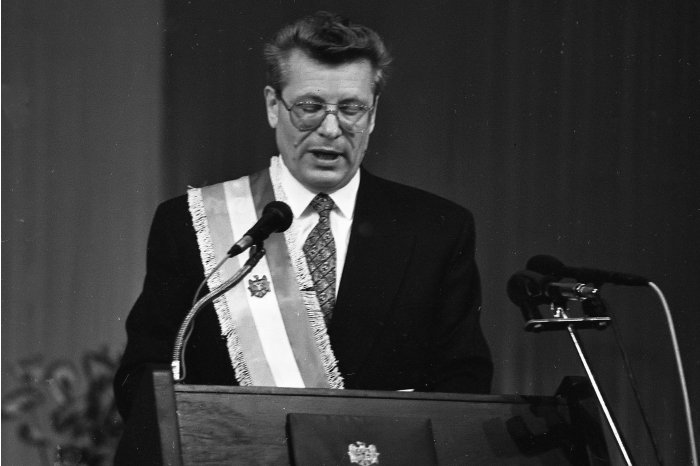
15 January 1997. Petru Lucinschi's swearing in office of President of Moldova
On 15 January 1997, Petru Lucinschi was sworn in the office of Moldova’s president. He was the second head of state, after the first president Mircea Snegur, who was in office during 1991-1997.
The presidential electoral campaign from 1996 was dynamic and spectacular. Snegur was backed by the right-wing forces and Lucinschi – by the left-wing ones.
Petru Lucinschi was born in the Radulenii Vechi village, now northern Floresti district, on 27 January 1940. He studied at the Philology and History Faculty of the Moldovan State University, which he graduated in 1962. Lucinschi had a fulminant career in the Soviet communist youth union (Comsomol) and in 1967 he became the first secretary of Comsomol from Moldova.
In 1971-1076, Lucinschi was secretary of the Central Committee (CC) and member of the Political Bureau of the Moldovan Communist Party. At that time, he was the only Bessarabian from the leadership of the Communist Party from the Moldovan Soviet Socialist Republic (RSSM). Since the foundation of this Soviet republic, the leadership was made up almost completely of citizens of the Russian, Ukrainian and Transnistrian origin. În perioada 1971-1976, este secretar al Comitetului Central (CC) și membru al Biroului Politic al Partidului Comunist din Moldova. El era pe atunci singurul basarabean din conducerea Partidului Comunist din RSS Moldovenească. De la înființarea acestei republici sovietice, conducerea era compusă aproape în întregime din cetățeni de origine ucraineană, rusă și transnistreană[1].
During time, he became the potential rival of the first secretary, Ivan Bodiul, and the latter wins the sending of Lucinschi to Moscow for the period 1978-1986, to work as deputy head of section at the CC of the Communist Party from the Soviet Union (PCUS). As of 1986 till 1989, he was secretary II of the CC of the Communist Party from Tajikistan.
On 16 November 1989, one week after the assault of the Interior Ministry by protesters, Lucinschi replaced the weak Simion Grosu in the office of first secretary of the communist party from Moldova.
On 4 February 1991, Mikhail Gorbachev appoints Petru Lucinschi secretary of PCUS, member of the PCUS Political Bureau. After the failed coup t’etat from August 1991, Lucinschi was the communists’ representative, who signed the acts on the liquidation of the Soviet Communist Party, at an initiative by Boris Yeltsin.
In April 1990, Lucinschi became MP in the first democratically elected parliament of Moldova and on 29 March 1994, he is elected as Speaker of Moldova’s parliament of the first legislative period.
On 15 January 1997, the procedure of swearing of Petru Lucinschi in the office of Moldova’s president took place. The western media outlets outlined the robot portrait of Lucinschi, presenting him as a man of the Russians, who remained oriented to the Soviet past. Russia’s reaction was friendly to the new president.
Once Petru Lucinschi took power, the reforms started by his predecessor Mircea Snegur were continued. Frankly speaking, more upon the pressure by the international financial organizations. The process of privatization of the state property continued and a certain rapprochement with the West was recorded, to a great extent, forced by the enhancing poverty.
The quite low living standards for most residents triggered discontent among Moldova’s citizens. During Lucinschi’s mandate, following the parliamentary elections from 20 march 1998, the Moldovan party of communists was voted by 30 per cent of the voters. In the next two years, Lucinschi’s mandate was marked by tough confrontations in the parliament.
The deep econmic crisis significantly decreased the popularity of Lu7cinschi and the ascension of the party of communists became more and more obvious an expression of the feelings of protest on the rise of the citizens against the poverty. In the context, a change of the Constitution took place in parliament, which implied a switch to the parliamentary republic, implicitly, the election of the head of state in parliament. In 2001, following snap parliamentary elections, the communists gained an overwhelming victory and elected their leader Vladimir Voronin as president of Moldova.
Presently, Petru Lucinschi is not affiliated to any party and is the head of the Lucinschi Foundation of Strategic Studies and International Relations.

Chisinau, 21 January /MOLDPRES/.
 Facebook
 Instagram
 X/Twitter
 Telegram
13 July 1995. Moldova becomes member of Council of Europe
Maria Cebotari, golden voice of Bessarabia
2 July 2014. Moldovan Parliament ratifies Association Agreement with European Union
23 June 1990. Parliament adopts Declaration on Sovereignty of Moldova
4 June 1991. National Bank is set up, a fundamental instrument for Moldova's economic development
Serghei Lazo, legendary name that needs to be rehabilitated
25-31 May 1990. Moldova's parliament approves new concept on government, elects Mircea Druc as prime minister
6 May 1990. The Flowers Bridge - a gate opened to a new world
Ion Suruceanu, archaeologist, curator of European stature
27 April 1990. Moldova's parliament adopts state flag - Tricolour
17 April 1990. First democratically elected parliament of Moldova starts working
7 April 2009. Large, devastating, very strange protest takes place in Chisinau
24 March 2005 - Moldovan parliament adopts Declaration on European Integration of Moldova
Paul Gore, the greatest heraldist and last knight of Bessarabia
President attends commemoration in Budapest marking 70th anniversary of 1956 anti-communist revolution
Violence can escalate to femicide: How to recognize warning signs and where victims can seek help
PHOTO GALLERY // Romanian Armed Forces Day celebrated in Chișinău with exhibition dedicated to international military missions during interwar period
PHOTO // President honors courage of Hungarian people, 70 years after 1956 anti-communist Revolution
Ukraine condemns violation of Moldova’s airspace
Moldovan president condemns incident in Telenesti district: “Russia’s war continues to endanger citizens’ lives”
Staff member of Russia's Embassy in Moldova to be declared persona non grata after explosive-laden drone crashed in Telenesti district
 National Bank of Moldova
Moldovan President meets with Hungarian President and Prime Minister
President attends commemoration in Budapest marking 70th anniversary of 1956 anti-communist revolution
Moldovan PM meets young people who won three medals for Moldova at World Robotics Championship
Moldovan PM, vice-president of European Investment Bank discuss accelerating development projects in Moldova
Moldovan deputy PM for reintegration participates in marking 30 years of work of theoretical lyceum from Grigoriopol

Moldovan PM, vice-president of European Investment Bank discuss accelerating development projects in Moldova
Two cases of national airspace violations recorded in Moldova in past week; Defence Ministry reiterates need to strengthen air defense capabilities
Moldovan deputy PM for reintegration participates in marking 30 years of work of theoretical lyceum from Grigoriopol
Drone falls in central Moldova village; police secure area
First at November 1, 2026 elections in Moldova: voters to be able to vote using digital ID from EVO app
National Bank of Moldova simplifies foreign exchange rules: transfers, investments of up to 100,000 euros without authorization
PHOTO, VIDEO // Moldovan head of state president welcomed by Hungarian president at Sándor Palace in Budapest
Drone illegally entered airspace of Moldova, disappears from radar
PHOTO GALLERY // Two hospitals of Moldova start process of energy modernization
Two members of Judges' Evaluation Commission to end activities on 31 December 2026
Energy consumption in ten hospitals in Moldova expected to drop by 40%; first two hospitals begin renovation
COMMENTARY on Tiraspol event
CHINA EXPO – Christmas Sale to be held for first time at Moldexpo on December 17
State Secretary for Reintegration: Revenue from taxes imposed in Transnistrian region will return to population through Convergence Fund
MOLDPRES INTERVIEW // What should a woman in an abusive relationship know? Dominika Stojanoska, UN Women Country Representative: “The violence is not her fault and she does not have to go through this situation alone”
Joint border control, energy projects on Prime Minister’s agenda during visit to Kyiv
Receive the latest news directly to your email

Receive the latest news directly to your email