
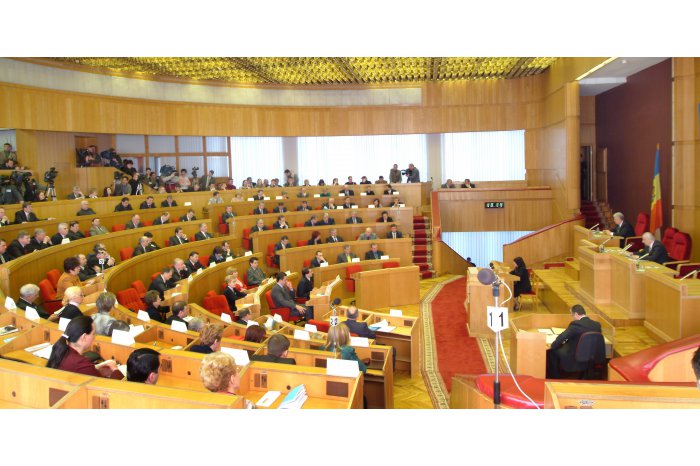
24 March 2005 - Moldovan parliament adopts Declaration on European Integration of Moldova
Chisinau, 23 March /MOLDPRES/- The adoption of the Declaration on European Integration of the Republic of Moldova, adopted on 24 March 2005 by the Moldovan Parliament was the result of previous actions and compromises that characterized the inconsistency of the political class in Chisinau.
The accession of the Communist Party to power in 2001 led the society to assume that many of the democratic achievements of the 1990s would be revised and the federalization of the Republic of Moldova would take place. All the more so as the Communist Party had a comfortable parliamentary majority in Parliament.
The first actions proved the justice of these concerns. In a hurry, and in an almost secret manner, the Kozak Plan was being prepared, which provided for the formation of an asymmetric federation with three subjects: Moldova, Transnistria and Gagauzia, the official Russian language and a Russian military base for a period of 25 years, Parliament bicameral with a Senate, where Moldova was on a par with the Gagauz-Transnistrian team. Moreover, the Kozak plan also provided for the veto right of federal subjects, ie Tiraspol and Comrat in major domestic and foreign policy issues of the future federal state.
The Communists' pro-European approach was a hostile signal to Moscow, and the Russians relied heavily on Voronin's defeat in the March 2005 parliamentary elections. on the leader of the Moldovan communists and this was also felt when totaling the election results. Unlike the triumphant result of 2001, the Communists won only 56 seats, which was a parliamentary majority but an insufficient number of votes to elect the head of state.
Thus, on 24 March 2005, for the first time, in the Chisinau parliament the Declaration on European Integration of the Republic of Moldova was voted by general consensus. A sober document in which were, in an exact manner, formulated the fundamental principles of the European Union that Moldova assumes.Previously, the Republic of Moldova adopted the principles of the European Neighborhood Policy.
After many negotiations, compromises and drafts, on March 24, 2005, the draft Declaration on the European Integration of the Republic of Moldova is proposed for the attention of the deputies. The preamble was a very balanced and promising one and created the illusion that the country would step irreversibly on the path of European integration.
24 March 2005 was a time of euphoria for pro-European forces, but what followed brought bitter disappointments.
The following years were marked by contradictory reforms, a quasi-total violation of the principle of separation of powers and the flourishing of corruption. It took a new effort in 2010-2014, which brought us the status of associate member of the EU, but followed the apocalyptic events with the theft of the billion, which almost permanently compromised the European course of the Republic of Moldova.
 Facebook
 Instagram
 X/Twitter
 Telegram
13 July 1995. Moldova becomes member of Council of Europe
Maria Cebotari, golden voice of Bessarabia
2 July 2014. Moldovan Parliament ratifies Association Agreement with European Union
23 June 1990. Parliament adopts Declaration on Sovereignty of Moldova
4 June 1991. National Bank is set up, a fundamental instrument for Moldova's economic development
Serghei Lazo, legendary name that needs to be rehabilitated
25-31 May 1990. Moldova's parliament approves new concept on government, elects Mircea Druc as prime minister
6 May 1990. The Flowers Bridge - a gate opened to a new world
Ion Suruceanu, archaeologist, curator of European stature
27 April 1990. Moldova's parliament adopts state flag - Tricolour
17 April 1990. First democratically elected parliament of Moldova starts working
7 April 2009. Large, devastating, very strange protest takes place in Chisinau
Paul Gore, the greatest heraldist and last knight of Bessarabia
11 March 2011 - Joe Biden to Chisinau
BTA: Trend of Falling Water Levels in the Danube Persists, Hydrological Situation Remains Difficult
VIDEO // Călărași forms largest voluntary amalgamation cluster in Moldova
Moldova is me // Tamara Șchiopu - entrepreneur building bridges between United Kingdom and Moldova
Joseph Burkhalter confirmed by U.S. Senate as next ambassador to Moldova
Diaspora Forum // “The Seven Wonders of Moldova” – project aiming to bring diaspora children closer to country of origin
Diaspora Forum // Moldova promoted in Switzerland through tourism, investment and exports
PHOTO // Moldova and Ukraine strengthen customs cooperation for border security and European integration
 National Bank of Moldova
Prime Minister and Turkish Ambassador approach prospects for Moldovan-Turkish cooperation
Prime Minister in talks with Italy’s Ambassador
Moldovan, Belgian Prime Ministers discussed European path of country
Secretary General of Government at Diaspora Forum: We need each of you to build stronger communities
Prime Minister at Diaspora Forum: We must restore people’s optimism and confidence that Moldova is moving in right direction

Secretary General of Government at Diaspora Forum: We need each of you to build stronger communities
Diaspora children to benefit from new measures to support integration into education system of Moldova
Prime Minister at Diaspora Forum: We must restore people’s optimism and confidence that Moldova is moving in right direction
ARMENPRESS // EU membership referendum in Armenia not possible at this stage, Pashinyan says
VIDEO // Over 450 town halls decided to merge voluntarily and will receive investment funds
Deputy Prime Minister at Diaspora Forum: Each of you is an ambassador of our country and contributes to promoting image of Moldova
Prime Minister at Diaspora Forum: We must improve people’s lives and restart engines of economy
PHOTO GALLERY // Diaspora at home: Images from largest gathering of Moldovans from abroad
Strengthening Moldovan-Swedish partnership discussed by Prime Minister and Sweden’s Ambassador
Prime Minister’s message to diaspora citizens: I encourage you to contribute to development of Moldova
Speaker at Diaspora Forum: Moldova shows through its citizens at home and abroad that it deserves to become part of great European family
Head of Reintegration Policies Bureau meets with Representatives of Mission of International Committee of Red Cross in Moldova
Diaspora Forum held in Chișinău
VIDEO // Moldelectrica: Final consumers were not affected by damage to Bălți–Dnestrovsk Line
DOC // Strengthening security and cooperation with EU
People’s Assembly of Gagauzia must have full mandate
Receive the latest news directly to your email

Receive the latest news directly to your email