
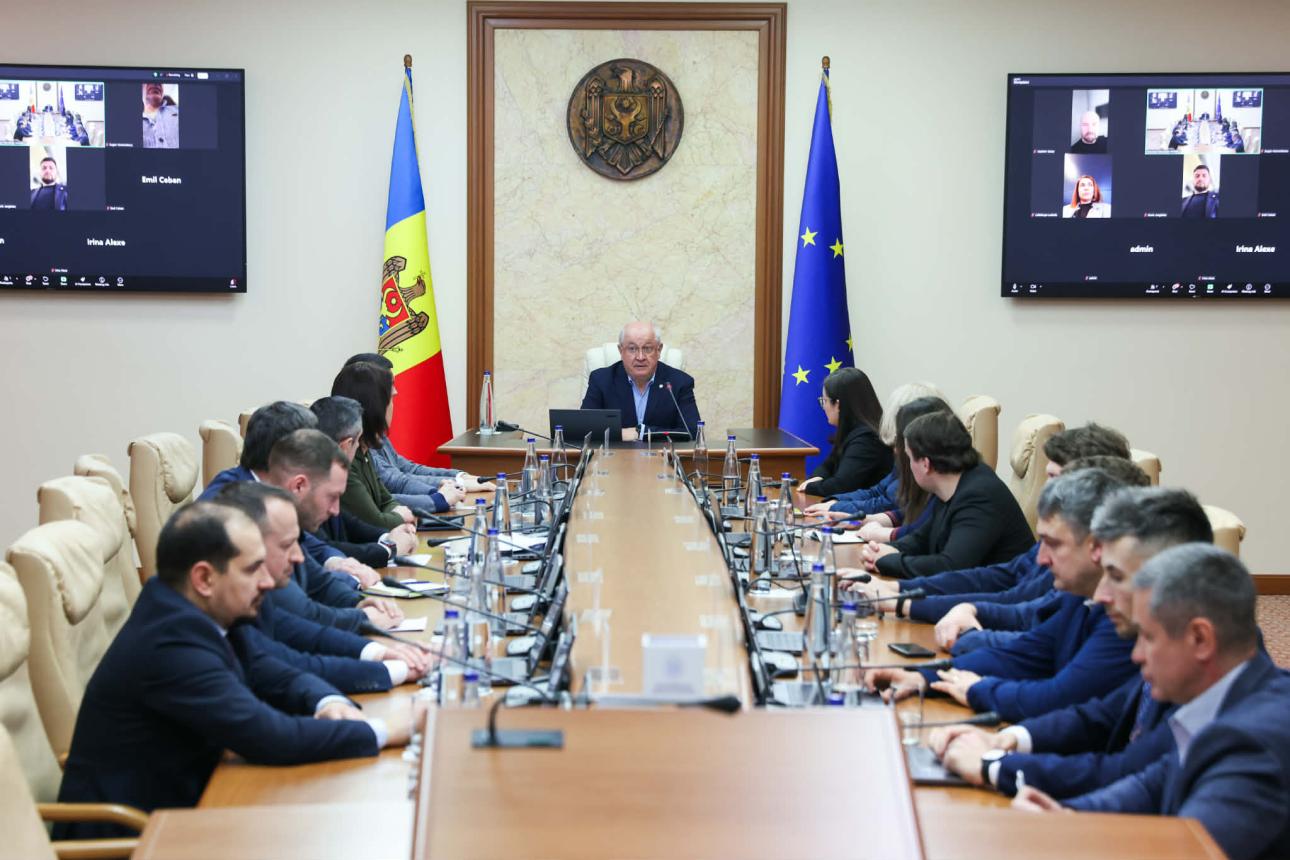
Moldovan government establishes environmental alert status for Dniester River basin; PM says authorities take this decision to prevent any risk to population’s health
The government has established an environmental alert status for the Dniester River basin for 15 days, starting from 16 March 2026. The decision is based on the analysis of risk indicators carried out by the responsible institutions and on the requests submitted today to the National Crisis Management Center (NCMC) by the Environment Ministry and the National Public Health Agency (ANSP).

“We are taking this decision to make sure we prevent any risk to the population’s health. Because of the continuous wave of pollution with oil products, the risk of the pollution spreading, and the exceedance of contaminant levels in the northern area of the Dniester River, it is necessary to mobilize resources quickly. The competent institutions will continue to monitor the situation, intervene in the affected areas, inform the population and provide the necessary recommendations,” said Prime Minister Alexandru Munteanu.

From the moment the leak of polluting substances was detected, the competent institutions activated mechanisms for continuous monitoring of the situation. Anti-pollution booms and absorbent materials were installed at points identified as critical, water samples are being taken continuously, and the test results are being evaluated in real time.

At present, there are clear indications that the pollution wave continues to move downstream and in the Naslavcea–Soroca area, there are recorded exceedances of the permissible values for oil products and aromatic hydrocarbons. Even if, at some points, the values may temporarily fall back within acceptable limits, the substance continues to come in waves, which makes it difficult to accurately anticipate its evolution. For this reason, it was considered necessary to move to a more intensive management regime of the situation.

The draft decision approved by the Government proposes the establishment of an alert status for a period of 15 days in the administrative–territorial units located in the Dniester River basin, including the districts of Drochia, Soroca, Balti municipality, Sangerei, Floresti, Soldanesti, Telenesti, Rezina, Calarasi, Orhei, Dubasari, Chisinau municipality, Criuleni, Anenii Noi, Tighina, the administrative–territorial units on the left bank of the Dniester, as well as partly: Briceni, Edinet, Ocnita, Donduseni, Rascani, Glodeni, Falesti, Ungheni, Nisporeni, Straseni, Hancesti, Ialoveni, Cimislia, Causeni and Stefan Voda.

“The alert status does not mean that the situation has become critical, but that the authorities are establishing in advance a legal mechanism that allows the prevention of its aggravation. This regime gives the authorities more important levers,” said Serghei Diaconu, Director General of the National Crisis Management Center (NCMC).

According to the NCMC Director, the alert status will allow the authorities to boost technical interventions, impose temporary restrictions on water abstraction and use in sectors where analyses indicate exceedances of the permissible values, and rapidly mobilize additional resources.

Environment Minister Gheorghe Hajder stressed that, in the coming days, additional booms would be installed at the Dubasari reservoir, in order to prevent the oil substance from passing beyond the Dubasari dam. In addition, local public institutions and private economic agents will inventory underground water wells, state institutions will verify alternative water sources, and the districts and localities that are supplied with water from the Dniester, on the Naslavcea–Dubasari segment, will not use the water for household purposes over the next 48 hours.

In sectors where there are risks, local authorities will inform citizens to avoid using water from the Dniester River for drinking, watering animals, or other activities until parameters return to permissible limits.

“What we see today on the river is not a natural accident, but the direct consequence of the war at our border. Russia’s aggression is hitting us ever harder—from drones violating our airspace to the pollution of our essential water resources with direct risks to public health. We must call things by their name: the sole culprit for this massive pollution of the Dniester is the Russian Federation. The government and the Environment Ministry will continue to monitor the situation and take all necessary measures. We stay on duty to protect the health of our citizens,” said the environment minister.
 Facebook
 Instagram
 X/Twitter
 Telegram
Government approves plan on preparing for 2026–2027 heating season
President attends state funeral of King Harald V of Norway
Strengthening transparency in public procurement – new measures approved by Government
Government simplifies authorization of renewable energy projects and sets new rules for biofuel market
Prime Minister discussed next steps in Moldova’s EU accession with European Commissioner
Moldovan PM, Ambassador of France discuss strengthening economic cooperation, attracting investments
PM has meeting with new Head of OSCE Mission to Moldova
Fiscal and Customs Policy for 2027 approved by Government
Moldovan PM, Slovakian counterpart have phone conversation
New ambassadors, including from EU member states, present letters of accreditation to Moldovan President
Parliament speaker meets new Head of OSCE Mission to Moldova
Moldovan parliament speaker meets new director of Swiss Cooperation Office
Reality concerns you │ While Tiraspol declares loyalty to Russia, Transnistrian region’s economy depends heavily on access to European market
Moldovan president has meeting with new Head of OSCE Mission to Moldova
PHOTO // Moldova promotes gastronomy and traditions in Paris
Chisinau maintains position on withdrawal of Russian troops and demilitarization of Transnistrian region
Tudor Bratu - World University Weightlifting Champion
5+2 format no longer works
 National Bank of Moldova
Moldovan, Hungarian PMs have phone conversation
PM, European Commissioner discuss European agenda, strengthening resilience of Moldova
Message to Moldova's public authorities on absolute unacceptability, “Zero Tolerance” for arbitrary detention, extralegal transfers
Moldovan president, European Commissioner discuss European path, resilience of Moldova
Moldovan president, Hungarian PM have phone conversation

European Commissioner reconfirms EU support for advancing reforms in European integration process
Moldova stands in solidarity with United States; victims of September 11, 2001 terrorist attacks commemorated in Chisinau
Cyberattack takes place on government resources of Moldova; authorities working to restore access
Moldovan, Hungarian PMs have phone conversation
PM, European Commissioner discuss European agenda, strengthening resilience of Moldova
Message to Moldova's public authorities on absolute unacceptability, “Zero Tolerance” for arbitrary detention, extralegal transfers
Moldovan president, European Commissioner discuss European path, resilience of Moldova
Moldovan president, Hungarian PM have phone conversation
European Commissioner holds talks with Prime Minister
PHOTO // European Commissioner visited Moldova’s Urban Search and Rescue Team: practical demonstration using EU-provided equipment
Women MPs Platform held public hearings on preventing and combating violence against women and femicide
MOLDPRES INTERVIEW // Moldovan deputy PM for reintegration: “Reintegration cannot happen through a single decision. Citizens must feel that moving closer to the right bank brings them benefits”
Social worker from Chișinău involved in influence-peddling case
External assistance provided to Moldova in 2025: key results and areas of support
Moldovan President, European Commissioner for Equality approach progress in implementing reforms
New measures for child-friendly justice
Receive the latest news directly to your email

Receive the latest news directly to your email