
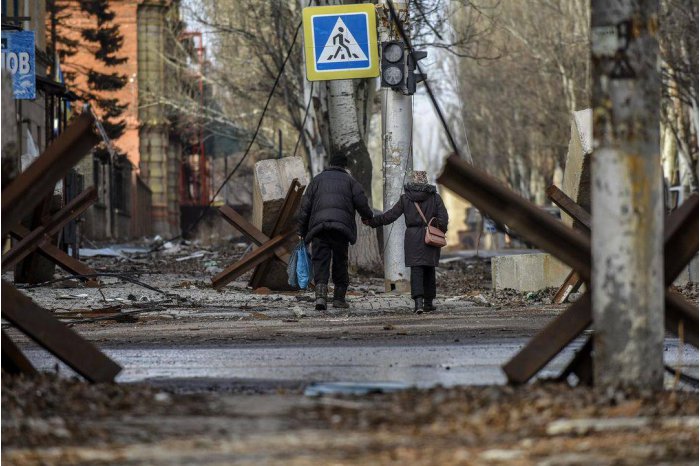
Four years since start of Russian invasion of Ukraine: Ambassador Paun Rohovei: Ukrainian people have shown extraordinary unity and resilience
Today marks four years since the beginning of the Russian invasion of Ukraine, four years of fierce struggle by the Ukrainian people for freedom. The effects of the war are being felt worldwide, with a major impact on the states in the region, as all eyes are turned to peace talks whose results are still awaited.

Ambassador of Ukraine to Chișinău Paun Rohovei said that in these four years of war, the Ukrainian people have demonstrated extraordinary unity and resilience.

“Four years of war, exhaustion, fear, tragedies, destroyed families is indeed a shock. Yet the key word is still resilience. The Ukrainian people have demonstrated extraordinary unity and resilience. It is no coincidence that this is a people who love their homeland, a people who love their native land, a people who love their close ones, their children, their families, and a people who love democracy and freedom – which is, in fact, what we are striving for. This war itself was launched by the Russian Federation to destroy a nation, and here, when I speak of a nation, I am not talking about nationality. The Ukrainian nation is multicultural. All those who live in Ukraine want a decent, free, democratic future,” Rohovei told a TV show.

The official noted that the Ukrainian army is holding out and maintaining the front line, but the situation is critical.

“The front line is being held, but the situation is very critical. There are massive attacks, yet the Ukrainian army resists and holds the front line. In fact, if we talk about the advance of the Russians or their progress, there is practically none. This explains the attacks launched on civilian infrastructure with missiles and drones, in order to frighten civil society, to stir up hatred towards the authorities, to provoke fatigue and protests against the defense of the country. As you can see, it will not go as they plan in Moscow. The Ukrainian people are becoming more resilient and tougher, of course enduring many hardships,” the Ambassador stressed.

“We Ukrainians, the Ukrainian people, there is probably no other people who want peace more than we do ourselves. (...) What I can tell you with certainty is that we want this peace, we are ready to achieve it, and we have several steps to take in order to reach this goal. The first step we want to achieve in these negotiations is the cessation of fire. Not an armistice, but a complete cessation of fire, both on the front line and in the air and at sea, and an end to attacks on the major cities of Ukraine. This will allow us to create the conditions to sit down at the negotiating table and negotiate peace, without preconditions, while of course starting from the premise that what is stipulated in the Constitution of Ukraine is sacred. And here I refer to the sovereignty and territorial integrity of Ukraine and to Ukraine’s integration into the European Union and NATO. For the time being these are not postponed; they remain priorities of foreign policy. The second point that interests us very much is security guarantees,” he said.

In recent months, Russia has intensified its attacks on Ukrainian civilian and energy infrastructure, with particular ferocity against the Ukrainian capital, Kyiv, leaving millions of people without electricity and heating and causing the temperatures inside affected homes to drop to around 0 degrees Celsius.

Nevertheless, the reality is that since November there has been almost no change on the main sectors of the front. The Russians have barely managed to advance on the outskirts of the city of Pokrovsk. The Ukrainians continue to hold out in Hryshyne, where drone operators are preventing Moscow from advancing west of Donetsk.

Destroyed families and lost lives

Both sides are paying the price of four years of war, with a large number of casualties proportional to their respective populations, as well as heavy economic costs. Four years after the outbreak of the war, data on human losses cannot be independently verified, and the parties involved publish different figures. The British newspaper The Guardian cites estimates according to which approximately 400,000 Russian soldiers are believed to have been killed in the fighting for control of Ukrainian territories. The Guardian notes that Russia currently controls an area about 13% larger than at the beginning of 2022. At the same time, the UN Human Rights Monitoring Mission in Ukraine (HRMMU) warns of an increasing number of violations and growing risks for civilians. An information sheet published last week highlights a constant deterioration of human rights and civilian protection across the entire national territory. Millions of people have been displaced, and property and civilian infrastructure have been damaged or destroyed.

HRMMU notes that since the Russian Federation launched its full-scale invasion in February 2022, in four years of hostilities more than 15,000 civilians have lost their lives and over 41,000 have been injured. At least 766 children have been killed and 2,540 injured. Civilians have been killed and injured in 26 of Ukraine’s 27 administrative regions.

Peace talks continue

Donald Trump’s return to the White House has brought a new phase of the war, focused on negotiations that have not yet led to any stable ceasefire agreement. The latest attempt at talks between Ukraine, Russia and the United States, which took place last week in Geneva, ended without progress. Experts do not see the prospect of a peace agreement as imminent.

Impact on the Republic of Moldova

After the outbreak of the war, the Moldovan authorities repeatedly condemned Russia’s attack on Ukraine and announced that they were ready to receive refugees. Subsequently, centers for hosting refugees were opened. At the same time, many families expressed their willingness to host people from Ukraine. Following this gesture of solidarity, the Republic of Moldova became known internationally as “a small country with a big heart.”

At the same time, over the four years of war, numerous incidents have been recorded in which fragments of missiles have fallen on the territory of the Republic of Moldova.
 Facebook
 Instagram
 X/Twitter
 Telegram
Prime Minister: infrastructure investments - security priority
Chișinău authorities consider new dialogue format for settling Transnistrian conflict
Moldova, Poland prepare new cooperation agreement in defence sector
Deputy Prime Minister meets with Secretary General of Central European Initiative
Daniel Vodă explains Moldova’s stakes in Coalition of Willing for Ukraine
Amalgamation process - voluntary and does not affect Chișinău’s status - Government Secretary General says
VIDEO // Prime Minister on State Flag Day: We carry it with pride and commit to hoisting it with dignity alongside flags of great European family
President on State Flag Day: It is important we rise to height of values flag represents – to be united and work together for country’s future
PHOTO GALLERY // Tricolor honored in Chișinău: Images from solemn ceremony dedicated to Flag Day
VIDEO // Speaker on State Flag Day: Under this flag, we have duty to build future and take Moldova where it belongs – into community of free and prosperous countries
State Flag Day: Tricolor of Moldova, symbol of national identity and unity officially celebrated in Chișinău
VIDEO // Ukrainian president says Ukraine, Moldova moving together towards EU, strengthening their security cooperation
Moldova ready to help rebuild Ukraine; Moldovan president Kyiv says Ukraine's recovery shared responsibility of Europe
Moldovan parliament speaker conveys message on 40 years since Chernobyl catastrophe
Japanese Minister to visit Moldova on 2–3 May
VIDEO // Labour Day 2026 marked by reforms in Moldova: strategies for competitive wages, digital employment services and stronger protection against discrimination
PHOTO // Republic of Moldova celebrates International Workers’ Day, between tradition, social rights and relaxation
SIS Director reveals details on Alexandru Bălan’s espionage activities
EXCLUSIVE // Moldova's People's Artist, composer conductor marks 75th birthday anniversary
Writers from Moldova, Romania call for turning idea of unification into national priority
Integrity assessment at Moldova's Anticorruption Prosecutor’s Office: two prosecutors pass, two fail test
 National Bank of Moldova
Moldovan head of state continues dialogue on children’s safety online in Balti
Paid internships in public service of Moldova: young people invited to apply for edition 6.1 of programme
VIDEO // Prime Minister at National Forum of Labour Market and Social Dialogue
President at swearing-in ceremony of Prosecutor General: You have my full support for genuine rule of law that strictly serves interests of citizens and Republic of Moldova
Head of State signed decree appointing new Prosecutor General of Moldova

Moldovan head of state continues dialogue on children’s safety online in Balti
Moldovan parliament expands foreign relations: friendship groups with United Arab Emirates, Saudi Arabia created
Paid internships in public service of Moldova: young people invited to apply for edition 6.1 of programme
Largest energy storage system of Moldova launched in Radeni; Energy minister says investment promises competitive prices for consumers
Moldovan parliament speaker comments on detection of drones on country’s territory
Moldovan parliament speaker says removing tax, legislative discrepancies between two banks of Dniester River to bring concrete benefits for citizens
VIDEO // Prime Minister at National Forum of Labour Market and Social Dialogue
Japan’s Minister for Internal Affairs to pay visit to Moldova
VIDEO // Speaker welcomes return home of SIS officers and thanks U.S. and European partners for involvement
Parliament tightens rules for operation of zoos
BTA: Honorary Citizen of Taraclia Recalls Role of Traditional Bulgarian Dance on International Dance Day
Diplomat Dumitru Socolan appointed Secretary General of Foreign Ministry
VIDEO // One year passes since launch of Identity Card in Moldova: over 360,000 documents requested
Moldova moved up in press freedom ranking
As of 1 July, new rules to come into force for imports from United States
Unified taxes and excise duties on both banks of Dniester approved by Parliament
Receive the latest news directly to your email

Receive the latest news directly to your email