
VIDEO // PISA 2025 results show progress in science, stagnation in mathematics and reading, with wide gaps between urban and rural schools
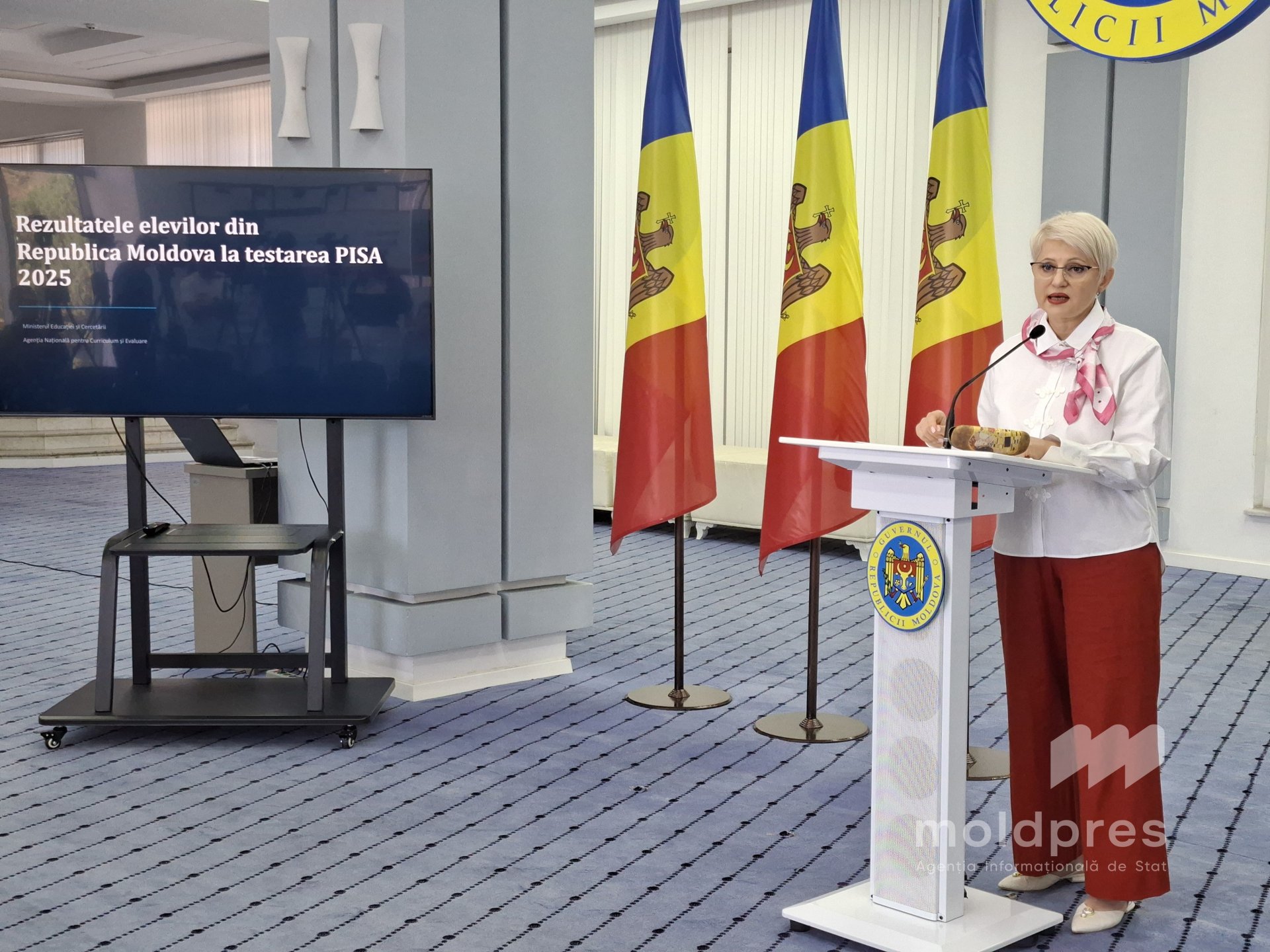
The Republic of Moldova made progress in science in the 2025 PISA assessment, achieving its best result to date in this field. However, the data continue to highlight significant differences between students in urban and rural areas, according to the results presented today by the National Agency for Curriculum and Evaluation (ANCE).

According to the international results, Moldovan students scored an average of 422 points in science, five points higher than in 2022. At the same time, results in the other two assessed areas declined slightly. In mathematics, the average score was 410 points, four points lower than in 2022, while in reading it was 404 points, down by seven points.


The director of the National Agency for Curriculum and Evaluation, Lilia Ivanov, said that the results should be viewed both through the lens of the progress recorded in science and in the context of international developments.


“Science is the only area in which we made progress in 2025, achieving our best result to date,” said Lilia Ivanov.


She noted that the decline recorded in mathematics and reading may also be associated with the delayed effects of the pandemic on students.


“Although we recorded a slight decline in mathematics and reading, also influenced by the delayed effects of the pandemic on young people’s ability to concentrate, we have moved significantly closer to the OECD average,” explained the ANCE director.


According to her, one of the reasons Moldova has moved closer to the OECD average is that, internationally, the decline in student performance was more pronounced than in the Republic of Moldova.

The PISA 2025 report also highlights performance differences based on gender, socioeconomic status and place of residence.

Girls achieved better results than boys in all three assessed areas, with the largest difference recorded in reading—38 points.

Another determining factor remains the socioeconomic status of the family. Students from socioeconomically advantaged families scored an average of 85 points higher in science than students from disadvantaged families.

According to the data presented, this difference is equivalent to approximately three years of schooling, showing how strongly socioeconomic conditions influence educational outcomes.

However, the most serious issue highlighted by the PISA 2025 results concerns the differences between educational institutions in urban areas and those in rural areas.

The gap between students from cities and those from villages ranges from 55 to 65 points, depending on the assessed area.

Lilia Ivanov argues that these differences can no longer be viewed merely as a statistical issue, but represent a problem of equity and quality within the education system.


“The data show us a harsh reality: a child in a small rural institution does not reach the minimum proficiency level in any of the three tested areas, while students in large urban institutions reach this level in all subjects,” said the ANCE director.


In her view, the results also provide an argument for reorganizing the school network.


“This demonstrates that reorganizing and consolidating the school network is not merely a budget-efficiency measure, but an absolute necessity to ensure the quality and equity of education,” Ivanov stated.


She emphasized that differences in educational opportunities have a direct impact on children from small communities.


“A child in a small institution is paying an educational price that can be measured today,” added Lilia Ivanov.


PISA does not only assess how much subject matter students have memorized; it measures their ability to apply what they have learned in real-life situations. The assessment is conducted every three years by the Organisation for Economic Co-operation and Development (OECD) and targets 15-year-old students. Depending on the edition, the assessment focuses on one of the main areas—mathematics, reading or science—while also analyzing the other competencies.

The Republic of Moldova has participated in PISA since 2009, and the results are used as an indicator for assessing the performance of the education system and for shaping public policies.
 Facebook
 Instagram
 X/Twitter
 Telegram
Hydrological situation on Dniester, Prut stays worrying; water levels in Novodnestrovsk, Stanca-Costesti reservoirs continue to drop
Special measures taken at Chisinau Airport during transit of Hasidic pilgrims
All schools of Moldova to switch to electronic gradebooks
Military personnel from Moldova, Romania and United States participating in Fire Shield 2026 exercise
DOC // Education 2030 Program published in Official Journal
UPDATE // Heavy cross-border traffic at Costești border eased
Schools to come under Ministry of Education and Research and be managed by Territorial Education Agencies: reform approved by Parliament in second reading
Solutions for children’s online safety analyzed in Chisinau; Romania's First lady: “We must work together to protect children in an ever-changing digital environment”
PHOTO GALLERY // Children’s online safety at center of international conference in Chisinau, attended by Moldovan president, Romania’s First Lady
Moldovan president, at international online safety conference, says each child must grow up healthy, free, safe in world where physical, digital realities intersect
Searches conducted in more settlements of Moldova in case concerning illegal financing of parties through cryptocurrencies
Electronic monitoring of domestic abusers to be strengthened: Moldova's National Probation Inspectorate to receive 200 new bracelets, 2027 budget to be doubled
Moldovan parliament speaker, on National Army Day, says National Army symbol of defending peace
VIDEO // PM announces urgent measures following tragic case in central Moldova village
Moldova, Bulgaria strengthen cooperation in economy, energy, security
Tudora–Starokazacie Moldovan-Ukrainian border crossing point resumes operations; traffic through crossing point proceeds as normal
Truck traffic redirected through Palanca customs checkpoint; Moldova's Customs Service increases number of officers
VIDEO // Tour of Romania starts from Moldova; more than 130 cyclists start in Chisinau
Assigning young specialists in healthcare system to be optimized
Speaker: Moldova must become relevant security provider in Europe
President attends state funeral of King Harald V of Norway
 National Bank of Moldova
Speaker: Moldova must become relevant security provider in Europe
Government approves plan on preparing for 2026–2027 heating season
President attends state funeral of King Harald V of Norway
Strengthening transparency in public procurement – new measures approved by Government
Government simplifies authorization of renewable energy projects and sets new rules for biofuel market

Prime Minister about PISA test results: We must continue education reforms
Government simplifies authorization of renewable energy projects and sets new rules for biofuel market
Defense Minister: Russian Federation continues to represent main threat to state’s military security
Prime Minister discussed next steps in Moldova’s EU accession with European Commissioner
President after drone attack at Moldova’s border: Brutal war reaching our border
Cold-season assistance program in finalization stage
Prime Minister: In August alone, 17 drones struck our territory. This is extremely worrying
PHOTO GALLERY // More than 130 cyclists set off from Chișinău in Tour of Romania
Government proposes measures to prepare for next cold season
Health Ministry to have new state secretary
Moldsilva Agency and National Probation Inspectorate without directors
Moldova Railways to be reorganized and transformed into joint-stock company
Speaker: Russia’s threat not scare tactic and not propaganda. It is daily reality
Moldova's Foreign Ministry condemns Russian attacks on Ukraine
UPDATE // Customs Service's information systems operating normally
Eight properties worth over 9.6 million lei permanently seized for benefit of state
Receive the latest news directly to your email

Receive the latest news directly to your email