
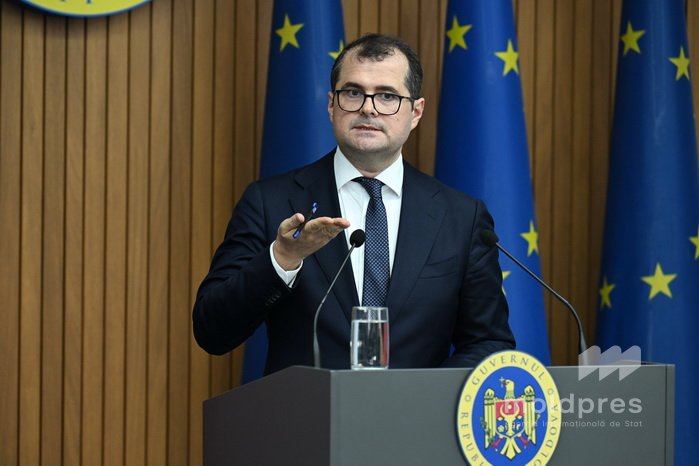
Prime Minister presents new fiscal policy concept for 2027
Prime Minister Vasile Tofan today presented the new concept of the fiscal policy for 2027. The official said that it is focused on four lines of action: taxing labour less, stimulating investments, taxing vices and balancing consumption taxation. The Prime Minister underlined that the great responsibility of fiscal policy is to bring balance and ensure fair taxation, as well as social solidarity.

During the presentation, the Prime Minister said that fiscal policy must respond to the state’s economic and social objectives through a fair and predictable tax system. He pointed out that if we want a state that can pay higher pensions, fund schools and hospitals, a state that takes care of itself and invests in its security, then we must have a simpler, fairer tax system that is harder to circumvent.

“I want to start with a simple idea: the way a country organizes its taxes influences how its economy functions. If we want more people to work legally, we must tax labour in a way that encourages legal work. If we want companies to invest more, we must leave them more capital for investments. If we want to discourage vices – tobacco, vaping, especially among young people, excessive alcohol consumption, gambling – if we want to prevent the environment from being polluted by fireworks, this must also be reflected in fiscal policy. And if we want a state that can pay pensions, salaries, roads, schools, hospitals and security, we need a tax system that is simpler, fairer and harder to avoid,” said Prime Minister Tofan.

The official emphasised that the major responsibility of fiscal policy is to bring balance and fairness in taxation, while also ensuring social solidarity so that wage increases become possible.

“Sometimes we talk about percentages – 6%, 8%, 12%, 20%. But behind each percentage stand decisions that affect millions of lives: how much remains in a family’s pocket, whether a company invests or postpones investment, whether a salary is paid officially or in an envelope, whether a young person chooses to work at home or to leave,” said Vasile Tofan.

The head of Government added that the authorities’ approach is not “to raise taxes”, but “to put the emphasis in the right place”. “Less tax on labour. We leave about 800 million lei with working people. More support for investment. More taxation of vices. More fairness between those who pay correctly and those who evade. Fewer exceptions that complicate the lives of entrepreneurs and citizens. We will not solve all the problems of the tax system with this project. It would be unfair to promise that. This is an important first step. We will come back, including in the context of a new Fiscal Code, with the same objective: not a higher tax burden, but a simpler, clearer tax regime, more favourable to labour and investments,” Vasile Tofan noted.

Less tax on labour to encourage formal employment

The first direction of fiscal policy is lower taxation of labour, in order to motivate citizens to work legally and to discourage “envelope salaries”.

“The Republic of Moldova has a structural problem: too few people are economically active, too many work informally, and the ratio between people who work and pensioners is already critically low: 1.1 workers support one pensioner. In the governing programme we have committed to increase the employment rate from 57% to 62% by 2029 and to integrate at least 100,000 people into work through the National Employment Agency (ANOFM),” the official said.

Thus, the fiscal policy provides for a 35% increase in the personal exemption, from 29,700 to 40,000 lei. This means that every person who works legally will not pay income tax on the first 40,000 lei earned annually.

“If the burden on labour is too high, the temptation to avoid it increases. If the burden becomes more reasonable, formal work becomes more attractive. That is why we are increasing the personal exemption by 35%, a very ambitious step. Today, the personal exemption is 29,700 lei. We propose to increase it to 40,000 lei. This means that every person who works legally will not pay income tax on the first 40,000 lei earned annually. It is an increase of 10,300 lei per year in the amount protected from taxation. This is a measure that especially helps people with low and medium incomes. It is a measure that leaves more money in the pockets of those who work. And it is a measure that sends a clear message: the state must start by respecting legal work,” the Prime Minister explained.

He added that this measure, combined with the increase in the minimum wage, which will come into force from 1 January, will allow an even greater reduction of undeclared payments, where employees have a formal minimum wage but receive the rest in an envelope. The budgetary cost of this measure is almost 800 million lei, money that we leave to the people, said Vasile Tofan.

Extended tax incentives for investment and reinvested profit

The second theme of fiscal policy concerns investments. To attract new investments into the economy, the authorities propose extending the 0% tax regime for reinvested profit. The facility will apply to small and very small companies with turnover or assets of up to 200 million lei, compared to the 100 million lei threshold that applied until now.

“An economy does not grow only through consumption. An economy grows when companies invest: in equipment, technologies, warehouses, production lines, digitalisation, exports, people. In recent years we have seen a very important signal. After the introduction of the facility for reinvested profit, investments by Moldovan companies moved from decline to rapid growth. I am not saying that all the growth is due to a single fiscal measure. But the direction is clear: when we leave companies more capital for investments, they invest more. And Moldova needs exactly that. We have a large trade deficit. We import much more than we export. To change this reality, it is not enough to talk about exports. We need companies that can produce more, better and more competitively. Therefore, we are extending the 0% tax regime for reinvested profit. Today, the facility applies to small and very small companies with turnover or assets of up to 100 million lei. We propose to raise the threshold to 200 million lei,” the Prime Minister said.

At the same time, if a company wants to withdraw money from the business, it will pay the tax at that moment, plus an increased dividend tax of 8%. “Our message is simple: if you take the profit out of the company, we tax it. If you reinvest it in development, we encourage you. This is a sound fiscal philosophy,” he stressed.

Higher taxes on gambling, tobacco, alcohol and vaping

Taxing vices is another direction targeted by the fiscal policy draft. In this regard, the authorities propose increasing taxation on gambling, tobacco and alcohol products, as well as introducing a tax on pyrotechnic products.

“Here I want to be very clear. Not all taxes have only a budgetary revenue purpose. Some taxes also have a public behaviour purpose. If a product harms health, affects public order, creates addiction, affects young people – the state must intervene. We are increasing the taxation of gambling. Moldovans spend 10 billion lei on it. This is a larger amount than the transfers from the state budget for health. It is an amount equivalent to all heating compensations granted by the Government in the last almost four years. We are introducing a 6% tax and estimate significant additional revenues to the budget. But we will pay attention to one thing: we must not push people towards illegal or cross-border platforms. We must tax more fairly, but also have administration and control, so that the activity remains in the legal and monitored area,” said Prime Minister Tofan.

Taxes will also increase on tobacco and vaping. In the case of vaping, the increase will be 50%. At the same time, excise duties will be introduced for sugary and energy drinks, and an excise tax of 25% of value will be set for pyrotechnic items.

Differentiated VAT: protection for essential consumption and fairer rules

The new fiscal policy comes with a differentiated approach regarding value-added tax. Thus, the Government proposes that the reduced rate of 8% be maintained for essential products.

“Here we have listened carefully to the criticisms after the first version of the draft. We know that VAT is seen directly in prices. We know that any change in VAT on food, medicines, gas or energy can affect families. Therefore, we have chosen a much more cautious approach. For essential products, we are not making any changes – we keep the reduced rate of 8%. We are talking about bread, vegetables, fruit, most dairy products, essential medicines and medical products. Moldovan cheese remains at 8%. Mozzarella and other products move to 12%. People must have access to essential, local products without this becoming too much pressure on household expenditure. This is an important signal: we are not making fiscal reform at the expense of people’s basic consumption,” explained Vasile Tofan.

At the same time, for other food products and for sectors such as agriculture, HoReCa, accommodation and tourism, a 12% VAT rate is proposed.

“This is a compromise. We are not going to 20% for these sectors, because we understand the impact on prices and on industries that are sensitive. But we also cannot indefinitely maintain a highly fragmented system in which some similar products are treated differently and distortions appear. For HoReCa, 12% is a reasonable rate. The sector needs predictability, not shocks. Tourism, public catering, rural guesthouses, accommodation services need to develop. That is why the Government has also created a holiday voucher mechanism for domestic guesthouses. For agriculture, the approach must be balanced: farmers must remain competitive, and for exporters the effect is neutral, because VAT is refunded,” the Prime Minister argued.

Similarly, for electricity, the first 100 kWh per month will remain with 0% VAT. For natural gas, the first 150 cubic metres per month will remain with 8% VAT. District heating will remain at a 0% rate. The 20% VAT will apply only to consumption that exceeds these thresholds. The new rules will enter into force only after the cold season – from 1 April 2027.

“For energy and natural gas, we have introduced the most important protection. And I want to underline very clearly: nothing will change this winter. From 1 April, the 20% VAT will apply only to consumption that exceeds these thresholds. Not to the whole bill. It does not apply to the first 100 kWh. It does not apply to the first 150 m³ of gas. Only to the portion that exceeds the threshold. A consumer with a large house, with higher incomes, who consumes a lot of gas, will pay more. A family with a small apartment that saves energy will not be affected by this measure. And apartments heated with district heating will have no VAT. Our objective is to protect basic consumption, especially for vulnerable families and moderate consumers, but not to offer the same tax facility for very high consumption levels. The facility must be targeted. That is what fairness means,” Vasile Tofan pointed out.

Another important measure concerns parcels ordered from foreign platforms. Thus, it is proposed to introduce VAT on goods ordered from foreign platforms and a fixed fee of 12 lei per parcel.

“Today we have an unfair situation. Local retailers pay VAT. Local producers pay VAT. Shops that employ people here, pay wages here, rents, taxes, charge VAT. At the same time, many goods ordered from outside the country enter without VAT. This is not fair competition. We cannot say, on the one hand, that we want to fight tax evasion and support local producers, and on the other hand accept that imports via parcels are treated more favourably than local trade. Therefore, we are introducing VAT on goods ordered from foreign platforms and a fixed fee of 12 lei per parcel for managing these flows. But the mechanism is very important here. People must not be turned into customs brokers. We do not want citizens to fill in complicated forms for every parcel. The objective is for the mechanism to be simple, automated, as invisible as possible to the citizen. The person orders, pays and receives the parcel. The state must build the system in the background. We will not launch the system until it is functional,” Vasile Tofan specified.

At the same time, the Government proposes adjusting the taxation of capital gains from 6% to 12% and of dividends from 6% to 8%. “We have another important topic: fairness between forms of income. Currently, labour income and capital income are treated differently. More simply put, a person who receives a salary pays more to the state than a person who has income from other sources. Sometimes the differences are justified. Other times, they create opportunities for optimisation and distortions. If two people earn comparable incomes, but one pays more just because the income is classified as labour, while the other pays less because the income is classified as capital income, then the system creates distortions. Therefore, we propose adjusting the taxation of capital gains from 6% to 12% and of dividends from 6% to 8%. It is not a radical change. But it is a move towards more fairness and fewer loopholes,” the Prime Minister underlined.

Another direction concerns the financial sector. In this regard, the draft provides, for the 2027 fiscal year, for an increase in the income tax for banks and financial institutions from 12% to 18%.

“This is a 50% increase in the rate. I know this is a popular measure. Banks are not loved anywhere in the world. And, probably, as a former investor in banks, I should be more careful when I say this. But precisely because I understand how the financial system works, I want us to be fair and clear-headed. An economy cannot grow without a healthy financial system. Banks transform people’s savings into investments, loans for companies, mortgages, working capital, development. If we take too much capital out of the banking system, we risk reducing lending capacity. In simple terms, one leu taken from a bank’s capital can mean many fewer lei going into loans for the economy. Therefore, we must be cautious. But in the current context, we consider that an additional temporary contribution for 2027 is justified. The financial sector has had good results. The state has major needs. Society needs solidarity,” Vasile Tofan stressed.

The Prime Minister underlined that through the proposed amendments the authorities want simpler, more uniform and clearer rules.

“Fiscal policy is not just accounting. Fiscal policy is a choice about what kind of economy we want to build. We want an economy in which more people work legally. We want an economy in which companies invest more. We want an economy in which exporters grow and reduce our dependence on imports. We want an economy in which vices are taxed more severely and labour is respected. We want a system in which essential consumption is protected and tax facilities are not granted blindly and without limit, including to those with high consumption. This fiscal policy is not perfect. No tax reform is perfect from the first reading. We have listened to feedback and adjusted the measures. We will continue to talk with the business community, with trade unions, with local authorities, with citizens. What matters is that we choose the right direction,” Prime Minister Tofan declared.

He added that the changes are necessary because “we cannot build a European economy with a tax system full of exceptions, loopholes and treatments that are hard to explain”. “We cannot ask for investments if we tax capital before it is put to work. We cannot ask for legal work if legal work is excessively burdened. We cannot protect young people if we treat vaping and harmful products like ordinary products. We cannot support local trade if we accept unequal tax competition from abroad. Instead, we can start correcting things. That is why this package is about balance. Less tax on labour. More stimulation of investments. Firmer on vices. Fairer on exceptions. Simpler for the economy. This is the meaning of the fiscal policy for 2027,” Vasile Tofan concluded.

The concept of the new fiscal policy will be proposed for public consultation.
 Facebook
 Instagram
 X/Twitter
 Telegram
Two years since launch of MIA Instant Payments in Moldova: over 31 million transactions processed, with total value of around 28.5 billion lei
VIDEO // Investments in government securities exceed 1.3 billion lei via eVMS.md platform in Moldova
State-owned companies of Moldova increase profit more than fivefold in 2025; who tops ranking
Moldovan parliament obliges gas supplier from Transnistrian region to create strategic reserves
Moldova to receive 350,000-dollar grant for implementing Register of Movable Collateral system
Strategic transport infrastructure projects to benefit from faster authorization procedures in Moldova
Benefits for consumers in Moldova: smart meters' data to be read remotely, processed automatically
Moldova’s agricultural sector to benefit from new 150-million-euros financing programme
Moldova to modernize 134 km of road with funding from top European bank
VIDEO // Fuel stocks replenished with new imports of petrol, diesel in Moldova
Moldova's Energy Ministry explains main measures applied during state of alert
Moldovan PM requests de-bureaucratization measures for entrepreneurs
Around 300 public institutions from Chisinau to benefit from modernization of district heating infrastructure
Moldovan Economic Development and Digitalization Ministry prepares two new deregulation packages: 100 laws, government decisions to be amended
Energocom: Electricity shortage during peak hours; consumers urged to save energy
Prime Minister held talks with Bulgarian counterpart
Prime Minister: This government’s focus is to moderate rise in real estate prices
Finance Minister explains key proposed 2027 tax policy changes on income tax
 National Bank of Moldova
Prime Minister held talks with Bulgarian counterpart
Fiscal policy for 2027 presented by Prime Minister: Reducing burden on labor, stimulating investments, fairer taxation
Prime Minister’s speech on main provisions of fiscal policy for 2027
Prime Minister held meeting with Ambassador of the United Kingdom of Great Britain and Northern Ireland
Confiscated assets and money to be used for social and public interest purposes

Government to increase personal tax exemption for employees to 40,000 lei
Prime Minister presents new fiscal policy concept for 2027
BTA: More than 1,000 Children Winners of Competitions Held by Bulgarian Agency for Bulgarians Abroad to Be Awarded
DOC // Law ratifying Convention establishing International Claims Commission for Ukraine published in Official Journal
Apple harvest in Moldova could grow by 17.5% this year, while EU production expected to decline
LIVE // Prime Minister presents main provisions of fiscal policy for 2027
Prime Minister’s speech on main provisions of fiscal policy for 2027
PHOTO // President met with DOR camp participants
Moldova and Estonia reaffirm commitment to strengthening cooperation
Prime Minister held meeting with Ambassador of the United Kingdom of Great Britain and Northern Ireland
PAS has two new MPs in Parliament
DOC // Capital residents to pay more for water and sewerage services as of today
Government steps up measures to prevent water crisis in Chișinău
PHOTO // Republic of Moldova hosts 25th edition of EPSA Summer University for first time
VIDEO // Digital transformation must be visible in people’s daily lives and in how economy works: Prime Minister visits e-Governance Agency
Prime Minister announces new package of measures on high salaries in public sector
Receive the latest news directly to your email

Receive the latest news directly to your email