
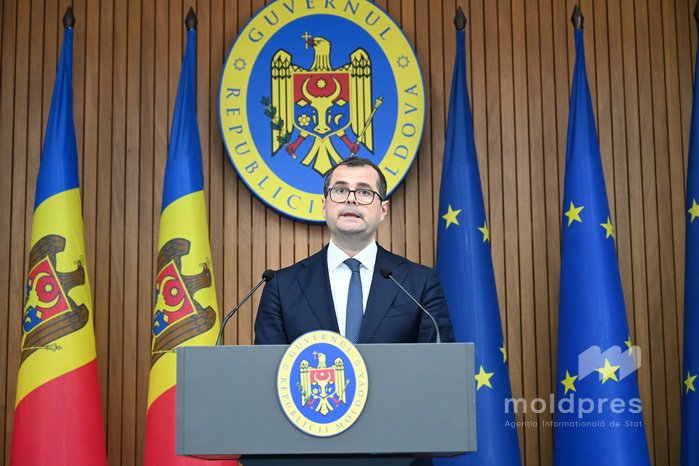
Prime Minister’s speech on main provisions of fiscal policy for 2027
Today we are presenting the fiscal policy for 2027 for public consultation.
I want to start with a simple idea: the way a country organizes its taxes influences the way its economy functions. If we want more people to work legally, we must tax labor in a way that encourages legal work. If we want companies to invest more, we must leave them with more capital for investment. If we want to discourage vices — tobacco, vaping (especially among young people), excessive alcohol consumption, gambling, if we want the environment not to be polluted by fireworks — this must also be reflected in fiscal policy.
And if we want to have a state that can pay pensions, salaries, roads, schools, hospitals, and security, we need a simpler, fairer tax system that is harder to circumvent.
This is the major responsibility of fiscal policy – to bring balance and fairness in taxation, but also to ensure social solidarity, so that we can afford to increase those much-awaited salaries for teachers and doctors. Sometimes we talk about percentages — 6%, 8%, 12%, 20%. But behind every percentage there are decisions that determine millions of lives: how much remains in a family’s pocket, whether a company invests or postpones its investment, whether a wage is paid officially or in an envelope, whether a young person chooses to work at home or leave.
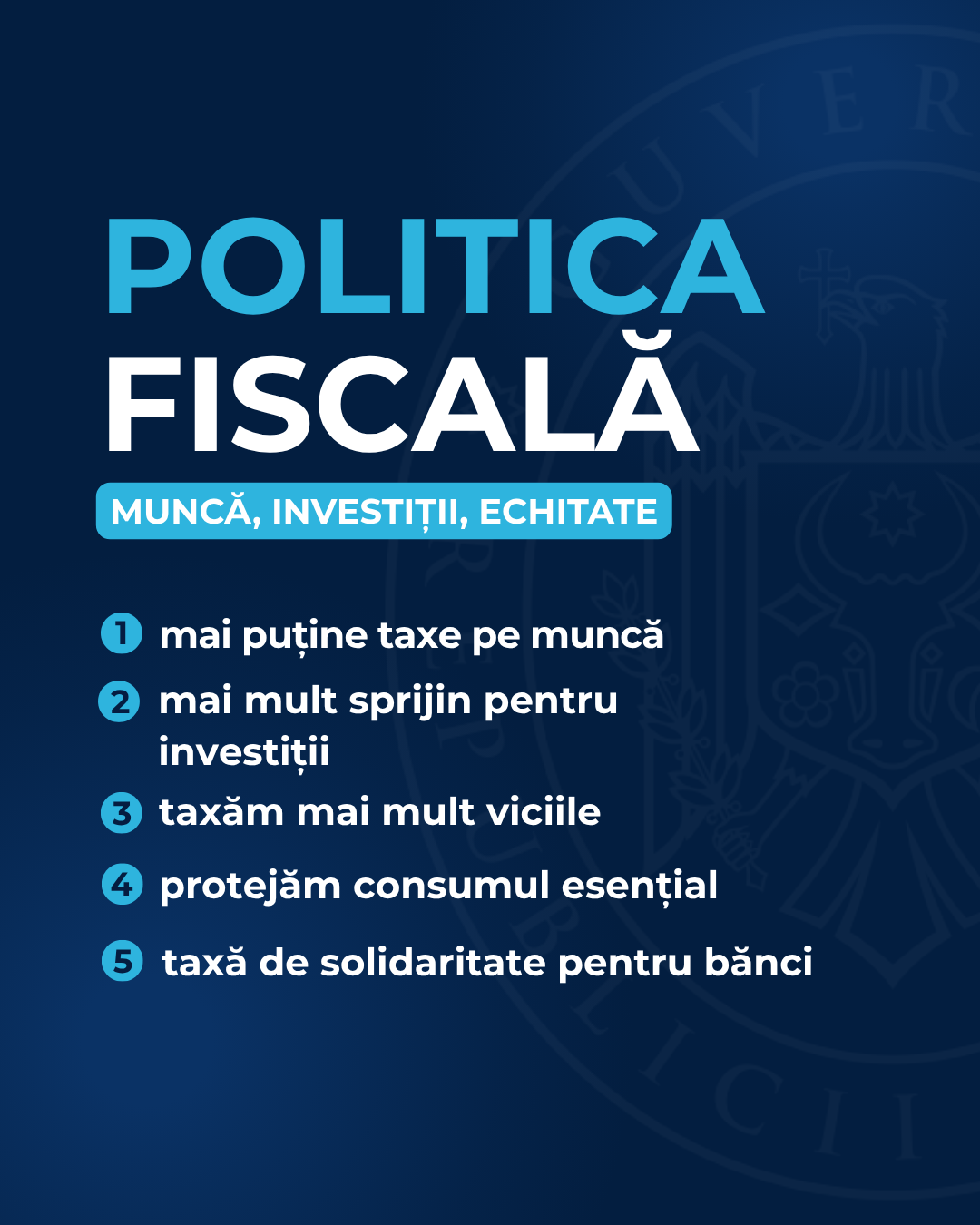
That is why our approach is not “to raise taxes.” Our approach is: to put the right emphasis.
Less tax on labor. We leave about 800 million lei in the hands of working people.
More support for investment.
More taxation of vices.
More fairness between those who pay correctly and those who evade taxes.
Fewer exemptions that complicate the lives of entrepreneurs and ordinary people.We will not solve all the problems of the tax system with this project. It would be wrong to promise such a thing. This is an important first step. We will come back, including in the context of a new Fiscal Code, with the same objective: not a higher tax burden, but a simpler, clearer system, more favorable to work and investment.
The first topic is labor
The Republic of Moldova has a structural problem: too few people are economically active, too many work informally, and the ratio between people who work and pensioners is already critically low – 1.1 workers support 1 pensioner.
In the government program we committed to increase the employment rate from 57% to 62% by 2029 and to integrate at least 100,000 people into work through ANOFM.
This means more women returning to the labor market. Young people entering their first legal job instead of leaving the country. People returning from the diaspora. People who today work occasionally, informally, or only partially declared. Older people who want and are able to keep working. Persons with disabilities who must have real access to the labor market.
For this we need employment services, nurseries, vocational training, and more modern labor rules. But we also need fair taxation to support these programs.
Because legal work must make sense.
We can hire hundreds more tax inspectors and labor inspectors. Sometimes enforcement is needed. But I believe the best form of compliance is when the system is built in such a way that people want to be honest and not avoid taxes. If the burden on labor is too high, the temptation to avoid it grows. If the burden becomes more reasonable, formal work becomes more attractive.
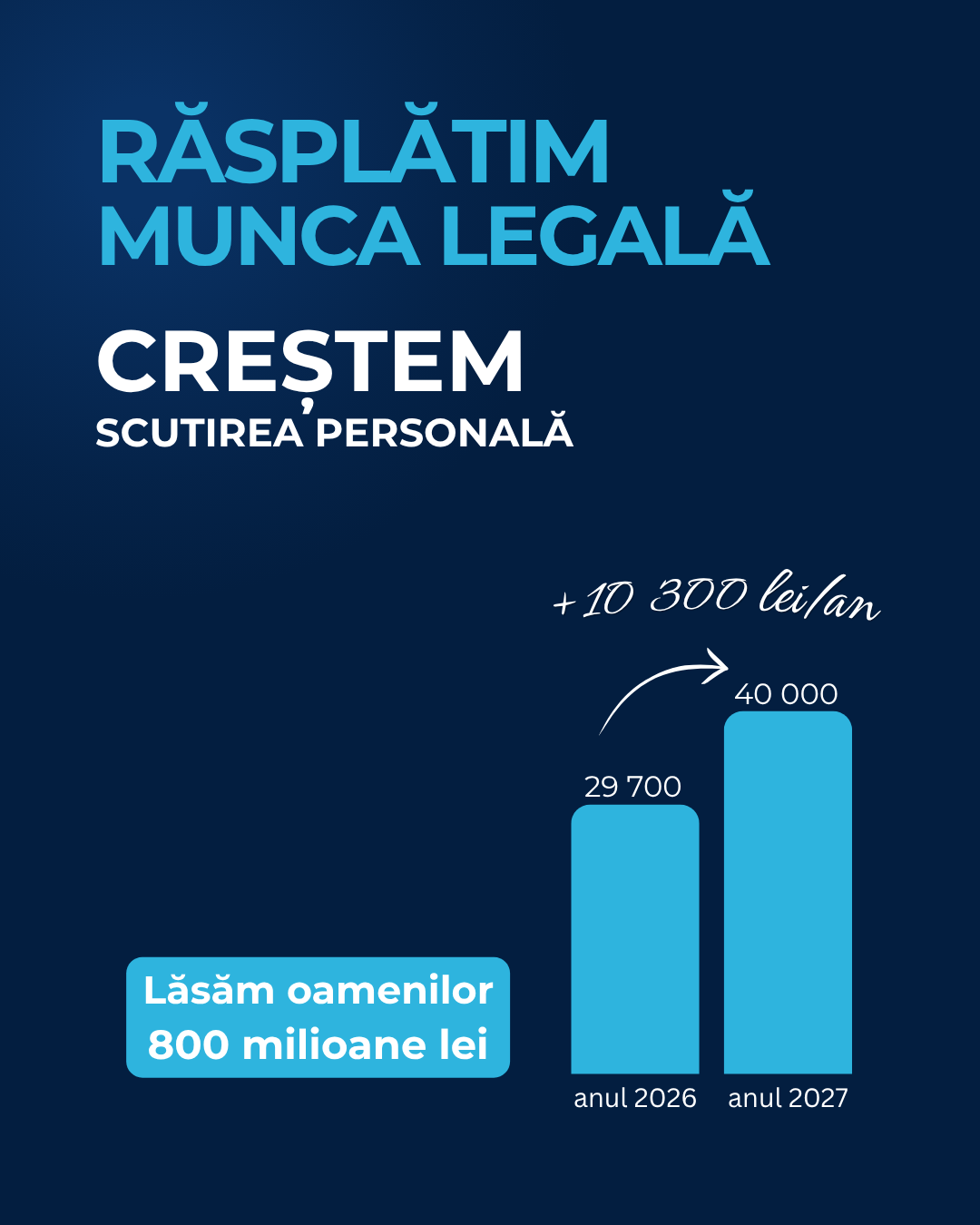
That is why we are increasing the personal exemption by 35%, a very ambitious step.
Today, the personal exemption is 29,700 lei. We propose to raise it to 40,000 lei.
This means that every person who works legally will not pay income tax on the first 40,000 lei earned annually. It is an increase of 10,300 lei per year in the amount protected from taxation. It is a measure that helps especially people with low and medium incomes. It is a measure that leaves more money in the pockets of those who work. And it is a measure that sends a clear message: the state must start by respecting legal work.
Combined with the increase in the minimum wage, which will enter into force on 1 January, this will allow us to further reduce under-the-table payments, when employees have a formal minimum wage but receive the rest in an envelope.
The budgetary cost is significant — almost 800 million lei, money we are leaving with the people.
We prefer to leave more money to people who work legally and to compensate for this reduction by broadening the tax base, by taxing vices more fairly, by reducing exemptions and through better administration. This is the right direction: not to suffocate work, but to encourage it.
The second topic concerns investment
An economy does not grow only through consumption. An economy grows when companies invest: in equipment, technologies, warehouses, production lines, digitalisation, exports, people. In recent years we have seen a very important signal. After the introduction of the facility for reinvested profit, investments by Moldovan companies moved from decline to accelerated growth.
The chart shows exactly this.
I am not saying that all the growth is due to a single fiscal measure. But the direction is clear: when we leave companies with more capital to invest, companies invest more.
And Moldova needs exactly that.
We have a large trade deficit. We import much more than we export. To change this reality, it is not enough to talk about exports. We must have companies that can produce more, better and more competitively.
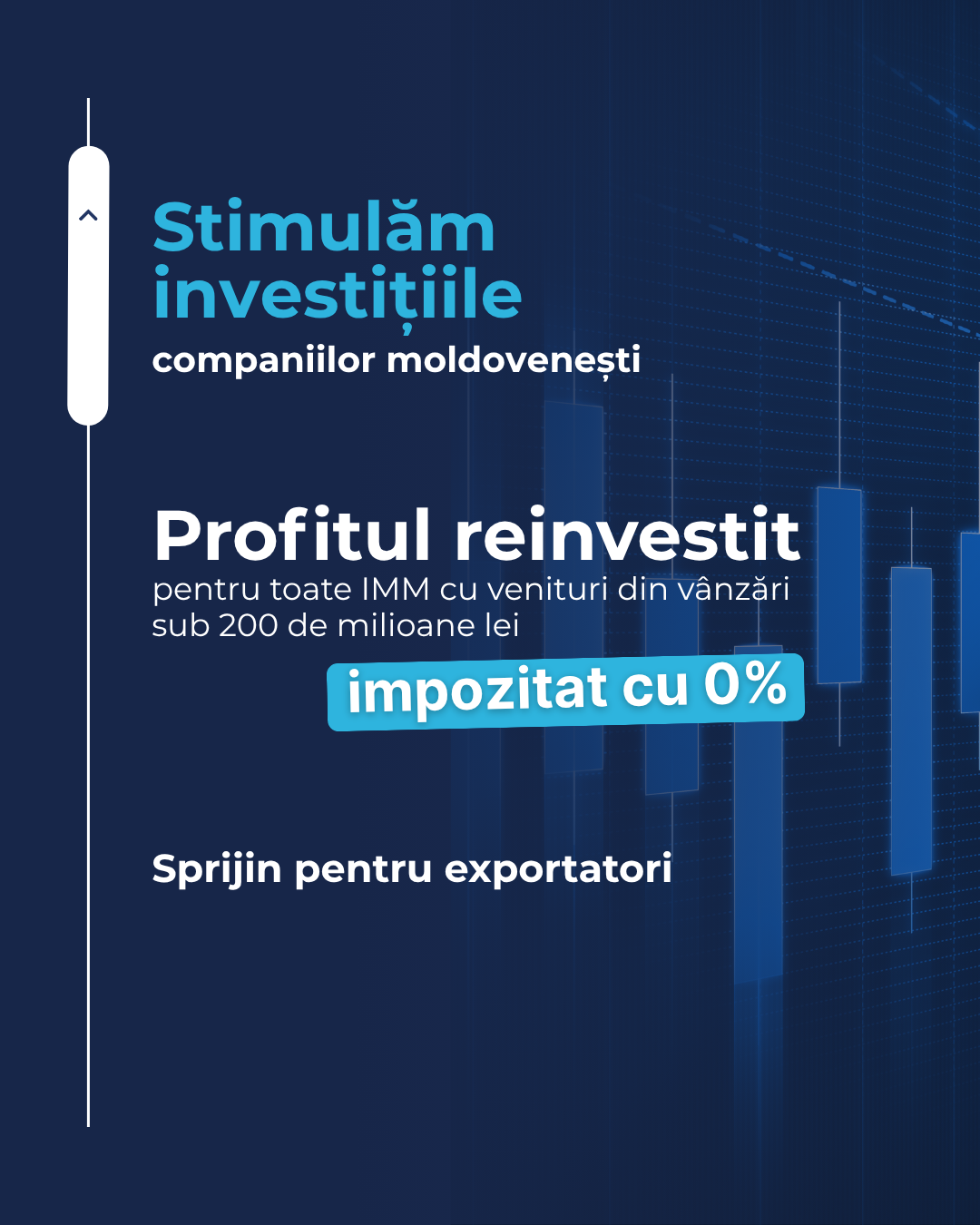
That is why we are extending the 0% tax regime for reinvested profit.
Today, the facility applies to small and very small companies, with turnover or assets of up to 100 million lei. We propose raising the threshold to 200 million lei.
This is especially important for companies that have grown, that export, that need equipment, financing, stocks, expansion.
An exporting company is often larger. It needs capacity. It needs capital. If we tax it too early, we take away exactly the resource it needs to compete on external export markets.
At the same time, if a company wants to withdraw money from the business, it will pay tax at that moment, plus an increased dividend tax of 8%. So we want to discourage the withdrawal of funds and encourage their reinvestment.
Our message is simple: if you take profit out of the company, we tax it. If you reinvest it in development, we encourage you. This is sound fiscal philosophy.
The third topic is the taxation of vices.
Here I want to be very clear. Not all taxes have only a budgetary revenue purpose. Some taxes also have a public behavior purpose.
If a product damages health, affects public order, creates addiction, affects young people — the state must intervene.
We are increasing the taxation of gambling. Moldovans spend 10 billion lei on it. This amount is higher than the transfers from the state budget for healthcare. It is equivalent to all heating compensations granted by the government over almost the last 4 years.
We are introducing a 6% tax and we estimate significant additional revenues for the budget. But we will be careful about one thing: we must not push people towards illegal or cross-border platforms. We need to tax more fairly, but also have administration and control, so that this activity remains in the legal and monitored area.
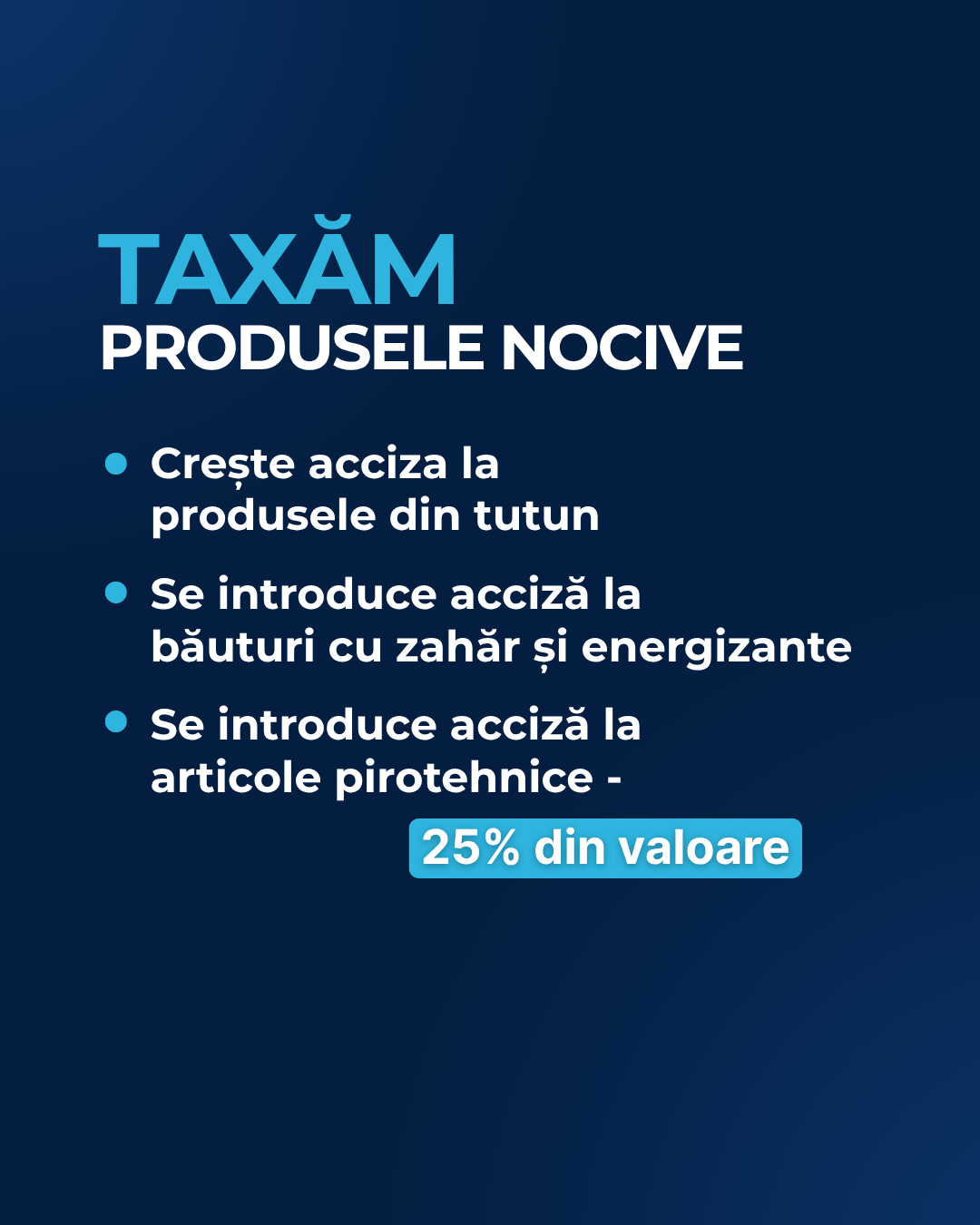
On tobacco and vaping, the message is even more direct. We see more and more young people using vaping products. It is a fast-growing category with obvious health risks. We will increase excise duties, especially on these products, in the case of vaping by 50%.
We cannot treat vaping as a minor phenomenon. It is the fastest growing segment of smoking, about 30% year-on-year. When we see more and more teenagers with such products, the state must react.
We will introduce excise duties on sugary drinks and energy drinks. This is a measure applied in many countries because these products affect public health, especially for children and young people.
And we will introduce an excise tax on pyrotechnic articles – 25% of their value. We are sending an important signal – pyrotechnics are not just entertainment. They affect public order, health, the environment, animals, vulnerable people and create costs for the community.
The fourth topic is VAT.
Here we have listened carefully to the criticisms after the first version of the project. We know that VAT is seen directly in prices. We know that any change in VAT on food, medicines, gas, or energy can affect families. That is why we have chosen a much more cautious approach.
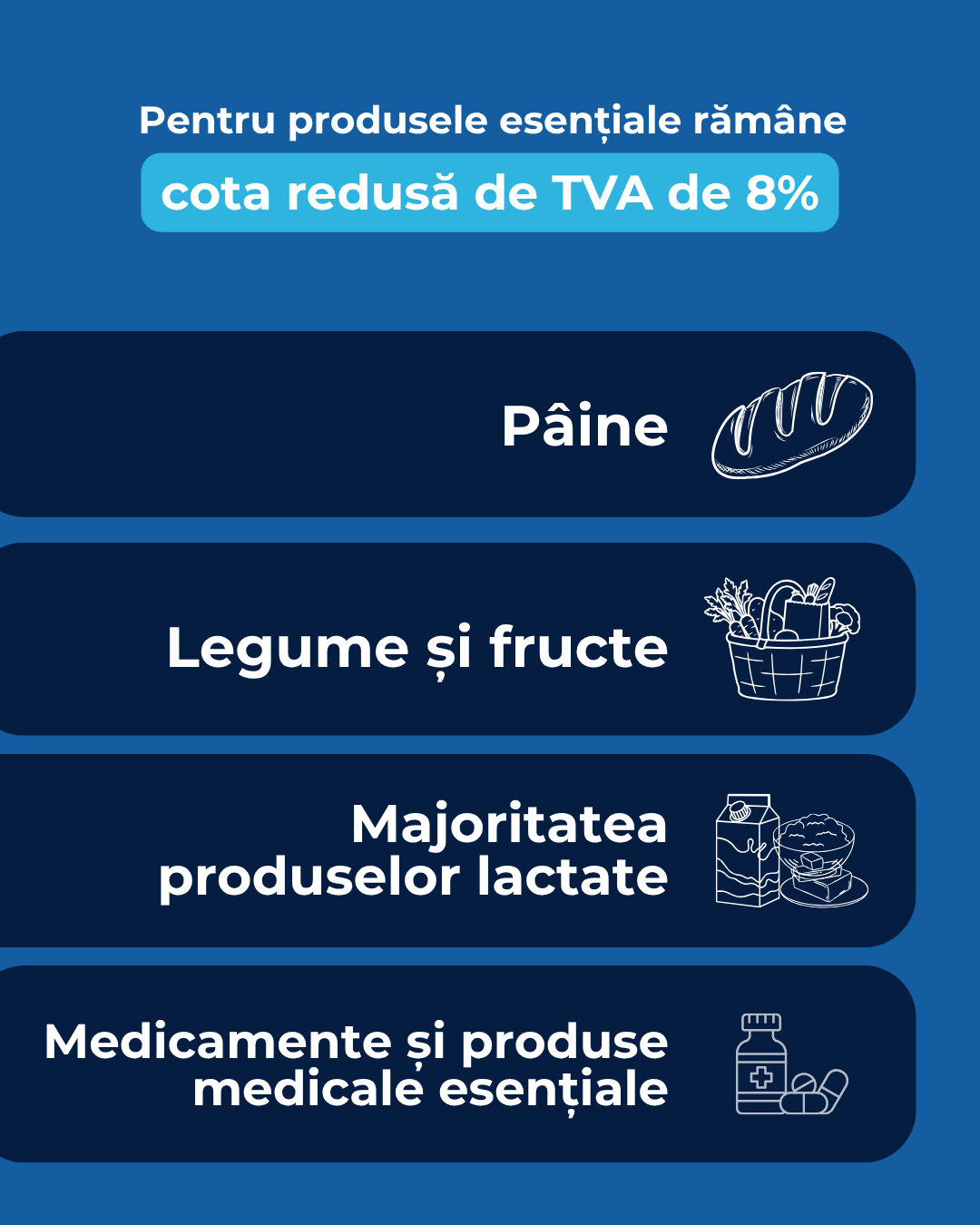
For essential products, we are not making any changes – we keep the reduced rate of 8%.
We are talking about bread, vegetables, fruits, most dairy products, medicines and essential medical products. Moldovan cheese remains at 8%. Mozzarella and other products move to 12%. People must have access to essential, Moldovan products without this becoming an excessive pressure on household spending.
This is an important signal: we are not doing tax reform at the expense of people’s basic consumption.
At the same time, we cannot ignore that the current VAT system has many exemptions, many differences, a lot of VAT blocked in the system, many areas that are hard to administer. When you have too many rates and too many categories, you get interpretations, loopholes, reclassifications, and inequalities between those who sell similar products.
Therefore, the long-term direction remains simplification. But we will do it carefully, in stages, taking into account the social impact.
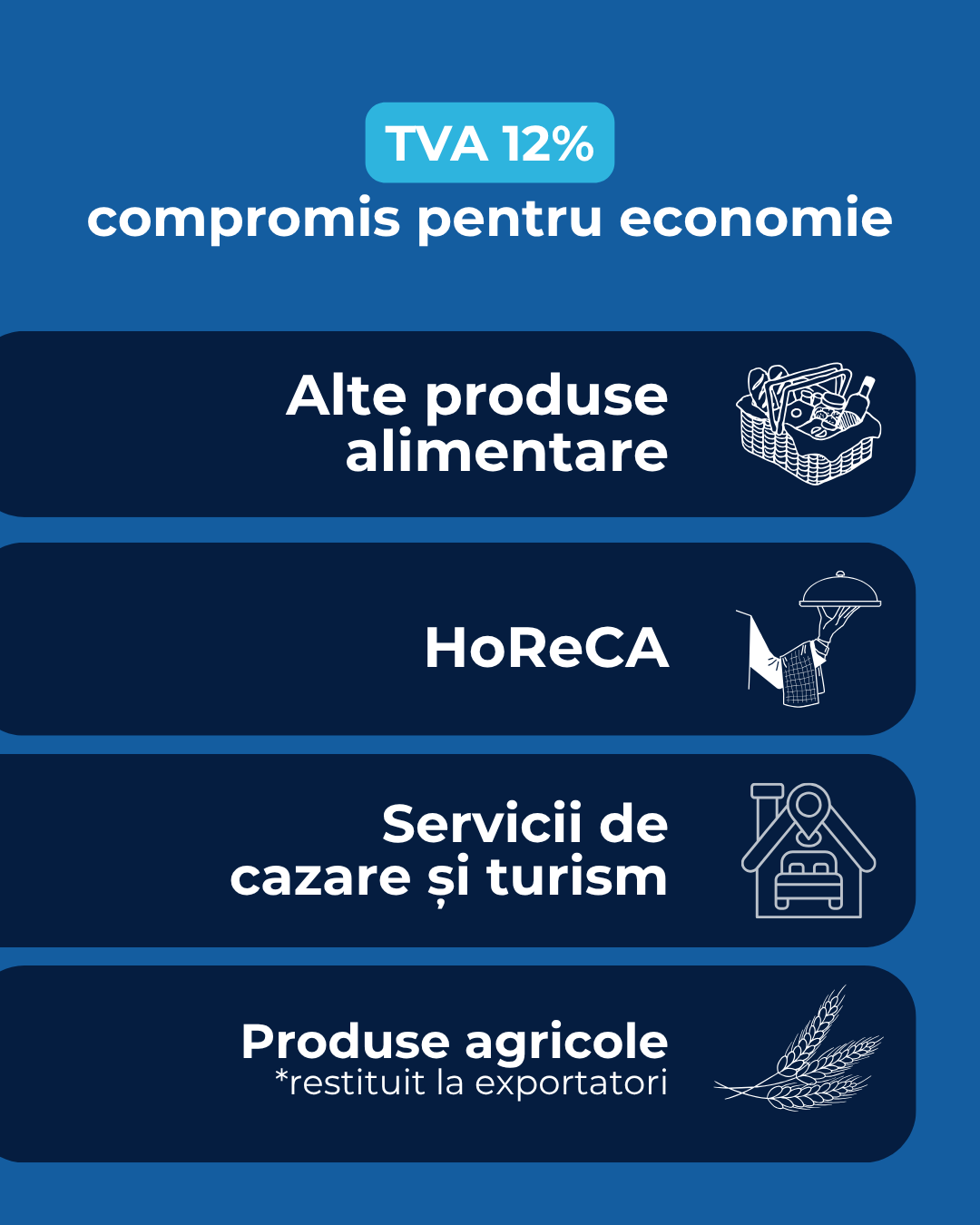
For other food products and for sectors such as agriculture, HoReCa, accommodation and tourism, we propose a 12% rate.
This is a compromise.
We are not going to 20% for these sectors, because we understand the impact on prices and on industries that are sensitive. But we also cannot indefinitely preserve a highly fragmented system, in which some similar products are treated differently and distortions appear.
For HoReCa, 12% is a reasonable rate. The sector needs predictability, not shocks. Tourism, public catering, rural guesthouses, accommodation services must develop. That is precisely why the Government has also created a holiday voucher mechanism for local guesthouses.
For agriculture, the approach must be balanced: farmers must remain competitive, and in the case of exporters, the effect is neutral, because VAT is refunded.
For energy and natural gas, we have introduced the most important protection.
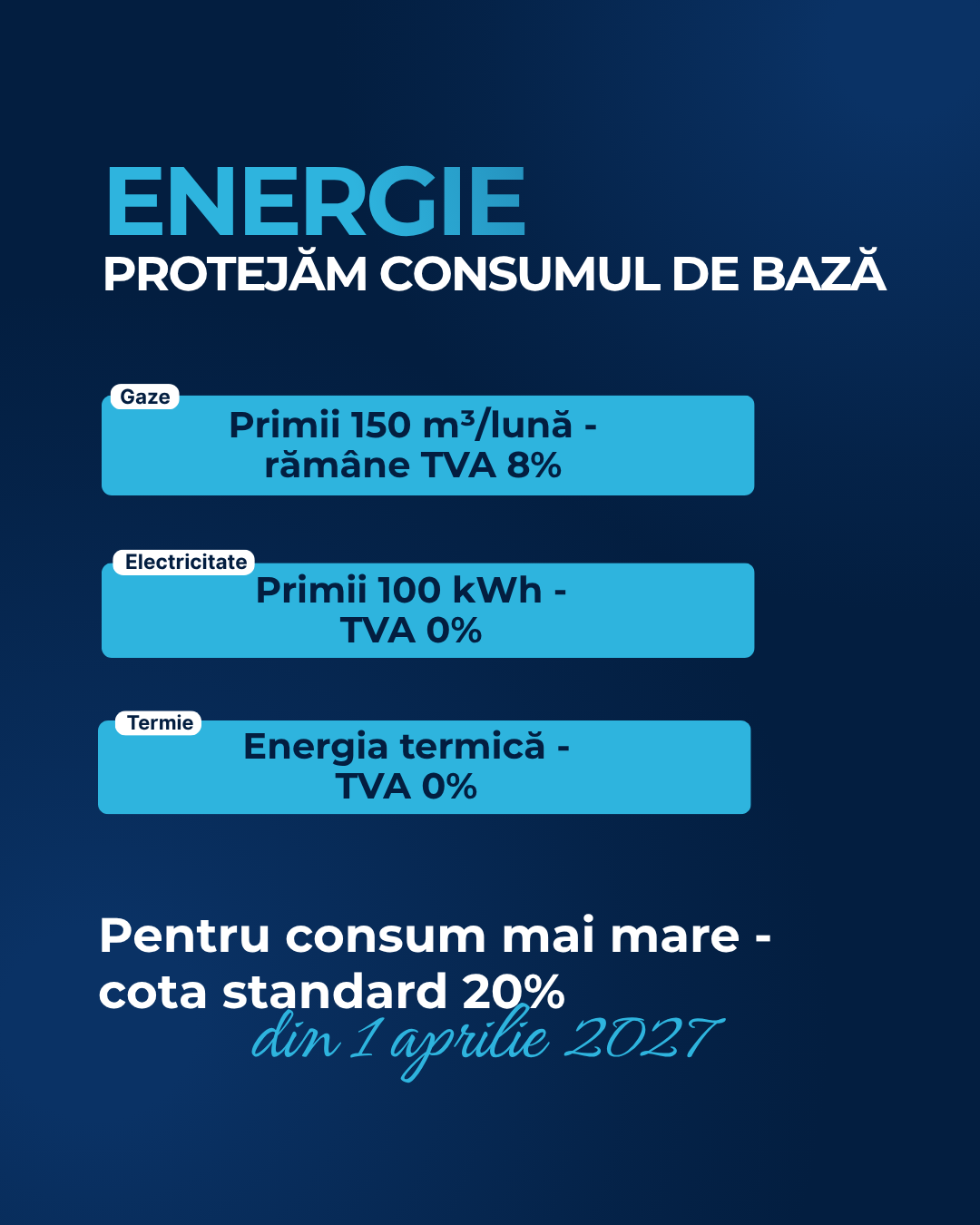
The new rules will enter into force only after the cold season — from 1 April 2027.
For electricity, the first 100 kWh per month will remain with 0% VAT.
For natural gas, the first 150 cubic meters per month will remain with 8% VAT.
District heating will remain at 0% VAT.
And I want to emphasize very clearly: nothing will change this winter. From 1 April, the 20% VAT will apply only to consumption exceeding these thresholds. Not to the entire bill. It does not apply to the first 100 kWh. It does not apply to the first 150 m³ of gas. Only to the portion that exceeds the threshold.
A consumer with a large house, with a higher income, who uses a lot of gas, will pay more. A family in a small apartment that economizes will not be affected by this measure. And apartments heated with district heating will have no VAT.
Our objective is to protect basic consumption, especially that of vulnerable families and moderate consumers, but not to offer the same tax break for very high levels of consumption. The facility must be targeted. That means fairness.
Another important measure concerns parcels ordered from foreign platforms.
Today we have an unfair situation. Local traders pay VAT. Local producers pay VAT. Shops that employ people here, pay salaries here, rents here, taxes here, apply VAT. At the same time, many goods ordered from abroad enter without VAT. This is not fair competition.
We cannot say, on the one hand, that we want to combat tax evasion and support local producers, and on the other hand accept that imports via parcels are treated more favorably than local trade.
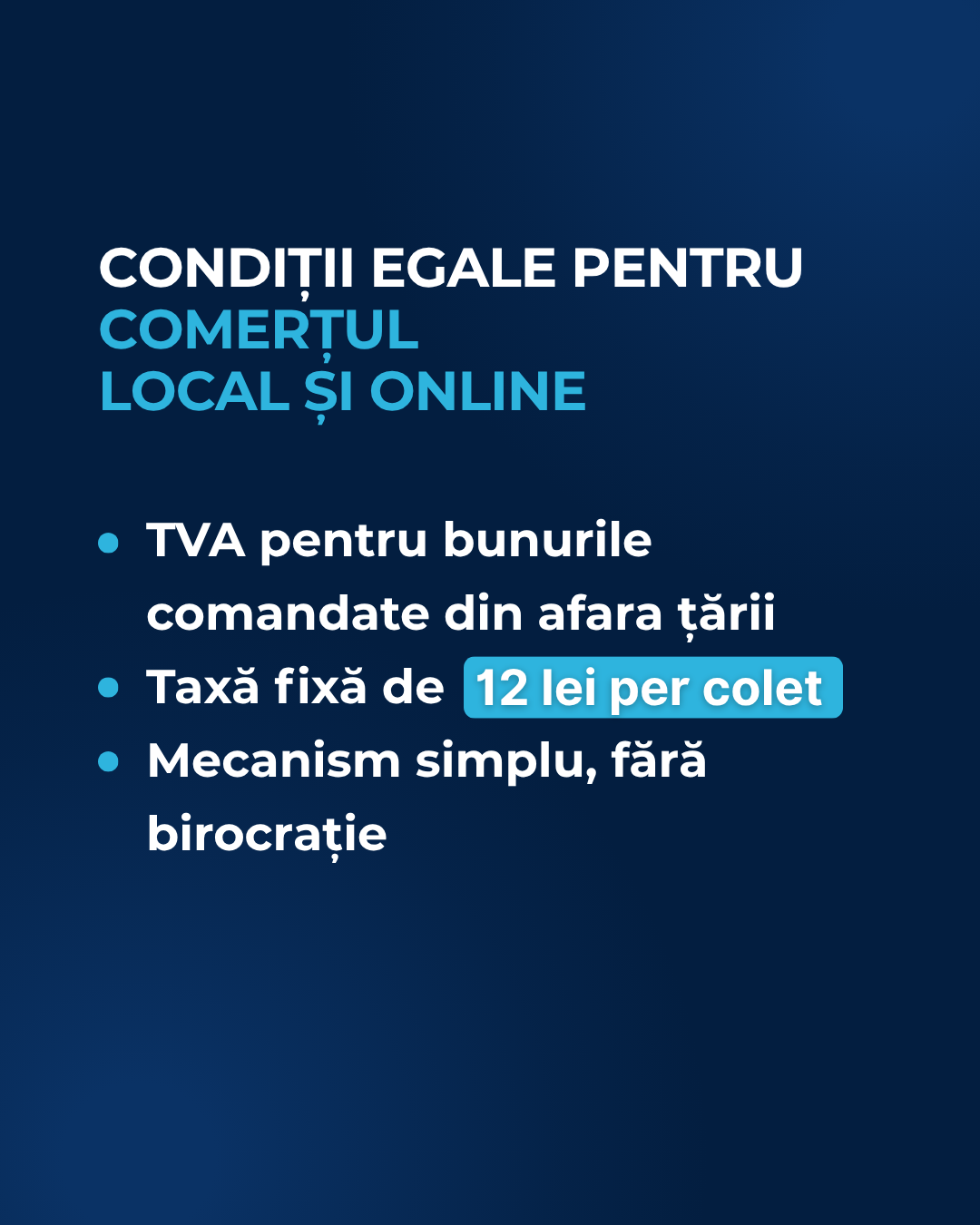
Therefore, we are introducing VAT for goods ordered from foreign platforms and a fixed fee of 12 lei per parcel for managing these flows.
However, the mechanism is very important here. People must not be turned into customs brokers. We do not want citizens to fill out complicated forms for every parcel.
The goal is for the mechanism to be simple, automated, as invisible as possible for citizens. The person orders, pays, receives the parcel. The state must build the system in the background. We will not launch the system until it is functional.
We have another important topic: fairness between forms of income.
Currently, income from work and income from capital are treated differently. More simply put, a person who receives a salary pays more to the state than a person who has income from other sources. Sometimes the differences are justified. Other times, they create opportunities for optimization and distortions.
If two people obtain comparable incomes, but one pays more just because the income is classified as labor, and the other pays less because the income is classified as capital income, then the system creates distortions.
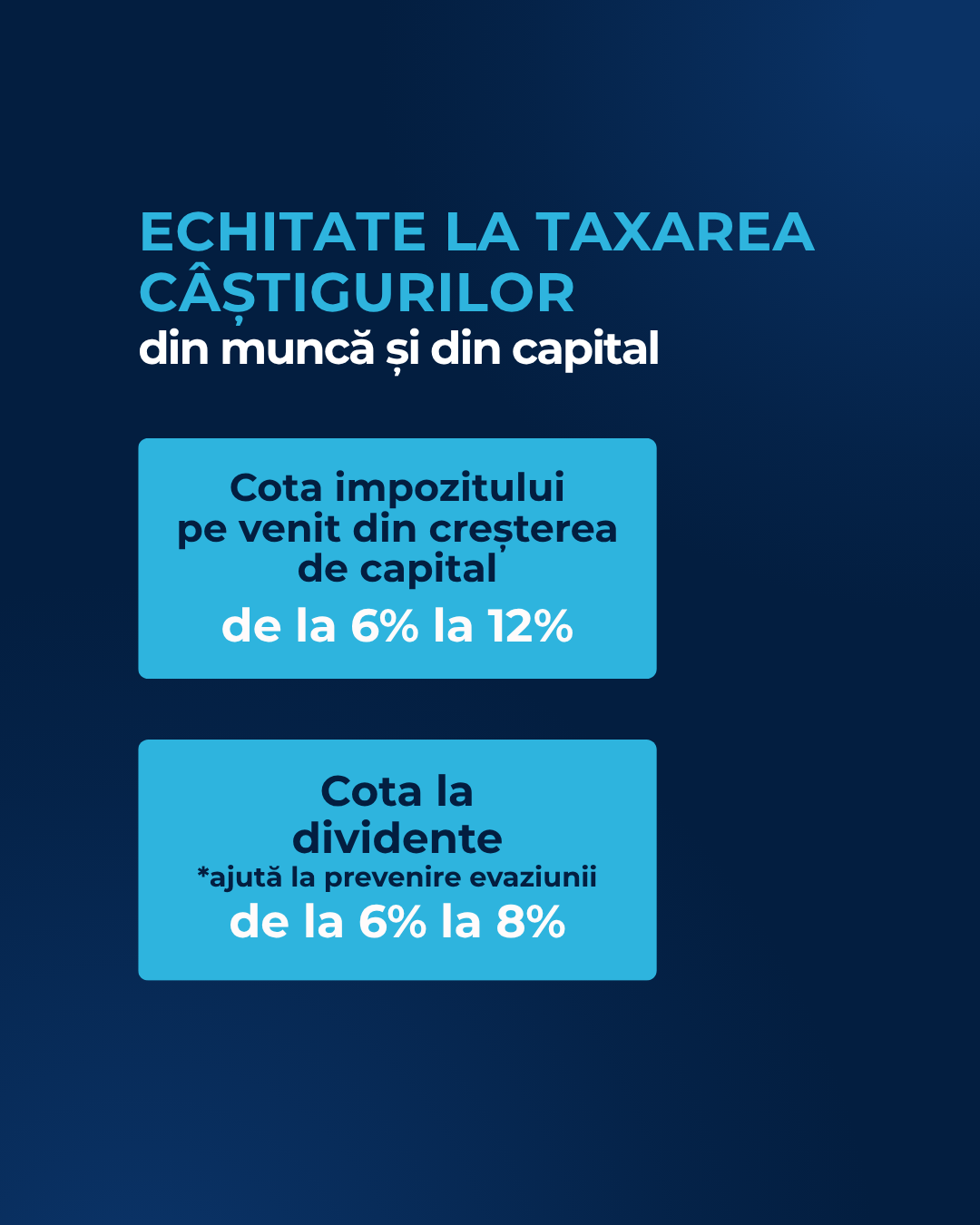
Therefore, we propose adjusting the tax on capital gains from 6% to 12% and on dividends from 6% to 8%.
This is not a radical change. But it is a move toward more equity and fewer loopholes.
I also want to talk about the financial sector.
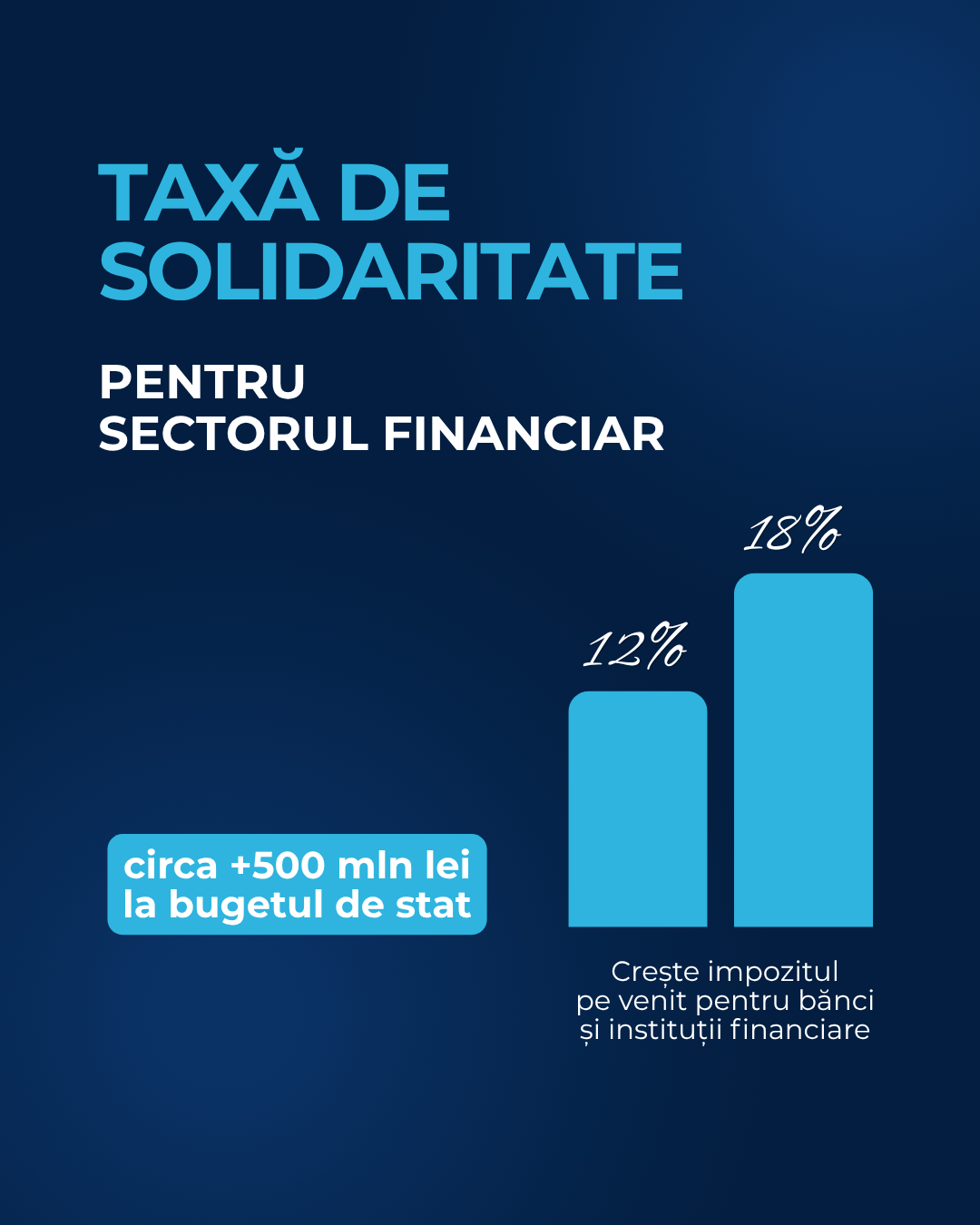
For the 2027 tax year, we propose increasing the income tax for banks and financial institutions from 12% to 18%.
This is a 50% increase in the rate.
I know this is a popular measure. Banks are not loved anywhere in the world. And, probably, as a former investor in banks, I should be more careful when I say this. But precisely because I understand how the financial system works, I want us to be fair and clear-headed. An economy cannot grow without a healthy financial system. Banks transform people’s savings into investment, loans for companies, mortgages, working capital, development.
If we take too much capital out of the banking system, we risk reducing lending capacity. In simple terms, one leu taken from a bank’s capital can mean many fewer lei going into loans for the economy.
That is why we must be cautious.
But in the current context, we consider that an additional temporary contribution for 2027 is justified. The financial sector has had good results. The state has major needs. Society needs solidarity.
My message to banks is this: this measure is not against the financial sector. It is a contribution at a time when we need balance. An act of solidarity. But we will closely monitor that it does not reduce financing for the real economy and does not turn into additional fees or rates for clients.
In conclusion, I want to return to the basic principle.
Fiscal policy is not just accounting. Fiscal policy is a choice about the kind of economy we want to build. We want an economy in which more people work legally. We want an economy in which companies invest more. We want an economy in which exporters grow and reduce our dependence on imports. We want an economy in which vices are taxed more severely and work is respected.
We want a system in which essential consumption is protected, and fiscal facilities are not granted blindly and without limit, including to those with very high consumption.
We want simpler, more uniform, clearer rules.
This fiscal policy is not perfect. No tax reform is perfect from the first reading. We have listened to feedback and adjusted the measures. We will continue to discuss with the business community, with trade unions, with local authorities, with citizens.
What matters, however, is to choose the right direction.
We cannot build a European economy with a tax system full of exemptions, loopholes and treatments that are hard to explain. We cannot ask for investment if we tax capital before it is put to work. We cannot ask for legal work if legal work is excessively burdened. We cannot protect young people if we treat vaping and harmful products as ordinary products. We cannot support local trade if we accept unequal tax competition from outside.
Instead, we can start to correct things. That is why this package is about balance.
Less tax on labor. More incentive for investment. Firmer on vices. Fairer on exemptions. Simpler for the economy.
This is the meaning of the fiscal policy for 2027.
 Facebook
 Instagram
 X/Twitter
 Telegram
Coaches of Moldova to have professional day, marked annually on September 25
Processing of personal data for purpose of combating crime regulated by new law in Moldova
Moldova's legislation on supervision of investment firms harmonized with EU rules
Moldovan legislation on administration, use of public roads aligned with EU standards
Strategic energy infrastructure projects to receive priority authorization in Moldova
Moldovan PM meets members of Club of Bessarabian Businesspeople in Bucharest
Strengthening of Moldovan-Romanian partnership discussed with leaders of Romania's parliament
Moldovan president has farewell meeting with Head of Swiss Cooperation Office in Moldova
Moldovan PM has discussion with Irish counterpart
Moldovan president to host Bavarian Minister-President
Moldovan PM, after meeting with Romanian counterpart, says leadership willing to turn closeness between two countries into more investments, opportunities for people
Moldovan deputy PM for reintegration conveys messages of appreciation to people on behalf of Moldova in charge of maintaining peace, rule of law in Security Zone
Moldovan PM has meeting with Romania's President
Moldovan PM meets members of Moldova IT Park Council
DOC // Law ratifying Convention establishing International Claims Commission for Ukraine published in Official Journal
Apple harvest in Moldova could grow by 17.5% this year, while EU production expected to decline
LIVE // Prime Minister presents main provisions of fiscal policy for 2027
Prime Minister’s speech on main provisions of fiscal policy for 2027
PHOTO // President met with DOR camp participants
Moldova and Estonia reaffirm commitment to strengthening cooperation
Prime Minister held meeting with Ambassador of the United Kingdom of Great Britain and Northern Ireland
 National Bank of Moldova
Prime Minister held meeting with Ambassador of the United Kingdom of Great Britain and Northern Ireland
Confiscated assets and money to be used for social and public interest purposes
30 MW photovoltaic park with 60 MWh storage system to be built in Vadul lui Vodă
Moldova’s defence system to be modernized under implementation Program of National Defence Strategy
Head of State appoints Liliana Vițu as Director of Center for Strategic Communication and Countering Disinformation


Government steps up measures to prevent water crisis in Chișinău
PHOTO // Republic of Moldova hosts 25th edition of EPSA Summer University for first time
VIDEO // Digital transformation must be visible in people’s daily lives and in how economy works: Prime Minister visits e-Governance Agency
Prime Minister announces new package of measures on high salaries in public sector
PHOTO // Over 200 local public authority representatives trained within Local Environmental Platforms on application of two sector regulations
Fuel crisis: PM announces Romania to support Moldova
I Will Serve My Term Until 2029 and Replace Ministers Who Do Not Deliver Results, Prime Minister says
Prime Minister warns of critical situation in energy sector
VIDEO // Prime Minister announces sweeping tax reform: lower labor taxes, higher levies for banks, tobacco and gambling
Gheorghe Hajder: Reducing Dniester’s flow to 30 cubic meters per second would mean natural disaster
Foreign Ministry condemns airspace violation after discovery of drone fragments near Văleni
Drone fragments discovered in Văleni
President about Tofan Government: Development plans are big and ambitious. A lot of energy and stability are needed to succeed
Energy investments and projects - priorities on Moldova–US relations agenda
VIDEO // Moldova to mark Independence Day with solemn military parade
ARMENPRESS: Armenian and US officials discuss swift launch of TRIPP program
Receive the latest news directly to your email

Receive the latest news directly to your email