
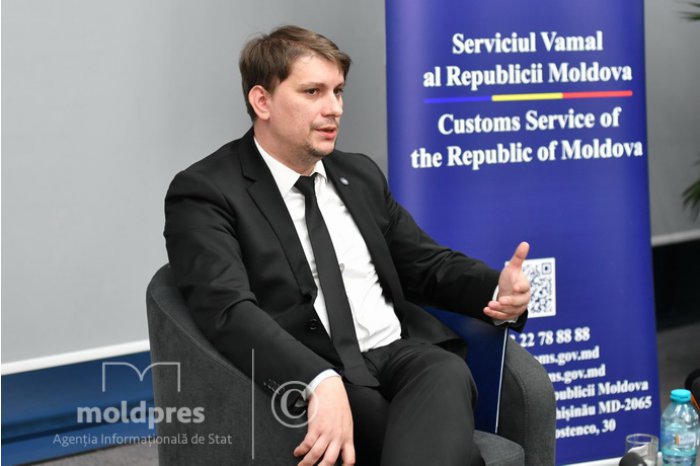
Interview with Customs Service director: Our vision based on integration with international standards, maximum efficiency and strong climate of integrity
Chisinau, Dec. 22 /MOLDPRES/- Customs Service director Alexandru Iacub took over the management of the institution three months ago. He presented a clear vision of integrity, fairness and continuous modernization of processes within the institution.
In the context of the country's EU accession process, an important task remains to align with European standards, strengthening both national and international cooperation.
Alexandu Iacub gave an interview to MOLDPRES State News Agency, and provided answers to topical issues, commitments on the integrity of customs employees, digitalization of customs processes, as well as partnership relations with Romania and Ukraine.
MOLDPRES: Mr. Iacub, you took over this important portfolio three months ago. At the current stage, what are the main priorities and achievements in the work of the Customs Service?
Alexandru Iacub: Thank you for the opportunity to share some of our achievements. As of 1 September 2024, we have managed to implement a number of key measures to modernize and optimize the work of the Customs Service. These include strengthening international relations, digitalizing customs processes and promoting transparency by creating innovative systems for information exchange and anti-fraud control. Cooperation with international partners has been a catalyst for these achievements, having a direct impact on border security and aligning with European standards.
MOLDPRES: The Customs Service of the Republic of Moldova is under institutional reform and adjusting to EU legislation. What role do neighboring countries - Romania and Ukraine - play as international partners at the country's borders?
Alexandru Iacub: International collaboration has undoubtedly been essential. An important example is the organization for the first time of a trilateral meeting of the heads of customs authorities of the Republic of Moldova, Romania and Ukraine. On this platform, we discussed collaboration and synchronization of activities, expanding the exchange of information, developing the professional capacities of staff in the three customs authorities. A priority remains the modernization of infrastructure, but also the exchange of experience and best practices. Following this meeting, we have boosted cooperation in key areas such as risk management and law enforcement, which has significantly contributed to more efficient customs processes and cross-border security.
At the same time, we agreed on the creation of a regional capacity building platform of the three customs authorities to facilitate the provision of expertise in the application of European customs legislation and professional capacity building, the implementation of the New Computerized Transit System and AEO, the use of artificial intelligence, the strengthening of the integrity climate and the conduct of joint anti-fraud operations.
MOLDPRES: Customs processes directly affect the activity of economic agents for which digitalization remains a priority. Currently, to what extent are customs services responding to the needs of entrepreneurs in terms of implementing modern systems?
Alexandru Iacub: Digitalization is an important factor of reform within the Customs Service. For example, Moldova's integration into the New Computerized Transit System (NCTS), with the support of the European Union, is a major step in modernizing the customs infrastructure. A considerable effort has been made during September and we have achieved a set objective - the fact that all economic operators, with the support of our colleagues, have voluntarily migrated to the new NCTS system.
We are also in the final phase of launching the pilot project at Costești customs for testing "BQS" system - electronic scheduling of trucks at border customs, which will give drivers an opportunity to schedule their optimal time for crossing through customs. These actions are essential to smooth cross-border traffic and reduce waiting times.
MOLDPRES: The key factor in the work of an institution is its employees. How do you assess the capacities of customs employees and what challenges are there in their work?
Alexandru Iacub: In parallel with the external reforms, we have also focused our efforts on internal modernization. We have started assessing the capacity of customs employees to ensure that they are ready to meet the current challenges and requirements. We have boosted the organization of training courses and we are currently reorganizing the Customs Service in line with EU standards.
We have also implemented new IT solutions, such as E-Cancelaria document system, which will improve the management of customs documentation. All these measures have a single aim: to make our work more efficient and increase transparency.
Transparency is essential for our credibility. That is why we have introduced a number of measures, including the implementation of the Systematic Electronic Exchange of Data (SEED/SEED+), which will increase transparency and efficiency. We have also organized training sessions for customs employees in order to improve their communication skills and better handle complex situations.
Another initiative is the implementation of AGILE principles in the work of customs employees, a tool that will optimize work processes, contribute to more efficient management of tasks, which will increase the productivity and performance of the institution.
We also organize regular meetings with business representatives to maintain a constant and transparent dialogue.
We are aware that the process of modernization of the institution requires maintaining a balance between infrastructure development, digitalization of processes and training of employees. We already have an ambitious program to recruit 200 talented young people through the Customs Next Generation program. This will ensure a young, motivated team that is well prepared for the challenges ahead. We will continue to implement European best practices and strengthen international relations to ensure that the Customs Service remains a model of efficiency and integrity.
MOLDPRES: During this year, customs employees have seized significant amounts of money in foreign currency as a result of the registration of violations of the law on entry, dispatch and exit of cash in foreign currency into/from the Republic of Moldova. What are the most important provisions regulating the entry and exit of money from the country?
Alexandru Iacub: There are no restrictions on bringing cash in national currency, as well as cash and traveler's checks in foreign currency into the Republic of Moldova. Private people are obliged to declare in writing amounts exceeding 10 thousand euro or their equivalent for one person. At the same time, individuals are entitled to declare in writing amounts not exceeding 10 thousand euro or their equivalent for one person/trip.
With reference to taking currency out of the country, it is important to know that individuals are entitled to take out cash in national currency, as well as cash and traveler's cheques in foreign currency in the total amount not exceeding 10 thousand euro (or their equivalent) per person/trip, without presenting the confirming documents.
For information, the Customs Service has a Single Call Center, which operates 24/7.
MOLDPRES: About 65% of the state budget is made up of the Customs Service's revenues, what are the values of the budget burden for 11 months of 2024?
Alexandru Iacub: In January-November 2024, the Customs Service administered revenues of about 34.6 billion lei to the state budget, which represents 92% of the annual budget burden and an increase of 9.4% compared to the same period last year, or 2.97 billion lei more. These results are remarkable given that as of 1 January, the fee for customs procedures under the new Customs Code has been abolished.
Significant increases in revenues, especially from VAT on imports (23.03 billion lei) and excise duties (9.25 billion lei), show the effectiveness of the measures implemented by the Customs Service and its essential role to support the state budget.
Under the current conditions, our vision for the work of the institution is based on full integration into international standards, maximum efficiency and a solid climate of integrity. We aim to strengthen a Customs Service that is transparent, innovative and able to meet the needs of the national economy quickly. Thus, we continue to invest in staff training, modernize infrastructure and strengthen international cooperation.
 Facebook
 Instagram
 X/Twitter
 Telegram
Moldovan justice minister says, according to European Commission’s Report, Moldova made greatest progress among EU candidate states, including in justice field
INTERVIEW MOLDPRES // Moldovan defense minister says Russia's war in Ukraine highlighted vulnerability of defense sector, need of building strong, prepared, resilient army to current challenges
INTERVIEW WITH MOLDPRES // Deputy PM says wants Moldova where a child from any village has same opportunities as a child from Chisinau
INTERVIEW MOLDPRES // Deputy Prime Minister on Ukraine Peace Agreement: No discussion about Moldova can take place without Chișinău's participation
INTERVIEW MOLDPRES // Moldovan agriculture and food industry minister says European integration fundamentally changes way leadership supports agriculture
INTERVIEW MOLDPRES // Romania's Ambassador in Chisinau says Moldova to never be alone in its efforts, Romania to stand by its side
MOLDPRES INTERVIEW // Romanian culture minister says culture adds value, rebuilds trust
MOLDPRES interview // IGP head: Russia whether through Ilan Shor or other means to constantly try to find ways to create disorder and destabilization
MOLDPRES interview // Minister of Internal Affairs: Moldova experiencing wave of concerted attacks from abroad and supported by criminal groups
INTERVIEW MOLDPRES // President Maia Sandu: "Our parents achieved independence and sovereignty, and now it is our duty to preserve them by joining the EU"
INTERVIEW MOLDPRES // Moldovan foreign affairs minister says Moldova becoming stronger, more resilient, capable of counteracting Russia's interferences
INTERVIEW MOLDPRES // Deputy Prime Minister: Our goal - transition from consumer economy to modern, competitive, export-oriented one, deeply connected to European market
INTERVIEW MOLDPRES // Moldovan parliament speaker says mandate full of challenges; leadership had to deliver more than promised
INTERVIEW MOLDPRES // Paun Rohovei, Ambassador of Ukraine: "Moldova–EU Summit conveys clear signal - Chisinau stays firm on path of European integration''
Moldovan PM conveys message to border police on 34th anniversary of institution's foundation
MOLDOVA IS ME // From Denmark, through China, back home; story of Moldovan woman who opened in Chisinau first restaurant with Japanese Omakase concept
Moldova withdraws from cultural agreement signed within Commonwealth of Independent States
Moldovan Wine wins 66 medals at Concours Mondial de Bruxelles 2026
 National Bank of Moldova
Moldovan PM participates in South-East European Cooperation Process Summit
Moldovan PM meets Bulgarian counterpart in Sofia
Moldovan deputy PM for reintegration has meeting with Ambassador of Canada
Deputy Secretary General of Government participates in Strasbourg in meeting of Steering Committee on Democracy
Moldovan deputy PM for reintegration has meeting with French senators

Inga Ionesii and Sergiu Gurduza to be appointed ambassadors to India and Portugal
Deputy Secretary General of Government participates in Strasbourg in meeting of Steering Committee on Democracy
VIDEO // Civil Society Gala held in Chișinău
PHOTO // Minister of Energy inspects construction works at Chișinău Electrical Substation: project completion deadline remains unchanged
Prime Minister on visit to Sofia to attend South-East European Cooperation Process Summit
First European Forum of Environmental Human Rights Defenders held in Strasbourg; Moldova’s experience presented by EcoContact
Number of electric cars might double in Moldova by 2030; authorities prepare solutions to expand charging stations
PHOTO // Moldova learns from France’s experience in urban mobility, public transport's modernization; deputy PM’s visit to Paris
Over 300 tons of used appliances collected for recycling through EcoVoucher Programme in Moldova
Moldovan deputy PM for reintegration has meeting with French senators
Moldovan-Hungarian cooperation in focus for foreign ministers of Chisinau and Budapest
European Commission President: EU to open first negotiation cluster with Moldova on days to come
Moldova, Romania coordinate efforts to advance EU accession negotiations
Over 250 rescuers from Europe to take part in MD–EU MODEX 2026 exercise organized in Moldova
Moldovan parliament speaker thanks UNICEF representative in Moldova for support in social reforms, child protection
VIDEO // Over 5 million lei seized following searches in fraud file in Moldova; five people detained
Receive the latest news directly to your email

Receive the latest news directly to your email