
Moldovan PM says government acts to achieve three major objectives – economic growth, faster EU accession, peace, security at home
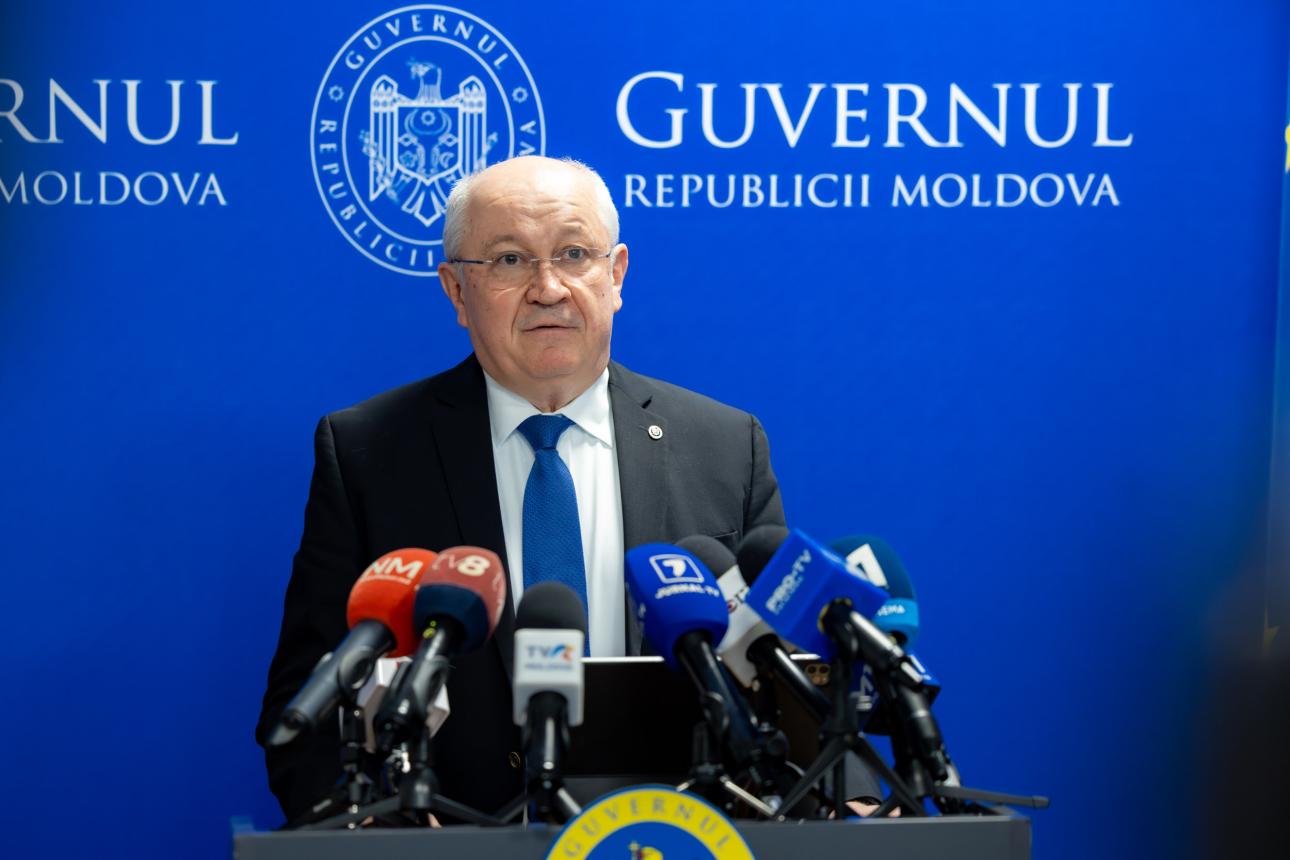
The government works 365 days a year on initiatives, projects and decisions aimed at meeting the three objectives of governance – economic growth, accelerating EU accession, peace and security at home. Prime Minister Alexandru Munteanu today unveiled the main actions in key areas at a news conference.

Prime Minister Alexandru Munteanu emphasized that, in addition to foreign visits to important capitals, such as Bucharest, Brussels and Kyiv, where the image of Moldova and the investment opportunities of the country are promoted, the government communicates with citizens during visits to localities across the  Moldova, learns about their needs and comes up with measures to solve people’s current problems.

“Citizens want their lives to be better today, not in a few years or decades, and all our efforts are directed towards being as close as possible to these expectations. The things we do are not always visible or have immediate effects, but I want to assure you that all the time and all the energy of this cabinet are devoted to doing better – maybe not overnight, but gradually and with patience, we will succeed,” the prime minister underlined.

The PM referred to measures in the economic field, noting the approval of a Responsible Investment Budget, which will increase capital investments by 55 per cent, up to 3 billion lei, the highest level in recent years, and will increase investments in business environment programs. Capacities for implementing major local development projects will also be strengthened, which will create new jobs in rural areas.

A de-bureaucratization package is being implemented, by simplifying permissive documents (around 100 documents will be simplified or eliminated). At the same time, the Freelancers Law has been created, and starting from January 1, 2026, individuals carrying out economic activities will be able to register officially, easily, without registering a company, paying a single tax of 15 per cent.

In 2025, resident companies of the Moldova Innovation Technology Park (MITP) exceeded, for the first time, a turnover of 1 billion dollars, registering an increase of 24.3 per cent compared to 2024 and almost 10 times more than in 2018, when the Park was established.

According to the prime minister, although forecasts had previously indicated a growth of 2.2 per cent, after the first 11 months an economic growth of 2.7 per cent is recorded. Inflation is declining and the National Bank of Moldova has repeatedly reduced refinancing rates.

The country is also advancing on its European path – on 15 December, Moldova opened technical negotiations for 3 of the 6 groups of chapters (1, 2 and 6). In December 2025 alone, more than 70 pieces of legislation were adopted.

In the energy sector, thanks to interconnection with the European and Romanian markets, and thanks to the commissioning and testing this summer of four 110kV power lines – Stanca–Costesti, Tutora–Ungheni, Husi–Cioara and Falciu–Cantemir – the massive disconnection of the country from electricity was resolved within a few hours. Work is also continuing, in order to complete three major lines that will ensure full energy independence.

In December, the first transactions were carried out on the Day-Ahead Market and the Intraday Market – a historic moment marking Moldova’s entry into a completely new stage of market’s work. Starting from 1 April 2026, 180 large consumers will move to the free market and will purchase gas only through bilateral contracts or on the exchange.

The prime minister noted that a kerosene crisis was averted following the sanctions imposed on Lukoil. The authorities are now in the process of taking over the airport oil terminal into state ownership.

The prime minister also touched upon the launch of the second auction for wind power plants, with an allocated capacity of 170 MW and with an obligation to store energy. The share of renewable energy will increase by 5.8 per cent, and together with the first 165 MW auction, wind energy will contribute approximately 11.4 per cent to achieving the national target of 30 per cent renewable energy by 2030.

In terms of modernizing infrastructure across the country, by the end of 2025, 226 local development projects had been completed – including water and sewerage, kindergartens, medical centers, schools, street lighting, and renovated sports and playgrounds – and another 662 projects are planned for 2026.Roads are being repaired both nationally and locally and resources are being identified to repair as many kilometers of road as possible in 2026.

Additionally, financial resources have been allocated for more nurseries. While in 2025, 241 new places were created, in 2026/2027 another 5,000 new places will be created. The budget increased from 18 million lei in 2025 to 385 million lei for the next two years – a budget 20 times larger. Funding for free meals was increased by 238 million lei and 41 million lei more was allocated for the renovation of kindergartens.

The government continues its social measures and takes care of the people. In this cold season, over 53 per cent – more than half of eligible households – will receive the maximum compensation of 800 lei for firewood or 1,000 lei for thermal energy, natural gas or electricity.

At the same time, preparations for the local public administration reform have been launched, through extensive public consultations – a serious and complex reform, whose objective is to create strong mayoralties, better services close to the people, and development in localities regardless of whether they are located in the Center, North or South. In this context, the government encourages voluntary amalgamation – over 400 localities have already expressed their intention to start this process.

In education, deployment allowances have been extended to young specialists who choose to continue their careers in technical vocational education, as well as those who go to research institutes or become lecturers in higher education. Pupils who go to better-performing schools will be supported with financial aid of 1,000 lei per month for 2 years, a free school bus, as well as relocation allowances for teachers who choose to move to another school.

Also, the allowance programme for performance sportspeople and for young people aged 13–23 has been expanded. Sport has been supported in recent years in Moldova and the authorities will continue to pay it increased attention.

In the culture field, additional funds have been allocated, so that more young specialists can benefit from one-time hiring allowances of 90,000 or 120,000 lei. Moldova joined the European Creative Europe Programme, through which the country will have access to international funding and projects, and the reconstruction of the National Philharmonic is planned to start soon.
 Facebook
 Instagram
 X/Twitter
 Telegram
Government tightens penalties for drug-related offences
Moldovan driving licences to be recognized in Ireland
Moldovan PM has meeting with Romanian counterpart
Moldovan government's secretary general in Strasbourg says good reforms achieved through strong partnerships, dialogue, solutions for people’s well-being
Moldovan PM has discussions with Romania's president
Moldovan deputy PM for reintegration has meeting with Secretary-General of Federal Ministry for European and International Affairs of Austria
Moldovan PM invites members of American Chamber of Commerce in Romania to invest in Moldova
Moldovan parliament speaker participates in Bucha Summit
Prime Minister at Romania Government Roundtable Conference
Moldovan president’s working visit to Finland postponed later date
PM meets Ambassador of Czech Republic to Moldova
Moldovan president has meeting with delegation of European affairs committees from, Baltic, Nordic states, Poland
Interreg Europe Programme in Moldova: funding opportunities, interregional cooperation
Moldovan PM to pay official visit to Bucharest
New oil slicks on Dniester River; Moldovan authorities order reinforcement, expansion of anti-pollution barriers
New wave of oil products' slicks detected on Dniester River; authorities convene for emergency meeting
Moldovan PM participates in awards ceremony recognizing rescuers' achievements
Large wind farms with energy storage systems to be built in Moldova: 16 bids submitted in tender
Environmental protection experts from two banks of Dniester hold new working meeting
Moldovan Central Electoral Commission accredits 14 national observers to monitor new local elections, local referendums
New milestone for green energy: Moldova surpassed 1 Gigawatt of installed renewable energy capacity
 National Bank of Moldova
Moldovan authorities step up prevention, response measures on Dniester, amid anticipated new pollution wave
Moldovan PM participates in awards ceremony recognizing rescuers' achievements
Environmental protection experts from two banks of Dniester hold new working meeting
Moldovan deputy PM has meeting with Ambassador of Germany
President met with U.S. Senator

President met with U.S. Senator
PAS faction to have new MP
VIDEO // Single institution to manage Moldova’s forests
CNMC: Eenergy sector remains fragile, ending state of emergency requires caution
Foreign Ministry: We condemn violation of airspace. Such actions endanger citizens’ security
Support for export promotion: 16 business associations to receive 14.6 million lei through Bridge Export Program
Over 20 media projects to get funding from media subsidy fund
Shahed drone illegally flew over airspace of Moldova
Over 25,000 residents from left bank of Dniester commute daily to right bank, Deputy Prime Minister for Reintegration says
BTA: Bulgarian Literature Has Become Increasingly Visible on International Stage - Deputy Culture Minister Stoyanov
Simple motion on public policies implemented by Ministry of Labour and Social Protection failed
Proposals for improving efficiency of ministries discussed at roundtable
PHOTO GALLERY // Premiere at Mihai Eminescu National Theater: “Intrigue and Love,” directed by Alexandru Cozub
Moldova to sign social security agreements with Quebec (Canada), Albania, Croatia and Ireland
Around 622,000 vulnerable families receive energy compensation
Prime Minister visited agricultural business in Unguri village, Ocnița district
Receive the latest news directly to your email

Receive the latest news directly to your email