
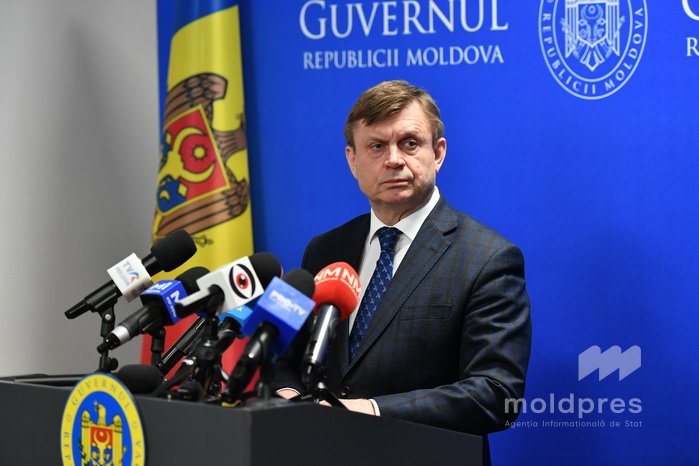
Moldovan deputy PM for reintegration speaks about energy crisis on left bank of Dniester
The energy crises in the Transnistrian region could recur. As long as the leaders in Tiraspol do not accept a transparent and sustainable formula for gas delivery in the region, this problem will reappear, given that the paying agent is constantly changing. Deputy Prime Minister for Reintegration Valeriu Chiveri today made statements to this effect before the government meeting.

According to the official, the current situation on the left bank of Dniester is caused by a technical issue.

“This is a situation that is repeated every 10 days, for more than a year already. As long as the leaders in Tiraspol do not accept a transparent and sustainable formula for gas delivery in the region, this problem will reappear, given that the paying agent is constantly changing. There is a sanctions policy of the European Union that must be observed. If the model proposed by Chisinau is not accepted, the situation will continue to repeat itself,” said Valeriu Chiveri.

The deputy PM also referred to Ukraine’s willingness to supply coal for the Kuchurgan power plant.

“This is an older idea, which was launched by the Ukrainian side at the time of the crisis at the beginning of 2025, but it was not accepted by the Transnistrian side. I do not know in detail what the proposal was this time, but I assume it has the same meaning. However, without the leaders in Tiraspol accepting such cooperation, this will obviously not materialize,” Valeriu Chiveri noted.

In late last August, the National Energy Regulatory Agency (ANRE) ruled to designate the company Moldovagaz as responsible for the supply of natural gas to the Transnistrian region until 31 March 2026. The ANRE decision stipulates that Moldovagaz will be able to purchase natural gas on the wholesale market of Moldova, but exclusively for the needs of the Transnistrian region.

Starting 1 January 2025, the Russian company Gazprom unjustifiably suspended the delivery of natural gas to Moldovagaz, even though there was a valid contract until 2026, leaving consumers in the Transnistrian region without natural gas and, consequently, without electricity, heating and hot water.

In the emerged situation, the European Union allocated a grant of 30 million euros for the purchase of the energy resources needed both for consumers on the left bank of Dniester and for those on the right bank. At the same time, the EU came forward with an aid offer of 60 million euros, in order to cover the energy needs of the Transnistrian region. The support was, however, refused by Tiraspol.
 Facebook
 Instagram
 X/Twitter
 Telegram
Moldovan expert says Moldova becomes strategic constant in Romania
Romania supports Moldova's economic integration; Romanian president says Romania to continue to support Moldova's integration into European Union, integration of two economies
Prime Minister at The Economist conference on accelerating EU accession process: Moldova moves forward despite challenges
PAS to have new MP in Parliament
Ben Gurion Airport in Tel Aviv remains closed until 16 April
National airspace overflown by Shahed drone
Perspectives on Moldova's European integration: experts says joint declaration announced today by officials from seven states good political signal
European Union member states' MPs call for speeding up EU accession talks with Moldova; declaration to this effect signed in Chisinau
Moldovan president to meet Moldovans living in Ireland
PHOTO // Republic of Moldova opened Honorary Consulate in Almaty, Kazakhstan
President on 108 years since Union of Bessarabia with Romania
Prime Minister conveys message on anniversary of Bessarabia's Union with Romania
Speaker - 108 years after Union of Bessarabia with Romania
PHOTO // Moldovan foreign affairs minister meets Romanian senators
New oil slicks on Dniester River; Moldovan authorities order reinforcement, expansion of anti-pollution barriers
New wave of oil products' slicks detected on Dniester River; authorities convene for emergency meeting
Moldovan PM participates in awards ceremony recognizing rescuers' achievements
Large wind farms with energy storage systems to be built in Moldova: 16 bids submitted in tender
Environmental protection experts from two banks of Dniester hold new working meeting
Moldovan Central Electoral Commission accredits 14 national observers to monitor new local elections, local referendums
New milestone for green energy: Moldova surpassed 1 Gigawatt of installed renewable energy capacity
 National Bank of Moldova
Moldovan authorities step up prevention, response measures on Dniester, amid anticipated new pollution wave
Moldovan PM participates in awards ceremony recognizing rescuers' achievements
Environmental protection experts from two banks of Dniester hold new working meeting
Moldovan deputy PM has meeting with Ambassador of Germany
President met with U.S. Senator

President met with U.S. Senator
PAS faction to have new MP
VIDEO // Single institution to manage Moldova’s forests
CNMC: Eenergy sector remains fragile, ending state of emergency requires caution
Foreign Ministry: We condemn violation of airspace. Such actions endanger citizens’ security
Support for export promotion: 16 business associations to receive 14.6 million lei through Bridge Export Program
Over 20 media projects to get funding from media subsidy fund
Shahed drone illegally flew over airspace of Moldova
Over 25,000 residents from left bank of Dniester commute daily to right bank, Deputy Prime Minister for Reintegration says
BTA: Bulgarian Literature Has Become Increasingly Visible on International Stage - Deputy Culture Minister Stoyanov
Simple motion on public policies implemented by Ministry of Labour and Social Protection failed
Proposals for improving efficiency of ministries discussed at roundtable
PHOTO GALLERY // Premiere at Mihai Eminescu National Theater: “Intrigue and Love,” directed by Alexandru Cozub
Moldova to sign social security agreements with Quebec (Canada), Albania, Croatia and Ireland
Around 622,000 vulnerable families receive energy compensation
Prime Minister visited agricultural business in Unguri village, Ocnița district
Receive the latest news directly to your email

Receive the latest news directly to your email