
August 1991: Review of a failed coup d'etat (II)
The first day of the 1991 coup d’etat started in a triumphalist way for the coup promoters, but ended with clear-cut signs that the authors of the coup d’etat did not take into account the new realities from the USSR after 1985. Following 70 years of Stalinist prison, the people were willing freedom and the nations of the great empire – independence. The parliaments from the regions were already elected by democratic voting and took over a good deal of the centre’s powers. The people were choosing another life than the one proposed by the authors of the coup d’etat.
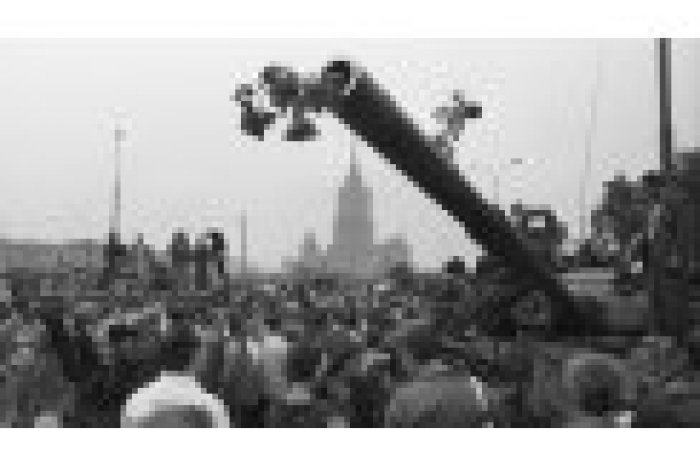
On the night of 19 to 20 August, hundreds of thousands of Moscow residents took to streets. Civilians started fraternizing with a part of the Russian servicemen sent with clear order to resort to repressions against the demonstrators. The situation radicalized even more after three people who tried to stop a convoy of tanks had been killed. In a short time, more motorized units aligned to defend the White House against the authors of the coup d’atat. A photo with Boris Yeltsin on a tank was spread all over the world and in a single day he became the most popular personage in the world. Some of the army generals started already negotiating with the Russian president and the commander of the special airborne troops Pavel Gusev and his deputy Aleksandr Lebed declared full faithfulness to the democratic forces.
Meanwhile, in Chisinau, all the state’s institutions were guarded by thousands of unarmed people, who came following an appeal by Moldova’s leadership. This was not at all a symbolic thing, as movements of troops were noticed around Chisinau on the night of 19 to 20 August. There were sources from inside the security bodies informing about the compilation of lists of people who were to be imprisoned in the case of the success of the coup d’atat. This was occurring both nationally and regionally.
In this situation, Moldova’s leadership ruled to delegate the first deputy parliament speaker, Ion Hadarca and Foreign Affairs Minister Nicolae Tiu to Bucharest. They had the task to create a government of Moldova in emigration in the case of the success of the coup d’etat. Moldova’s representatives had meetings with Romanian Foreign Affairs Minister Adrian Nastase, Prime Minister Petre Roman and President Ion Iliescu. We can suppose that Iliescu did not quite like the idea.
Moldova’s parliament convened at an extraordinary meeting on 21 August. In the beginning of the meeting, the situation was still tense. The MPs hostile to the democratization were enthusiastic and were making explicit statements on backing the coup d’etat. Most democratic lawmakers toughly condemned the attempt of the coup d’etat. At the same time, an extraordinary meeting of the Russian parliament took place in Moscow, which adopted a clear position against the usurpers of the state power. By the noon, news was received about the resumption of the broadcasting of more radio and TV stations in Moscow. Closer to the evening, a competition between the representatives of the coup d’atat and the comrades of Yeltsin began. Everybody wanted to quicker come to Foros, in order to impose their own viewpoint to Gorbachev. Aleksandr Rutskoy, a fellow close to Yeltsin, managed to be the first to take out of the isolation the first and the last head of the Soviet state.
Also by the end of the 21 August day, the atmosphere radically changed in the Moldovan parliament. The MPs who were plainly backing the coup d’etat in the morning changed their discourse and lawmaker Piotr Shornikov even asked to remove his message in the support of the coup d’atat from the meeting’s short report. The parliament unanimously adopted a Declaration which ended as follows: ‘’In this crisis moment, when the democratic achievements and reforms are in danger, Moldova’s parliament expresses firm decision to continue the fight for the republic’s sovereignty and independence.’’
To be continued
 Facebook
 Instagram
 X/Twitter
 Telegram
2 July 2014. Moldovan Parliament ratifies Association Agreement with European Union
23 June 1990. Parliament adopts Declaration on Sovereignty of Moldova
4 June 1991. National Bank is set up, a fundamental instrument for Moldova's economic development
Serghei Lazo, legendary name that needs to be rehabilitated
25-31 May 1990. Moldova's parliament approves new concept on government, elects Mircea Druc as prime minister
6 May 1990. The Flowers Bridge - a gate opened to a new world
Ion Suruceanu, archaeologist, curator of European stature
27 April 1990. Moldova's parliament adopts state flag - Tricolour
17 April 1990. First democratically elected parliament of Moldova starts working
7 April 2009. Large, devastating, very strange protest takes place in Chisinau
24 March 2005 - Moldovan parliament adopts Declaration on European Integration of Moldova
Paul Gore, the greatest heraldist and last knight of Bessarabia
11 March 2011 - Joe Biden to Chisinau
Breakaway region in eastern Moldova causes large-scale armed conflict
Europe Day // Romanian Ambassador says Moldova should look to future with confidence, Romania stands by country's side
VIDEO // European Council President says Moldova’s future in EU, many efforts made to turn this into reality
VIDEO // EU Ambassador to Moldova: “On Europe Day, we proudly say: Europe is you – Republic of Moldova”
PHOTO // Moldovan PM says Russia has not learned its lesson, Moldova heading to the EU, which brings prosperity, peace
9 May in Chisinau // Moldovan president says Moldova commemorates people who lost their lives to restore peace on continent, European Union strongest peace project
Victory Day, Europe Day marked through string of events in Moldovan capital
PHOTO // First two courtyards modernized under European Courtyard government programme inaugurated in Moldovan capital
 National Bank of Moldova
Reforms, security, Moldova’s European path on agenda of meeting between Moldovan president and European Commission's vice-president
Moldovan head of state to host president of Cyprus in Chisinau on Europe Day
Local councils in Moldova approved 451 decisions on voluntary amalgamation
Speech by President of the Republic of Moldova at joint press conference with EU High Representative for Foreign Affairs and Security Policy
Moldovan PM has meeting with businesspeople from Balti

Exports of Moldovan fruits to EU grow steadily: apples, sweet cherries record largest increases
Reforms, security, Moldova’s European path on agenda of meeting between Moldovan president and European Commission's vice-president
Moldovan head of state to host president of Cyprus in Chisinau on Europe Day
VIDEO // Moldovan foreign affairs minister comments on case involving former ambassador to India
Kaja Kallas on May 9: We all have different pasts, but we must focus on our common future. That is what Europe Day means
Head of State: Goal remains same. Moldova aims to sign EU accession treaty by 2028
PHOTO GALLERY // Teams from across country gathered at EuroQuiz Moldova 2026 final
Local councils in Moldova approved 451 decisions on voluntary amalgamation
EuroQuiz Moldova 2026 Grand Final held in Chișinău
Silver and bronze medals for students from Moldova at Balkan Mathematical Olympiad
Foreign Ministry condemns unauthorized overflight of national airspace by unmanned aircraft
EU may increase financial support for Moldova in security sector
President: Moldova’s accession to EU to be act of strategic coherence for entire Union
Case of activist Ghenadie Ciorba reaches ECHR: allegations of unlawful detention and persecution for criticizing Tiraspol
European Commission Vice-President: Transnistrian region will not be obstacle to European future of Moldova
Speech by President of the Republic of Moldova at joint press conference with EU High Representative for Foreign Affairs and Security Policy
Receive the latest news directly to your email

Receive the latest news directly to your email