
Authorities assure that petroleum product stocks and energy resources sufficient
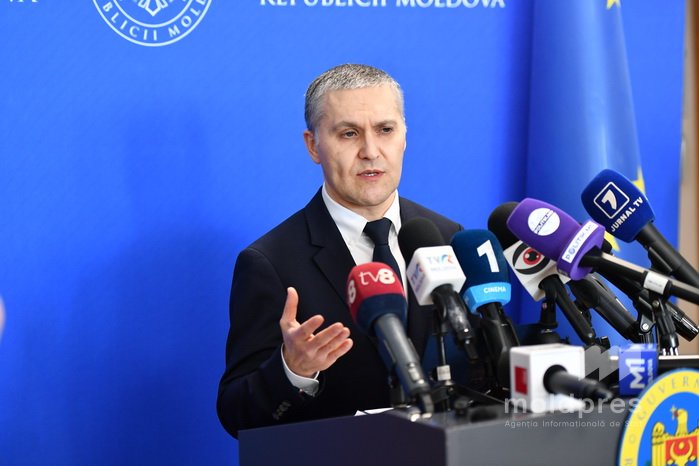
The supply of petroleum products and electricity is not and will not be interrupted, and stocks for at least the next 30 days are guaranteed for consumption. The assurance comes from director of the National Crisis Management Center Serghei Diaconu in the context of a state of alert in the energy sector.

"The state of alert is not a measure meant to alarm citizens. It is a mechanism that allows us, first and foremost as state institutions, to mobilize internally and act in advance to ensure that possible external risks do not produce effects in the Republic of Moldova. It is important to clarify from the outset that the supply of petroleum products and electricity is not and will not be interrupted, and stocks for at least the next 30 days are guaranteed for consumption," Serghei Diaconu stated today, after the Government meeting in which the state of alert in the energy sector was established for a period of 60 days.

The official emphasized that there is no reason for panic or for excessive fuel purchases.

"I urge citizens to trust the institutions: there is no reason for excessive fuel purchases, there is no point in queuing at gas stations. The existing stocks at the moment and those we are securing through our measures cover the necessary consumption, and the establishment of the state of alert has precisely this purpose – to ensure that petroleum products and energy resources remain sufficient on the domestic market," underlined Serghei Diaconu.

He mentioned that the decision to declare the state of alert is based on an integrated analysis of risk indicators, carried out by state institutions.

"We are seeing an accumulation of external factors: increased volatility in oil markets in the context of the situation in the Middle East, the degradation of Ukraine’s energy infrastructure as a result of repeated attacks by the Russian Federation, the shutdown or maintenance works at refineries in the region – Romania, Bulgaria, and other states. These elements reduce the safety margin of the energy system. Our responsibility is to intervene before these risks materialize," the official said.

At the same time, Serghei Diaconu stressed that the purpose of declaring the state of alert is to maintain sufficient stocks of petroleum products for domestic consumption, to ensure the continuity of electricity supply, especially during peak or maximum consumption hours, and to protect household consumers and critical infrastructure.

Before declaring the state of alert, several operational meetings were convened with the participation of 13 relevant institutions, and risks were analyzed along three major dimensions: energy security and supply routes, economic impact including price developments, and state security and citizen safety. During the meetings, the drafting of contingency plans was ordered for the next 10 days, for the next month, and for the next three months, and by Friday the institutions are to present updated plans that will be integrated into a national contingency plan, said Serghei Diaconu.

The official also explained the difference between a state of alert and a state of emergency.

"The state of alert is a preventive measure that allows authorities to act faster and coordinate responsible institutions more efficiently. The state of alert is more limited in terms of possibilities for intervention and in time than the state of emergency. However, it allows, at certain stages, temporary intervention to stop certain processes. At the same time, the state of emergency has a much stricter regime, which is instituted when a crisis has already occurred and may involve exceptional measures," argued Serghei Diaconu.

Today, March 4, the Government declared a state of alert in the energy sector for a period of 60 days, in connection with the external situation. The measure is a preventive one, meant to protect domestic consumption and maintain the stability of the energy system. The decision was taken after the analysis of external factors by the National Crisis Management Center, the Ministry of Energy and the National Agency for Energy Regulation.

The draft Government decision introduces temporary conditions regarding the export of petroleum products, only if stocks fall below safety thresholds. In addition, measures are envisaged to prioritize domestic electricity consumption during peak hours, in order to protect the stability of the system. At the same time, a temporary consolidated coordination regime is introduced for 60 days, and state reserves will be replenished.
 Facebook
 Instagram
 X/Twitter
 Telegram
PHOTO // Prime Minister praises entrepreneurship in Nisporeni
Strășeni–Gutinaș power line project and energy system modernization discussed in Washington
Parliament adopts new mechanisms for exercising appeals in public procurement, sectoral procurement and concessions
DOC // 1.82 billion lei for national roads in 2026: Road Fund Program published in Official Journal
Moldovan deputy PM in Brussels says Moldova-EU cooperation continues to be strengthened, with significant results in various fields
Moldova’s digital progress, shared priorities discussed by deputy PM with European Commission’s Executive Vice-President
VIDEO // Agriculture minister says Moldova not denouncing trade agreements with Commonwealth of Independent States, agri‑food exports reorient themselves towards EU
VIDEO // Imports of poultry meat from Ukraine gradually resumed: Moldovan Agriculture Ministry imposes strict food safety conditions
Moldovan energy minister at Transatlantic Gas Security Summit says partnership with USA essential for strengthening energy security in Central, Eastern Europe
Moldovan PM makes statements on government's priorities, expectations concerning implementation of project in roads' sector
Road Fund 2026 implemented
Finance Minister about VAT rate in HORECA sector: It is too early to say what rate will be
Moldova Business Week 2026 to be held on 28 September - 2 October
Government approves 2026 Road Fund Allocation Program: over 1.82 billion lei for national roads
Deputy Prime Minister about impact of possible licensing of Moldovan wines in Ukraine: Only 2% of wines exported to neighboring state
Administrative reform based on flexibility: government secretary general announces simplification of voluntary amalgamation process
Authorities urge Moldovan citizens in Dubai to go to airport only after being contacted by airlines
Authorities assure that petroleum product stocks and energy resources sufficient
Moldovan driving licences to be recognized in United Arab Emirates
Government declares state of alert in energy sector in connection with external situation to maintain stability of energy system
Government allocates resources for paying membership fees to international organizations
 National Bank of Moldova
Government declares state of alert in energy sector in connection with external situation to maintain stability of energy system
Government maintains 70% support for agricultural insurance policies
Giurgiulești International Free Port: modernization and more efficient management
Government approved National Program on Learning Romanian Language for 2026–2028
Selection of civil society representatives to Open Governance Coordination Committee: Vote on edemocratie.gov.md by 20 March

Giurgiulești International Free Port: modernization and more efficient management
Government approved National Program on Learning Romanian Language for 2026–2028
PHOTO // Moldova’s Ambassador to Romania presented letters of credence to President of Romania
Agriculture Minister: We are seeking balance in trade with Ukraine without sacrificing quality standards
More than half of adults of Moldova overweight, one quarter living with obesity
Government appoints Iuliana Albu as director of Medicines and Medical Devices Agency
Government declares energy sector alert in connection with Middle East war
Crisis Cell : Middle East remains volatile area, citizens urged to avoid travel
High-level Moldova–United Arab Emirates call amid regional tensions
Selection of civil society representatives to Open Governance Coordination Committee: Vote on edemocratie.gov.md by 20 March
Moldova prepares new development model for airport sector
Economic cooperation and European path of Moldova discussed in Hamburg
Otilia Dandara elected rector of Moldova State University
Wage inequality reaches critical level: women of Moldova worked 41 extra days for same income
War in Iran shakes energy markets: Will Moldovans pay more for gas and fuel?
PHOTO GALLERY // Homage paid to writers through voice of public, at National Library of Moldova
Receive the latest news directly to your email

Receive the latest news directly to your email