
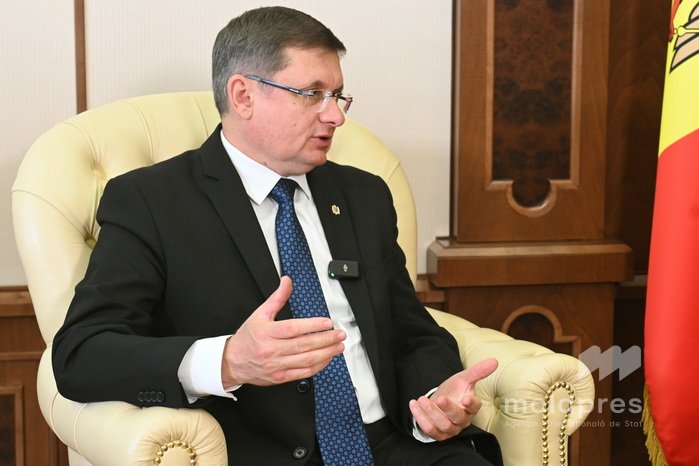
State to intervene to help citizens, if natural gas prices rise; Moldovan parliament speaker says government to come up with solutions, state cannot leave people facing price hikes
Parliament Speaker Igor Grosu has said that the state would intervene to support citizens in the event of higher natural gas tariffs, emphasizing that the government was preparing new compensation mechanisms for the cold season. At the same time, the parliament speaker noted that the gas price is determined both by developments on international markets and by domestic transport and administrative costs, where the authorities can intervene.

In an exclusive interview with the MOLDPRES State Information Agency, Igor Grosu specified that the first component of the tariff is the purchase price on international exchanges, influenced by global quotations and geopolitical developments, including the war in Ukraine and tensions in the Strait of Hormuz and the Black Sea.

“Moldova does not have its own resources. Everything we consume – gas, diesel, gasoline, liquefied gas – we import. Here we depend on international quotations. Obviously, we have done everything possible to diversify our sources, so as not to depend on a single source, as we did until 2021, on the Russian Federation. And then, even if you had a contract, at any time – and that moment was usually in winter, when you most need energy resources – they would gradually reduce deliveries and give you no explanation – a dependency and a geopolitical weapon against those who are not obedient to them,” Grosu said.

Igor Grosu pointed out that the second component of the tariff is distribution and administrative costs, and they can be optimized through domestic decisions. At the plenary meeting on July 30, the parliament adopted, in the second reading, a law stipulating that, if two or more natural gas distribution system operators belong to the same founder, their administrative expenses will be recognized in the tariff only once, for one of the operators, and not separately for each. The measure aims to prevent the same administrative costs from being included multiple times in the uniform tariff, thereby avoiding double charging of consumers.

“Moldovagaz, beyond the excessive salaries – the director, 377–378 thousand in April, for example, or the members of the Board of Directors or advisers – around 90 thousand, I say this is excessive for Moldova. And this is not only the case of Moldovagaz; there are other institutions, and we will see what the State Chancellery will provide us. Twelve enterprises across the entire territory, 12 directors, 12 accountants, 12 deputy directors and so on. I believe a single enterprise would cope under current conditions. (...) This is where we can intervene to reduce administrative costs, which can have an impact on the tariff, in the sense of reducing it, that’s what I mean,” Igor Grosu said.

Referring to possible tariff increases, Igor Grosu assured that the cabinet would introduce support measures for the population.

“My answer is yes, obviously, the state will intervene and will help citizens. Just as we have done in previous years, in the cold season, over those five months, the government will come up with solutions, with proposals to compensate part of these costs. Obviously, we cannot leave people facing these price hikes and we are talking about the months of November–December of the current year and three months – January, February, March – of the next year. So, we will come, the government will come, the Labour and Social Protection Ministry will come with proposals, we will discuss them. We will see whether we improve and what we improve in the compensation process,” Igor Grosu said.

At the same time, Igor Grosu called for the responsible use of energy resources, both in public institutions and households. He recalled that the latest decision of the Commission for Crisis Management provides for a 20-per cent reduction in fuel expenditures in public institutions, in the context of the current economic and energy situation.
 Facebook
 Instagram
 X/Twitter
 Telegram
Moldova enters hydrological alert
Moldovan government declares state of alert in energy sector
Moldovan Energy Ministry consults business community to set priorities in energy sector
Natural gas prices on European exchange fall by over 7 per cent
Moldovan Finance Ministry launches new subscription round for government bonds for population
New guarantees for investors: Moldova to conclude bilateral agreements with Sweden, Kazakhstan
Moldovan government announces measures to reduce diesel deficit: stocks to be replenished with 12,000 tons of fuel
Chinese company Yutong explores investment opportunities in Moldova
Two strategic routes of Moldova to be rehabilitated with support of top European bank
Energocom company of Moldova continues gas purchases for 2026-2027 cold season
Chisinau Airport sets up temporary pre-boarding area, to ease passenger traffic
VIDEO // Slobozia Mare bypass road reopened to traffic; Moldovan parliament speaker describes event as European investment due to benefit carriers, citizens
VIDEO // Moldovan PM holds daily talks with business representatives
Financial instruments' market of Moldova to be aligned with EU standards
State to intervene to help citizens, if natural gas prices rise; Moldovan parliament speaker says government to come up with solutions, state cannot leave people facing price hikes
ERRATUM // Moldovan parliament speaker does not say in interview given with MOLDPRES that Moldova is dependent on Russian gas
Moldova, Ukraine step up cooperation to monitor Dniester River flow
Energocom company of Moldova urges consumers to reduce electricity use during peak hours
MOLDPRES REPORT // Green China of Tibetan Plateau: Aba region as modern model of coexistence between people, tradition, nature
Moldovan PM, U.S. Chargé d’Affaires discuss strengthening of Moldovan–American partnership
Moldovan PM has phone conversation with Ukrainian counterpart
 National Bank of Moldova
PMs of Moldova, Ukraine discuss by phone
Moldovan PM, U.S. Chargé d’Affaires discuss strengthening of Moldovan–American partnership
Over 400 local councils adopted final decisions on voluntary amalgamation in Moldova
Moldova, Bavaria strengthen economic cooperation
Moldovan government proposes targeted measures to stop excessive remuneration practices

Ilan Shor, sent to court in file concerning embezzlement of 100 million dollars from Savings Bank of Moldova
Over 400 local councils adopted final decisions on voluntary amalgamation in Moldova
ARMENPRESS // Strong medal ambitions: Armenian athletes reflect on Baku World Championships results
Decisions to initiate voluntary amalgamation approved by 85 percent of Moldova's mayoralties
VIDEO // MOLDPRES INTERVIEW // Moldovan parliament speaker: “We must persuade each member state that Moldova deserves to be in the European Union”
Moldova, Bavaria strengthen economic cooperation
VIDEO // Discharges from Novodnistrovsk Reservoir of Ukraine to be reduced in next two weeks over drought
Deadline to initiate voluntary amalgamation of Moldova's localities expires on July 31
Yellow fire danger warning Moldova till August 7
VIDEO // Moldova, German state of Bavaria to establish intergovernmental commission for economic cooperation
Moldovan government proposes targeted measures to stop excessive remuneration practices
Two years since launch of MIA Instant Payments in Moldova: over 31 million transactions processed, with total value of around 28.5 billion lei
Moldovan president says voluntary amalgamation comes with significant resources for local projects
VIDEO // Moldovan PM announces results of preliminary analysis "obscene salaries," main solutions proposed by government
Bavarian PM pledges support for Moldova’s European path: “Moldova must have a place in the European Union”
VIDEO // Investments in government securities exceed 1.3 billion lei via eVMS.md platform in Moldova
Receive the latest news directly to your email

Receive the latest news directly to your email