
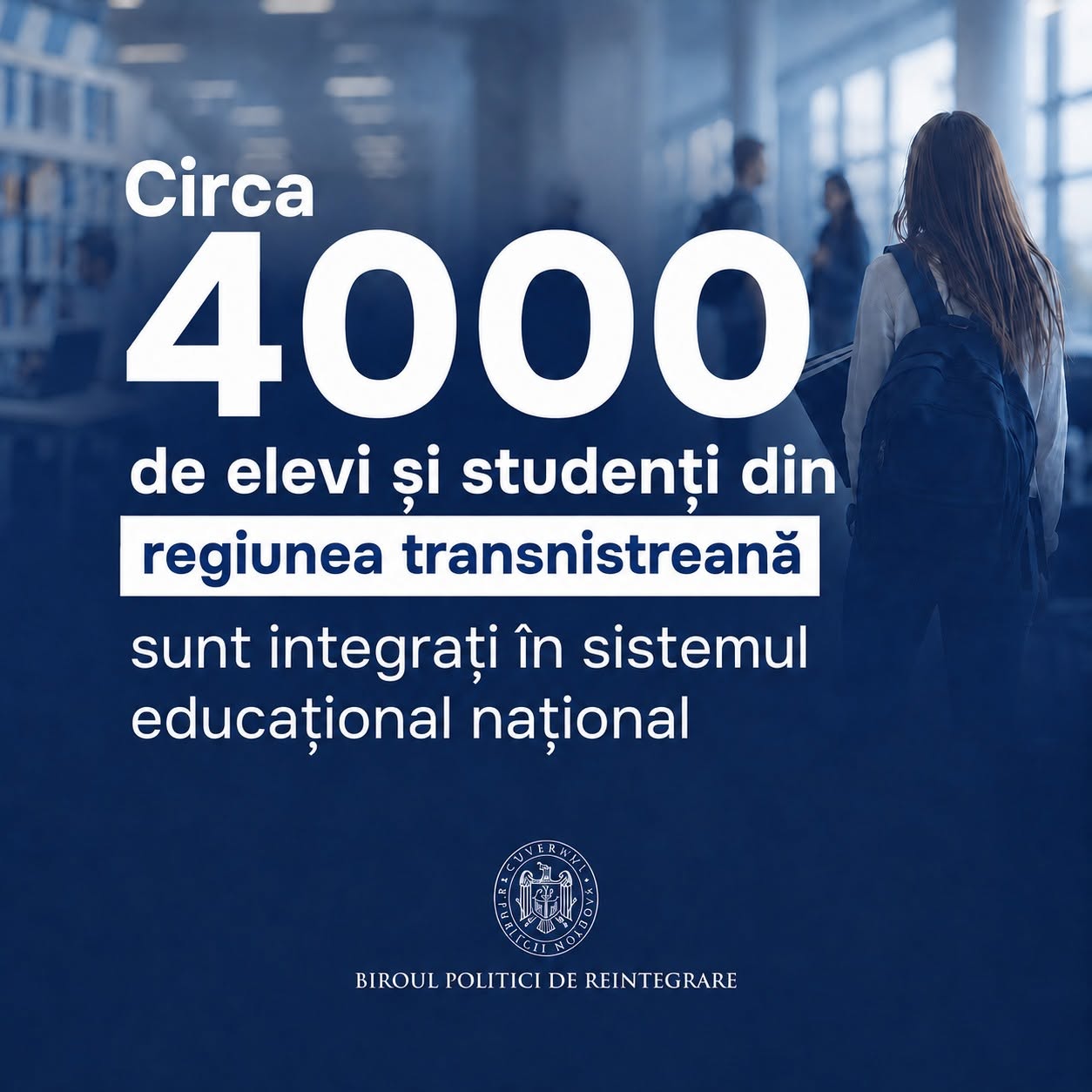
About 4,000 pupils, students from Transnistrian region integrated into Moldova's national education system
About 4,000 children and young people from the Transnistrian region and the Bender municipality are enrolled in the national education system, benefiting from studies in general, technical vocational and higher education institutions. This figure also includes about 2,000 pupils from Romanian-language education institutions of the region, subordinated to the Education and Research Ministry (MEC).

In the 2025–2026 academic year, 971 pupils residing in the Transnistrian region and the Bender municipality studied in general education institutions located on the right bank of the Dniester. Most of them were enrolled in institutions from the districts of Dubasari, Anenii Noi and Rezina, being funded under the same conditions as all other pupils in the public education system, without differentiation based on place of residence or region of origin.

At the same time, 346 young people residing in the Transnistrian region are enrolled in state-funded places in technical vocational education institutions. The average annual cost for training one pupil is 26,000 lei in vocational schools and 32,500 lei in colleges and centers of excellence.

Another 674 young people from the region are pursuing their studies in state-funded places at public higher education institutions, including within the compensatory year. Expenditures of over 37.4 million lei are estimated for their training, the granting of scholarships and their accommodation in dormitories.  These measures contribute to the expansion of educational opportunities and to the integration of young people into the single educational space of Moldova.

In order to facilitate the continuation of studies and the use of qualifications abroad, graduates of education institutions from the Transnistrian region can benefit from the mechanism for completing and apostilling neutral-format diplomas. By June 30, 2026, 681 such diplomas had been apostilled, 26 of them in the first semester of 2026. This mechanism does not entail the recognition of diplomas issued by non-accredited entities of the region, but provides holders with a neutral-format educational document, so that the apostille of Moldova can be applied and international educational opportunities can be provided.
 Facebook
 Instagram
 X/Twitter
 Telegram
State to cover half of expenses of companies training students through dual education in Moldova
Medicine stocks of Moldova to be monitored daily at national level
PM has meeting with Ambassador of Ukraine to Moldova
PM meets European Union Ambassador to Moldova
Moldovan PM to pay official visit to Bucharest
PM, Ambassador of Romania discuss Moldovan-Romanian partnership, European path of Moldova
Moldovan PM says government to intervene before problems turn into bigger crises
Moldovan PM, fuel market participants discuss measures to secure domestic market
Moldovan government declares 30-day state of alert in energy, hydrological sectors
Moldovan PM says European integration government’s top priority
Moldovan president chairs meeting of National Commission for European Integration
Moldovan governments financially supports voluntary amalgamation: 81 mayoralties receive first incentive
Additional measures taken to supply diesel on market in Moldova
Moldovan deputy PM for reintegration meets Ambassador of Romania
State-owned companies of Moldova increase profit more than fivefold in 2025; who tops ranking
Deadline to initiate voluntary amalgamation of Moldova's localities expires on July 31
Moldova's wrestler wins country’s first medal at U17 World Championships in Baku
VIDEO // New contingent of Moldova's National Army takes part in KFOR Mission in Kosovo
About 4,000 pupils, students from Transnistrian region integrated into Moldova's national education system
Over 70 candidates for 39 vacant judge positions in Moldova; ten new prosecutors proposed after graduating from National Justice institute
Moldovan parliament concludes spring–summer session; parliament speaker extraordinary meeting to be held on August 24
 National Bank of Moldova
Coaches of Moldova to have professional day, marked annually on September 25
Processing of personal data for purpose of combating crime regulated by new law in Moldova
Moldova's legislation on supervision of investment firms harmonized with EU rules
Moldovan legislation on administration, use of public roads aligned with EU standards
Strategic energy infrastructure projects to receive priority authorization in Moldova

Moldovan legislation on administration, use of public roads aligned with EU standards
Strategic energy infrastructure projects to receive priority authorization in Moldova
Defence procurement to have new rules aligned with EU standards in Moldova
Harsher penalties for human traffickers in Moldova: parliament eliminates possibility of suspending sentences in severe cases
Moldova aligns employment rules with EU standards: new rights for unemployed, cross-border workers
Convicted persons to no longer escape punishment in Moldova: parliament tightens rules, expands electronic monitoring
Voted by Moldovan parliament: tougher penalties, prison for promoting illegal substances on social media
Moldovan parliament obliges gas supplier from Transnistrian region to create strategic reserves
Moldova's Electoral Code amended in first reading: new rules for elections in Gagauzia
Moldova's justice aligns with European standards: overview of achievements on path to EU accession
Moldovan PM meets members of Club of Bessarabian Businesspeople in Bucharest
Strengthening of Moldovan-Romanian partnership discussed with leaders of Romania's parliament
Moldovan parliament ratifies, in first reading, Council of Europe Convention on Co-Production of Audiovisual Works in Form of Series
Moldova to receive 350,000-dollar grant for implementing Register of Movable Collateral system
Expert comments on stakes of Moldovan PM's first visit to Bucharest
Moldovan president has farewell meeting with Head of Swiss Cooperation Office in Moldova
Receive the latest news directly to your email

Receive the latest news directly to your email