
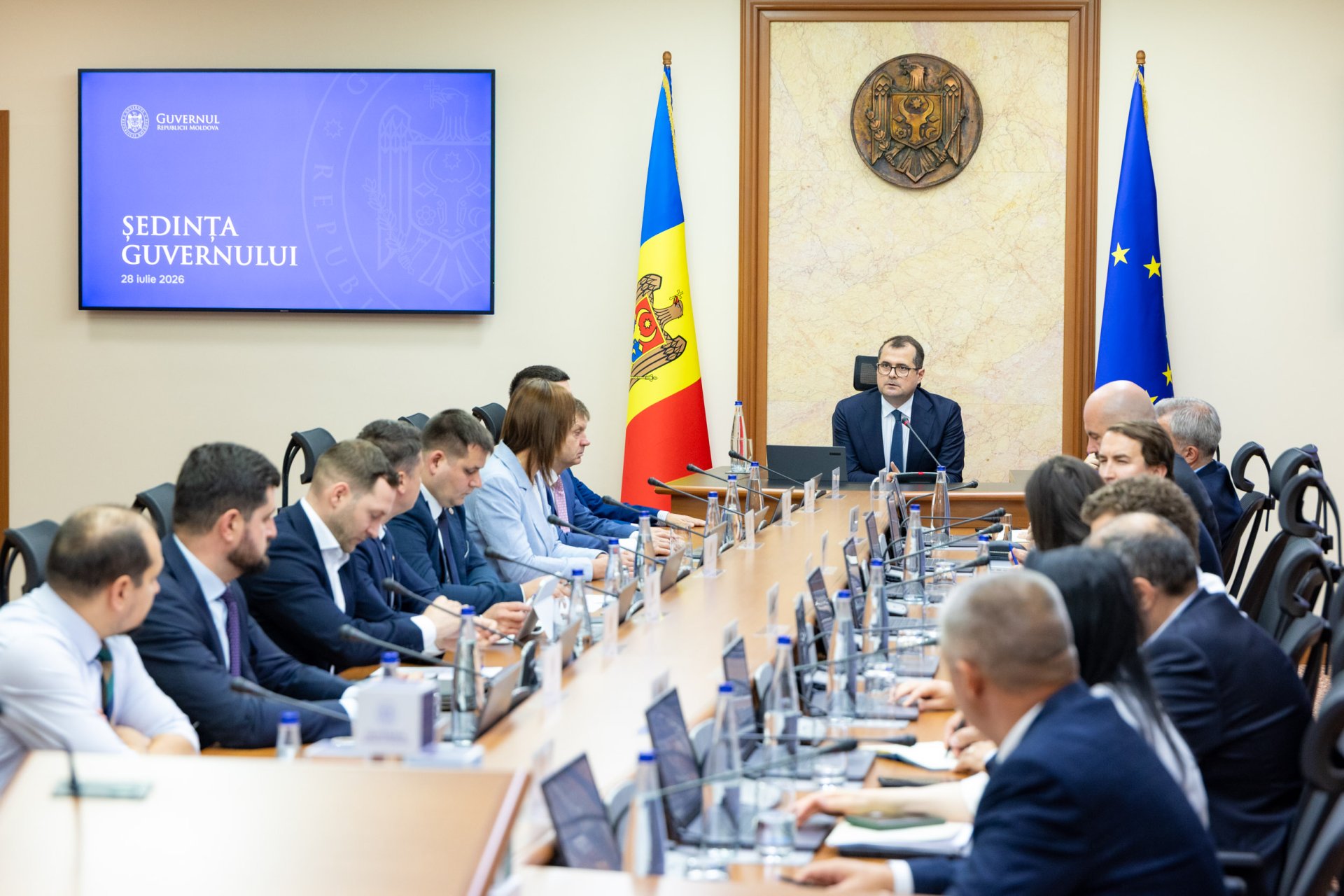
Moldovan government declares 30-day state of alert in energy, hydrological sectors
The government has introduced, for a period of 30 days, a state of alert in the energy sector and a hydrological state of alert for a period of 30 days, in order to prevent risks to the country’s fuel and water supply. The decisions were taken at an extraordinary meeting of the cabinet of ministers.

The state of alert in the energy sector was declared in the context of disruptions on the regional fuel market. Rising international prices for oil and diesel, the conflict in the Middle East, the temporary interruption of Kazakh crude oil deliveries through the Novorossiysk terminal and the low level of the Danube have all affected supply chains. Commercial diesel stocks fell from a safety level of 17.6 days at the end of June to 6.9 days, and on July 27, 53 fuel stations of Moldova had no diesel available.

The approved measures will allow the streamlining of imports, prioritized customs clearance and the creation of green corridors at the border, the prevention of speculative purchases and the maintenance of continuous fuel supply at the pump. Exports from the Port of Giurgiulesti will be allowed only if the domestic market is provided with minimum stocks of 7,500 tons of diesel and 2,500 tons of petrol.

“It is important to intervene proactively, in order to prevent a diesel shortage on the market, especially now, in the agricultural season, and to make sure that the country’s fuel supply continues,” said Prime Minister Vasile Tofan.

The hydrological state of alert was introduced following a significant reduction in water resources in the Dniester basin. On July 27, the water level in the Dniester reservoir was 113.24 meters, compared to the normal level of 121 meters. At the same time, there is a risk that the discharge flow from Novodnistrovsk will fall below the safety threshold of 100 m³ per second, which might affect the working  of water intake stations and the water supply.

The authorities will assess alternative supply sources, take stock of water intake points on the Dniester and its tributaries and prepare backup water wells. At the same time, operators will update their continuity plans, including by reducing losses in networks, while the Environment Ministry will continuously monitor the hydrological situation.

To coordinate these measures, the government has approved the immediate entry into force of provisions that allow the activation of the National Crisis Management Commission, chaired by prime minister. The Commission will ensure continuous assessment of the situation, coordination of the institutional response and prompt adoption of necessary decisions.
 Facebook
 Instagram
 X/Twitter
 Telegram
Moldovan PM announces concept for deregulation, simplification of inspections
New ways to advance Moldova-Bulgaria relations on agenda of discussions between Moldovan foreign affairs minister and Bulgarian MPs
Moldovan PM has phone conversation with Dutch counterpart
Moldovan PM visits Superior Council of Magistracy
Speaker: Moldova must become relevant security provider in Europe
Government approves plan on preparing for 2026–2027 heating season
President attends state funeral of King Harald V of Norway
Strengthening transparency in public procurement – new measures approved by Government
Government simplifies authorization of renewable energy projects and sets new rules for biofuel market
Prime Minister discussed next steps in Moldova’s EU accession with European Commissioner
Moldovan PM, Ambassador of France discuss strengthening economic cooperation, attracting investments
PM has meeting with new Head of OSCE Mission to Moldova
Fiscal and Customs Policy for 2027 approved by Government
Moldovan PM, Slovakian counterpart have phone conversation
Interferon medication, unavailable at Oncology Institute from Chisinau, to be available as of September 15, Health Ministry says
Implementation of Growth Plan advances; Moldovan government prepares new package of projects to attract investments worth 2 billion euros
Annual meeting of Conference of Regional and Local Authorities for Eastern Partnership held in Chisinau
Moldova’s airspace violated again: drone enters from direction of Ukraine
Drone briefly entered airspace of Moldova near Palanca
Prime Minister in dialogue with business community: less bureaucracy, clear rules and more investment
National weightlifting team wins 26 medals at World University Championships in Doha
 National Bank of Moldova
Stronger local administrations for European living standards in communities: European local, regional authorities convene in Moldovan capital
Prime Minister in dialogue with business community: less bureaucracy, clear rules and more investment
Moldovan Speaker to pay working visits to Slovenia and Hungary
Prime Minister welcomed participants in Chișinău Marathon 2026
Over 500 artists from Moldova gathered in Parliament square and sang about homeland, nation and national values

Prime Minister in dialogue with business community: less bureaucracy, clear rules and more investment
National weightlifting team wins 26 medals at World University Championships in Doha
As of today, Chisinau Airport implements special access measures: rules for travelers
DOC // Law on accessibility of products and services published in Official Journal
DOC // Tax incentives for modernizing 15 schools
Convergence fund for Transnistrian region expected to finance infrastructure, education and public services
Moldovan Speaker to pay working visits to Slovenia and Hungary
PHOTO // Students from Moldova win bronze medal at International English Language Olympiad
Prime Minister welcomed participants in Chișinău Marathon 2026
Over 500 artists from Moldova gathered in Parliament square and sang about homeland, nation and national values
Deputy Prime Minister: Reintegration has already begun through things that bring people closer together
PHOTO, VIDEO // More than 500 artists attend Gala. Speaker: I hope it becomes beautiful tradition for Parliament
Drone entered Moldova. Airspace temporarily closed
UPDATE // Activity at border crossing points in northern part of country resumed
Application of national tax regime to goods from Transnistrian region enters new stage
PHOTO // Moldova promotes gastronomy and traditions in Paris
Receive the latest news directly to your email

Receive the latest news directly to your email