
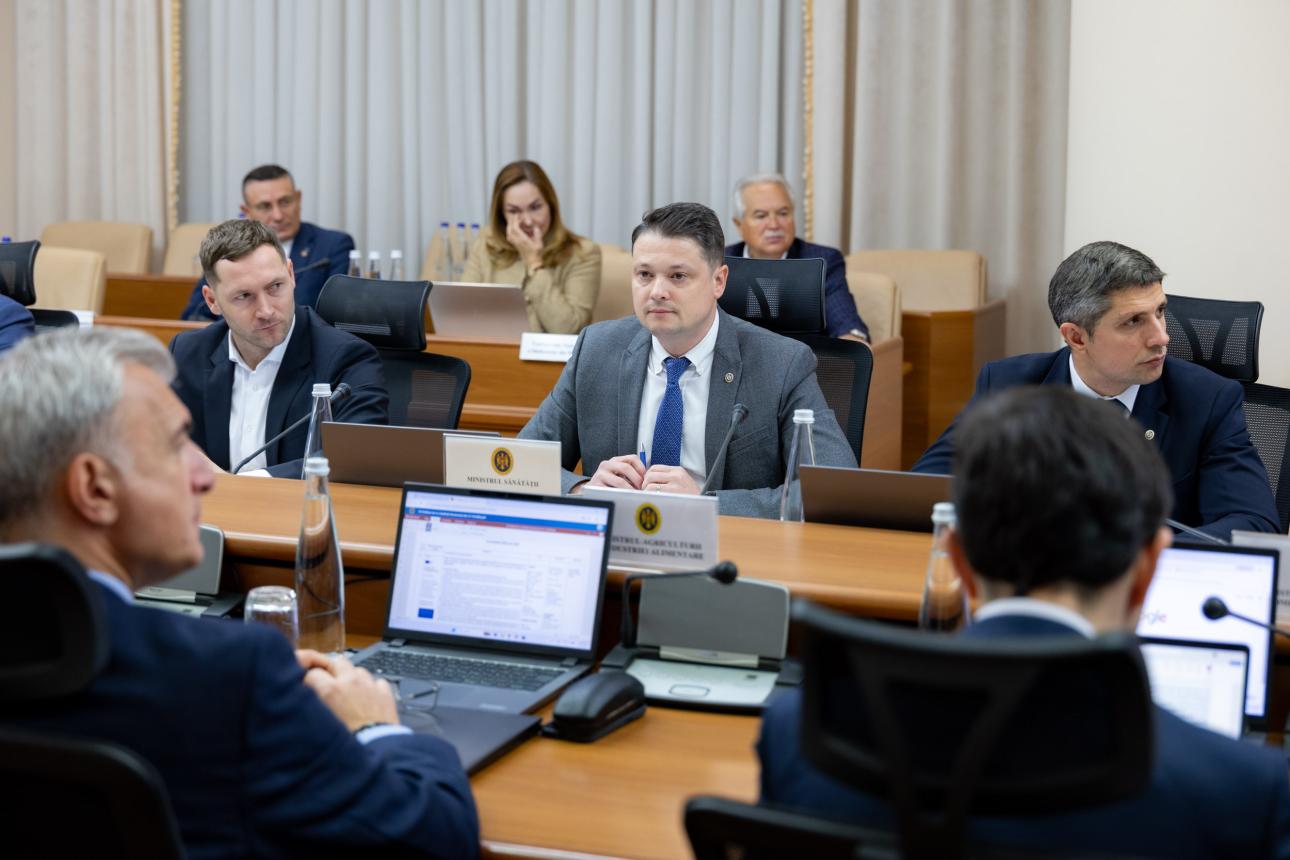
Moldovan government approves national strategy on drugs, addictions for 2026–2032
The prevention of drug use, improving access to treatment and recovery, combating drug trafficking and rapidly identifying new dangerous substances are the main goals of the National Strategy on Drugs and Addictions for 2026-2032, approve by the government today.

„We have a problem that we must acknowledge: the drug phenomenon has changed significantly, but the way the state responds to it has not adapted quickly enough. Today, a teenager can purchase psychoactive substances through a messaging app. They may end up in the emergency room with intoxication caused by a new substance that doctors are not yet sufficiently familiar with, while the family may only discover the problem at that moment. This is no longer solely a problem for the police or the healthcare system. It is a public health, education, social protection and community safety problem,” said Health Minister Alexandru Gasnas.

In 2025, 704 new cases related to drug use were recorded in the medical records of Moldova, compared with 545 in 2024. At the same time, the emergence of new synthetic drugs and the development of online distribution methods pose additional risks, particularly for children and adolescents. Presently, interventions are fragmented. The police combat trafficking, doctors treat intoxication and addiction, schools try to prevent drug use and social services intervene when families have already been affected.

The adopted strategy aims to shift from institutions that respond separately to a system that prevents, identifies risks and intervenes in a coordinated manner. In the area of prevention, special attention will be given to adolescents, including the risks in the digital environment, where both new forms of drug distribution and addictive behaviors are developing. In the area of addiction treatment, addiction services will be integrated with mental health services, community-based services will be developed and continuity of treatment and recovery will be ensured.

„A person should not have to reach a hospital only after a severe intoxication. He/she must be able to seek help earlier and have access to recovery and social reintegration, including outside the Chisinau municipality,” the minister said.

The document also provides for the prevention of serious consequences of drugs’ use, including overdose prevention, reducing the transmission of HIV and viral hepatitis, testing, counseling and access to effective treatments. To combat drug trafficking, the strategy focuses on identifying new distribution methods, including online distribution, combating criminal networks and cooperation among law enforcement institutions.

At the same time, the National Drug Observatory will be strengthened and the National Early Warning System will be developed, so that information about the risks posed by new substances can quickly reach doctors, emergency services and law enforcement authorities.

„We cannot combat trafficking through treatment alone and we cannot treat addiction through sanctions alone. We need a state that is firm against trafficking, but also a system capable of protecting children, identifying drug use at an early stage, and providing treatment to affected persons,” Minister Gasnas said.

The strategy also addresses addictions associated with alcohol, tobacco, gambling, and problematic use of the digital environment. It also emphasizes reducing the stigmatization of people affected by addictions and strengthening cooperation among institutions in the fields of health, education, internal affairs, justice and social protection, including by reorganizing the National Anti-Drug Commission into a coordination mechanism for drugs and addictions.

The strategy will be implemented in stages through the National Programme on Drugs and Addictions for 2027–2032, which will establish the specific measures, responsible institutions, costs and outcome indicators.

By 2032, the strategy aims to reduce the number of children and young people who begin using drugs, prevent intoxications and deaths, increase access to treatment, and improve communities’ safety.
 Facebook
 Instagram
 X/Twitter
 Telegram
Moldovan parliament speaker presents Moldova’s experience in countering foreign interference at European Conference of Presidents of Parliament
Progress in implementing public administration reform roadmap discussed with civil society of Moldova
Moldovan deputy PM for reintegration has meeting with Special Representative of OSCE Chairperson-in-Office for Transnistrian Settlement Process
More opportunities for small-, medium-sized enterprises in Moldova; national legislation to be harmonized with EU acquis
Authorities purchasing vehicles through public procurement procedures to have to consider environmental impact and energy efficiency
Farmers to gain access to modern agricultural machinery and irrigation systems with Japan’s support
Public buildings in Moldova to be modernized to reduce energy consumption and maintenance costs
Construction of Strășeni–Gutinaș Power Line and modernization of Strășeni substation to be declared of national public utility
€80 million investment to modernize 25 vocational schools, colleges, and centers of excellence by 2032
Moldovan PM meets Ukraine’s first deputy prime minister: water discharge into Dniester River to increase by about 20 per cent
Moldovan parliament speaker to attend European Conference of Presidents of Parliament of Council of Europe member states
Moldovan Prime Minister discussed advancing European integration of Moldova with Malta’s Prime Minister
State Chancellery and European partners discuss support for public administration reform
Books, photographs, stories from interwar Chisinau brought together in exhibition at Moldova's parliament
Moldovan government approves national strategy on drugs, addictions for 2026–2032
Moldovan deputy PM for reintegration says gradual reintegration process to allow establish formula through which Transnistrian region to be represented in country's administrative structure
Coal imports into Moldova fall by 19%
Minister Mihai Popșoi holds talks with Romanian counterpart
Republic of Moldova seeks alternatives for natural gas procurement, including in Ukraine
Alexei Buzu announces new round of consultations amid local public administration reform
Government approves creation of 34 territorial education agencies to administer country’s schools
 National Bank of Moldova

Balti municipality's mayor to be able to be assisted by own cabinet
Government approves creation of 34 territorial education agencies to administer country’s schools
Better medicines, medical devices and technologies: Government approves single national assessment mechanism
Moldova accelerates transition to electric transport: at least 600 charging points by 2030
Moldovan citizens working in Ireland to receive pensions for years worked in both countries

Prime Minister explains failure of Zarea hotel privatization, announces changes for future auctions
Republic of Moldova to conclude social security agreement with Ireland
Government makes personnel changes at Ministry of Health, Environment Agency and State Chancellery
Speaker congratulates Romania’s new Government, led by Luca Niculescu
Moldovan citizens working in Ireland to receive pensions for years worked in both countries
French support for continuing reforms in energy sector
Moldovans working in Ireland to benefit from pensions and social benefits
Moldova Prepared Program targeted by manipulative narratives
Chisinau Airport to have new air connection with Serbia
Interior minister on people seeking refuge in Transnistria
Moldovan Prime Minister held phone conversation with Romanian counterpart
VIDEO // Moldova's interior minister says two incidents involving Ukrainian border guards first recorded since beginning of war
Moldovan PM congratulates Romanian counterpart on assuming office as Romania’s prime minister
PHOTO // Moldova's General Inspectorate of Carabineers equipped with new vehicles purchased through EU-co-financed projects
Moldovan president tells new Romanian government: “Romania can always count on us”
PHOTO // Moldovan carabineers awarded NATO medal for participation in KFOR mission in Kosovo
Receive the latest news directly to your email

Receive the latest news directly to your email