
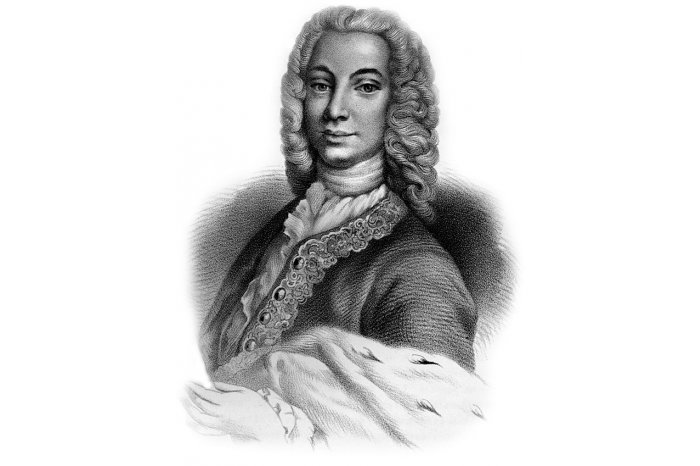
Antioh Cantemir, Moldovan representative in European culture
One of the brightest minds Moldova gave to the universal culture is the poet, scientist and diplomat Antioh Cantemir, the son of the famous ruler and scientist, Dimitrie Cantemir. Antioh was born in Constantinople, in 1709; his parents were Dimitrie Cantemir and Smaranda Cantacuzino, the daughter of the rule Serban Cantacuzino. From an early age, Antioh was carried by his father to long journeys, from Constantinople to Iasi, then to Kharkiv, Moscow and St. Petersburg. Being an extremely experienced scientist, Dimitrie Cantemir early discovered the special qualities of his son and employed for him famous teachers for their erudition. From an early age, Antioh had courses at the St. Petersburg Academy, where well-known scientists were teaching, who had come from various European countries. The education received in family and the deep studies allowed him to become a perfect polyglot as early as in his youth. He knew well Romanian, Russian, Greek, Latin, Italian, French, Spanish and English.  This knowledge gave him possibility to study valuable scientific works in original.
The first prodigious work of Antioh Cantemir was the one of translator. From the young age, he proved a surprising capacity to be exception in terms of philosophy. Antioh was considering that the ‘’light of reason’’ was born out of the deep knowledge of the concept about man and nature. Cantemir was permanently concerned about the moral philosophy and he started writing satire.
Those eight satires represented a true monument of the Russian poetry of the 18th century. Nobody has approached such a sophisticated subject as the moral philosophy in the Russian literature before Antioh Cantemir. The satire fulfills a social duty for the first time ever. The work of young Cantemir was praised in the high scientific society from St. Petersburg.
Antioh Cantemir, with a perfectly structured scientific mind, paid a special attention to the quality of the Russian language and permanently polished up his literary work. Cantemir entered the Russian literature with an extremely impressive force, bringing the depth and splendor of the European culture on the ground of the Russian culture. From now on, during centuries, most anthologies of the Russian poetry were beginning with the work of the already famous Antioh Cantemir.
The exceptional qualities of the young Antioh were quickly noticed by the Russian government. In 1732, at the age of only 22, Antioh Cantemir was appointed Russia’s ambassador to England. Till this appointment, the relations between the Russian Empire and England were oscillating. In just several years, diplomat Cantemir managed to transform the Russian-English relations into stable and predictable ones.
In 1738, he was appointed Russia’s plenipotentiary minister at the French Court. Through his diplomatic talent, Cantemir managed to persuade France to assume the role of mediator in the frequent conflicts between the Russian Empire and the Ottoman Empire. The diplomatic reports by Antioh Cantemir to St. Petersburg are true literary works, as well as proofs of refined diplomatic spirit. Antioh Cantemir  continued his cultural concerns in Paris. He tried to know the French scientists of the time, among whom Voltaire.
Antioh Cantemir died in France of an incurable disease on 31 March 1744, at the age of 35. He was buried in Moscow, in the Greek church, nearby his father. The great French philosopher Montesquieu was saying that he doubts whether ‘’Russia will soon have an ambassador endowed with the qualities of Cantemir.’’
The literary work of Antioh Cantemir had a strong imprint on the Russian literature. In 2003 in St. Petersburg, on the occasion of the 300th anniversary of the city’s foundation, a statue to Antioh Cantemir was erected, with the inscription, To the father founder of the Russian classicism and master of the literary satire. Cantemir strongly influenced the Russian literature for many years ahead and is regarded as a generator of ideas and models for the great Russian poetry from the 19th century. The literature from Moldova was deeply marked by the work of Cantemir as well. Writers Alexandru Donici and Constantin Negruzzi were the first considering him their teacher in the literary activity.
Antioh Cantemir was an expression of the vast culture of the Cantemirs – a family of princely offspring from Moldova, as well as a renowned representative of the Russian culture from the 18th century. Undoubtedly, both the Moldovans and the Russians can be proud with the name of Antioh Cantemir; at the same time, his work remained a component part of the European civilization.
 Facebook
 Instagram
 X/Twitter
 Telegram
13 July 1995. Moldova becomes member of Council of Europe
Maria Cebotari, golden voice of Bessarabia
2 July 2014. Moldovan Parliament ratifies Association Agreement with European Union
23 June 1990. Parliament adopts Declaration on Sovereignty of Moldova
4 June 1991. National Bank is set up, a fundamental instrument for Moldova's economic development
Serghei Lazo, legendary name that needs to be rehabilitated
25-31 May 1990. Moldova's parliament approves new concept on government, elects Mircea Druc as prime minister
6 May 1990. The Flowers Bridge - a gate opened to a new world
Ion Suruceanu, archaeologist, curator of European stature
27 April 1990. Moldova's parliament adopts state flag - Tricolour
17 April 1990. First democratically elected parliament of Moldova starts working
7 April 2009. Large, devastating, very strange protest takes place in Chisinau
24 March 2005 - Moldovan parliament adopts Declaration on European Integration of Moldova
Paul Gore, the greatest heraldist and last knight of Bessarabia
Moldovan president meets Estonia’s foreign affairs minister, on visit to Chisinau for inauguration of Embassy
Moldovan PM, European commissioners discuss energy, security, economic reforms to accelerate Moldova’s European path
Moldovan PM has talks with Belgian counterpart
Estonia strengthens diplomatic presence in Moldova; Embassy in Chisinau to be inaugurated by foreign affairs ministers
 National Bank of Moldova
Moldovan president meets Estonia’s foreign affairs minister, on visit to Chisinau for inauguration of Embassy
Moldovan PM, European commissioners discuss energy, security, economic reforms to accelerate Moldova’s European path
Moldovan PM has talks with Belgian counterpart
Priorities of Moldova-Germany development cooperation discussed at Moldova's government
On Professional Day of Education Workers, 70 lyceum pupils of Moldova simulate parliament meeting, discuss school network's reform

Activity at Palanca-Maiaki-Udobnoe border crossing point resumed
Moldovan Energy Ministry, U.S. Embassy in Chisinau launch working group for Straseni–Gutinas power line
Estonia strengthens diplomatic presence in Moldova; Embassy in Chisinau to be inaugurated by foreign affairs ministers
Priorities of Moldova-Germany development cooperation discussed at Moldova's government
On Professional Day of Education Workers, 70 lyceum pupils of Moldova simulate parliament meeting, discuss school network's reform
Moldovan PM says Moldova must enhance air defense capacity, amid drone incidents
NATIONS LEAGUE // Head coach Lilian Popescu, Nicky Clescenco optimistic ahead of “crucial match” against Slovakia; victory would put Moldovan football team on first position in group
Moldovan government's secretary-general, after Association Council meeting: “The reforms we are completing are turning into opportunities for the country’s development”
European Union's foreign policy chief: “The EU and Moldova are stronger when they work together”
VIDEO // Moldovan PM: “Our goal is to complete technical work required to conclude the negotiations by early 2028 and prepare Moldova for membership by 2030”
Moldova advances toward EU at an “impressive” pace; European Commissioner for Enlargement: “We expect to open all negotiating clusters by the end of this year”
Moldova to receive new 157 million-euros installment from Growth Plan
LIVE // Kaja Kallas, Marta Kos and Vasile Tofan hold press conference after Moldova-EU Association Council meeting
Romania condemns incident in Palanca area
Speech by Prime Minister following EU–Moldova Association Council
Students of Mihai Bătrânu School of Arts in Dondușeni exhibit works at Parliament
Receive the latest news directly to your email

Receive the latest news directly to your email