
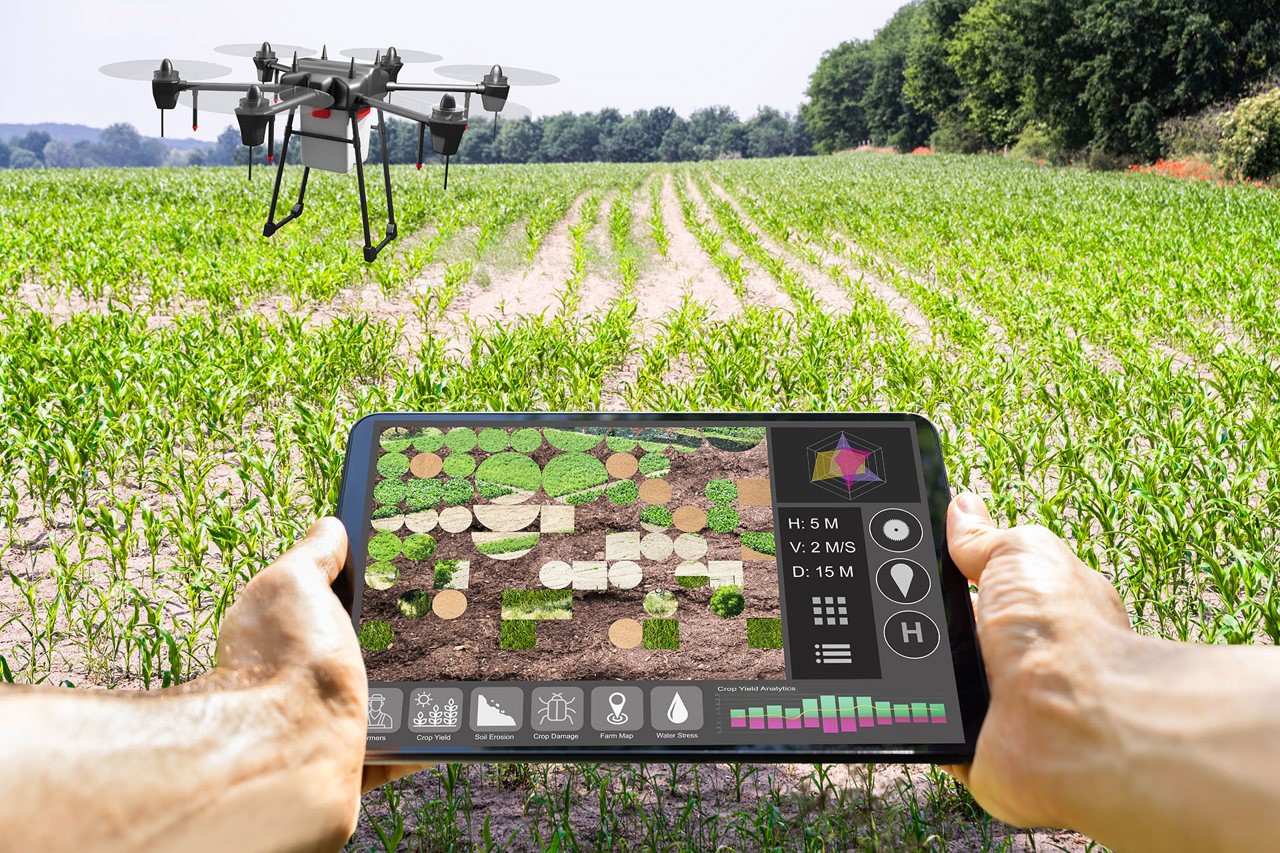
Smart agriculture, priority for Moldova; agriculture minister says agriculture should be based on science
Moldova aims to develop smart agriculture across the entire country through digitalization, the use of artificial intelligence and the application of scientific research findings. Agriculture and Food Industry Minister Eugeniu Osmochescu has made statements to this effect during the “La 360 de grade” (At 360 Degrees) programme on Radio Moldova.

The minister said that technologies and elements of smart agriculture were already being used by some farmers, but they are not currently implemented on the basis of a national vision.

“We already have smart agriculture, but not on a state-wide scale, throughout the entire country. Individual farmers are applying certain elements, but unfortunately, we do not have a clear vision, which is why we plan to develop one in 2027. Smart agriculture is based, among other things, on digitalization and the use of artificial intelligence. So, we are talking not only about digitalization, but also about artificial intelligence and all scientific tools available to us, from satellites to the soil,” Eugeniu Osmochescu said.

To support this vision, the Agriculture Ministry intends to prepare a comprehensive study on agriculture in Moldova. The document is expected to be based on scientific research and provide an overview of the sector’s modernization prospects.

“Intelligence, including in agriculture, must be science-based. That is why, we aim to have, by next June, a comprehensive, science-based study of agriculture. We have already started the necessary discussions to identify teams, both domestic and foreign, that would address all details across all the industries we have in Moldova. I am referring now to agriculture, of course, as well as horticulture, beekeeping, poultry farming and so on,” the minister explained.

In July 2026, a delegation from the Agriculture and Food Industry Ministry participated in the Global Conference on Smart Farming, held at the headquarters of the Food and Agriculture Organization of the United Nations (FAO) in Rome, Italy. The event provided Moldova with a platform to strengthen international cooperation and exchange experience in digital and geospatial solutions applied to agriculture, including sector monitoring, climate risks’ management and the development of modern information and support services for farmers.

Another objective announced by the minister is the organization of an agricultural census. It could be conducted in parallel with the sector’s modernization and digitalization process and would provide clearer data on the state of agriculture in Moldova.

“The agricultural census would be another activity that could be implemented in parallel, but it would greatly contribute to the image of Moldova and the convergence of our agriculture following accession to the European Union. Moreover, the goal is not only for our domestic purposes, but also for Brussels to know what we have in Moldova, as this would demonstrate that we are prepared,” the agriculture minister said.

As for the timeline for conducting the agricultural census, the current plan shows 2030.

The first General Agricultural Census was conducted in Moldova during March 15 -April 15, 2011, throughout the country, with the exception of the Transnistrian region. Approximately 903,000 agricultural holdings were surveyed and the data provided, for the first time, a comprehensive picture of the structure of the agricultural sector, land, livestock numbers and technical resources.

Fifteen years later, the National Statistics Bureau (BNS) is preparing the next General Agricultural Census, the 2030 round, in line with European Union requirements. In 2026, the BNS intensified its preparatory work, including identifying administrative and statistical data sources that could be used to establish the census framework and identify agricultural holdings, including small ones. In parallel, the Integrated Agricultural Survey is scheduled to be conducted for the first time in 2027, complementing preparations for the 2030 census round.
 Facebook
 Instagram
 X/Twitter
 Telegram
VIDEO // Country's energy resource supply amid state of emergency: Energy Minister presents updated information
Fuel prices to fall in Moldova on October 1: drivers to pay less for petrol, diesel
Creation of Office for Implementation of Strategic National Infrastructure Projects approved by Government
Government to seek long-term contracts for gas purchases and prepare higher winter compensation
Moldova strengthens cooperation with Danube states to develop inland waterway transport
Moldovan energy minister, officials from Ireland, Norway, Canada, Lithuania discuss opportunities of cooperation in energy field
Moldovan economic development minister says ministry to ease administrative burden on entrepreneurs
PHOTO // Moldova included in strategic transport cooperation plan
PHOTO // Moldova requests EU's support for Ungheni–Chisinau railway, Iasi–Ungheni–Chisinau highway
Farmers’ registry launched in Moldova: less bureaucracy, easier access to funding
Moldova International Exchange initiates admission process for capital market
PHOTO GALLERY //11th edition of Moldova Business Week starts in Chisinau
Moldova Business Week 2026 starts in Chișinău
Chișinău and Bălți residents to pay more for heating
Moldovan president meets Estonia’s foreign affairs minister, on visit to Chisinau for inauguration of Embassy
Moldovan PM, European commissioners discuss energy, security, economic reforms to accelerate Moldova’s European path
Moldovan PM has talks with Belgian counterpart
Estonia strengthens diplomatic presence in Moldova; Embassy in Chisinau to be inaugurated by foreign affairs ministers
 National Bank of Moldova
Moldovan president meets Estonia’s foreign affairs minister, on visit to Chisinau for inauguration of Embassy
Moldovan PM, European commissioners discuss energy, security, economic reforms to accelerate Moldova’s European path
Moldovan PM has talks with Belgian counterpart
Priorities of Moldova-Germany development cooperation discussed at Moldova's government
On Professional Day of Education Workers, 70 lyceum pupils of Moldova simulate parliament meeting, discuss school network's reform

Activity at Palanca-Maiaki-Udobnoe border crossing point resumed
Moldovan Energy Ministry, U.S. Embassy in Chisinau launch working group for Straseni–Gutinas power line
Estonia strengthens diplomatic presence in Moldova; Embassy in Chisinau to be inaugurated by foreign affairs ministers
Priorities of Moldova-Germany development cooperation discussed at Moldova's government
On Professional Day of Education Workers, 70 lyceum pupils of Moldova simulate parliament meeting, discuss school network's reform
Moldovan PM says Moldova must enhance air defense capacity, amid drone incidents
NATIONS LEAGUE // Head coach Lilian Popescu, Nicky Clescenco optimistic ahead of “crucial match” against Slovakia; victory would put Moldovan football team on first position in group
Moldovan government's secretary-general, after Association Council meeting: “The reforms we are completing are turning into opportunities for the country’s development”
European Union's foreign policy chief: “The EU and Moldova are stronger when they work together”
VIDEO // Moldovan PM: “Our goal is to complete technical work required to conclude the negotiations by early 2028 and prepare Moldova for membership by 2030”
Moldova advances toward EU at an “impressive” pace; European Commissioner for Enlargement: “We expect to open all negotiating clusters by the end of this year”
Moldova to receive new 157 million-euros installment from Growth Plan
LIVE // Kaja Kallas, Marta Kos and Vasile Tofan hold press conference after Moldova-EU Association Council meeting
Romania condemns incident in Palanca area
Speech by Prime Minister following EU–Moldova Association Council
Students of Mihai Bătrânu School of Arts in Dondușeni exhibit works at Parliament
Receive the latest news directly to your email

Receive the latest news directly to your email